It All Begins with a Smile
DENTAL EXCELLENCE";Panchkula Haryana, India
ABSTRACT
The aesthetic rehabilitation of patients with functionally compromised dentition frequently involves a multidisciplinary approach. The realization of aesthetic objectives in multidisciplinary cases represents a considerable clinical challenge. A correct aesthetic diagnosis, treatment plan, and careful material selection are critical factors in successful restoration. A team approach that includes the clinicians, the laboratory technician, and the patient is essential to achieve the desired result. The following case presentation demonstrates a successful multidisciplinary approach used to recreate an aesthetic smile in a young patient with functionally and aesthetically compromised anterior maxillary dentition.
INTRODUCTION
The ability to recognize the anatomic characteristics of natural teeth enables the professional to reproduce them with restorative materials. In addition, the more naturalness one is able to incorporate into a certain prosthetic part or restorative procedure, the less perceptible it will be in the patient’s mouth.1
The normal anatomic shape of the teeth and their alignment in the dental arch not only assure efficient mastication, but also contribute to maintaining their integrity and the stability of their position.2 The protective functional shape of dental crowns is characterized by anatomic details with functional significance and are recognized as being aesthetic. So deformities of the smile, although superficial, limit an individual’s social activities, they should be corrected whenever possible to restore harmony and equilibrium, and reintegrate the individual into the social circle.3
Tooth discolouration may influence an individual to have a compromised self image and thus, bleaching treatments provide both aesthetic as well as psychological benefits. It is well said that “A charming smile can open doors and knock down barriers that stand between a person and a fuller, richer life.”
At the time of treatment planning it is important to evaluate facial harmony. Therefore, the individual’s capacity to exhibit a pleasant smile depends directly on the quality of the teeth and gingiva that contain them, their conformity with the rules of structural beauty, as well as the relationships existent between the teeth and lips during the smile and their harmonious integration with the facial composition.4
In seeking to find an agreeable composition in the smile, some factors of aesthetic arrangement must be observed for guidance in performing clinical work, such as proportion, symmetry and perspective, used as guides for restorative treatments. One could say that the dental relationships and proportions in the anterior segment determine the equilibrium and aesthetic perception of a smile.5 Both dental and gingival aesthetics act in conjunction to provide a harmonious and balanced smile.
CLINICAL REPORT
A 24-year-old male patient reported to our clinic. On clinical examination, it was observed that his teeth were extrinsically stained yellow, along with chipped maxillary central incisors,anterior open bite and buccally placed maxillary canines (fig. 1). After the radiographic examination, photographs and study models, the treatment plan was made with the purpose of obtaining lasting aesthetic results. It was decided to fabricate metal free crown crowns on maxillary right and left central incisors and lateral incisors, and maxillary right canine; followed by in-office bleaching of teeth in the patient’s smile zone.
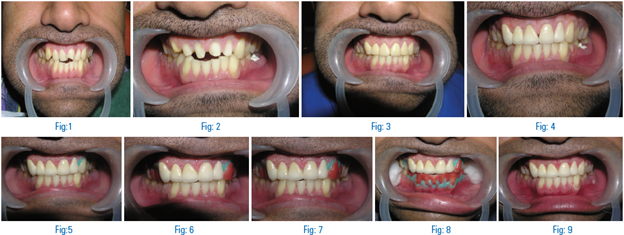
The maxillary right and left central and lateral incisors, and maxillary right canine were prepared (fig. 2), for the placement of metal- free crowns. Following the tooth preparation, provisional crowns were fabricated and luted with temorary cement(RelyX Temp/3M ESPE, St. Paul, MN, USA) (fig. 3). After the shade selection, the prostheses were fabricated with E-max all-ceramic system (Ivoclar Vivadent, Barueri, SP, Brazil) and cemented with Variolink II (Ivoclar Vivadent, Barueri, SP, Brazil) cement shade A1 (fig. 4). The prosthesis fabricated was a shade lighter than patients own tooth color because of patient’s aesthetic demands.
Laser bleaching of the remaining anterior teeth was planned to match the shade of the prosthesis. Gingival protection was provided using a resin barrier (OpalDam, Ultradent) (fig. 5). The bleaching gel (JWhite Power Bleaching Gel, Heydent) was then prepared as per the manufacturer’s instructions and applied onto the teeth using an applicator tip (fig. 6, fig. 7, fig. 8)). A diode laser (Fotona XD-2) with a special bleaching hand piece (R24-B) was used for activating the bleaching gel. After two cycles, the bleaching gel was washed away and patient was made to rinse and the teeth were dried (fig. 9).
DISCUSSION
The many innovations in modern dental sciences have provided today’s dentists with entirely new approaches to create a perfect smile. New materials, new techniques and new concepts of dental artistry create uniform , white and beautiful smile capable of reestablishing the functional and biological factors characterstic of dental tissues.
Technological advancements in restorative techniques and materials have made it possible to perform procedures capable of re-establishing the functional, aesthetic and biologic factors characteristic of dental tissues.6,7
It is important to establish a logical sequence, making available the various possibilities of techniques and restorative materials to make the reconstruction of the anterior teeth more predictable. As the patient’s smile was in disagreement with many of the aesthetic principles, so treatment objectives were based on aesthetic enhancement, sociopsychological support of the patient, restoration of form function, phonetics and comfort. This was possible using the basic principles of shape, symmetry, proportionality, color, position and alignment as a foundation. Re-establishment of the anterior tooth dimensions was important to restoring the harmony of the patient’s smile.
During the stage of the provisionals, the importance was noted of starting with reproduction of the characteristics of the natural teeth, to simulate the possible final desirable effects of the definitive restorative material. The allceramic E-max system (Ivoclar Vivadent, Barueri, SP, Brazil) was selected because it has a lithium disilicate coping, which is capable of being acid etched, and thus improves the bond to the preparation. In addition, it is a feldspathic ceramic with high translucency that more easily mimics the tooth structure and reproduces it more faithfully. Laser bleaching is done as it causes less enamel demineralization, less temperature elevation and requires less time to achieve desirable results.
REFERENCES
- Qualtrough AJ, Burke FJ. A look at dental esthetics. Quintessence Int. 1994; 25: 7-14.
- Araújo EM. Cor e forma: elementos essenciais na estética dental. Clínica – Int Braz Dent. 2007; 2:108-23.
- Urzal V. Relationships between teeth and adjacent structures: how to achieve more esthetic results. Int Orthod. 2010; 8: 91-104. http:// dx.doi.org/10.1016/j.ortho.2010.03.013
- Steuer S. Esthetic rehabilitation of anterior teeth with consideration of periodontal and functional parameters. Part 2: treatment and discussion. Eur J Esthet Dent. 2009;4:250-61. PMid:19704926.
Disclaimer from Guident
The views and opinions expressed in articles published in Guident are solely those of the authors and do not necessarily reflect the views of the editors, the editorial board or the publisher, Ivory India. Guident does not endorse any product, technique or treatment described. Clinical content is intended for qualified dental and medical professionals and is not a substitute for individual clinical judgement. Guident, its editors and the publisher accept no liability for any consequence arising from the use of information published in the journal.
How to cite this article
Dr. Rajat Dang, Dr. Dipti Dang, Dr. Monika Joshi. It All Begins with a Smile. Guident. 2013 Jan;6(3). Available from: https://guident.in/articles/prosthodontics/it-all-begins-with-a-smile.html