The Effect of Various Disinfectant Solutions on the Surface Hardness of Acrylic Denture Base Resins
Vydehi Institute of Dental Sciences & Research Centre, Bangalore, Karnataka, India, AECS Maaruti College of Dental Sciences & Research Centre, Bangalore, Karnataka, India, Department of Prostodontics & Implantology
Abstract
An investigation was undertaken to find the effect of various disinfectant solutions on the surface hardness of acrylic denture base resins so as to minimise the cross infection control at the same time not compromising the physical properties of denture base resins.
The effect of three disinfectant solutions 2% gluteraldehyde, 0.5% sodium hypochlorite and 0.4% chlorhexidine gluconate were investigated on two commercially available conventional heat cured acrylic denture base resin DPI-Heat cure and Trevalon – HI.
Rectangular block specimens of DPI-Heat cure and Trevalon – HI were made according to standard dental laboratory procedure and recommended curing time. The specimens were polished, finished and stored in water bath at 370C for 6 weeks.
The specimens were subjected to an immersion time of 0 (control), 30 min, 2hr, 10hr, 24hr, 48hr, 7 days and 14 days in three disinfectant solutions. The samples were then tested for surface hardness by using a zwick hardness tester. The data then obtained were analysed.
It was shown that there was no significant effect on the surface hardness of DPI-Heat cure and Trevalon – HI specimen after immersion in any of the three disinfectant solutions for 24 hrs. But there was a significant reduction in surface hardness of both DPIHeat cure and Trevalon – HI after immersion for 7-14 days.
Trevalon – HI produced less changes in surface hardness than DPIHeat cure after immersion for 7-14 days. Immersion of specimen for longer duration in chlorhexidine gluconate produced more changes in surface hardness than sodium hypochlorite and gluteraldehyde. Gluteraldehyde had the least effect on the surface hardness among the three disinfectant solution.
Key Words: Disinfection, Surface hardness, Acrylic , Denture base Resins
INTRODUCTION
The need for cross-infection control in dental office and dental laboratory has become a necessity to protect the dentist, staff and patients from bacterial and viral infection such as Hepatitis B and Acquired Immune Deficiency Syndrome which are transmitted through procedures in a dental office .
These micro-organisms can spread by direct contact with blood or saliva from an infected patient in the clinical area or by indirect contact with micro-organisms from impressions, gypsum casts, and dental prosthesis in the clinical and laboratory areas. The American Dental Association and Federation Dentaire Internationale1 recommend that at every stage of prosthesis fabrication the components should be thoroughly cleaned and disinfected before it is sent to the laboratory. They advocate immersion in a disinfecting solution for atleast 10 hrs, while the British Dental Association recommends a 3 hr immersion period.
Cross contamination can occur through polishing agents and instrumentation by the use of contaminated wheel and pumice used to polish old dentures which may contaminate the new dentures, if they are not disinfected 2. To reduce the chances of cross contamination in a new denture, it should be fully disinfected or sterilized before delivering to the patient. As a matter of routine, dentures should also be disinfected before and after each adjustment procedures. Autoclaving pumice, replacing pumice and wheel after each use, adding disinfecting agent to the pumice, using disinfecting solution for wetting pumice and using an ultrasonic cleaner to increase the biocidal activity of a disinfectant are the other precautionary measures recommended to prevent cross infection3.
Various methods of sterilization and disinfection in the dental office have been suggested. Some of the materials and instruments used in dentistry cannot be subjected to high heat and hence chemical agents is the alternative to sterilize or disinfect them. The immersion of a denture in a suitable disinfecting solution for an adequate length of time to achieve disinfection or sterilization is a convenient, inexpensive and reliable method. Storage of the denture in disinfectant solution may reduce the portability of viral colonization on the surface of the denture base4.
A denture base during its service, is likely to be exposed to different disinfectants. It has been shown that immersion in certain disinfecting solutions can affect the physical and mechanical properties of denture base resins like flexural strength, elastic modulus and surface morphology5. Hardness of a material is an important property and the measurements of surface hardness of a denture base resin indicate to what extent the force applied during mastication can be resisted6. The effect of disinfecting solutions on surface hardness of denture base resin and the frequent exposure and long-term immersion of the denture base resin in various disinfecting solutions to its physical property such as surface hardness should be known before they can be recommended7.
The purpose of this study was therefore to evaluate
1. Effect of three disinfectant solutions on the surface hardness of two commonly used heat cure denture base materials
2. The period of immersion time in the disinfecting solutions and its effect on the surface hardness of denture base resins.
MATERIALS AND METHOD
The commercially available disinfectant solutions and the heat cured denture base resins are listed in Table I and II
Cidex is a 2% alkaline gluteraldehyde. It is effective against bacteria, incl. Tubercle bacillus, fungi, pseudomonas, spores and virus incl. HBV and HIV. Cidex activated solution destroys 99.8% in 10 min and 100% in 45 min at 25ºC on inanimate surfaces. The date of expiry will be 14 days from the date on which the cidex solution has been activated 8.
Hexipep – T is a 0.4% w/v chlorhexidine gluconate solution in isopropyl alcohol base. Chlorhexidine is a broad spectrum antimicrobial antiseptic and disinfectant that acts by destroying the cell membrane and precipitating the cell cytoplasm. Sodium hypochlorite offers intermediate level disinfection in less time (3 min) than other products. It has been shown to be more effective against micro-organisms like bacteria, fungi, spores and virus including HBV and HIV 9. Sodium hypochlorite must be prepared daily because its useful life is considered to be just 24hrs. as chlorine gets evaporated.
Preparation of Specimen
Rectangular wax blocks that measured 20 × 25 × 5 mm were used to create uniform mould spaces in gypsum and 22 replica blocks of – Heat cure acrylic denture base materials DPI – Heatcure and Trevalon – HI each were made.[ FIG. I ]
Mould separation, packing and flasking followed the standard dental laboratory procedures. Only one side of the specimen was polished and finished by using a polishing cake. The finished specimens were
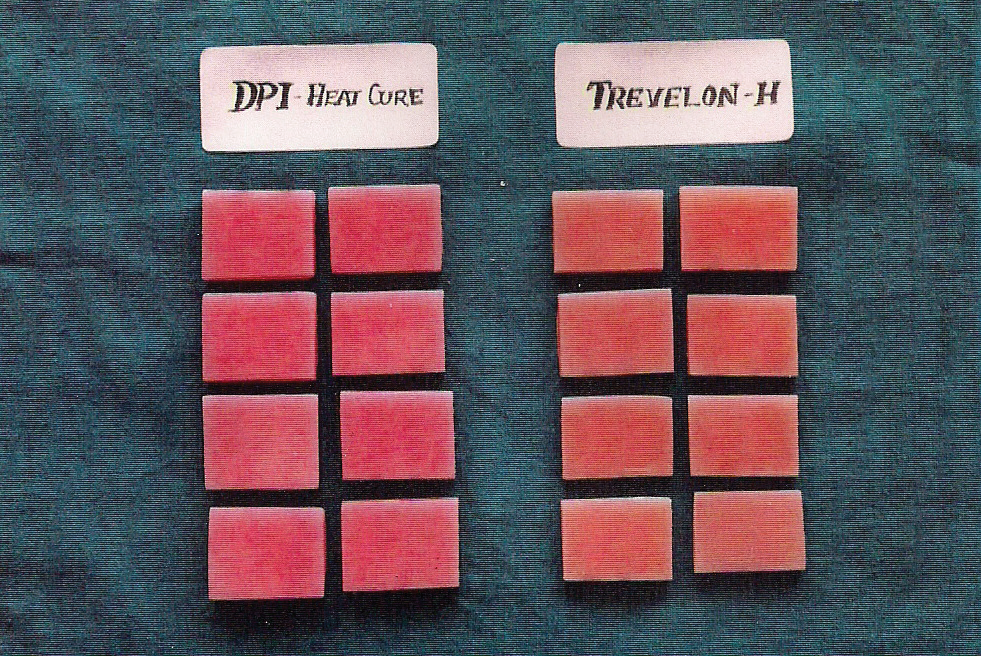
Fig 1: Specimens of DPI and Trevalon - HI Heat cure acrylic denture base materials
then stored in a water bath at 37ºC for 6 weeks which would allow the specimen to reach a 96% water saturation level10.
Testing Conditions
The specimens were subjected to an immersion time of 0 (control), 30 min, 2hr, 10 hr, 24hr, 48hr, 7 days, 14 days in three disinfecting solutions before mechanical testing. [ FIG II ]. Control specimens were not subjected to immersion in disinfectants but kept in water for the same period11.
Testing procedure

Fig 2: Immersion of Specimens in three disinfectant solutions
The samples were taken out from the disinfectant solutions after the specified period of immersion. These samples were then tested for surface hardness by using a Zwick hardness tester12. This test is based upon the ability of the surface of a material to resist penetration by a point under a specified load13.
Zwick hardness tester has a loading arm which utilises a diamond indentor of pyramidal shape with a face angle of 136°. It also comprises of an eye piece with an inbuilt scale to visualise and measure the indentation [ FIG III ].
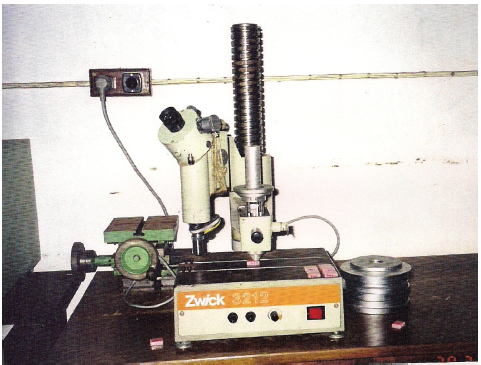
Fig 3: Zwick hardness tester
The samples were subjected to a predetermined load of 500 gms for 15 secs. The indentation produced was visualised through an eye piece and the diagonal of the pyramid shape indentations were measured. All the measurements were made in air at 23° ± 2°C
The Vickers hardness is determined from the quotient of the test load and the surface area of a permanent impression which has been produced by a square based diamond pyramid with a face angle of 136º at a preselected test load and prescribed acting period at the test piece.
The Vickers hardness is proportional to the quotient of the test load F and the area of the permanent impression (Indentation). The impression is considered as a regular pyramid having a graduate base with diagonal ‘d’ and the same face angle as the indentor.

In this manner heat cured acrylic test samples were tested for their surface hardness after the specified time of immersion in 3 different disinfectant solutions.
The data thus obtained were analysed.
Results
The data obtained from the forgoing investigation was statistically analysed and the results are presented in table III to VIII. The data comprises the mean values obtained, together with the standard deviation and coefficient of variation. To identify any significant difference between the data obtained for the groups of materials tested a one-way analysis of variance (ANOVA) wasundertaken and if a significant difference was established, the students t test was used to determine the probability values.
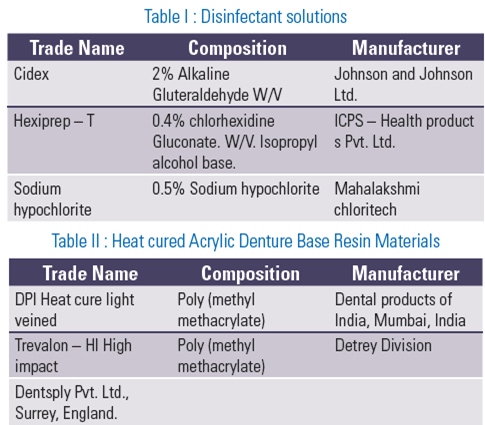
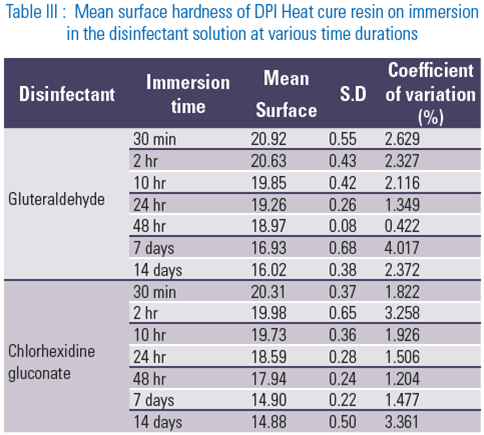
Table III shows, the mean surface hardness values of DPI Heat cure resin on immersion in there disinfectant solutions at various time durations. The mean surface hardness value of DPI Heat cure control sample which was immersed in water for 6 week is 21.11 with 0.81 SD and 3.84 (v(%). It is found that the surface hardness values when compared with the control gradually decreased with time on immersion is disinfectant solutions.
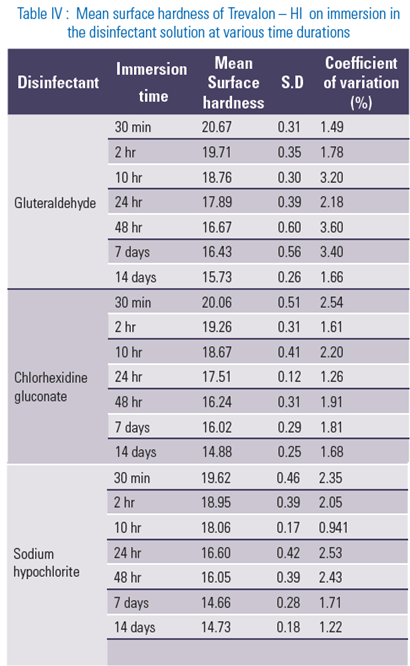
Note : The hardness value of “DPI Heat cure” control sample which was immersed in water for 6 weeks is 21.11 with 0.81 SD and 3.84 CV (%) Table IV shown the mean surface hardness values of Trevalon– HI on immersion in three disinfectant solutions at various time durations. The mean surface hardness value of Trevalon – HI control sample which was immersed in water for 6 wks is 20.45 with 0.42 SD and 2.00 CV (%). If is found that the surface hardness values of Trevalon – HI when compared with its control gradually decreased with time on immersion in disinfectant solutions.
Note : The hardness value of “Trevalon – HI” control sample which was immersed in water for 6 weeks is 20.75 with 0.42 SD and 2.05 CV (%) Table V shows the comparison among the groups – Gluteraldehyde, chlorhexidine gluconate and sodium hypochlorite at various time duration for both DPI Heat cure and Trevalon – HI (by ANOVA test) The F and P values denotes the overall significant changes in surface hardness at various time durations. It is found that there is a significant change in surface hardness of DPI-Heat cure and Trevalon – HI immersed in disinfecant solution for 48 hours and a highly significant change when immersed for 7-14 days.

Table VI shows the test of significance results for gluteraldehyde at various time durations. It is found that there is no significant deviation of the mean surface hardness values from the control till 48 hours of immersion for both DPI Heat cure and Trevalon – HI. But there is a significant deviation from the control for 7 days of immersion and highly significant deviation for 14-days of immersion for both DPI-Heat cure and Trevalon - HI.

Table VII shows the test of significance results for chlorhexidine gluconate at various time duration. It is found that there is no significant deviation of mean surface hardness values from the control till 24 hrs for both DPI-Heat cure and Trevalon – HI. But there is a significant deviation from the control for 48 hours of immersion,highly significant deviation for 7 days of immersion and very highly significant deviation for 14 days of immersion for both DPI Heat cure and Trevalon – HI.
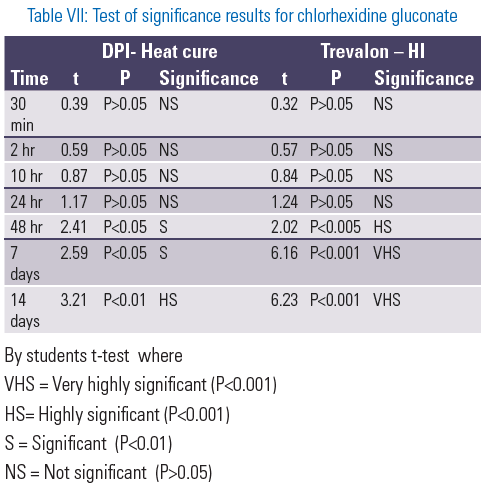
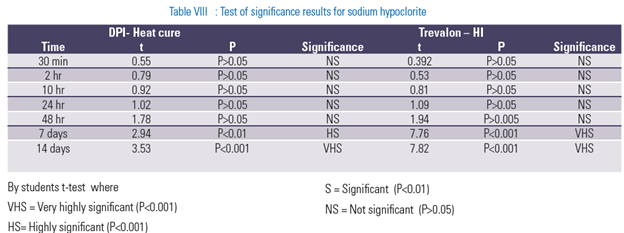
Table VIII shows the test of significance results for sodium hypochlorite at various time durations. It is found that there is no significant deviation of the mean surface hardness values from the control till 48 hrs of immersion for both DPI-Heat cure Trevalon – HI. But there is a highly significant deviation from the control for 7 days of immersion and very highly significant deviation for 14-days of immersion for both DPI-Heat cure and Trevalon – HI.
DISCUSSION
The objective of immersing a denture in a disinfectant is to obtain a clean, decontaminated prosthesis by the destruction of microorganisms without damaging the denture base. It is desirable that the process should not involve any physical, mechanical or chemical changes in the denture. Such changes may include alteration of the surface morphology and changes in Flexural transverse strength and rigidity. This study was conducted to identify the effect of immersion in various disinfectants for 14 days on the surface hardness of heat cure acrylic resin, to test the worst scenario, and to study the possible effect of repeated short immersions. Since most agents can disinfect in 10 min and many can sterilize in 6 hrs, a 7-14 days immersion time would be realistic in normal practice.
Hardness of a material is an important property. Measurements of surface hardness of a denture base resin indicate to what extent the forces applied during mastication can be resisted. Many methods of hardness measurements have been used but the most realistic approach to assessment of the hardness of a material is by measurement of its resistance to indentation. Then a logical definition of the hardness might be the “resistance of a material to indentation” and therefore, greater indentation indicates softer material.
Studies on indentation resistance of denture base polymers, before and after storage in water, show that storage in water produces softening of the surface in heat-polymerized acrylic resins. This decrease in surface hardness indicates that water either combines with or more probably enters into the amorphous outer layer of the acrylic surface, which suggests a form of chemical reaction that cannot be prevented. So, the specimen were stored in a water bath at 370 C for 6 weeks to reach a 96% water saturation level. These specimens were considered as control group for the study. The data presented in table V shows that no significant difference in surface hardness of DPI- Heat cure and Trevalon – HI, was found when immersed in disinfectant solutions for 1 day when compared to the control group.
However there is a significant change observed when DPI – Heat cure and Trevalon – HI specimens were immersed in chlorhexidine gluconate for 48 hrs and no significant change observed for the other two groups. This could be due to the presence of isopropyl alcohol as base for chlorhexidine gluconate disinfectant which may cause dissolution, swelling, pitting or crazing of the resin.
The data also shows that there is a highly significant change observed when DPI- Heat cure and Trevalon – HI specimens were immersed in chlorhexidine gluconate for 7 days and 14 days. This change could be accounted for slow absorption of disinfecting chemicals into the resin that resulted in some structural changes in the polymers.
The data obtained in table VI, VII and VIII is in accordance with the above result and it shows that chlorhexidine gluconate produced more significant changes in surface hardners of DPI-Heat cure and Trevelon –H than sodium hypochlorite and Gluteraldehyde. Glutaradehyde produced the least changes in surface hardness among the three disinfectant solutions.
CONCLUSIONS
The following conclusions have been drawn after an investigation into the effect of immersion of DPI – Heat cure and Trevalon – HI blocks in three disinfectant solutions.
There was no significant effect on surface hardness of the DPI-heat cure and Trevalon – HI specimens after immersion in any of the three disinfectant solution for 24 hours.
Immersion of specimens in chlorhexidine gluconate for 48 days produced a significant reduction in surface hardness of both DPIHeat cure and Trevalon – HI resins.
Immersion of specimen in any of the three disinfectant solution for 7-14 days produced a highly significant reduction in surface hardness of both DPI-Heat cure and Trevalon – HI. Between the two Trevalon – HI produced less changes in surface hardness than DPI–Heat cure for immersion for 7-14 days.
Immersion of specimens in chlorhexidine gluconate produced more significant change in surface hardness than sodium hypochlorite and Gluteraldehyde in longer duration of immersion. Gluteraldehyde had the least effect on the surface hardness among the three disinfectant solutions.
REFERENCES
- American Dental Association Council on Prosthetic Services and Dental Laboratory Relations. “Guidelines for infection control in the dental office and commercial dental laboratory”. J Am Dent Assoc 1985; 110-969-72.
- Kann, R. C., Lancaster, M. V., Kate, W.: “The microbial cross contamination of dental prostheses”. J Prosthet Dent 1982; 47: 556- 559
- Robert, L. Engelmeier., Otto, C. Tebrock., Theresa, G. Mayfield. : “A protocol for dental laboratory Infection control”. Quint. Dent Tech. 1989; 107-110.
- Chau. V. B., Saunders, T. R., Pimsler, M., Elfring, D. R., “Indepth disinfection of acrylic resins.” J.Prosthet Dent 1995 ; 74(3) : 309-13.
- Asad, T., Watkinson A. C., Huggett R.: “The effect of disinfection procedures on flexural properties of denture base acrylic resins”. J Prosthet Dent 1990. 68:191-5.
- Bell, J. A., Brockmann, .S. L., Feil, P., Sackuvich, D. A.: “The effectiveness of two disinfectants on denture base acrylic resin withan organic load”. J. Prosthet Dent. 1989; 61: 580-3.
- Tsun, M. A., Glen, H. Johnson., Glenn, E. Gordon. : “Effects of chemical disinfectants on the surface characteristics and color of dentureresins”. J. Prosthet Dent. 1997; 77: 197-204.
- Chiayi Shen, Nikzad, S. Javid.: “The effect of gluteraldehyde basedisinfectants on denture base resins”. J. Prosthet Dent 1989; 61:583-9.
- Rudd, R. W., Senia, E. S., McClesky, F. K., Adams, E. D. Jr.: “Sterilization of complete dentures with sodium hypochlorite”. J Prosthet Dent.1984;51:318-321.
- Braden, M. : “The absorption of water by acrylic resins and other materials”. J Prosthet Dent 1964; 14:307-316.
- Danna, L. Dixon., Lavry, C. Breeding., Kaul, G. Ekstrand. : “Linear dimensional variability of three denture base resins after processingand in water storage”. J. Prosthet Dent. 1992; 67:68: 196-200.
- Huggett, R.: “Studies on the measurements of hardness of some dental acrylic resins”. J. Br. Inst. Surg. Techns, 1975;1:36-58.
- Stafford, G. D., Huggett, R.: “Creep and hardness testing of some denture base polymers”. J Prosthet Dent 1978; 39:682-687.
Disclaimer from Guident
The views and opinions expressed in articles published in Guident are solely those of the authors and do not necessarily reflect the views of the editors, the editorial board or the publisher, Ivory India. Guident does not endorse any product, technique or treatment described. Clinical content is intended for qualified dental and medical professionals and is not a substitute for individual clinical judgement. Guident, its editors and the publisher accept no liability for any consequence arising from the use of information published in the journal.
How to cite this article
Dr. V.A Reddy, Dr. Vahini Reddy. The Effect of Various Disinfectant Solutions on the Surface Hardness of Acrylic Denture Base Resins. Guident. 2013 Jan;6(3). Available from: https://guident.in/articles/research/the-effect-of-various-disinfectant-solutions-on-the-surface-hardness-of-acrylic-denture-base-resins.html