Effect of Organic Fluorides on Acid Dissolution of Enamel
Department of Conservative Dentistry and Endodontics, Yerala Medical Trust, Dental College and Hospital, Kharghar, Navi Mumbai, Maharashtra, India, Group Pharmaceutical Ltd. Bangalore, (Kar), India
Abstract
Introduction: A special category of fluoride compounds is represented by organic fluoride: amine fluorides. It has been proven that regular etching time is insufficient to effectively etch fluorosed enamel.
Materials and methods: This in vitro study was performed to study etching pattern by SEM on 3o freshly extracted premolars which were pre treated with amine fluoride dentifrice twice daily.
Conclusion: Within the limits of this study it was concluded that the recommended 15 second etching time with 37%orthophosphoric acid is inadequate to effectively etch enamel of teeth in which there is a previous history of use of amine fluoride toothpaste.
Keywords: Amine fluorides , CaF2[Calcium Fluoride], Fluorapatite.
INTRODUCTION
Dental Caries is a major dental disease affecting large proportion of the inhabitants of the world. It impairs the quality of life for many people causing pain and discomfort. There are many technologies available in the world but only fluoride’s Cariostatic efficacy has been convincingly demonstrated and decline in caries prevalence is primarily attributed to the increased use of various fluoride agents.1-5 A special category of fluoride compounds is represented by organic fluorides.Various studies have been conducted and it is proven that amino fluorides produce the most powerful enrichment in fluoride of the enamel, even in low concentration. The carious preventive action is due to fluoride on one side and to the anti-enzyme effect of the organic fraction on the other side and also by arresting the formation of dental plaque, as a result of the tensioactive properties.
Retention of composite depends directly on the etching pattern of enamel. Use of fluoridated toothpaste especially organic fluoride makes tooth acid resistant . Hence common belief of 15 second etching of enamel is debatable for patients who are using organic fluoride. Hence this study was conducted.
MATERIALS AND METHODS
Armamentarium
- 37% phosphoric acid gel.
- Diamond disc/straight micromotor handpiece
- Amine fluoride toothpaste
- Non fluoridated toothpaste
- Oral –B powered toothbrush
- Distilled water
30 freshly extracted premolars were sectioned into two equal halves bucco-lingually.

Study Group: The sections in study group were brushed with organic fluoride dentifrice and Oral B cross action power toothbrush twice daily for 3 minutes for a period of 7 days.
Control Group:The control group sections were treated with a non fluoridated toothpaste in a similar way.
All samples were stored in distilled water.
After a period of 7days both the groups were etched with 37%phosphoric acid for 15 seconds and observed under SEM.

ASSESSMENT OF GROUPS AND ANALYSIS OF DATA
The severity of acid dissolution was compared with HOBSON’S observations and assigned degrees I to V to indicate progressively greater acid dissolution of surface enamel.
Hobson’s observations
Degree –I- Only micro pitting over the enamel surface.
Degree-II-Sparsely distributed prismatic enamel structure visible.
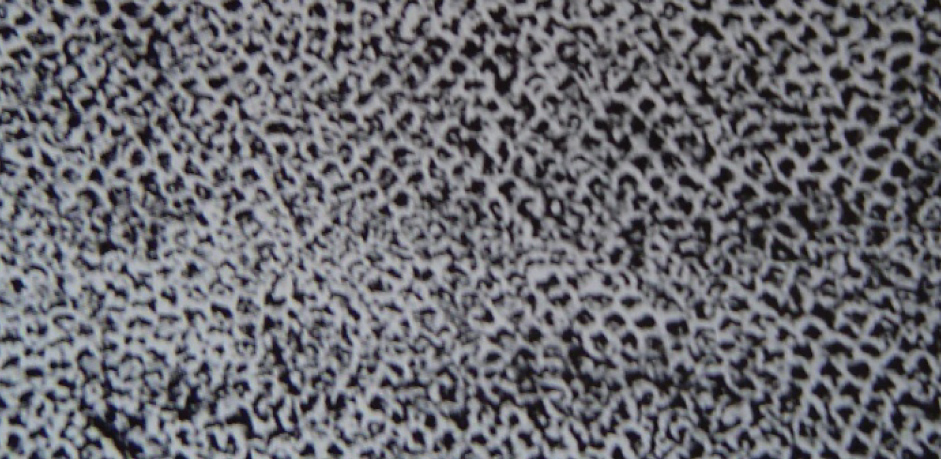
Degree –III-Prismatic enamel structure is more obvious over the surface
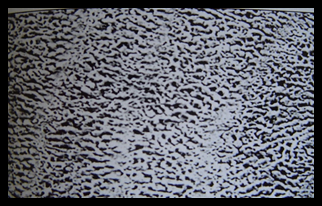
Degree-IV-Complete loss of aprismatic enamel and prismatic enamel observed through out the surface
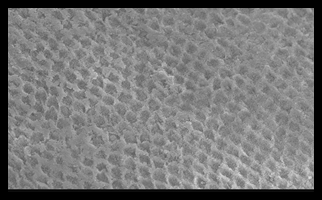
Degree –V - Typical acid etched patterns Honeycomb appearance
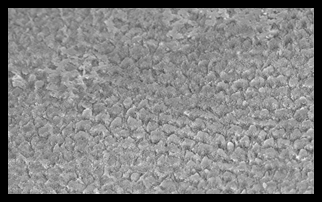
Fish scale appearance
Attention was focused on the degree of dissolution over a large area of the enamel surface .
The SEM observation of all the sample were graded from I to V.
RESULTS
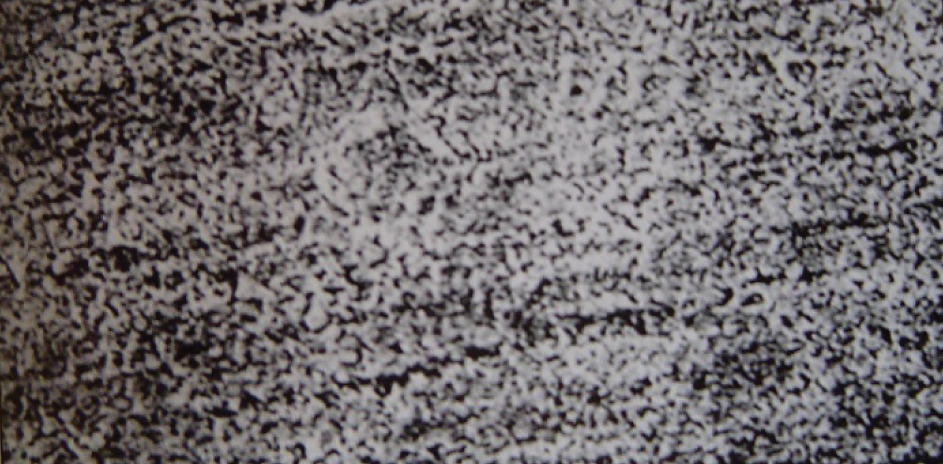
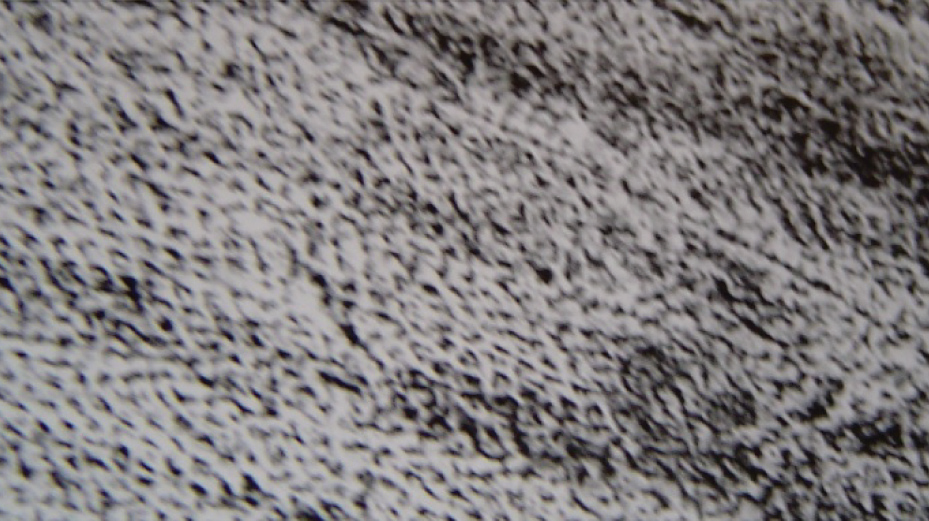
Out of the 30 specimens of control group 22 showed Hobson’s class V typical honey comb appearance; 8 specimens showed type IV and V mixed pattern.
Whereas none of the 30 study group specimens showed characteristic etching pattern.
All of the study group specimens showed uniform CaF2 deposits on the surface.
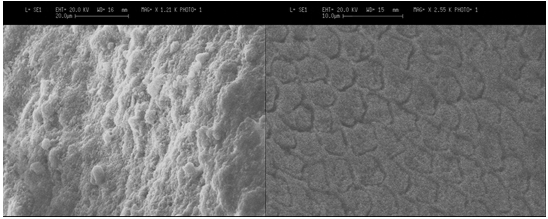
FIG 7: AMFLOR GROUP [ STUDY GROUP] FIG 8: CONTROL GROUP
DISCUSSION
Enamel is more than 96% inorganic mineral in the form of hydroxy apatite and 4% is water and organic material in the form of amelogenin and non amelogenin protein e.g.: enamelin ( TEN .CATE.1998).This study was done to determine the effect of recommended acid etching for 15 seconds with 37%orthophosphoric acid on intact enamel surface in which there is a history of use of amine fluoride toothpaste.
The toothpaste used in study group was AMFLOR which contains Amine Fluoride{Bis-(hydroxyethyl)-
aminopropyl -N hydroxyethyl octadecylamine dihydrofluoride(Olaflur)} 1000 ppm
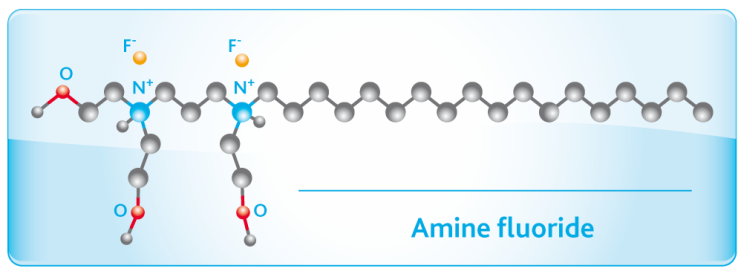
The AmF molecule consists of two functional groups –the organic amine which is a cationic surface active agent fluoride ion with its known anticaries properties.
Because of its surface activity amine fluorides are rapidly scattered in the oral cavity and they ensure proper moistening of all dental surfaces . Like any surfactant these cations have a hydrophilic and a hydrophhobic part.At the hydrophilic end there is a positively charged nitrogen atom which attaches itself easily to the predominantly negatively charged enamel surface. The hydrophobic part of molecule aligns towards the oral cavity .
This self organised arrangement leads to accumulation of fluoride close to the tooth surface which is directly available for production of CaF2. Also the hydrophobic part reduces moistening by saliva and thereby prevents CaF2 from being washed out rapidly.6-9
After a brief exposure to topical fluoride agents; fluoride is retained as CaF2 like material (TenCate 1997,Ogaard 1999) .CaF2 is insoluble in water (Bruun et al 1983) and in saliva at neutral pH.CaF2 can be found weeks (ogaard et al 1983)and months after a single fluoride application (Dijkman et al 1983, Dijkman and Arends,1988).
In this study uniform CaF2 deposits were observed in all of the samples which were brushed with amine fluoride toothpaste. Also no distinct etching was seen in any of these study group samples . Samples brushed with non fluoridated toothpaste showed characteristic type IV and V etching pattern according to Hobson’s classification.
CONCLUSION
- 1.Within the limits of this study it was concluded that the recommended 15 second etching time with 37%orthophosphoric acid is inadequate to effectively etch enamel of teeth in which there is a previous history of use of amine fluoride toothpaste. The probable reason for inability of acid etchant to not to dissolve the enamel is the formation of calcium fluoride labile depot which is acid resistant in nature and at critical pH i.e 4.5 to 5.5 it dissolves and fluoride ions bind with hydroxy apatite crystals to form Fluorapatite crystals .The fluorapatite crystals are larger and acid resistant , hence the 37% of phosphoric acid did not cause any etchant pattern on the enamel.
- 2.As none of the specimens of study group showed a distinct etching pattern it can be concluded that the objective of achieving micromechanical retention with bonded restorations will be jeopardized in such cases.
Because the results of this in vitro study cannot necessarily be extrapolated to clinical situation more research is needed to evaluate the required etching time in patients who give history of use of amine fluoride toothpaste.
CLINICAL SIGNIFICANCE
- Recommended etching time of 15 seconds was found to be inadequate with use of amine fluoride toothpaste.
- The effective micromechanical retention with bonded restorations is hence compromised.
- Patient history for use of amine fluoride toothpaste should be taken prior to use of bonded restorationsand etching time modified accordingly.
- Further studies are required to determine the adequate etching time in patients who use amine fluoride toothpaste
REFERENCES
- G. Menghini, M. Steiner, T. M. Marthaler, A. Bandi: Kariesbefall bei Schülern des Kantons Glarus in den Jahren 1974 bis 1992: Wirkung der Salzfluoridierung. Schweiz Monatsschr Zahnmed 105 (1995) 467 - 473
- M. Steiner, G. Menghini, T. M. Marthaler: Kariesbefall bei Schulkindern des Kantons Glarus 13 Jahre nach der Einführung des höher fluoridierten Salzes. Schweiz Monatsschr Zahnmed 99 (1989) 897 - 901
- C. Allmark, H. P. Green, A. D. Linney, D. J. Will, D. C. A. Picton: Acommunity study of fluoride tablets for school children in Portsmouth. Brit Dent J 153 (1982) 426 – 430
- M. Büttner: Prophylaxeerfolge in Berlin-Hohenschönhausen. Vergleichende Studie 1992 – 1994. Bezirksamt Hohenschönhausen von Berlin, Abt. Gesundheitswesen 1995
- U. Helfenstein, M. Steiner: Fluoride varnishes (Duraphosphat): A metha-analysis. Community Dent Oral Epidemiol 22 (1994) 1 – 5
- E. Hellwig: Kariesprophylaxe mit fluoridierten Kinderzahnpasten. Quintessenz J 20 (1990) 467 - 472
- E. Hellwig, J. Klimek, H.Wagner: The influence of plaque on reaction mechanism of MFP and NaF in vivo. J Dent Res 66 (1987) 46 – 49
- H. Schmid: Chemie und Oberflächenwirkung der Aminfluoride. Dtsch Zahnärztl Z 38 (Sonderheft 1) (1983) 9 – 13
- H. J. Gülzow, G. Lang: Klinisch experimentelle Untersuchungen über die Wirksamkeit zur Kariesprophylaxe angewandter Aminfluoride. Dtsch Zahnärztl Z 22 (1967) 414 – 418
Disclaimer from Guident
The views and opinions expressed in articles published in Guident are solely those of the authors and do not necessarily reflect the views of the editors, the editorial board or the publisher, Ivory India. Guident does not endorse any product, technique or treatment described. Clinical content is intended for qualified dental and medical professionals and is not a substitute for individual clinical judgement. Guident, its editors and the publisher accept no liability for any consequence arising from the use of information published in the journal.
How to cite this article
Dr. Mrinalini Kunte, Dr. Raghu Narayan. Effect of Organic Fluorides on Acid Dissolution of Enamel. Guident. 2013 Sep;6(11). Available from: https://guident.in/articles/research/effect-of-organic-fluorides-on-acid-dissolution-of-enamel.html