Dental Chairs from Past to Present...an Overview
Department of Conservative Dentistry and Endodontics D. J. College of Dental Sciences & Research, Modinagar (U. P.), India
ABSTRACT
The nature of dentistry--getting a good look inside the patient’s mouth--requires the patient to be lower than the doctor. Thus mankind has tinkered for centuries with the optimum dental chair design. From baroque Victorian designs to the foot controls and adjustable headrests of modern technology, many types of dental chairs have graced the ages. The dental chair from its invention to its present design changed due to position and comfort of the patient while providing doctor and assistant easy access to oral cavity. 21st century dental chairs provided control to rise or lower height of chair usually located on chair base and operated by foot. Future lies in the computer reconstructed dental chairs custom made for individual dentist according to their need. This article gives a review of the various dental chairs available to dentists through years.
Key words: History, dental chairs, ergonomic.
INTRODUCTION
Dental chairs have become a testing ground for high tech wizardry and ergonomics, evolving from decorative Victorian models to space-age pods with insect-like composite limb attachments. The foreground for the improvement in providing proper treatment lead to the alteration in the design of the dental chair. The first chair to be used specifically in the dental office was designed by Josiah Flagg in 1790 when he added a headrest to an armchair (Fig. 1, 2, 3), that chair is now considered to be the oldest dental chair along with the creation drills at the end of XIX - early XX centuries by S.S. White.1

18 TH -19 TH CENTURY
Dr. Josiah Flagg made the first chair for dentistry in 1790 when he attached a headrest that tilted back to a wooden Windsor chair. This chair was an American country-style, slat-back armchair with a similar headrest. He also made it more convenient for the dentist, by adding an extension to the chair that provided storage for commonly used tools.1

Fig 4
James Bael Morrison (1868) had a unique mechanism that allowed the dentist to tilt it in any direction. James Snell of London created a chair that was designed specifically for dental work in 1832. Snell’s chair featured both a back and a seat that allowed for minor adjustment. (Fig. 4)1
Innovations in dental chair design improved and multiplied, and by the late 1800s, over eighty different chair designs could be found on the market.
The true precursor to the modern dental chair, constructed by James Beal Morrison, merited a British patent in 1867. The base of the chair
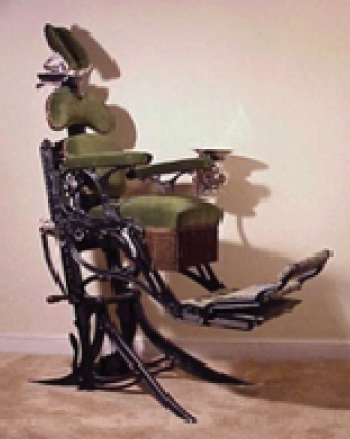
Fig 5
was made of iron, and the chair itself boasted both a headrest and a footrest. A ball-and-socket joint beneath the chair, accessible bya foot pedal, lets the chair tilt backwards and forwards as well as to the right and left. The chair also allowed for over three feet of vertical adjustment. (Fig. 5)2
A faithful reproduction of a Circa 1850 antique, the dentist’s chair originally hailed from the town of Menton on the French Riviera. Sculptural and striking in its composition, it’s also ergonomically designed to offer superior lumbar support. Fully functional, the chair swivels 360 degrees and tilts back to multiple positions from upright to recline via settings in the arm, just like the original. (Fig. 6)1, 3

Fig 6

Fig 7
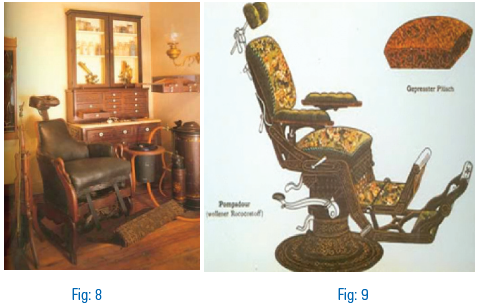
The Executive Office of the dentist, Jacksonville, Illinois (1885) (Fig. 8) and German chair with foot pedal (1890) (Fig. 9) were richly upholstered and decorated for patient seating. These chairs provided comfort and elegance to the dental chair.1, 2, 4
The “High-Low ”Wilkerson dental chair (1886) (Fig. 10, 11) and dental office of circa (1900) (Fig. 12, 13) showed a series of dental chairs spanning many years, including a child’s chair; an instrument made by Paul Revere for Dr. Josiah Flagg, the first American-born, full-time dentist. (Fig. 14, 15)4

20 TH CENTURY
In 1910-1924 dental chairs gained much required attention in Army Dental Surgery. (Fig. 16)1, 5
Vintage 1940’s - 1950’s chair with working hydraulics improved the workability and adjustability of the chair. (Fig. 17)1, 4, 5

Child’s Dental Chair, circa 20th Century Morrison dental chair with spittoon by S.S. White (Fig. 18), dentist’s stool by Smith (Fig. 19), foot dental engine White (Fig. 20), White bracket, Electro-Dental Mfg. Co., Rhein cluster light (ca. 1911), quarter-sewn oak dental cabinet (ca. 1902) by The Harvard Co. (Fig. 21) were some of the dental chairs introduced in early 20th century.1, 6

Dental Clinic, Temple University School of Dentistry, circa 1950 demonstrated a large scale dental treatment area for mass patient, providing dental care. (Fig. 22) Improvement in the basic support structure in dental chair caused large scale manufacture.6

Fig 22
Dr. Richard Glenner in the 1970s wrote how the dental chair and other equipment evolved. The changes occurred due to change in treatment protocol, in turn, chair position ideal for the dentist to provide treatment. From standing chair position to sitting position, the angulation of the chair along with the basic structure changed dramatically which included the dentist stool for sitting treatment position.6
21 ST CENTURY
In the 21st Century dentist chair upholstered in vinyl material and semi-automatic to fully adjustable chairs with foot control were made available. (Fig. 23, 24)7

Mobile products for dental practices are becoming extremely popular, and this has become major topic among dentists of late. These types of products, especially a mobile dental chair, aides the dentist by being able to move patients about the office without the use of a wheelchair, if so needed, as well as being able to go out to patients that are not able to come into the office, such as the elderly and homebound. (Fig. 25, 26, 27)7, 8 Dentaid has designed
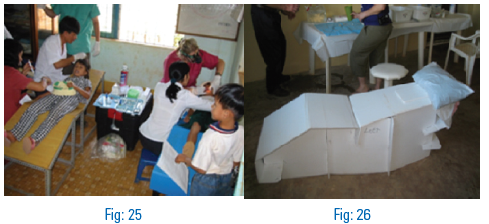
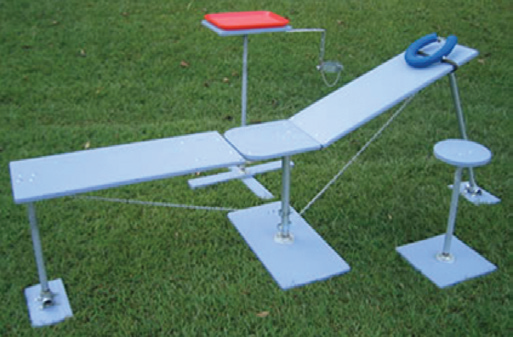
Fig 27
and created a portable dental chair to be used in remote rural communities overseas. An adjustable dental chair is essential to the delivery of safe and effective dental treatment. Many dentists offering outreach dental treatment in remote rural communities struggle to find a suitable dental chair to work with, particularly where there is no access to electricity. Dentaid’s Portable Dental Chair is a low cost, easy to use and fully mobile chair designed specifically for in-field use. By facilitating the supplythis Portable Chair communities worldwide benefit from improved oral health. (Fig. 28, 29)8
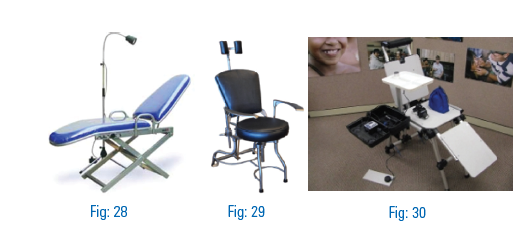
I-Tec’s Portable Dental System (PDS) is a robust, fully articulating dental chair and battery-operated handpiece -- all in one package you can comfortably carry on your back. Setting a new world standard in truly portable dentistry, the I-TEC PDS unlike other systems with its compact, 33-pound package. (Fig. 30)8
The handpiece includes a well-balanced 2,000-25,000 rpm dental handpiece, state-of-the-art electronic controller, low-battery indicator, reversing switch, air-operated foot pedal and headlamp. The system’s folding dental chair has been fitted with a headrest and handrails, an instrument tray, a handpiece, LED headlamp, AC/ DC charger, and solar panel. Constructed of anodized aluminum tubing and engineering plastics, the chair sets up in less than two minutes, supports up to 300 lbs., and is exceptionally stable.8
Ergonomic chairs are available in market which reduces the amount of stress and fatigue caused to dentist during treatment. (Fig. 31, 32, 33, 34)9

As an experienced manufacturer of dental chairs, such as Pelton & Crane has combined critical elements to create the ergonomic chairs. Sleek lines and quiet movements contribute to a stylish aesthetic and relaxing environment, while ergonomic design and massage technology put the patient at ease. Designed with efficiency in mind, the dentist chair offers ergonomically-positioned touchpads to control motion, and is available in a narrow back and traditional back versions. (Fig. 35, 36, 37, 38)8, 9

Narrow back design allows easy access to the patient without compromising comfort. Contemporary design with 4 distinct models will complement any operatory. Dual-integrated touch pads located on the arm supports have been oriented so the user can read the button functions without moving out of position. Control up to 4 programmable chair positions, the electronic swivel brake, an optional dental light at a touch of a button, these remoteactivated electric chair swivel allows up to 60º rotation for precise chair positioning. No manual repositioning armrest design allows the armrest to articulate with the angle of the seat back, keeping the patient’s arm cradled in a natural position. Quick-release, dual-articulating headrest with squeeze mechanism enables to position the patient precisely for easy access to the oral cavity. (Fig. 39, 40)9
CONCLUSION
The advancement of dental chair has led up to improved dental treatment and reduced stress to the patient and dentist. The mordernization of dental chair provides custom made dental chair for the dentist to suite their need. Further resarch and alteration indesign of dental chair is limitless which is upto the imagination of the individual.
REFERENCES
- The selection and use of operator’s stools and contour chairs. Anderson JA. Dent Clin North Am. 1965 Jul;25:303-18.
- Proposal for the design of dental chairs for treatment of the reclining patient. Plischka G. Quintessence Int (Berl). 1972 Jul;3(7):77-8.
- New dental chairs. Gorelov BV, Konychev BI. Med Tekh. 1980 Mar- Apr;(2):52-3.
Disclaimer from Guident
The views and opinions expressed in articles published in Guident are solely those of the authors and do not necessarily reflect the views of the editors, the editorial board or the publisher, Ivory India. Guident does not endorse any product, technique or treatment described. Clinical content is intended for qualified dental and medical professionals and is not a substitute for individual clinical judgement. Guident, its editors and the publisher accept no liability for any consequence arising from the use of information published in the journal.
How to cite this article
Dr. Satyabrat Banerjee, Dr. Anil Dhingra, Dr. Himesh Jain. Dental Chairs from Past to Present...an Overview. Guident. 2013 Jan;6(3). Available from: https://guident.in/articles/general/dental-chairs-from-past-to-present-an-overview.html