"Bio Medical Waste -a Significant Issue"
Department of Periodontics, Department of Periodontics, Department of Prosthodontics, Vyas Dental College And Hospital, Jodhpur, India.
Abstract
The biomedical waste produced in the course of health care activities carries a higher potential for infection and injury than any other type of waste. Inappropriate handling of biomedical waste may have serious public health consequences and a significant impact on the environment. The potential risks associated with health care waste are still unfamiliar to health workers, and the assessment requires expert advice. Public health is compromised due to lack of accountability in the handling of some hospital waste; specifically body fluid contaminated equipment and containers as well as microbiological materials. Purpose of this review is to understand the various handling and disposal procedures of biomedical waste, the knowledge and awareness of individuals involved in bio medical waste generation, handling and disposal, and the potential impacts of the waste stream on both human health and the natural environment.
Keywords: biomedical waste, biomedical waste hazard, incineration, isolation, management of biomedical waste, universal precaution,
INTRODUCTION
Heath care facilities such as hospitals, clinics, laboratories, and many other places are bound to dispose of materials that have been used in medical care or treatment, and hospital waste is a potential health hazard to the health care workers, public and to the surrounding flora. The hazardous nature of the health-care waste may be due to one or more of the following characteristics: it contains infectious agents, genotoxic materials, contains toxic or hazardous chemicals or pharmaceuticals agents, radioactive materials, and contains sharp instruments having the potentiality of cross infections.1,2 as well as general refuse, and pathological waste materials.
Bio medical waste means a waste or reusable material derived from the medical treatment of an animal or human, which includes diagnosis and immunization, or from biomedical research, which includes the production and testing of biological products.3
COMPOSITION
Classification of medical waste by Eigenheer & Zanon (1991).4,5They classified medical waste according to their liquid and solid state.
1.Liquid Wastes
- Biological waste - Blood, excrement, body fluid etc
- Chemical waste – Solvents and Solutions, inorganic salts etc.
- Solvents and Solutions - Wastes containing solvents are generated in various departments of a hospital, including pathology and histology laboratories as well as in engineering departments. Solvents used in hospitals include halogenated compounds, such as methylene chloride, chloroform, trichloroethylene, refrigerants, and non-halogenated compounds such as xylene, methanol, acetone, isopropanol, toluene, ethyl acetate, and acetonitrile.
- Organic chemicals- Waste organic chemicals generated in health-care facilities include: disinfecting and cleaning solutions such as phenol-based chemicals used for scrubbing floors, perchlorethylene used in workshops and laundries;
- Inorganic chemicals- Waste inorganic chemicals consist mainly of acids and alkalis (e.g. sulfuric, hydrochloric, nitric, and chromic acids, sodium hydroxide and ammonia solutions). They also include oxidants, such as potassium permanganate (KMnO4) and potassium dichromate (K2Cr2O7), and reducing agents, such as sodium bisulphate (NaHSO3) and sodium sulphate (Na2SO3).
Over-date medicines -
Unused drugs, over-dated drugs.
- Pharmaceutical waste- Pharmaceutical waste includes expired and contaminated pharmaceutical products such as drugs, vaccines, and sera that are no longer required and need to be disposed of appropriately. Genotoxic and cytotoxic wastes is highly hazardous and may have mutagenic, teratogenic, or carcinogenic properties.
- Radioactive waste - Wastes from radiology (iodine 125, iodine 131), Ionizing radiations cannot be detected by any of the senses. The ionizing radiations of interest in medicine include the X-rays, alpha- and beta-particles, and gamma-rays emitted by radioactive substances. An important practical difference between these types of radiation is that X-rays from X-ray tubes are emitted only when generating equipment is switched on, whereas radiation from radionuclide’s can never be switched off and can be avoided only by shielding the material.
Solid Wastes
- Perforating and cutting wastes - Needles, syringes, scalpels, blades, broken glass, vials. Syringes and needles, have the highest disease transmission potential amongst all categories of medical waste. Almost 85% of sharp injuries are caused between their usage and subsequent disposal. More than 20% of those who handle them encounter ‘stick’ or prick injuries.
- Cutting wastes - Wastes from treatment (dressings, stool napkins, plaster cast etc.); Parts of the body: organs, placentas, tissue etc; Over-date medicines (Expired drugs).
According to World Health Organization (WHO) (BAN & HCWH, 1999) approximately 85% or hospital wastes are actually non-hazardous, 10% are infectious, and around 5% are non-infectious but hazardous. In the US for example, about 15% of hospital waste are regulated as infectious waste. In India this could range from 15 to 35% depending on the total amount of waste generated.6
ENVIRONMENTAL HAZARDS RELATED TO MEDICAL WASTE (WORLD BANK, 1991): 7
Piles of refuse or landfill during its decomposition process generate several gases, the most important among which are methane (CH4), nitrogen (N2) and occasionally hydrogen sulfide (H2S). If burnt carbon dioxide (CO2) is released. CH4 and CO2 are greenhouse gases and have potential greenhouse effects. The soil underlying these wastes is typically contaminated by pathogenic micro-organisms, heavy metals, salts, and chlorinated hydrocarbons. These wastes also cause public nuisance by clogging sewers and open drains, encroaching on roadways, diminishing landscape aesthetics and giving off unpleasant odours and dust.
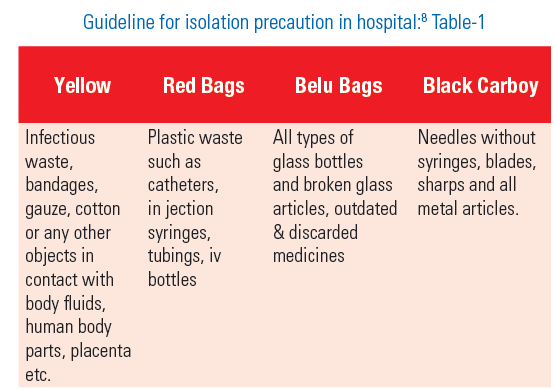
STANDARD PRECAUTIONS: 8,9
Assume that every person is potentially infected or colonized with an organism that could be transmitted in the healthcare setting and apply the following infection control practices during the delivery of health care.
- Hand washing - Wash hands after touching blood, body fluids, secretions, excretio and contaminated items, whether or not gloves are worn. It is advisable to wash hands immediately after gloves are removed or in between patient contacts, and when otherwise indicated to avoid transfer of microorganisms to other patients or environments. It may be necessary to wash hands between tasks and procedures on the same patient to prevent cross- contamination of different body fluids.
- Gloves -Wear gloves when touching blood, body fluids, secretions, excretions, and contaminated items. Put on clean gloves just before touching mucous membranes and non-intact skin. Change gloves between tasks and procedures on the same patient after contact with material that may contain a high concentration of microorganisms. Remove gloves promptly after use, before touching non-contaminated items and environmental surfaces, and before going to another patient.
- Mask, Eye Protection, Face Shield – Wear a mask and eye protection or a face shield to protect mucous membranes of the eyes, nose, and mouth during procedures and patient-care activities that are likely to generate splashes or sprays of blood, body fluids, secretions, and excretions.
- Gown- Isolation gowns are used as specified by Standard and Transmission-Based Precautions, to protect the arms and exposed body areas and prevent contamination of clothing with blood, body fluids, and other potentially infectious material.
- Patient-Care Equipment- Handle used patient-care equipment soiled with blood, body fluids, secretions, and excretions in a manner that prevents skin and mucous membrane exposures, contamination of clothing, and transfer of microorganisms to other patients and environments. Ensure that reusable equipment is not used for the care of another patient until it has been cleaned and reprocessed appropriately.
- Environmental Control - Ensure that the hospital has adequate procedures for the routine care, cleaning, and disinfection of environmental surfaces, beds, bedrails bedside equipment, and other frequently touched surfaces, and ensure that these procedures are being followed.
- Textiles and laundry- Handle used textiles and fabrics with minimum agitation to avoid contamination of air, surfaces and persons.
- Occupational Health and Bloodborne Pathogens- Use aseptic technique to avoid
contamination of sterile injection equipment, do not administer medications from a syringe to multiple patients, even if the needle or cannula on the syringe is changed. Needles, cannulae and syringes are sterile, single-use items; they should not be reused for another patient nor to access a medication or solution that might be used for a subsequent patient, use fluid infusion and administration sets (i.e., intravenous bags, tubing and connectors) for one patient only and dispose appropriately after use. Consider a syringe or needle/cannula contaminated once it has been used to enter or connect to a patient’s intravenous infusion bag or administration set, use single-dose vials for parenteral medications whenever possible, do not administer medications from single-dose vials or ampules to multiple patients or combine leftover contents for later use, if multidose vials must be used, both the needle or cannula and syringe used to access the multidose vial must be sterile, do not keep multidose vials in the immediate patient treatment area and store in accordance with the manufacturer’s recommendations; discard if sterility is compromised or questionable, do not use bags or bottles of intravenous solution as a common source of supply for multiple patients.
- Patient Placement- Place a patient who contaminates the environment or who does not assist in maintaining appropriate hygiene or environmental control in a private room. If a private room is not available, consult with infection control professionals regarding patient placement or other alternatives.
- AIRBORN PRECAUTION:8,9 In addition to Standard Precautions, use Airborne Precautions, or the equivalent, for patients known or suspected to be infected with microorganisms transmitted by airborne droplet nuclei (small-particle residue [5 pm or smaller in size] of evaporated droplets containing microorganisms that remain suspended in the air and that can be dispersed widely by air currents with-in a room or over a long distance).
- DROPLET PRECAUTIONS:8,9 In addition to Standard Precautions, use Droplet Precautions, or the equivalent, for a patient known or suspected to be infected with microor-ganisms transmitted by droplets (large-particle droplets [larger than 5 pm in size] that can be generated by the patient during coughing, sneezing, talking, or the performance of procedures).
One estimate shows that some 5.2 million people (including 4 million children) die each year from waste-related diseases. Globally, the amount of municipal waste generated was double by the year 2000 and may quadruple by year 2025. Concerned with this situation Agenda 21, adopted in the United Nations Conference on Environment and Development (UNCED) in Rio de Janerio in June, 1992, set the following goals and targets with regard to waste management in cities:10
- All countries must establish waste treatment and disposal criteria and develop the ability to monitor the environmental impact of waste by the year 2000.
- By 2025, developing countries should ensure that at least half of the sewage, wastewater and solid waste are disposed according to national and international guidelines.
- By 2025, all countries shall dispose of all waste according to international quality guidelines.
METHODS FOR BIOMEDICAL WASTE MANAGEMENT:
The environmental regulations actually mandate the treatment of infectious medical waste on a daily basis if it is stored at room temperature. A number of treatment methods are available. The final choice of suitable treatment method is made carefully, on the basis of various factors, many of which depend on local conditions including the amount and composition of waste generated, available space, regulatory approval, public acceptance, cost.
- Incineration Technology: EPA’s (U.S. Environmental Protection Agency) research data and industry’s operating experience indicate that incineration is currently one of the best available technologies for disposing of various waste streams. The major advantage of incineration is that it significantly reduces the volume of material, can destroy pathogens and hazardous organics, and renders the waste unrecognizable, and in the form of ash. The disadvantage is that incineration may emit trace amounts of unwanted pollutants such as the polychlorinated dioxins and furans and metal particulates if incinerators are not well designed and operated. Incinerators designed especially for treatment of biomedical waste should operate at temperatures between 900 and 1200°C.11
- Non-Incineration Technology: Non-incineration treatment includes four basic processes: thermal, chemical, irradiative, and biological. The majority of non-incineration technologies employ the thermal and chemical processes. The main purpose of the treatment technology is to decontaminate waste by destroying pathogens. Facilities should make certain that the technology could meet state criteria for disinfection.
- Autoclaving: Autoclaving is an efficient wet thermal disinfection process. They allow for the treatment of highly infectious waste, such as microbial cultures or sharps. Research has shown that effective inactivation of all vegetative microorganisms and most bacterial spores in a small amount of waste (5-8 kg) require a 60- minute cycle at 121°C and 100kPa: this allows for full steam penetration of the waste material. About 99.9999% inactivation of microorganisms is achievable with autoclave sterilization.12 Thus, autoclaving of polyvinyl chloride (PVC) blood bags is a safer and reliable method compared to chemical disinfection.
- Microwave Irradiation: Most microorganisms are destroyed by the action of microwaves of a frequency of about 2450 MHz and a wavelength of 12.24 cm.. In the USA, a routine bacteriological test using Bacillus subtilis is recommended to demonstrate a 99.99% reduction of viable spores.13
- Plasma Pyrolysis: Plasma pyrolysis is a state-of-the-art technology for safe disposal of medical waste. It is an environment-friendly technology, which converts organic waste into commercially useful byproducts. Medical waste is pyrolysed into CO, H2, and hydrocarbons when it comes in contact with the plasma-arc. Inaba and Iwao, in the year 2000 reported that plasma treatment is being developed and routinely tested for incinerator ash, low level radioactive wastes, industrial and biomedical wastes which is mainly generated by industrial companies and municipalities world wide.14
- Chemical Methods: Chemical disinfection is most suitable for treating liquid waste such as blood, urine, stools, or hospital sewage. Barek et al.199815 have tested three chemical methods viz. oxidation with sodium hypochlorite (NaClO, 5%) hydrogen peroxide (H2O2, 30%), and Fenton reagent (FeCl2.2H2O; 0.3 g in 10 ml H2O2, 30%), for the degradation of four anticancer drugs: amsacrine, azathioprine, asparaginase and thiotepa. The efficiency of the degradation was monitored by high-performance liquid chromatography. In all cases where a high degree of degradation was achieved, the residues obtained were non mutagenic.

CONCLUSION
Medical wastes pose a significant impact on health and the environment. Medical wastes should be classified according to their source, type and risk factors associated with their handling, storage and ultimate disposal. The segregation of waste at source is the key step and reduction, reuse and recycling should be considered in proper perspectives. A group of infection prevention practices that apply to all patients, regardless of suspected or confirmed diagnosis or presumed infection status. Standard Precautions is a combination and expansion of Universal Precautions and Body Substance Isolation . From the results obtained, it is clear that: there is a need to establish a clear written biomedical waste management procedure which includes necessary rules, regulations and instructions on different aspect of collection and disposal of waste to authorized disposal site. Hazardous waste should be incorporated in all the hospital policy; health education for all hospital personnel in the form of multi language seminars, pamphlets on waste hazards.
REFERENCES
- Bent S, Shojania KG, Saint S. The use of systematic reviews and meta analyses in infection control and hospital epidemiology. Am J Infect Control. 32(4):246-54, 2004.
- Walker,A. Waste Disposal, Fresh look at a Rotting Problem.BMJ,1391pp.1991.
- Garner JS. Guideline for isolation precautions in hospitals. The Hospital Infection Control Practices Advisory Committee. Infect Control Hosp Epidemiol.17(1):53-80(s),1996.
- Chih-Shan L, Fu-Tien J. Physical and chemical composition of hospital waste. Infection control and hospital epidemiology. 14(3):145-150,1993.
- Garner JS. The CDC Hospital Infection Control Practices Advisory Committee. AmJ Infect Control. 21:160-162,1993.
- Garner JS. Comments on CDC guideline for isolation precautions in hospitals. Am J Infect Control. 12:163-164,1984.
- Gerberding JL. Hospital-onset infections: a patient safety issue. Ann Intern Med. 137(8):665-70,2002.
- Rutala WA, Weber DJ. Disinfection and sterilization in health care facilities: what clinicians need to know. Clin Infect Dis. 39(5):702-9,2004.
- Merritt K, Hitchins VM, Brown SA. Safety and cleaning of medical materials and devices. J Biomed Mater Res. 53(2):131-6,2000.
- Akter, N., N. M. Kazi, A. M. R. Chowdhury. Environmental Investigation of Medical Waste Management System in Bangldesh With Special Reference to Dhaka City. BRAC, Research and Evaluation Division, 75 Mohakhali, Dhaka 1212, Bangladesh,1991.
- EPA guide for infectious waste management. EPA Office of Solid Waste, EPA/530- SW-86-014, NTIS/PB 86-199130, May 1986.
- Lee, B.-K., Ellenbecker, M.J., Moure-Ersaso, R., Alternatives for treatment and Disposal cost reduction of regulated medical wastes. Waste Management. 24:143- 151,2004.
- Hoffman, P.N., Hanley, M.J., Assessment of a microwave-based clinical wast
- decontamination unit. Journal of Applied Bacteriology. 77:607-612,1994.
- Inaba, T., Iwao,T., Treatment of waste by dc arc discharge plasmas. IEEE Transactions on Dielectrics and Electrical Insulation. 7:684-692, 2000.
- Barek, J., Cvaka, J., Zima, J., Meo, M.D., Laget, M., Michelon, J., Castegnaro, M.,
- Chemical degradation of wastes of antineoplastic agents amsacrine, azathioprine, asparaginase and thiotepa. The Annals of Occupational Hygiene. 42:259-266,1998.
Disclaimer from Guident
The views and opinions expressed in articles published in Guident are solely those of the authors and do not necessarily reflect the views of the editors, the editorial board or the publisher, Ivory India. Guident does not endorse any product, technique or treatment described. Clinical content is intended for qualified dental and medical professionals and is not a substitute for individual clinical judgement. Guident, its editors and the publisher accept no liability for any consequence arising from the use of information published in the journal.
How to cite this article
Dr. Sameer Ahmed, Dr. Sweta Soni, Dr. Arun Gupta. "Bio Medical Waste -a Significant Issue". Guident. 2013 Feb;6(4). Available from: https://guident.in/articles/general/bio-medical-waste-a-significant-issue.html