Natal Tooth: A Case Report and Review
Dental Clinic Shushrut Hospital Lucknow, India
Abstract
Natal teeth are defined as teeth that are present in the mouth at the time of birth. It must be considered that natal and neonatal teeth are conditions of fundamental importance not only for a dental surgeon but also for a pediatrician, since their presence may lead to numerous complications. Hence the purpose of the present paper is to review and discuss its clinical features, complications and management.
Keywords : Natal teeth, neonatal tooth, congenital teeth, foetal teeth,
pre-deciduous teeth, premature teeth, dentitia praecox
INTRODUCTION
Child development from conception through the first year of life is marked by many changes. Tooth eruption at about 6 months of age is a milestone both in terms of functional and psychological changes in the child’s life and in emotional terms for the parents. The expectations about the eruption of the first teeth are great and even greater when the teeth appear early in the oral cavity.
When teeth are observed at birth or during the first month of life, it evokes interest, curiosity and concern to the parents. To complicate matters further, there are various difficulties, like pain on suckling, refusal to feed, faced by the mother and the child due to the natal tooth or teeth.
Teeth present at the time of birth are called Natal teeth. Teeth which erupt in the neonatal period that is, within thirty days of birth are Neonatal teeth. Teeth erupting beyond the natal period of thirty days (i.e. erupting within 1-3.5 months) are usually referred to as early infancy teeth.1 The presence of teeth in newborns is uncommon, varying from 1:6000 to 1:800 cases.2 Terms such as congenital teeth, foetal teeth, pre-deciduous teeth, premature teeth, precociously erupted teeth or dentitia praecox have been used to refer this condition.3
The exact etiology is unknown, it is thought be due to infection, febrile states, trauma, malnutrition, superficial portion of the tooth germ, hormonal stimulation and maternal exposure to environmental toxins.2-4 Natal teeth and neonatal teeth are frequently found associated with developmental abnormalities and recognized syndromes. These syndromes include Ellis-van Creveld (chondroectodermal dysplasia), pachyonychia congenita (Jadassohn-Lewandowsky), Hallerman-Streiff (occulo-mandibulo dyscephaly with hypotrichosis), Rubinstein-Taybi, steatocystoma multiplex, Pierre-Robin, cyclopia, Pallister-Hall, short rib-polydactyly type II, Wiedeman-Rautenstrauch (neonatal progeria), cleft lip and palate, Pfeiffer, ectodermal dysplasia, craniofacial dysostosis, multiple steacystoma, Sotos, adrenogenital, epidermolysis bullosa simplex including van der Woude and Walker- Warburgsyndrome .4,5
THE CASE
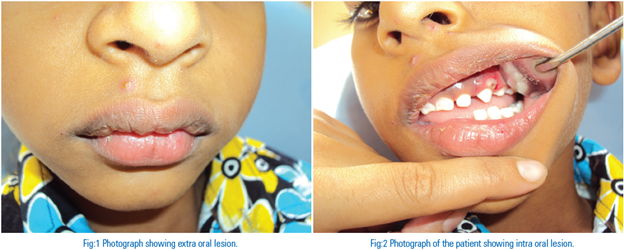
A 12 day-old male infant was referred to the Dental Clinic in Shushrut Hospital with complaint of a tooth in the lower jaw since birth, mother complaining of pain on suckling, and refusal to suck milk. Oral examination revealed one crown of the tooth in the mandibular anterior region [Fig 1], whitish opaque in color and exhibiting grade II mobility. The crown size was small; the gingiva was of normal appearance. A diagnosis of natal tooth was made and was extracted under topical anesthesia. The extracted teeth had a crown but weredevoid of roots [Fig 2]. The patient was reevaluated after two days and the recovery was uneventful.

DISCUSSION
It has been observed that, natal and neonatal teeth erupt 85% in mandibular incisor region, 11% in maxillary incisor region, 3% in mandibular canine region and 1% in maxillary canine and molar region.5 Spouge and Feasby (1966) have suggested that clinically, natal and neonatal teeth are further classified according to their degree of maturity:-6
1. A mature natal or neonatal tooth is one which is nearly or fully developed and has relatively good prognosis for maintenance.
2. The term immature natal or neonatal tooth, on the other hand, refers to a tooth with incomplete or substandard structure; it has a poor prognosis The appearance of each natal tooth into the oral cavity can be classified into four categories as the teeth emerge into the oralcavity :6
1. Shell-shaped crown poorly fixed to the alveolus by gingival tissue and absence of a root.
2. Solid crown poorly fixed to the alveolus by gingival tissue and little or no root.
3. Eruption of the incisal margin of the crown through the gingival tissues.
4. Edema of gingival tissue with an unerupted but palpable tooth.
The most acceptable theory of presence of natal teeth is based upon the result of a superficial localization of the dental follicles, probably related to a hereditary factor.2, 4 But it is necessary to investigatethe possible local or systemic factors that could be related to the eruption of natal teeth, their association with other pathologies,and the basis of differential diagnosis, in order to promote a better oral condition.
It is also important to consider that natal teeth are not the onlyoral alteration that can be observed in neonates, remembering otherlesions such as cysts and developmental disturbances. A complete oral examination is recommended in newborns, in order to establish the differential diagnosis .2, 4, 7
Clinically, the natal teeth are small or of normal size, conical or of normal shape. They may reveal an immature appearance with enamel hypoplasia and small root formation. Natal teeth may exhibit a brown yellowish or whitish opaque color. They are attached to a pad of soft tissue above the alveolar ridge. The dimensions of the crown of these teeth are smaller than those of the primary teeth under normal conditions .6
Complications related to natal and neonatal teeth include discomfort during suckling, irritation and trauma to infants’ tongue, sublingual ulceration (Riga-Fede disease) laceration of the mother’s breast and risk of aspiration of the mobile teeth. 6,7 Prolonged gingival irritation from natal or neonatal teeth may cause localized inflammation of the gingiva or fibrous hyperplasia.1, 8
Cysts of the dental lamina and Bohn’s nodules could be confused with neonatal teeth. Another condition which should be considered is epulis, which are tumor like growths of the gingiva, and are reactive rather than neoplastic lesions. Other differential diagnosis includes lymphangioma.1, 4, and 8
Natal tooth with mobility of >1 mm of are indicated for extraction.9 The possibility of aspirating or ingesting natal teeth is reported to be a reason for extraction of mobile teeth. Extraction may also be needed to alleviate feeding difficulties or complications like Riga Fede disease. Extraction may also be done if child’s age is 10 days or above and child has appropriate amounts of Vitamin K in the blood The waiting period before performing extraction is to allow the commensal flora of the intestine to become established to produce vitamin K which is essential for production of prothrombin in liver. Therefore it is safer to wait until a child is 10 days old before extracting the tooth.
Otherwise prophylactic administration of vitamin K (0.5-1.0mg, i.m.) after discussing with the pediatricians advocated before and after extraction1.4, 9, 10
Teeth that are stable beyond four months have a good prognosis.2In some cases to prevent the injury to maternal breast; grinding or smoothening of the incisal edges of the teeth is also recommended.6
CONCLUSION
Natal and neonatal teeth do not appear frequently, proper evaluation and diagnosis are necessary for the best treatment option. Paediatricians are, usually, the first who find these teeth and early consultation with dentist can prevent complications. When teeth are supernumerary, they should be extracted.Alternatives such as smoothing the incisal edge are also recommended. Periodic follow-up by dentists are of fundamental importance, as are recommendations to the parents with respect to home dental hygiene.
REFERENCES
1. Alexander K.C. Leung, William Lane M. Robson. Natal Teeth: A Review. J Natl Med Assoc 2006;98(2):226-8.
Disclaimer from Guident
The views and opinions expressed in articles published in Guident are solely those of the authors and do not necessarily reflect the views of the editors, the editorial board or the publisher, Ivory India. Guident does not endorse any product, technique or treatment described. Clinical content is intended for qualified dental and medical professionals and is not a substitute for individual clinical judgement. Guident, its editors and the publisher accept no liability for any consequence arising from the use of information published in the journal.
How to cite this article
Dr. Dipti Singh, Dr. Sudhanshu Agrawal. Natal Tooth: A Case Report and Review. Guident. 2013 Jan;6(3). Available from: https://guident.in/articles/oral-medicine/natal-tooth-a-case-report-and-review.html