Non-Surgical Treatment of Temporomandibular Joint Disorders
Department of Oral Medicine and Radiology D.J College of Dental Sciences, Modinagar, India
Abstract
Temporomandibular joint pain disorders can be slated as one of the most troublesome problem leading distress of the patient thus forcing him to seek the professional treatment. There are many treatment modalities for temporomandibular disorders (TMD), most of which are effective in controlling symptoms, at least in the short term. The non-surgical treatment of temporo- mandibular disorders continues to be the most effective way of managing over 80 per cent of patients who present with symptoms of temporo- mandibular pain and dysfunction. In this, article, a general overview of the current non-surgical treatment strategies for TMD will be presented.
Keywords: Temporomandibular disorders, non-surgical, conservative, treatment
INTRODUCTION
Temporomandibular joint (TMJ) may be affected by inflammatory, traumatic, infectious, congenital, developmental and neoplastic diseases, as seen in other joints. However, the most common burden of the TMJ and masticatory apparatus is a group of functional disorders with associated pain and was previously known as the TMJ pain dysfunction syndrome.1 Temporomandibular disorders are recognized as the most common chronic Orofacial condition confronting oral physician and other health care providers. Signs and symptoms of temporomandibular disorders (TMD) were ï¬rst recognised by Costen in 1934 and since then a plethora of terms have been used, somewhat interchangeably, to describe TMD. These include Costen’s syndrome, temporomandibular joint dysfunctionsyndrome, pain dysfunction syndrome and facial arthromyalgia.2 According to American Association of Orofacial Pain (AAOP) temporomandibular disorder are defined as:
A collective term embracing a number of clinical problems that involve the masticatory musculature, the temporomandibular joint and associated structures, or both.3

MANAGEMENT OF TMD
Most authors recommend a multidisciplinary approach for the treatment of TMDs. Although some patients can be adequately managed utilizing single treatment approach, many are best managed by a group of health care professionals. Because of the multi-factorial nature of the TMDs, the treatment for any given patient will vary as to the diagnosis and the particular blend of contributing factors.
The goals for management of all patients with TMDs include: reduce pain; restore normal jaw functions; reduce the need for future health care and restore normal lifestyle functioning. These goals are best achieved by a well-defined program designed to treat the physical disorders and reduce the contributing factors.8
All the therapeutic modalities available for TMDs can be broadly classified into:
- Reversible and Non- invasive therapies : includes those techniques that cause no permanent change in maxilla -mandibular relationships or tooth position.
- Non reversible and invasive therapies: includes those techniques that cause permanent change in the dentition or maxilla-mandibular relationships such as – surgery, occlusal adjustment, Orthodontics, prosthetic reconstruction.
A number of Non -invasive and Reversible Therapies are widely used and appear to help many patients. Optimally, these therapiesshould have low morbidity and minimal alteration of underlying anatomic structures. These therapies include:
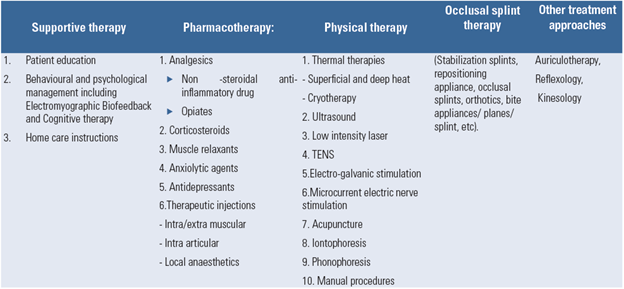
SUPPORTIVE THERAPY
PATIENT EDUCATION:
Initial attention should be given on patienteducation about TMD and the fact that most of these problems follow a benign course. Many experts recommend that patients undergo education directed at eliminating certain behaviors perceived to be harmful, such as clenching and grinding. Rest anddietary modifications may help some patients.9BEHAVIORAL AND PSYCHOLOGICAL MANAGEMENT:
Theliterature indicates that the behavioural and educational modalities most commonly used in the management of TMD collectively referred to as bio-behavioural treatments include electromyographic feed back from masticatory muscles, relaxation, hypnosis, behaviour modification, education, and cognitive behaviour therapy.10,11.As a treatment tool, electromyography has been and is beingused in conjunction with relaxation and biofeedback therapy. The effects of EMG biofeedback appear to reduce muscle output, andunder some conditions, bruxism. It is recommended for some TMDcases involving the muscles of mastication, including chronic nonresponding patients. Nevertheless, the beneficial effects are notlong lasting and a return to pre-treatment EMG levels is usuallyobserved soon after its use ends.12
HOME CARE INSTRUCTIONS / SELF – MANAGEMENT:
Self-care / self-management is a standard treatment for patients with myofascial pain. Studies have shown that 60-90 % of the patients report improvement in their symptoms after using only self-management. Self-management routinely include: restingthe masticatory muscles; becoming aware of and eliminating para-functional habits; applying heat or cold to the most painful masticatory areas and using anti-inflammatory medications.13
PHARMACOTHERAPY
Pharmacological intervention in the management of chronic orofacial pain is usually considered adjunctive to definite treatment on the assumption that more definitive treatments will eventually correct the underlying patho-physiologic process. It is now recognized that many putative dental and surgical therapies for TMDs have not withstood scientific scrutinity, which has led to the use of drugs as the primary intervention for some forms of chronic orofacial pain.14
Analgesics 15
The main objective in the use of analgesics is to reduce pain. Some clinicians consider that pain reduction is of primary importance inthe management of certain masticatory disorders.
Useful analgesics are divided into two main groups: Non-opioids and Opioids.
Non-opioid Analgesics
: The members of this heterogonous group of chemicals are effective in the treatment of pain due to an inflammatory process. The efficacy of these drugs is closely related to their action to inhibit of prostaglandin synthesis. These drugs are not equally effective in cases of acute pain. The most common complications from the use of these substances are related to gastric distress, although modern products claim less distress.15Opioid Analgesics:
15 These are morphine-like substances, the primary therapeutic effects of which are analgesia and sedation. The use of opioids in dentistry for chronic TMDs is seldom indicated.They are used more for acute post-traumatic and postoperative cases. The continuous prescription of opioids for as little as 10 days could lead to a serious addiction. If indicated, the prolonged use of opioids will require careful and constant medical supervisionMore appropriate opioids for TMDs may include opiate preparations like codeine (the most used one), propoxyphene, oxycodone, and meperidine which may be prescribed in combination with antiinflammatory / non-opioid analgesics to potentiate their actions
Corticosteroids:
Adrenal corticosteroids and their synthetic analogues are widely used in medicine for their potent antiinflammatory actions. As these substances increase metabolic reactions, including changes in the organic immunologic responses of the body, systemic administration of these medications for functional disorders of the masticatory system should only be considered with extreme careMuscle relaxants
: Drugs that are thought to reduce skeletal muscle tone are often administered to patients with chronic orofacial pain to help prevent or alleviate the increased muscle activity attributed to some forms of TMDs. Muscle relaxants are thought to decrease muscle tone without impairment in motor function by acting centrally to depress polysynaptic reflexes.14Anxiolytic agen
t: The scientific literature does not provide unequivocal support for either the use of benzodiazepines or their condemnation on the basis of lack of efficacy or potential toxicity. Patients whose pain appears to be of musculoskeletal origin may benefit from a 2 to 4 week course of a benzodiazepine, possibly in combination with an NSAID. In any event, therapy with a benzodiazepine should not be extended beyond a few weeks, because the natural course of myofascial pain combined with conservative therapy will likely to result in a lowering of symptomatology to acceptable levels, which would not justify the risks of pharmacological intervention.14Antidepressants:
Antidepressants have been used for more than 30 years for the management of pain from a wide variety of conditions, including chronic orofacial pain. Their analgesic effects are largely independent of antidepressant activity and are seen at doses lower than those usually effective in depression.14Therapeutic injections:
The use of injection therapy encompasses a wide range of clinical indications. It may be used to deliver various types of medicaments, including anti- inflammatory, and local anaesthetics, to specific sites. In the treatment of TMDs, injection therapy is most notably utilized in the inactivation of myofascial, tendinous, and ligamentous trigger points. In addition, anaesthetic blocking of muscles has been shown to be effective in decreasing muscles spasm. Anaesthetic blocks are used to produce anaesthesia of the TMJ and for manipulation of associated musculature.PHYSICAL THERAPY
The use of physical medicine modalities in the clinical management of orthopedic, musculoskeletal, and neurological disorders has a long and successful history in the field of health care. Because the problems encountered in TMDs are clinically similar to those encountered in orthopaedic, musculoskeletal, and neurological disorders, the successful use of physical medicine has become routine in dentistry.16
As the course of the physical therapy progresses, the physical therapy treatment program should shift from more passive treatments to more active forms of intervention17
The physical therapy interventions can be divided into passive and active categories as follows: passive treatments consisted of: cryotherapy, diathermy, electrical stimulation, ice, iontophoresis, phonophoresis, massage, moist heat myofascial techniques, muscle energy techniques, ultrasound, and mobilization and manipulation. Active treatments consisted of: electromyography/biofeedback, electrical stimulation for strength, orthotic training, craniocervical techniques, joint mobility exercises, and exercise to modulate pain, flexibility exercises, body mechanics training, strengthening exercises, home exercises, postural exercises, functional training, and proprioceptive exercises, etc.17
These physical medicine modalities may be used alone or in combination with other modalities. Use of a combined approach has been found by some authors to result in more rapid symptom relief, decreased treatment time, and overall superior therapeutic outcome.16
Thermal therapies:
Both modalities of cold and heat therapy alleviate pain through a counterirritant effect, acting directly on the peripheral innervations of the masticatory system, especially at the level of free nerve endings. Studies concerning the effects of temperature on muscle spindles have shown that the afferent neurotransmission of group IA-fibers increase with heat and decrease with cold applications. Another important physiologic response is the increase of blood flow in the presence of heat as well as tendency for ischemia in the presence of cold.15One primary advantage in the thermal therapy is that their actions are local to the area of dysfunction; minimizing effects on other parts of the body, as may occur with the use of medications and injections.15
Use of coolant treatment may be useful for reducing muscle spasm and spasticity, for muscle re-education, following acute mechanical trauma, for analgesia, or for myofascial trigger point therapy. Application may be by immersion of the part in ice water, ice or chemical compresses, or an evaporative cooling spray, such as ethyl chloride.
Ultrasound
: It has been used in the management of TMDs since 1950s. The effects are partly thermal; due to an increased tissue temperature caused by absorption of the ultrasound waves, thus increasing the blood flow. There is also a mechanical effect, as sound waves produce pressure changes in the tissues, resulting in ‘micromassage’, which is said to increase flexibility of collagen fibers and the breakdown of fibrous tissue. An increase in cellular permeability is also seen.Phonophoresis
: It is the property of ultrasound, which allows it to carry material present between the transducers and the tissue interface into the underlying tissue being treated. Because of this, ultrasound has been utilized to propel various medicaments, including anti-inflammatory agents, into underlying tissues for the reduction of inflammation.12Low intensity laser:
The biophysical properties of laser are poorly understood, but it causes a non- thermal response in the tissues with a temperature rise of less than 10C and 95 % of the radiation is absorbed within the first 3-4 mm of tissue. Laser therapy has an analgesic and anti-inflammatory action and improves capillary permeability, thereby reducing inflammation.18Electro-galvanic stimulation:
High voltage electrical stimulation utilizes a mono-phasic twin spike wave of short pulse duration, high peak voltage, and high peak current and low average current. These characteristics provide patient comfort and safety in application. In contrast to low voltage direct current devices, thermal and galvanic effects are minimized.Transcutaneous electrical nerve stimulation:
uses a lowvoltage electrical current that is designed for sensory counterstimulation in painful disorders. It is used to decrease muscle pain and hyper- activity and may also be useful in neuromuscular reeducation.Microcurrent electric nerve stimulation:
Microcurrent electric nerve stimulation is a modality, which delivers small amount of electricity to injured, inflamed and painful tissues. The levels of electricity used with M.E.N.S. are the same as the body’s natural electricity. M.E.N.S. has unique physiologic effects on the body, which help speed recovery from injury.Acupuncture:
It is one of the methods of reducing pain, which has been used since ancient times. The mechanism by which acupuncture relieves pain is believed to be due to an increase in endorphins and other central non-opioid effects. Patients with myofascial pain often require several acupuncture treatments to achieve an effective outcome.13Iontophoresis
: It is an electrotherapeutic modality thatadministers high concentrations of prescribed pharmacological agent noninvasively into a specific area. The action involves the transfer of medication from an electrode, across the skin, deep into underlying tissues. This technique prevents significant amount of the medication from entering the blood stream. Iontophoresis is useful in the treatment of local muscle dysfunction, joint inflammation and in conjunction with joint adhesion release procedureManual procedures:
Manipulative therapy is an adjunctive therapy that may be used alone or in combination with other therapeutic modalities that are used in the treatment of TMD. Manual therapy is typically used to improve function between articulating surfaces of the joints, eliminate soft tissue contracture, restore resting length of muscles, or improve the function of joints and soft tissue. Commonly used approaches include massage, manual mobilization, and “spray and stretch.16Therapeutic exercises:
The value of exercise therapy is to maintain or increase mobility of soft tissues, muscles, and joints. Passive and active stretching movements are important in maintaining full range of motion. Regular exercise therapy is essential to prevent tightness and restriction of motion, particularly after trauma, surgery or a period of immobilization. Carefully controlled mobility may be performed even in the acute stages of inflammation. If there are no exercises during the early phases of the injury and inflammation, fibrotic contractures occur quickly and may be irreversible. Thus, the functions of therapeutic exercises are to: 1) stretch the muscles to maintain the muscular mobility; 2) strengthen muscles and mobilize stiff joints; 3) condition specific muscles to re-establish neuromuscular coordination.19OCCLUSAL SPLINT THERAPY
Intraoral appliance therapy is employed for a variety of purposes. These may include the orthopaedic repositioning of the mandible to a predetermined treatment position, the neuromuscular positioning of the mandible to a determined neuromuscular position and the alteration of oral proprioception. The appliances may be fabricated for wear on either maxillary or mandibular teeth, worn only at night or up to a 24 hr. a day basis depending on specific patient conditions. The goals of such appliances are usually to unload, decompress or reposition the condyle /fossa relationship.
OTHER TREATMENT APPROACHES
Auriculotherpy:
It is the application of electrical impulses of specific amperage and frequency to a precise auricular locus. Stimulation of an auricular point produces analgesia or causes somatic changes to occur in the corresponding parts of the body. Controlled scientific studies have indicated that endorphins and adrenocorticotrophic hormone (ACTH) are released during the therapy.19Reflexology:
It is same as auriculotherapy, but the treatment points are to be found on the feet.19Kinesiology:
This method is a clinical extension of a neuromuscular physiology, which is concerned with proprioceptors and their effects on normal muscle function and general body strength. It has been used widely in the treatment of TMJ as well as other disorders and is based on the premise that aberrant functioning of the muscle spindles or Golgi tendon organs may be responsible, in part for macroscopic muscular problems.19CONCLUSION
Considering what is presently known about TMD, successful management should reflect three basic principles. Firstly, the initial line of treatment for patients with TMD should always involve simple, reversible, nonsurgical modalities, with progression to the more complex, irreversible treatment options only as dictated by the course of the disease in each case. Secondly, treatment strategies should always be tailored to suit the special needs of each patient, as no one treatment is effective in all patients. And finally, the management of TMD is best undertaken in a multidisciplinary environment involving numerous personnel including dentists, psychologists, physiotherapists, surgeons, neurologists, social workers, psychiatrists, prosthodontists, and so on, who have a special interest in facial pain and TMD.
Disclaimer from Guident
The views and opinions expressed in articles published in Guident are solely those of the authors and do not necessarily reflect the views of the editors, the editorial board or the publisher, Ivory India. Guident does not endorse any product, technique or treatment described. Clinical content is intended for qualified dental and medical professionals and is not a substitute for individual clinical judgement. Guident, its editors and the publisher accept no liability for any consequence arising from the use of information published in the journal.
How to cite this article
Dr. Trisha Rastogi. Non-Surgical Treatment of Temporomandibular Joint Disorders. Guident. 2013 May;6(7). Available from: https://guident.in/articles/oral-medicine/non-surgical-treatment-of-temporomandibular-joint-disorders.html