Simple Orthodontics for the GDP
Past President of the BACD shows how the combination of pre- alignment with simple orthodontic techniques and ceramic technology have created a paradigm shift in the way cosmetic dentistry can be carried out.
INTRODUCTION
This article will highlight Simple Orthodontics can offer any GDP and their practices an exciting simple, safe and effective treatment option for their patients.
A NEW ERA FOR NON-INVASIVE AESTHETIC DENTISTRY
For quite a few years cosmetic dentistry has been seen as aggressive, unnecessary, expensive and risky. This was primarily because certain teachers of the discipline seemed obsessed with the placement of porcelain veneers.
Training programmes were set up to teach dentists to understand the concept of smile design, how market smile makeovers, how to provide cosmetic imaging, how to cut veneers, place and contour temporaries and to then bond the veneers in place.
While some very practical skills can be gained from these programmes- especially those that tied occlusal principles in to the education and those that taught photography, a deep fundamental issue always exists that has divided dentists around the world.
Do these people really need veneers?- Even as the President Elect of the BACD I think this is a valid question. And more so I would ask–
How are we ascertaining what patients actually want ?
Traditionally in many practices where cosmetic dentistry is offered, computer-imaging software is used to give patients a visual preview of how their teeth can look. Much of the time, this is done by drawing on four to twelve veneers onto their smile to show them the improvement. While this can really give the patient an idea of what their teeth can look like, there is also an argument that says that imaging “ implants “an image of a patients smile that perhaps makes them think that is the ideal end result- if this means placing 8-10 veneers, even if they can be done with no- prep veneers, one has to ask is this right?
The problem in the past was that many patients had been put off by traditional orthodontics. Patients had the perception that orthodontics takes too long, involves fixed braces and is very expensive. Also many patients just wanted their anterior teeth treated and commonly complained they were only offered full mouth treatment.
Obviously full mouth, class setup orthodontics carried out by a specialist is always the gold standard. But in reality there are not that many people willing to put themselves through it. As a result many patients took a quick fix and had veneers even when their teeth were crooked resulting in aggressive tooth preparations meaning enamel, dentine and sometimes even pulp was sacrificed to allow space to place ceramic.
The potential risks involved put many dentists off from offering aesthetic treatments.
But now, new options exist that mean cosmetic dentistry can be far less risky, can be afforded by far more patients and can be offered in any practice private or not.
SIMPLE ORTHODONTICS
Simple orthodontics has always been available- however rarely was it ever mentioned in any of the worlds leading cosmetic dentistry academies or on any of the teaching programmes.
No real definition exists but it is commonly thought of as minor movement of just one or a few anterior teeth with removable appliances. Once could argue that some fixed orthodontics can be defined as simple also- however many would argue the opposite.
The interesting part of this is that much of the cosmetic dentistry patients were undertaking was simply down to minor alignment issues of their front teeth- indeed the kind of alignment issues that can be treated with simple orthodontics.
Old type spring aligners could be useful but they tended to have limited use because of the inherent problems of using stainless steel springs and components.
Namely
- Stainless steel wires do not have much flex or spring significantly affecting how much correction can be accomplished
- Stainless steel exerts and abrupt and uncomfortable force
- The direction of the force has a mousetrap affect that creates seating and retention problems.
More recently the Inman Aligner has offered GDPs a far more predictable and effective option that traditional spring aligners. The Inman Aligner is a development of the spring aligner, but it takes the idea much further by employing Nickel Titanium coil springs, which provide a gentle, steady and consistent force. It also uses two active components that drive in an opposite direction to create some actual anterior- posterior bodily movement of teeth as well as rotation, tipping and retraction.
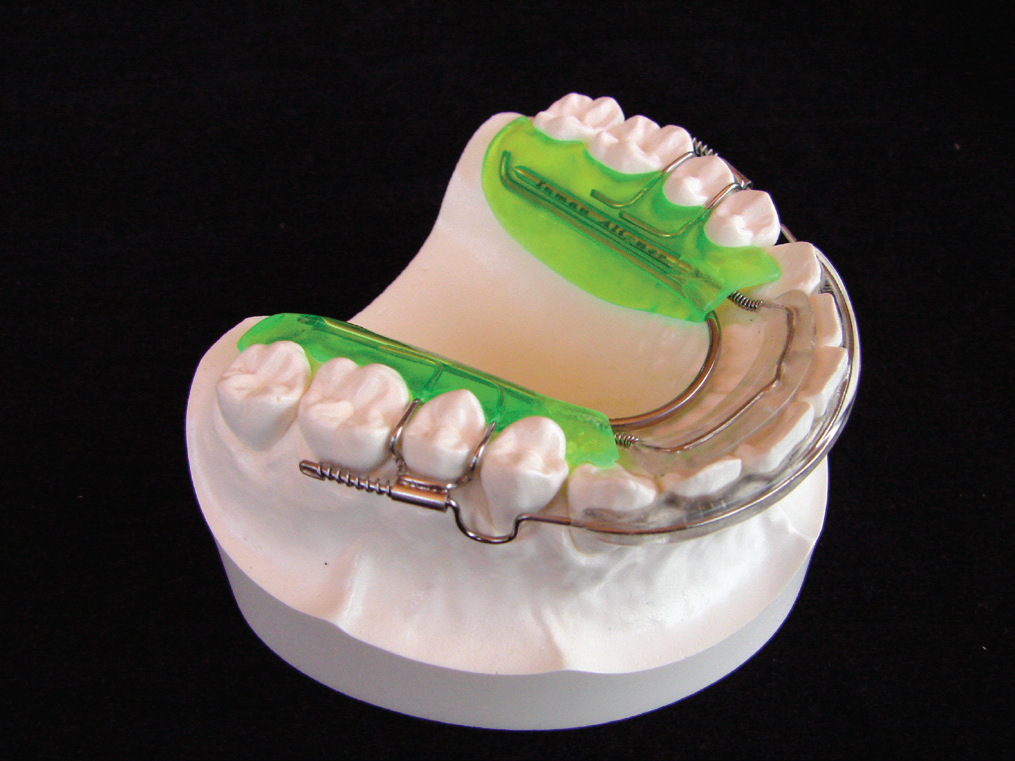
Figure 1- the Inman Aligner
The consistent Ni-ti driven forces mean that simple treatments can occur very rapidly, especially where only tipping, and rotation movements are required.
Because the Inman Aligner is removable, only needs to be worn from 16-20 hours a day and is relatively cheap, it meant many patients who had anterior mis-alignment issues had another option.
Initially the Inman Aligner was introduced primarily to UK cosmetic dentists and is reported to have had a dramatic effect on the treatments offered according the to BACD audit of 2008. Now many GDPs across the country are starting to see the attraction in offering simple orthodontics through appliances like the Inman Aligner and clear aligner systems produced by Orthodontic labs. This is because of the results that can be achieved and the simplicity and safety of the approach.
The aesthetic results especially when using a combined approach of Alignment, Bleaching and Bonding (ABB) can easily rival that of 10 veneers but can be done with virtually no tooth removal, and in a matter of 10-12 weeks with an Inman Aligner.
This begs the question- why would you want to have your teeth prepped if in 10-12 weeks you could have a completely no- invasive smile makeover done with ABB?
Meaning potentially far more dentists can offer this kind of treatment to far more patients in far more practices.
EDUCATION
Education is essential to get the best out of the Inman Aligner and all forms of Simple orthodontics for several reasons.
- Case selection is imperative- The Inman Aligner and other simple orthodontic techniques have limitations- it is essential that dentists understand the movement potential and restrictions on the type of orthodontics being offered
- Arch Evaluation- It is essential GDPs actually understand the amount of crowding being treated. This is done with variations of Hanchers technique1 which calculate the actual amount of crowding or spacing present to ensure that space creation techniques are accurately employed
- IPR (inter-proximal reduction) is one way space is created and needs teaching. It is very easy to be overly aggressive and create poor contact anatomy especially if large amounts of IPR are carried out in one go without really understanding the amount of crowding. – With Inman Aligner treatment this is done always progressively and taught in an anatomically respectful way. Also with arch evaluation, and strategic stripping, we always try to ensure the right contact points are stripped and never excessively. This is completely safe as long as teeth are smooth correctly and fluoride gel is administered 2,3
- Anchor placement- composite button placement both location and sequencing is essential to ensure the bows are most active. It can make a difference between a case taking 9 weeks and 9 month
- Adjusting the appliances- force variation can assist with finishing.
- Retention-(3) is essential for nearly all forms of orthodontics. Dentists need to know how to fit reliable retainers that can be repaired and replaced at a later date but the simple rule is that retention should be for life.
EXAMPLES
3 potential case types exist
Standalone treatment, Alignment, bleaching and bonding, Pre-alignment before restorative treatment.
CASE 1- STANDALONE TREATMENT
The 25-year-old female patient complained about the appearance of her lower anterior teeth. She gave a history of orthodontic treatment in her teenage years, having a fixed appliance fitted for a period of two years. She had been given a retainer at the time but was told to wear it at night for three months only. She had noticed her lower four incisors starting to become crowded again. Treatment options discussed were invisible braces, conventional fixed brackets or an Inman Aligner. The amount of space required for reduction was calculated as 3.5 mm. Interproximal reduction was performed using diamond strips (Brasseler). A reduction of 0.13 mm at each contact point was achieved at the fitting appointment. This was verified with a thickness gauge. The patient was seenthree weeks later and a further 0.13 mm reduced at each contact point. The teeth were aligned in just over nine weeks. The Aligner was left in for one month to stabilize the tooth positions. Tooth whitening was undertaken for two weeks during the last two weeks of treatment. Simultaneous bleaching is a significant advantage in removable systems and helps patient motivation. Finally, an orthodontic retention wire was bonded in place on the lingual surfaces, ensuring the patient could still use super-floss for hygiene.

Fig 2: Before
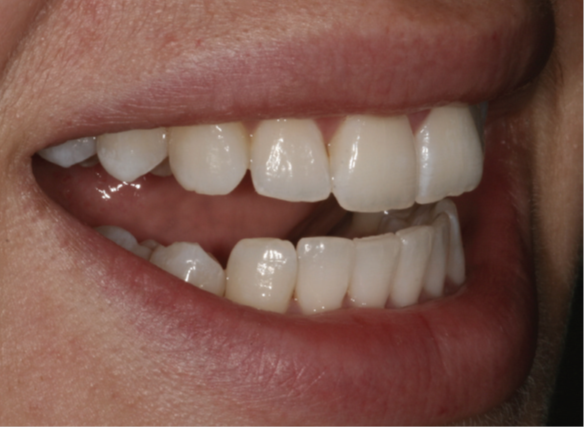
Fig 3: After 9 weeks
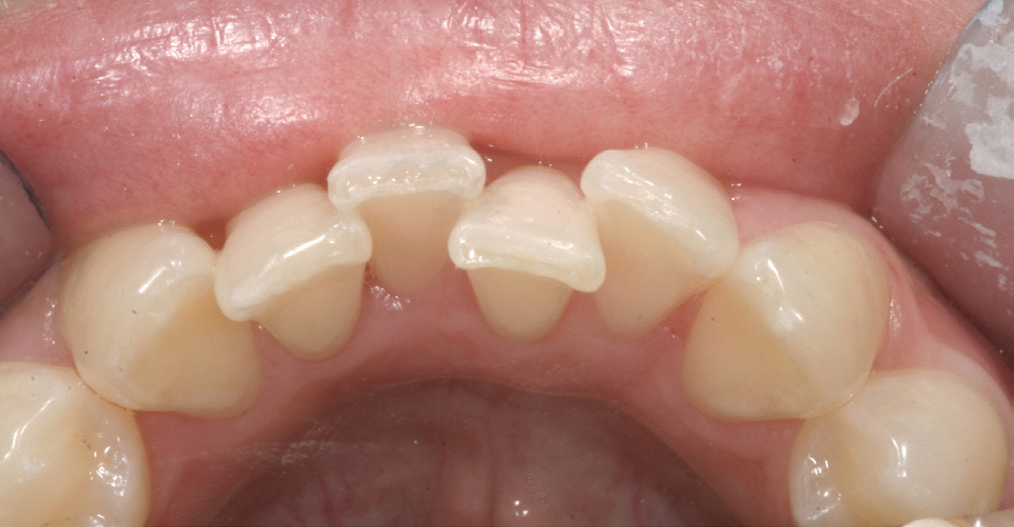
Fig 4: Occlusal before
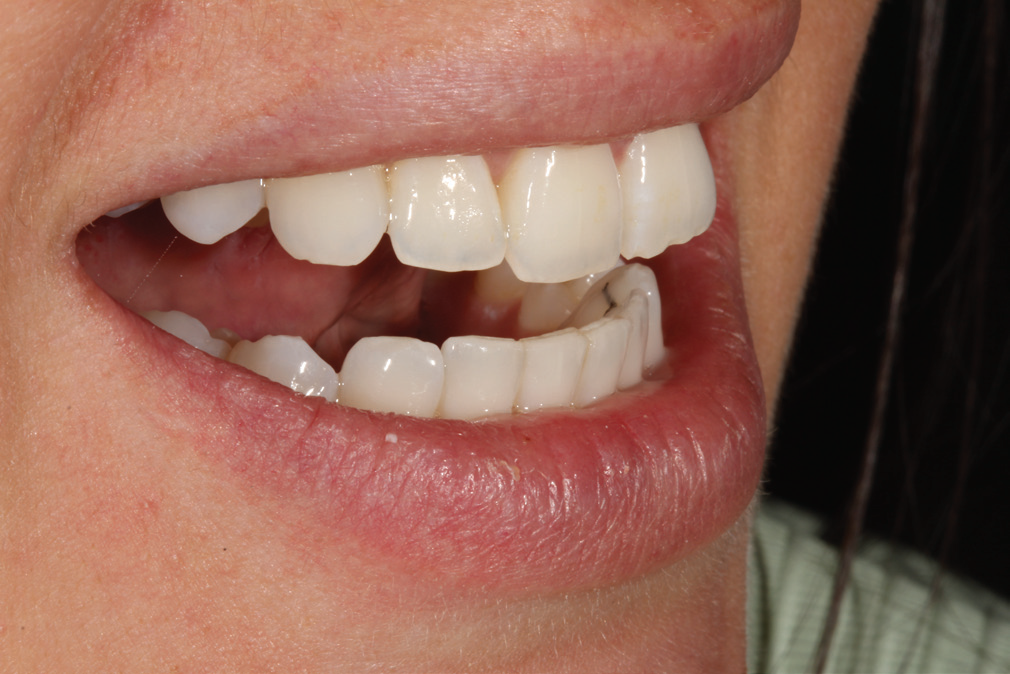
Fig 5: 7 Year follow up
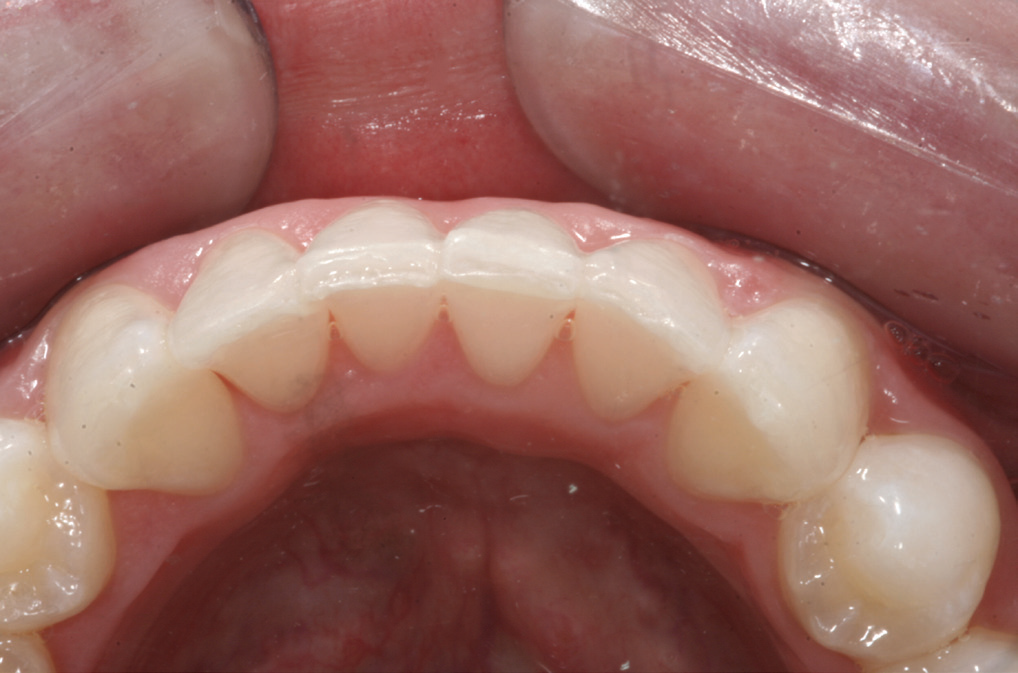
Fig 6: Occlusal after 9 weeks
CASE 2 ALIGNMENT BLEACHING BONDING.
This young lady was concerned about her very prominent central incisors. She wanted to have them straightened and had considered veneers in the past. She had ruled out conventional orthodontics and invisible braces because she wanted a quick treatment and did not want any brackets stuck to her teeth. BACD-style digital photographs were taken and the amount of crowding was calculated using an electronic crowding calculator, The results showed that there was only 1.6 mm crowding It was clear from the photographs that despite the obvious crowding, there was some less obvious irregular tooth wear. It was important to indicate this to the patient, as this would become more evident once the misalignment had been corrected. The patient was quoted for three incisal composite tips. She opted for an Inman Aligner with a combined expander. In this case because of the expander, no inter- proximal reduction was needed. At week six, part way through the Inman Aligner treatment, bleaching was started with soft rubber sealed trays. After nine weeks her teeth were in alignment. Looking at her post-alignment result, the golden proportion, gingival heights and axial-inclinations had improved dramatically, all without a hand-piece being picked up and in the space of nine weeks. What was very clear to the patient at this point was that she only needed some simple bonding to improve the incisal edge outlines. Without the use of an an-aesthetic, the edge outlines were prepared with very slight roughening of the edge, composite was bonded to improve the outline. The edges were then polished.
The patient was thrilled with the result we achieved using an Inman Aligner, simultaneous whitening and some simple bonding. There are still minor imperfections, but, arguably these contribute to her natural beauty. There is a stark contrast between the treatment selected and the potential treatment approaches in this case. Where once a patient, who refused orthodontics, would have consented and received highly aggressive tooth preparations to achieve correct alignment with veneers, now a removable aligner, whitening and some simple bonding were able to achieve a similar and arguably better result in less than three months without any tooth reduction needed.
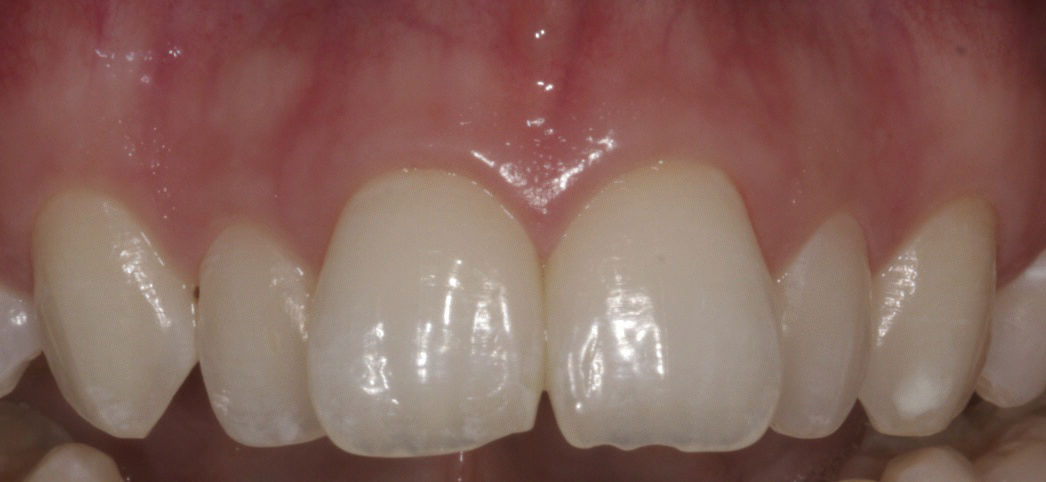
Figures 7:Before
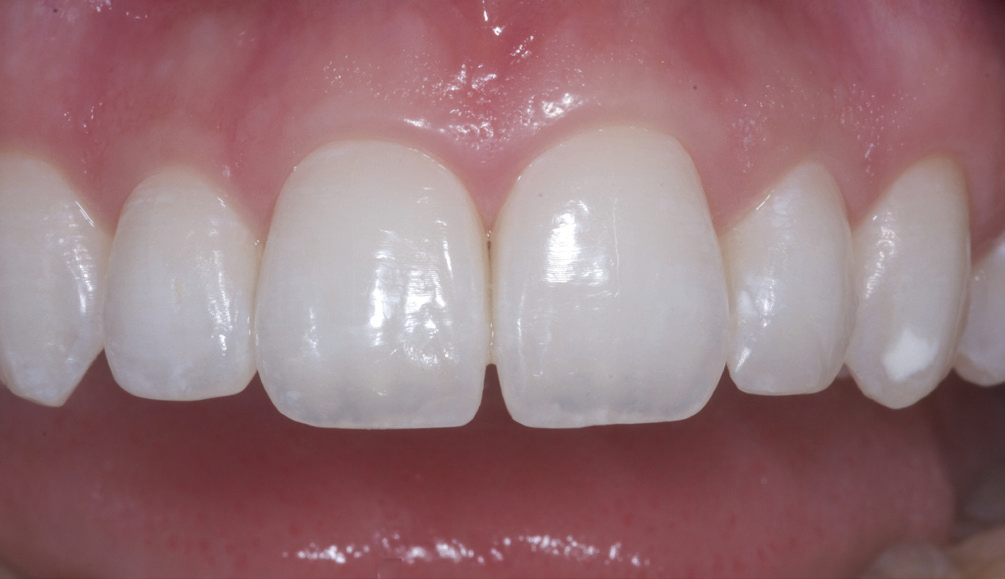
Fig 8: After 9 weeks

Fig 9: Before
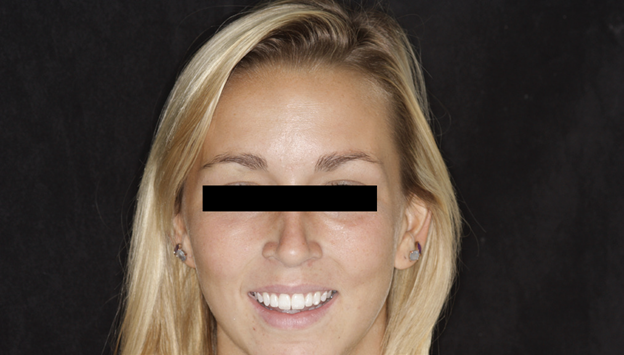
Fig 10: After 10 weeks

Fig 11: After 10 weeks
CASE 3  ALIGNMENT BEFORE RESTORATIVE TREATMENT.
This young lady presented wanting 10 porcelain veneers. On examination several key aesthetic problems existed. Firstly she had a Class 2 div 2 incisal relationship- meaning any attempt to use ceramics would result in aggressive preparations on the laterals, fat central incisors and poor emergence profiles all round. She also had quite dark discoloured teeth and large amounts of old composite especially inter-proximally on the incisors, which were short and badly chipped. This meant some kind of restoration might be needed.
The patient was shown an occlusal view of her teeth and quickly understood that the amount of tooth preparation required in her current position was unacceptable. All orthodontic options were outlined and offered. She chose an Inman Aligner in this case because she wanted something removable and something that wasn’t going to eat into her budget for any remaining treatment.
The Aligner was fitted and worn for 12 weeks. At week 9 whitening was started. It was interesting to see that by week 12 once alignment had finished and the patients teeth were whiter she could appreciate that only 4 teeth would need veneers, not 10. These were prepared minimally now because the teeth were in alignment and temporaries were placed which were left in position for 4 weeks to ensure the patient was happy- The final veneers were made to mimic the temporaries exactly and then fitted. A wire retainer was fitted to the back of the teeth to retain.

Fig 12: Before smile view

Fig 13: After Alignment, bleaching and 4 veneers

Fig 14: Before occlusal
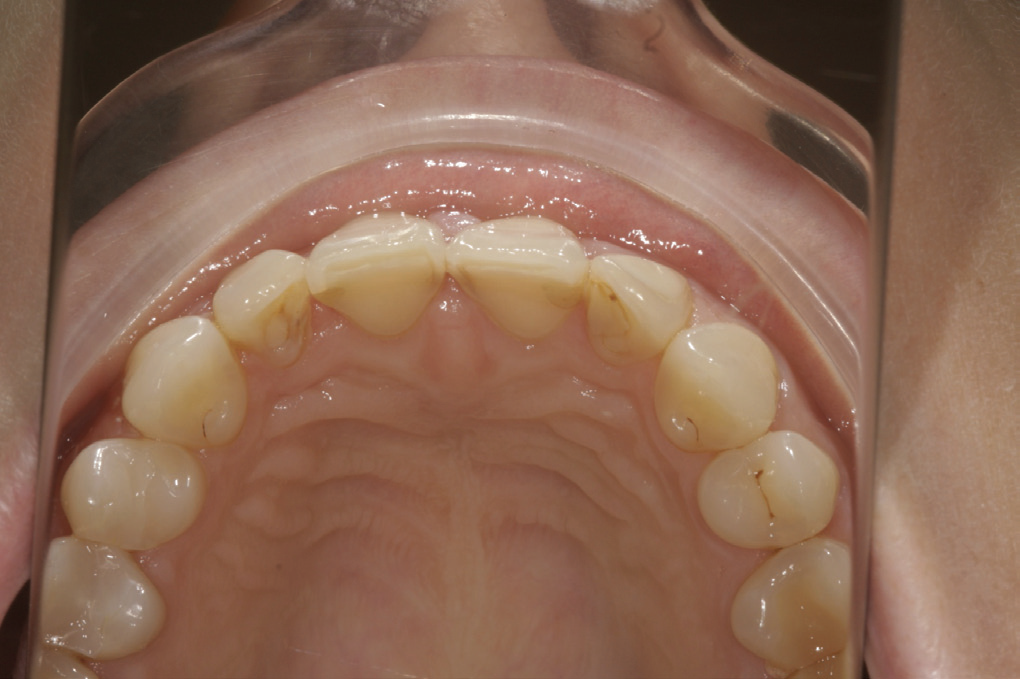
Fig 15: After 12 Weeks

Fig 16: After veneers and retainer
DISCUSSION
Simple Orthodontics can offer many practices a totally new simple and low risk option to offer their patients.
Everybody wants nice straight teeth, but previously barriers such as cost, time, potential tooth destruction, fixed brackets all served to put most people off. Now smile makeovers can be offered with truly minimally and non-invasive outcomes, dentists and patients are exposed to far less risk and can achieve better predictability.
As always, good education is mandatory. It is not simply a case of fitting and appliance and expecting it to work. Correct analysis of space, potential movement, function of appliance and patient compliance are critical to ensure success. Combination with good minimally restorative techniques can add huge aesthetic and functional value.
Disclosure- Dr. Tif Qureshi runs courses on the Inman Aligner and Minimally Invasive Dentistry.-
Dr. Tif Qureshi will be speaking at the BDA Annual Conference in Manchester on Saturday May 8th 2015
REFERENCES
- Hancher P Orthodontics for Esthetic Dentistry Part1. Journal of Cosmetic Dentistry Winter 2005(20) 4
- El-Mangoury N, et al. In vitro remineralization after air-rotor stripping. J Clin Ortho 25 (2):75- 78,1991
- Radlanski R.(1991) Morphology of interdentally stripped enamel one year after treatment. J Clin O4tho 23 (11)748-750, 1991
- Blake M, Bibby K. Retention and relapse: A review of the literature. Am J Orthod Dentofacial Orthop 1998;114:299-306.
Disclaimer from Guident
The views and opinions expressed in articles published in Guident are solely those of the authors and do not necessarily reflect the views of the editors, the editorial board or the publisher, Ivory India. Guident does not endorse any product, technique or treatment described. Clinical content is intended for qualified dental and medical professionals and is not a substitute for individual clinical judgement. Guident, its editors and the publisher accept no liability for any consequence arising from the use of information published in the journal.
How to cite this article
Dr. Tif Qureshi. Simple Orthodontics for the GDP. Guident. 2014 Dec;8(1). Available from: https://guident.in/articles/orthodontics/simple-orthodontics-for-the-gdp.html