Daktari for Maasai - Mobile Dental Care in the Serengeti
Even as early as the 1950s,the Serengeti hadalready gained worldwide attention through the numerous documentary films produced by Professor Bernhard Grzimek. The images from Serengeti darfnicht sterben (Don’t let the Serengeti die)were sopowerful that he was awarded the Oscar for Best Documentary Film in 1960. Grzimek’s film reportingand personal commitment eventually led to greatersensitivity in the handling of Tanzania’s unique natural resources as well as the expansion and protec-tion of Tanzania’s most
important national park: the Serengeti.
Many naturalists consider it the most importantnational park in the world, given how the migrationof wildlife depends on it to ensure their survival. It is the largest active mammalian eco-system, providingliving space for a total of up to six million animals.During their long migration, millions of animals con-tinuously traverse the full breadth of the Serengeti in search of food, and in the process cross the MaraRiver in order to reach the Maasai Mara in neigh-bouring Kenia.
GENESIS OF THE PROJECT
A safari I took in connection with an expedition to Kilimanjaro in 2010 brought me to the heart of the Serengeti and from there northward to a small Maasai village named Ololosokwan on the border with Kenia. The very proud yet quite welcoming Maasai received me warmly. My guide, Seleu Kedoki, a local ranger with and Beyond who was well acquainted with the region, took me to the typical gath ering places for elephants, lions and leopards and also brought me to his village, where he proudly showed off a school and a small clinic. The clinic was a dona-tion from and Beyond and Africa foundation and con-sisted of a well-built concrete building with seven rooms, two of which were furnished with equipment.A sign reading ‘Daktari’ that hung on the door to treat-ment room 4 had such a profound effect on me thatright then and there I promised the resident physician, Dr. Obed, to set up a dental care
station there.
Conditions were perfect and I knew right fromthat first moment that we had found the location we’d been looking for so long, where we could establish a dental care project in Africa. After spendingyears working for Land Rover as a mobile dentist at off-road events like Camel Trophy, the Land Rover G4 Challenge and Land Rover Experience, I had long been interested in establishing a permanent site where we could reach out to provide medical services using off-road vehicles. Everywhere I went during my safari I was
struck by the great lack of any kind of dental care.
Tanzania has a population of 52 million residents… but only 250 dentists. As a result, there are vast regions that must get by without any kind of dental care services. In general, patients have to walk great distances and under take arduous journeys in order to get to a city for dental treatment. Moreover, the standards at most dental practices are still very under developed so that in general many people are afraid of being treated. And often other needs in many areas are so great that dental care has to be put aside simply for
economic reasons
THE PROJECT GETS UNDER WAY
It took nearly a year before our practice, Dental-Specialists, was able to launch the ‘Daktari for Maasai’project. ‘Daktari for Maasai’ is Swahili and means‘doctors for Maasai’. Furnished with the best in mobile equipment and full of enthusiasm and a spirit of adventure, we travelled to our objectives at Lake Manyara, the Ngorongoro Conservation Area and the Serengeti. We were able to win over and Beyond as our primary sponsor. This South African group operates lodges in the regions where Daktari works on behalf of the Maasai and provides assistance to the project on a daily basis. On the one hand, this affords dental and medical aid to even the most remote parts of Tanzania. Depending on the region, up to 90% of lodge staff are themselves Maasai in origin. Their families and other residents from surrounding villages gratefully draw on the dental and medical aid we offer. To do so, they will often walk 200 kilometres –while Maasai from the neighbouring Massai Mara
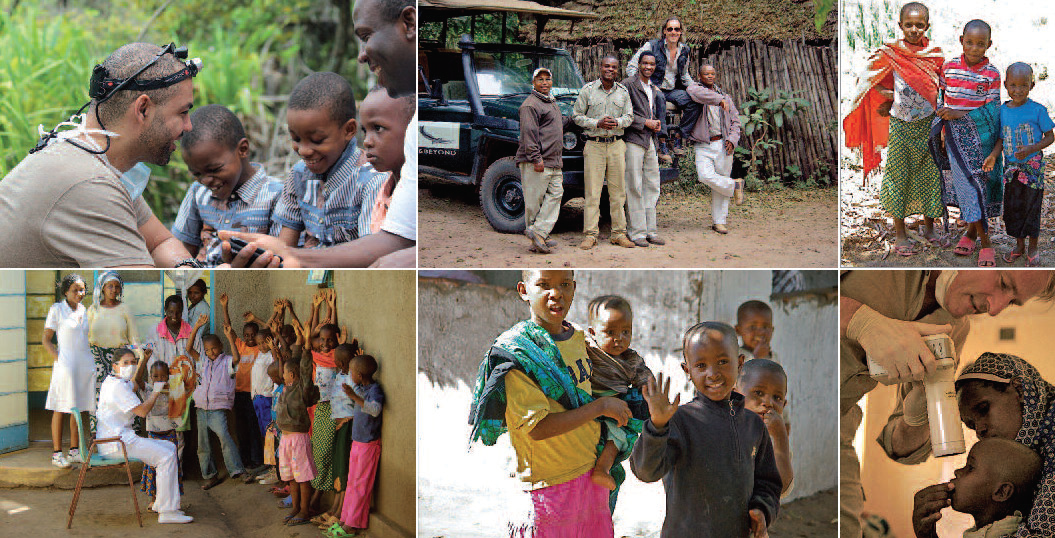
will cross the border with Kenia in order to receive dental treatment from us. At the same time, for a project like ‘Daktari for Maasai’ to function, it is vital that it has reliable local partners like and Beyond to draw on.Through this collaborative effort, the project receives logistical and communications support at every level, affording it the consistency, security and predictability that the local & Beyond staff provide on the ground. This also results in a high degree of confidence among all those involved. The philosophy at and Beyond always places the preservation and development of nature and wild life in the centre - along with providing practical support and development for the peoplein the regions where and Beyond operates. This can come about by building schools and clinics, or it may well take the form of appointing doctors to the clinics in order to ensure primary health care services. This is
also what we provide through our collaboration with ‘Daktari for Maasai’,as we are in a position to offer highly specialised treatments that normally would be unavailable.
At the time I headed out with my colleague at Dental Specialists, Dr Caroline Kentsch, on our first pre-scouting trip to Tanzania, flying with CONDOR from Frankfurt. On arrival at Kilimanjaro Airport, we acquired a long-chassis Toyota Land Cruiser 4X4 equipped for safari. It was the perfect vehicle, with excellent off-road capabilities and great loadhauling capacity. We first drove to Arusha to get additional medicines and instruments, since fifteen transport crates from Germany weren’t enough for it all. In Arusha we obtained a great
many medicines andother instruments from medeor that medeor Tanzania had ordered for us. We then continued on to Lake Manyara, where we worked for the next two days, first treating the lodge staff and their families. After that, curiosity drew in a large number of other villagers. Following an arduous Serengeti crossing, we arrived at Ololosokwan, where we worked every day at both the Kleins Camp Lodge and at the Ololosokwan clinic. We initially needed help at the clinic, which still lacks both electricity and running
water. A more or less functioning generator was provided and we adjusted our operations to fit our new surroundings among the Maasai. We quickly learned to deal with the heat, tsetse flies, mosquitoes, flies and numerous other in-sects. A smut candle specially designed to repel in-sects performed well, but caused masks and clothingto turn black. At the time there were still no dental chairs, so we had to treat patients while standing up all day. The patients themselves were treated either seated on an office chair or lying on a doctor’s couch. We gained valuable experience during this prescouting trip in the Serengeti that helped us prepare for our next visit.
Since we did not take any support staff with us the first time, we planned differently for our second trip. My close friend Dr Axel Roschker from Cologne, who specialises in implantology and oral surgery, wentalong to provide active support, as did two members of the staff at our clinic, Dental Specialists. Sandra Ahsan worked independently with us as a dental hygienist and Miriam Schorn transformed herself into a veritable tooth fairy in the jungle environment at Lake Manyara, assisting Dr Roschker with his work.
Using additional materials obtained from medeor, we were able to equip additional sites. Now there are surgical suction pumps and instruments in Lake Manyara and in Ololosokwan. With a team consisting of ineffect three persons providing treatment, we were ableto handle over 650 Maasai in 14 days. Bit by bit, the project gained acceptance among the local population. Classes from the primary and secondary schools in Ololosokwan now regularly visit our highly specialised clinic. For the most part, these children arrive together as a class to receive treatment at the clinic.
KEEPING THE PROJECT GOING
During another projectrelated trip in January 2013, led by Dr Caroline Kentsch and Dr Axel Roschker, about 650 patients received treatment. Once again, two assistants accompanied three doctors on thetrip. It is a welcome development that, owing to the technically advanced equipment available,

we were able to provide treatments for pain that did not necessarily involve tooth extraction. Numerous gluedsynthetic bridges were produced to close gaps between front teeth. A great many cavities were filled infront teeth as part of treatment for tooth decay. And serious cases of fluorosis were treated in order to pro-vide for a more aesthetically pleasing appearance. Fluorosis is a wide spread problem among the Tanzanian population. In the north, in the greater Arusha metropolitan area, up to 90 percent of inhabitants suffer
from serious cases of fluorosis. We also have been able to prevent tooth loss through rootcanal treatments. And we are able to preserve posterior teeth by putting in fillings. Using ultrasound equipment and mobile lasers, we are able to carry out comprehensive periodontal treatments. Korean made digital X-ray machines by Dexcowin allow us to produce razorsharp images in just seconds on a laptop in any kind of situation. These devices are absolute lyvital in performing surgical procedures and root canalfilling therapies.
In September 2013 the project achieved another milestone in its development when the University of Sevilla asked us to use the project as part of its training programme for oral surgeons. In September we travelled together with Dr. Axel Roschker and two Spanish oral surgeons, Dr. Roberto Garrido and Dr. Francisco Azcarate, to Lake Manyara, Ngor ongoroand Serengeti/ Ololosokwan. Joining us from England was Dr Andrea Chan, who previously served for sixyears as a dentist with the British Navy. Though shewas only
able to be with us for just one week, her visit came off smoothly owing to the availability of daily flights between Arusha and Ololosokwan by smallplane. Our multinational team operated nonstop in every part of the Tanzanian mainland previous lyserved. The international nature of the group spurred the project on immensely. The interactions of the individual specialists, despite never having worked together before, came off like a charm. This accomplished team of oral surgeons was even able to handle more involved surgical
procedures. And one thing quickly became clear: it was substantially more efficient to offer treatment as part of a larger team, sinceit meant that many activities could be shifted around so that highly specialised professionals were also available to serve as assistants. In February 2014 our path once again took us back to Zanzibar, where we had initiated a pilot project in February of the previous year. This time my other colleague at Dental Specialists, Professor Michael Wainw right, went with us as well. Local conditions and climate on Zanzibar, however, pose greater difficulties in providing dentalcare than on the mainland. Daytime temperatures can easily climb above 33C and the high humiditydoes its part to make any kind of physical activity difficult. We adjusted our treatment times and workhabits to better suit this new environment. Because our facilities and equipment were located on a small
off shore island, our patients reached us by boat. Life on the island made us feel a little like Robinson Crusoe. But the treatment we provided was affectedby our underlying circumstances in other ways aswell. While surgical procedures predominated on the Tanzanian mainland, on Zanzibar we treated a disproportionate number of serious cases of periodontitis.This is due, on the one hand, to a genetic predisposition to these types of diseases, but also to differencesin diet. People on Zanzibar consume more fish and vegetables and sweets are harder to come by than onthe mainland. Fluorosis is practically unheard of here too. After extensive preparations while still in Germany, we had significantly expanded the equipment available to us. Along with our tried and tested surgical suction pump, medeor Tanzania made available to us a new Chinese treatment unit. It turned out to be a real adventure getting this equipment, however, given the great number of administrative hurdles and impediments we had to overcome before the unitwas finally delivered.
DHL sent us daily assurances that the units wouldbe arriving on schedule. But each and every time the African authorities put up another unexpected hurdle.
One time the shipping documents were arbitrarily altered by a customs official; another time the equipment was removed from the flight, ostensibly because the plane was too heavy for the flight from Dares Salaam to Zanzibar. Thank God we had another treatment unit to use in handling our daily flow of patients. It was only with help from the folks atmedeor Tanzania and and Beyond that we were able to find a solution to our administrative nightmare.
When the Chinese unit finally reached us, we were surprised at how compact and efficient it was. A highly efficient, integrated compressor makes the unit ready to use in just five seconds and it can be used for every kind of procedure, from putting in synthetic fillings to performing complex surgical operations. It makesfor a very practical treatment tool that can even be checked in at the airport along with standard 23kg luggage.
The unit constitutes the basis for all future mobile treatments undertaken by Daktaris for Maasai. And we would like to take a moment here to extend thanks to our third primary partner, Condor Contribute, fortheir help in transporting medical and dental aid supplies. Without their support a dental project as adventurous as this would scarcely have been possible. The thanks we got from the people of Tanzania receiving free treatment was in describable and can not be compared with any other experience in medicine. Since rest thanks from the Daktaris for Maasai… Bon Voyage! – Na safari nzuri!_
Disclaimer from Guident
The views and opinions expressed in articles published in Guident are solely those of the authors and do not necessarily reflect the views of the editors, the editorial board or the publisher, Ivory India. Guident does not endorse any product, technique or treatment described. Clinical content is intended for qualified dental and medical professionals and is not a substitute for individual clinical judgement. Guident, its editors and the publisher accept no liability for any consequence arising from the use of information published in the journal.
How to cite this article
Dr. Martin Jorgens University of SevillaPresident of DGKZ - Deutsche Gesellschaft f. Kosmetische ZahnmedizinOwner of Dental Specialists in Dusseldorf. Daktari for Maasai - Mobile Dental Care in the Serengeti. Guident. 2014 Dec;8(1). Available from: https://guident.in/articles/general/daktari-for-maasai-mobile-dental-care-in-the-serengeti.html