TMJ Disorders Treatment: Low Level LASER Therapy (LLLT)
Department of Orthodontics, Department of Conservative Dentistry, Chandra Dental College & Hospital, Safedabad, Lucknow
ABSTRACT
Hard and soft tissue lasers have been widely used in modern dentistry. Low-level laser therapy (LLLT) is a newly developing technique in dentistry, although it has been used among medical, dental, physiotherapy, and veterinary professions in some parts of the world for decades. LLLT can offer tremendous therapeutic benefits to patients, such as accelerated wound healing and pain relief. This article discusses and presents a case report on how Low level laser therapy has proven to be beneficial in the treatment of pain related to TMDs.
KEYWORDS: LLLT, TMJ disorders, Occlusal splints, Biostimulation
INTRODUCTION
The fear of having pain is worse than having the actual pain . In our everyday dental practice there are some great days and some bad days when you feel helpless in instantly relieving the patient of symptoms especially those related to pain.
Many a times a patient arrives to the dental clinic with a diffused pain and swelling near the TMJ area which also involves the masticatory musculature and associated structures. The symptoms are collectively termed as Temporomandibular joints disorders (TMDs).
Non surgical treatment of TMD’s continues to be the most effective way of managing over 80% of the cases which includes pschycotherapy, behavioral therapy, pharmacotherapy, occlusal splint therapy and various physical therapies like thermal, acupuncture therapy, electrical stimulation therapy and low intensity laser therapy.1-4 Advances in dental technology helps in providing the best possible care to the patient as well as comfort to the dentist.
Soft tissue lasers came into the existence most recently in the field of physiotherapy. They can not only cut / abalate the tissue but also aid in healing / biostimulation commonly known as “Low Level Laser Therapy ” or LLLT.
They are the low cost , least invasive, non thermal, safe therapeutic procedures that have proven to be beneficial for the treatment of the pain related to TMDs. Certain devices are FDA approved to help treatment of TMDs and facial muscle pain. It can penetrate tissue & increases blood flow, decreases edema and aid in healing.
The term LLLT is used when working in compliance with the threshold of the cell survival. Karu5 stated that a non thermal therapy can promote cell and tissue alteration caused by the different types of the metabolic activation such as increased activities in mitochondria(Na + K+ pump), increased vascularization, and formation of fibroblast, increase in the recovery process and tissue healing with non invasive characterstics.
MECHANISM OF ACTION OF LOW LEVEL LASER THERAPY
There are mainly three main effects of laser light used in LLLT on soft tissue namely, analgesic effect, anti-inflammatory effect and biostimulation effect.
LLLT has a complex mechanism of action, but it is essentially related to the absorption of particular visible red and near infrared wavelength in photoreceptors within subcellular components and particularly the electron transport (respiratory) chain within the membranes of mitochondria.6,7
The production of ATP is essential for the cell to function. The mitochondria of the cell contain chromophores or photoreceptors which have the ability to absorb the photons and transform the energy into adenosine triphosphate (ATP). Laser stimulation has been shown to enhance the production of ATP by forming singlet oxygen, reactive oxygen species (ROS), or nitric oxide, all of which influence the normal formation of ATP .
EQUIPMENT
With the introduction of diode lasers, dentistry has progressed many folds. They are semi-conductor devices which have corresponding wavelengths, compact sizes, competitive prices and versatile additions regarding the various treatment applications. They have the ability to cut, ablate and coagulate. These semiconductor lasers, being simple in construction and light in weight with compact units and requiring little auxiliary equipment have found space in almost every dental clinic.8
Diode lasers used in LLLT are generally variants of either Aluminium:Gallium:Arsenide (AlGaAs) which emit in the near infrared spectrum (wavelength 700-940 nm), Indium:Gallium:Arsenide:Phosphorus (InGaAsP) devices which emit in the red portion of the visible spectrum range (wavelength 600-680 nm). Power outputs are typically in the order of 10-50 mW, when measured at the level of the diode laser itself.
Lasers units used for LLLT are generally classified as class 3 or class 3 b in terms of the optical hazards which they pose to staff and patients. Glasses are available which provide protection against common LLLT wavelength in both the visible and near infra red spectrum.9
This article presents a case report of a patient who came to the clinic with pain in TMJ region.
CASE REPORT
Patient aged 55 years female, came with chief complaint of pain and tenderness in her right jaw joint and has difficulty in chewing.
On clinical examination, pain started suddenly with intermittent discomfort in her right jaw joint for the past 2 years but it has been mild in nature. It radiates to the jaw muscle on that side and has worsened with the time to an extent that it becomes worse in the early morning with limitation in mouth opening. It typically lasts for few hours then becomes mild.
Patient gave history of grinding of her teeth when stressed. Chewing hard food and opening the mouth too wide made the pain worse.
Patient was on analgesics and anti inflammatory drugs since 2 years but pain does not subside and reappeared on and off.
On examination- Clicking sound in the jaw with limitation in mouth opening.
TMJ opening and lateral mandibular movements were assessed by 1st observing the patient from in front and 2nd by palpation of condylar heads with pressure crepitus/joint click. Masticatory muscles were palpated .
Right TMJ click and right massetric tenderness were detected.
AIMS OF TREATMENT
- Relief of TMDs
- Occlusal splint
- To look for any premature contacts.
- Treat any occlusal problems continuing to any dysfunction.
- SHORT TERM- Hard full coverage upper acrylic splint along with jaw exercise.
Patient was instructed for full time wear until TMJ symptoms subsided.
Intake of soft diet.
Avoid straining her jaw joint for example wide opening or yawn.
Mild analgesics were prescribed to be taken SOS.
LONG TERM- Combined ortho-surgical apporoach to correct facial and occlusal problems. TMD symptoms may ease with orthodontic treatment.
DEVICE SETTING
POWER- 6 Watt
WAVELENGTH- 940 nm
LASER MODE- Continuos and non contact mode.
DISTANCE TO TISSUE- 1 cm for lighter and up to 3 cm for darker skin types.
POSITIONING OF HANDPIECE- Stationary at treatment region.
EXPOSURE TIME- 8 to 10 minutes.
TOTAL DOSE- 1.8 to 3.6 J
PROCEDURE- The masticatory muscles are evaluated bilaterally with the firm an constant pressure to define painful areas ( Figure 1). The palpated sites to define tender point were origin, body and insertion of the masseter muscle : anterior , middle and posterior portion of the body the temporalis muscle and insertion of internal pterygoid muscle.
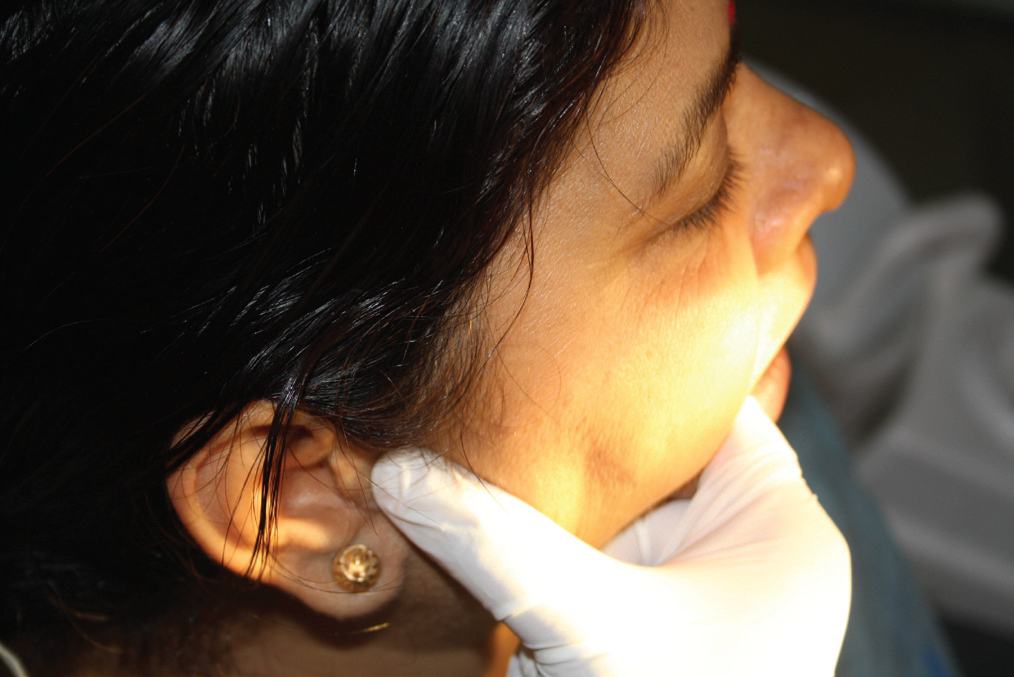
Fig. 1: Evaluation of Temporalis muscle
TREATMENT OF PAINFUL REGION- The treatment was conducted in 3 regions -temporalis region, joint region and masseter region.
The therapeutic handpiece was placed over the painful area at approximate 1 cm above the skin surface. The treatment settings were set and treatment was started by maintaining the handpiece at the same location and distance, LLLT was performed by moving the handpiece in a circular motion and non contact mode. Each session was performed for 8-10 minutes. Then the same procedure was repeated for the other regions ( Figure 2).

Fig 2: LLLT being performed with laser handpiece in noncontact mode
The pain level was measured pre and post treatment using a Visual Analogue Scale (VAS) with marking from 0-10 with 0 being no pain and 10 being worst pain.
Treatment Schedule- The above mentioned procedure was carried out twice a week and continued for next 2 weeks ie 5-6 treatment every 2-4 days.
After a few LLLT sessions and wearing the occlusal splint ( Figure 3), the patient had relief. She could open her mouth wide and within a span of two – three months, the patient was relieved of symptoms. She was asked to go further for her orthodontic treatment as the etiology still persisted.

Fig 3: Occlusal Splint
DISCUSSION
Low level laser therapy has been found to accelerate wound healing and reduce pain, possibly by stimulating oxidative phosphorylation in mitochondria and modulating inflammatory responses. Although there are no contraindication reported for dental therapeutic lasers, some side effect exist. Because laser light affects several rheologic factors, patients with coagulation disorders need special attention. Many studies, case reports and on going dissertations are going on to prove the efficiency of LLLT in TMJ disorders and other clinical problems in clinical dentistry.10,11,12
All the available diode wavelengths used in clinical dentistry can be used for biostimulation. If the dentist is having a laser unit in his dental office then he need not have to invest in another laser unit. But by using the same unit at proper power settings and non contact mode, we can achieve the desired result.
CONCLUSION
Future trials of newer applications of LLLT in the field of dentistry are required in a standardized manner to utilize this technology for the maximum benefit to the mankind.
REFERENCES
- Tunér J, Hode L. Low level laser therapy - clinical practice and scientific background. 1999. Prima Books. ISBN 91-630-7616-0.
- Fikackova H, Dostalova T, Vosicka R , et al: Arthralgia of the temporomandibular joint and low level laser therapy, Photomed laser surgery 2004; 24(4):522-527.
- De Mederios JS, Vieira GF, Nishimura PY: Laser application effects on bite strength of the masseter muscle , as an orofacial pain treatment, Photomed Laser Surgery 2005; 23(4):372-376.
- Farina CG, Duarte M, Mori M,et al :effects of low intensity laser therapy(780 nm) in temporomandibular disorders: electromyographic, pain and bite force analysis (abstract) 5th congress of world association for laser therap, 2004,Sao Paulo. Photomed Laser Surgery 2005; 23(1).
- Karu TI. Low power laser therapy. In: Letokhov VS, Shank CV, Shen YR, Walther H, editors. Biomedical photonics handbook. Switzerland: Khorwood Academic Publishers; 2003. p. 48.
- Karu TI. Photobiology of low-power laser effects. Hlth Phys 1989;56:691-704.
- Karu TI. Photobiology of low-power laser therapy. London: Harwood Academic Publishers. 1989.
- Srivastava VK, Mahajan S. Diode lasers: A magical wand to an orthodontic practice. Indian J Dent Res 2014;25:78-82.
- Walsh LJ. The current status of low level laser therapy in dentistry. I. Soft tissue applications. Aust Dent J 1997:42:247-254.
- Venancio RA, Camparis CM, Lizarelli RF: Low intensity laser therapy in the treatment of temporomandibular disorders: a double-blind study, J Oral rehabil 2005; 32(11):800-807.
- Cetinar S, Kahraman SA, Yucetas S: Evaluation of low level laser therapy in the treatment of temporomandibular disorders, Photomed Laser Surgery 2006; 24(5):637-641.
- Srivastava VK, Mahajan S. Diode Lasers: The War of wavelengths. Dental practice 2014; 12(6): 34-47.
Disclaimer from Guident
The views and opinions expressed in articles published in Guident are solely those of the authors and do not necessarily reflect the views of the editors, the editorial board or the publisher, Ivory India. Guident does not endorse any product, technique or treatment described. Clinical content is intended for qualified dental and medical professionals and is not a substitute for individual clinical judgement. Guident, its editors and the publisher accept no liability for any consequence arising from the use of information published in the journal.
How to cite this article
Dr. Shally Mahajan, Dr. Vipul Kumar Srivastava, Dr. Aakanksha Srivastava. TMJ Disorders Treatment: Low Level LASER Therapy (LLLT). Guident. 2014 Oct;7(11). Available from: https://guident.in/articles/general/tmj-disorders-treatment-low-level-laser-therapy-lllt.html