
Sparing Misery of Dentist,S Drill by Carie Care - a Chemomechanical Caries Removal System
1, 2K.L.E Society, s Institute of Dental Sciences, Yeshwanthpur suburb, Tumkur Road, Bangalore, India., 3K.L.E V.K Institute of Dental Sciences, JNMC Campus, Nehrunagar, Belgaum
Abstract
The clinical dental science is viewing a dramatic evolutionary era from concept of extension for prevention to construction with conservation. Concept of minimal invasive technique has evolved as a consequence of increased understanding of the carious process and the development of adhesive restorative materials. It is now recognised that demineralized not cavitated enamel and dentin can be healed and that surgical approach to the treatment of carious lesion along with “Extension for prevention” as approached by GV Black is no longer tenable. Of all the presently available options for minimal invasive dentistry, one of the widely accepted one is Chemomechanical Caries removal system (CMCR). CMCR is a minimally-invasive, gentle dentine caries removal based on biological principles. Carie Care, a natural endoprotein based formulation containing papaya extract is a commercially available Indian product. This paper presents the literature review, limitations of other CMCR agents with the case report on clinical application of the same.
Key words: Chemomechanical caries removal, dentinal caries, papaya extract
INTRODUCTION
In the modern time the prevalence of dental caries cannot be denied. The conventional approach to the elimination of carious lesion was developed a century ago; this method was necessary at that time because there was no valid alternative. The conventional method for caries removal is usually carried out with high speed hand piece to access the lesion and a low speed hand piece to remove caries. Although, this method is quick and efficient in caries removal, it may result in unnecessary removal of sound tooth structure. In addition, caries removal with the conventional method is usually associated with pain, annoying sound and possibility of producing thermal and mechanical injuries to dental pulp. Furthermore, in children and patients with anxiety the conventional technique is often associated with discomfort.1 Research over the last thirty years has made it possible to modify this approach to adopt the concept minimal invasive dentistry. There are many different treatment approaches for carious lesions depending upon causal factors, lesion stage and activity. Minimal invasive dentistry can be defined as maximal preservation of healthy dental structures.2
Of all the possible options available for the removal of the carious lesion, the most acceptable one is Chemomechanical caries Removal (CMCR) system. CMCR technique introduced almost three decades ago was claimed to be a non-invasive alternative for the removal of carious dentin. The chemomechanical approach was initially introduced in 1972; with the technique involved applying a solution on to the decayed dentinal tissue to soften it and finally scrapping it off with the blunt hand instrument. The partially degraded collagen in carious dentin was softened by the gel due to the breakage of the peptide bond.3,4
After an extensive research at Vittal Mallya Scientific Research Foundation, a Ministry of Science and Technology, Govt of India approved Research Centre has developed a new formula Carie CareTM (Figure – 1), to universalize the use of chemomechanical method for caries removal and to promote its use in public health. Eco works India Pvt Ltd; Bangalore has launched the product with an aim to make it available to the large population at very reasonable price using efficient supply chain.
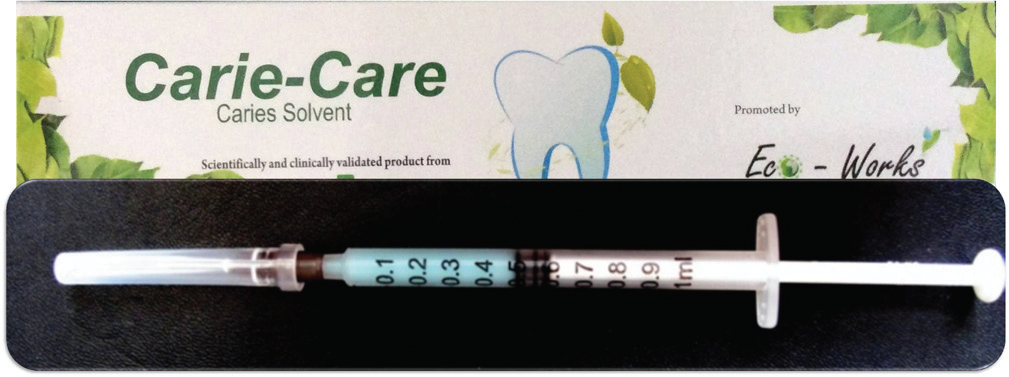
Figure-1: Carie CareTM, Eco works Pvt Ltd, Bangalore, www.ecodentalworks.com
Carie careTM gel is basically comprised of papaya extract with essential therapeutic oils which together are responsible for the proteolytic action, antimicrobial, antiseptic and anti-inflammatory properties. The papaya extract has proteolytic action that would soften the pre degraded collagen of the lesion without pain or undesirable effects to adjacent healthy tissues with the antiseptic and anti-inflammatory properties of the essential therapeutic oils5,6.
The mechanism on which Carie careTM works is it cause degradation of the partially degraded collagen (degrades intact non mineralized Type 1 collagen fibrils), present on the peripheral caries infected zone, which lacks the capacity to mineralized by cleavage of the polypeptide chains in the triple helix and/or hydrolysing the cross linkages. The polypeptide hydrolysis is brought about by endopeptidases extracted and purified to homogeneity from papaya extract.7,8
Ideal indications for the usage of Carie careTM are any carious lesion extending into the dentine. The cases may vary from the pin point or bottle neck caries into the dentine to the grossly carious lesion in the dentine. It is an established approach for the anxious patients and young paediatric patients.
CASE REPORT WITH THE MANAGEMENT
A 13 years old patient with the deep dentinal caries in relation to 36 without any clinical symptom of pain and sensitivity was selected (Figure -2A). The radiographic evaluation was done to confirm the extent of caries into the dentine with no pulpal involvement (Figure – 2B). The tooth was isolated using the proper isolation method (Figure -2C)
The caries excavation was done according to manufacturer’s instructions. The carious lesion was covered with the gel and left undisturbed for 30- 60 seconds (Figure -2D). The gel was removed by gently scrapping with the spoon excavator without applying pressure (Figure – 2E). Removal of the caries was continued until the hard and affected dentine appeared on the tooth. Then gel was removed and the cavity was wiped with the moistened cotton pellet and rinsed (Figure – 2F). Once the cavity was confirmed free of caries, it was restored with the ideal adhesive restorative material after attaining proper isolation.
DISCUSSION
Dentists are highly trained at using dental burs in slow speed or air turbine handpieces7. Moreover, the rotary instruments used often causes pain and are unpleasant to many patients and needs anaesthesia. Thus the advantages of using Carie care are: a) avoids painful removal of dentine b) fast action
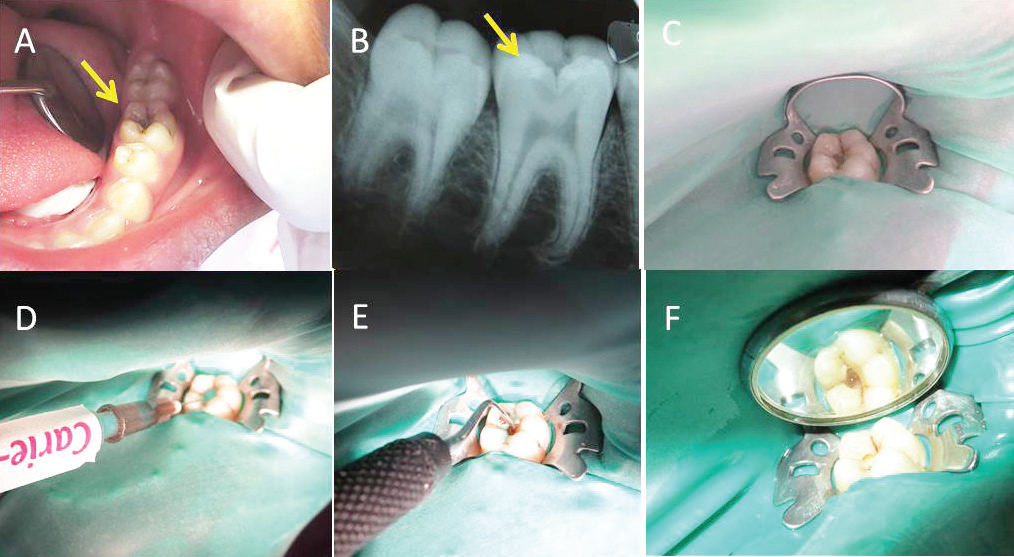
Figure-2: Steps involved in caries excavation using Carie Care A – Open carious lesionirt 36, B – Radiographic evaluation of 36, C – Isolation of the tooth, D – Application of Carie Care, E - followed by excavation, F – After cavity preparation using Carie Care
c) eliminates need of local anaesthesia d) provides more surface area which would be well suited to restoration with modern adhesive material e) no adverse effect on pulp and healthy tissues f) higher patient acceptance with palatable taste g) conservation of the sound tooth structure and reduce chances of pulp exposure h) well suited to the treatment of anxious and medically compromised patients as well as to paediatrics and domiciliary dentistry i) scientific and clinical validation for its efficacy and safety by various in house and external accredited agencies including multiple dental colleges.10-13 j) no adverse effect, side effects. The limitations cited for the use of CMCR agent are rotary instruments are still needed for removal of unsupported enamel. This includes the access to interproximal carious lesion. This is attributed to the site specific action of the gel as it acts only on the infected dentin, thus reducing the chances of iatrogenic removal of the healthy tissue.10 The other problem ported by the operator in using CMCR technology is the time consumed for caries excavation. However with time and development of expertise the reverse took place with CMCR being less time consuming than conventional method as reported previously. This is attributed to lack of any specialized equipment and ease of procedure using CMCR products14
In a recent Indian clinical trial, comparative evaluation was done between Carie care and conventional rotary turbine as caries removal measures on pediatric patients. The results of the following study showed that the two techniques were comparable in caries removal efficiency and removal of caries by Carie care was pain less, non-invasive, safe and more patient friendly 15.
CONCLUSION
This introduction of predictable caries removal technologies has led to a giant step in interest in minimal invasive dentistry. This will help in selective approach between prevention and surgical procedures, which just dentistry needs today. Development of a clinically effective CMCR, like Carie care, which is harmless to healthy tissue and bio-compatible, has given a conservative and optimal clinical approach to the management of the extensive caries. It also provides a unique opportunity in propagating pain-less bondage between patient and dentist and help the oral health care personnel in exploring the ever increasing avenues and opportunities to follow the concept of Painless dentistry.
REFERENCES
- Khattab NMA, Omar OM. Papain–Based Gel for Chemo-Mechanical Caries Removal: Influence on Microleakage and Microshear Bond Strength of Esthetic Restorative Materials. Journal of American Science, 2012;8(3):391-399.
- Ericson D, Kidd E, McComb D, Mjor I, Noack MJ. Minimal Invasive dentistry – concepts and techniques in cariology. Oral health Prev Dent 2003;1(1):59-72.
- Kabir R, Aeran H, Katre A, Kumar P. Chemomechanical caries removal: a clinical review. Indian Journal of Dental Sciences. (December 2013, Issue:5, Vol.:5):130-133.
- Maragakis GM, Hahn P, Hellwig E. Chemomechanical caries removal: a comprehensive review of literature. Int Dent Journal;51(4):291-299.
- Bussadori SK, Castro LC, Galvão AC. Papain gel: a new chemo-mechanical caries removal agent. J ClinPediatr Dent. 2005;30:115–119.
- Hosseini M, Kamkar M Asl, Raklshandeh H. Analgesic effect of clove essential oil in mice. Avicenna Journal of Phytomedicine 2011;1(1):1-6.
- Banerjee A. Minimal intervention Dentistry: Part 7. Minimallly invasive operative caries management:rationales and techniques. British Dental Journal 2013;214(3):107-111.
- Beeley JA, Yip HK, and Stevenson AJ.Chemochemical caries removal: a review of the techniques and latest developments British Dental Journal 2000;188(8) :427-430.
- Hosseini M, Kamkar M Asl, Raklshandeh H. Analgesic effect of clove essential oil in mice. Avicenna Journal of Phytomedicine 2011;1(1):1-6.
- Lopes MC, Mascarini RC, Silva BMC, Florio FM, Basting RT. Effect of Papain based gel for chemomechanical caries removal on dentin shear bond strength. ASDC J Dent Child 2007;74:93-97.
- Maragakis GM, Hahn P, Hellwig E. Chemomechanical caries removal: a comprehensive review of literature. Int Dent J 2001, 51(4):291-299.
- Abdelnur JP, Cerquiera DF, Castro GF, Maia LC, de Souza IP. Strategies for addressing restorative challenges in HIV- infected children. ASDC J Dent Child 2008;75(1):69-73.
- Piva E. Ogliari FA, Ratto R. Pain based gel for biochemical caries removal:influence on microtensile bond strength to dentin. Braz Oral Res 2008;22(4):364-370.
- Konde S, Urs P, Raj S. Efficacy of Papacarie for caries removal: An in vivo study. World Journal of Dentistry 2011;2(3):183-186.
- Hedge AM, Preeti VC, Shetty A and Shetty S. Clinical evaluation of Chemo-mechanical caries removal using Carie Care system in school children. NUJHS 2014;4(3):81-85.
Disclaimer from Guident
The views and opinions expressed in articles published in Guident are solely those of the authors and do not necessarily reflect the views of the editors, the editorial board or the publisher, Ivory India. Guident does not endorse any product, technique or treatment described. Clinical content is intended for qualified dental and medical professionals and is not a substitute for individual clinical judgement. Guident, its editors and the publisher accept no liability for any consequence arising from the use of information published in the journal.
How to cite this article
Dr. Rachna Thakur, Dr. Sandhya S. Patil, Dr. Madhu K. Sparing Misery of Dentist,S Drill by Carie Care - a Chemomechanical Caries Removal System. Guident. 2014 Dec;8(1). Available from: https://guident.in/articles/pedodontics/sparing-misery-of-dentist-s-drill-by-carie-care-a-chemomechanical-caries-removal-system.html


