Frictionless Mechanics for Space Closure Using Opus Loop
(P.G Student) Dr. U.S.Krishna Nayak (Dean acedemic & Head), Department of Orthodontics and Dentofacial Orthopedics, A.B. Shetty Memorial Institute of Dental Sciences. Mangalore.
ABSTRACT
Closure of extraction spaces by retraction of the anteriors is mainly done by either sliding mechanics or loop mechanics. Sliding mechanics, although simple, take longer time because of the friction between wire and bracket slot. Loop mechanics provide the advantage of faster retraction, anchorage control as needed etc. This paper describes a case report, where in an opus loop has been used for retraction.
Keywords: Opus loop, retraction, loop mechanics.
INTRODUCTION
Space closure forms an integral part of orthodontics, and for this, two primary methods exist; sliding mechanics or loop mechanics. Sliding mechanics have shown to be slower due to the inherent friction between the wire and the bracket slot. However, loop mechanics do not have this disadvantage of friction. Various loop designs are available like the T loop, boot loop, snail loop, opus loop etc.
The Opus loop, which is capable of delivering a nonvarying target M/F within the range of 8.0-9.1 mm inherently, without adding residual moments by twist or bends (commonly gable bends) anywhere in the arch wire or loop before insertion.
The resulting precise force systems delivered with nonvarying M/F can move groups of teeth more accurately to achieve predetermined anteroposterior treatment goals for esthetics and/or stability.
CASE REPORT
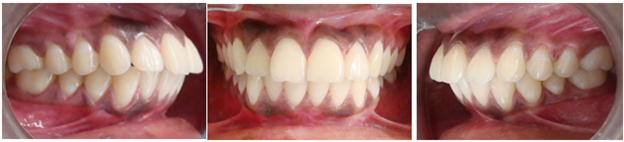
An 18 year old female patient reported to the Department of Orthodontics and Dentofacial Orthopaedics, A.B. Shetty Dental Memorial Institute of Dental Sciences with the chief complaint of forwardly placed front teeth.
On extraoral examination, she presented to be dolicocephalic, leptoproscopic with a convex profile, competent lips.


On intraoral examination, she presented with bilateral Class I molar and canine relationships with an overjet of 3mm and overbite of 1mm.
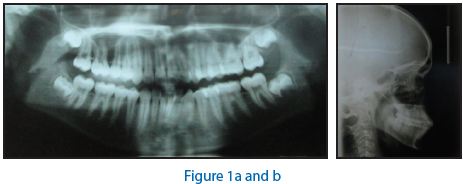
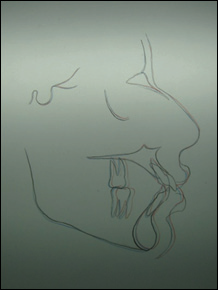
PRE-TREATMENT CEPHALOGRAM
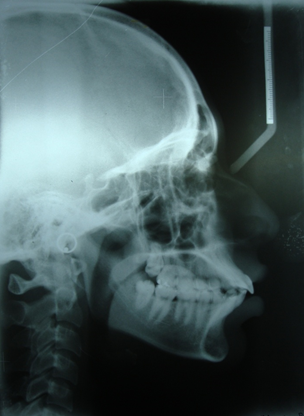
The Pre-treatment cephalogram values were suggestive a Class I bimaxillary protrusion pattern. ( TABLE 1)
MODEL ANALYSIS
- Boltons : Overall Mandibular tooth material excess by 1.7mm. Mandibular anterior tooth material excess by 1.4mm
- Careys : 3mm tooth material excess in Upper
3mm tooth material excess in lower.
DIAGNOSES
Using the above information, diagnoses were arrived to be:
- Skeletal- Class I apical base relationship.
- Dental- Angle’s Class I malocclusion with anterior proclination.
- Soft tissue- Acute nasiolabial angle.
TREATMENT PLAN
- Extraction of all first premolars.
- Leveling and aligning
- Retraction by loop mechanics (Opus loop)
TREATMENT PROGRESS
Levelling and alignment were achieved by sequential NiTi wires, starting from 0.016” niti. Thereafter, the opus loop was fabricated for the retraction of the anterior segment.
OPUS LOOP DESIGN

The loop was fabricated using 19x25 TMA wire.
RETRACTION USING THE OPUS LOOP
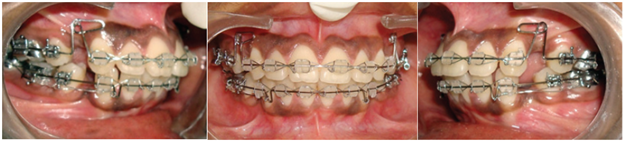
The loop was activated once in every 5 weeks.
The retraction was completed in 4 months, following which final finishing and detailing was done. The total treatment time was 12 months.
COMPARISON OF PRE AND POST TREATMENT IMAGES


POST TREATMENT CEPHALOGRAM
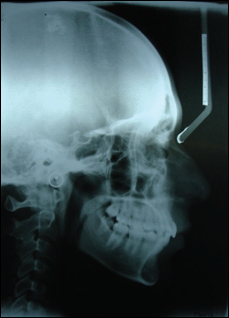
TABLE 1

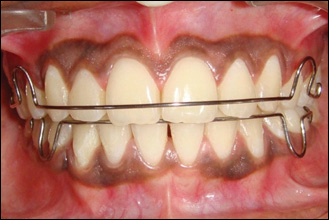
Hawley’s retainers were given in both the arches for a period of 12 months.
DISCUSSION
Similar to other loop designs, although to a lesser degree, Opus loops have the potential to steepen the occlusal plane. This can be advantageous in Class III cases. If this steepening is not needed, then certain interventions need to be done, such as reducing activation force or use of headgear.
Also, to eliminate bracket-wire play, a 20 degree twist in the incisor region of the wire was given. The Opus loop is free of residual moments, hence produces true rest periods between activations, hence applying intermittent force, which is favorable.
CONCLUSION
The opus loop, although a little complex in fabrication, provides true translatory retraction without any untoward moments, and proved to be a satisfactory option when deciding to go ahead with loop mechanics.
REFERENCES
- Raymond E. Siatkowski- Continuous arch wire closing and verification. Part II .AJODO 1997;112:487-95.
- Parikshit et al. – Evaluation and comparison of biomechanical properties of snail loop with that of opus loop and teardrop loop for en masse retraction of anterior teeth: An FEM Study- JIOS 2013;47(2):62-67.
- Braun et al- On management of extraction site- AJODO 1997;112:645-55.
- Raymond E Siatkowski. Continuous arch wire closing and verification. AJODO 1997;112:393-402.
Disclaimer from Guident
The views and opinions expressed in articles published in Guident are solely those of the authors and do not necessarily reflect the views of the editors, the editorial board or the publisher, Ivory India. Guident does not endorse any product, technique or treatment described. Clinical content is intended for qualified dental and medical professionals and is not a substitute for individual clinical judgement. Guident, its editors and the publisher accept no liability for any consequence arising from the use of information published in the journal.
How to cite this article
Dr. Saidath K ., Dr. Vivek Bhaskar. Frictionless Mechanics for Space Closure Using Opus Loop. Guident. 2014 Dec;8(1). Available from: https://guident.in/articles/orthodontics/frictionless-mechanics-for-space-closure-using-opus-loop.html