Denture in a Day
Department of Prosthodontics DAV (C) Dental College, Yamuna Nagar, Haryana, India
Abstract
The conventional fabrication of complete dentures involves separate clinical sessions for impression making, jaw registration, trial and insertion. The presented method combines these procedures in one session. Combining them into one appointment reduces the number of patient visits required. This attains greater significance in cases unable to give the required number of visits due to time, or health constraints.
INTRODUCTION
Complete denture making conventionally requires between five to seven appointments. Requirement of multiple visits is a major restraint to prospective patients due to health, or economic limitations. A method to combine the different steps of denture fabrication in one visit has been described in this case report.
CASE REPORT
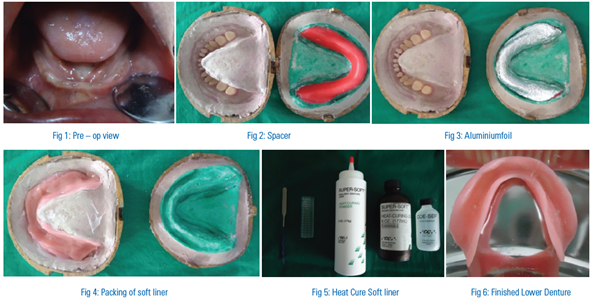
A 90 year old patient reported to the Deptt of Prosthodontics, DAV Dental College, Yamunanagar for complete denture fabrication. Patient was a previous denture wearer which was fabricated 3years back. Patient had a complaint of masticatory dissatisfaction due to wear off of denture teeth(Fig.1).

Fig 1: Intraoral Preoperative photograph
On examination the fit of the maxillary and mandibular denture was found to be satisfactory. Keeping in mind the inability of the patient to give multiple visits due to advanced age it was decided to fabricate the complete denture in one visit. The clinical steps undertaken were:
1. The denture teeth were trimmed off till the denture base and occlusal rims were build over the same(Fig.2).

2. The lip support, occlusal plane, Vertical dimension and freeway space of the patient were appropriately established. Jaw relation was recorded.
3. Following this, the rims were sealed using the nick and notch method. This would enable to separate the upper and lower impressions for beading and boxing and will enable accurate reorientation prior to articulation(Fig.3).
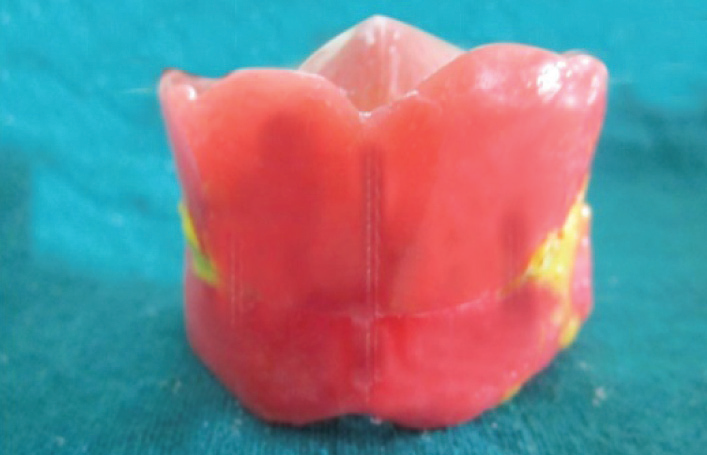
Fig 3: Rims sealed using the nick and notch method
4. The denture borders were trimmed 2mm short of the sulcus and border molding was done followed by a final wash impression with light body polyvinylsiloxane using a closed mouth technique(Fig.4).

5. Beading and boxing was done. Impressions were poured.
6. Casts were retrieved and rims were reoriented using the indices (nicks and notches) and the articulation was completed.
7. Teeth selection was done and the patient was scheduled for a trial. Try-in was done, in order to evaluate the stability, esthetics and occlusion intra-orally.
8. Following trial, the dentures were waxed up and invested. At the dewaxing stage, the impression material was separated and the dentures processed (removal prior to processing ensured maintenance of the relations and vertical dimension).
9. The dentures were finished, polished and inserted.
10. At the time of insertion,denture was evaluated for stability, esthetics and occlusion. Results were found to be satisfactory

DISCUSSION
In todays era, time is the scarcest commodity for both the patient and the clinician. Patients potentially appreciate the quicker completion of the rehabilitation especially in compromised situations. In cases where patients have to travel considerable distances for a dental treatment this technique would save both time and money. The use of rubber base materials for making impressions of edentulous ridges is not a new concept. Several authors have described and advocated their use as a border molding and final impression material. The use of elastomeric materials permitted removal and replacement of the impressions onto the cast, which would not have been possible in the case of alternate rigid materials. The real challenge to the prosthodontist is in providing a complete denture of an appreciable quality in a reduced number of appointments. By using the above mentioned technique it would be possible to achieve the same.
CONCLUSIONS
The use of this technique resulted in a reduction in the appointments required for complete denture fabrication. This attains greater significance in cases unable to give the required number of visits due to time, or health constraints.
Disclaimer from Guident
The views and opinions expressed in articles published in Guident are solely those of the authors and do not necessarily reflect the views of the editors, the editorial board or the publisher, Ivory India. Guident does not endorse any product, technique or treatment described. Clinical content is intended for qualified dental and medical professionals and is not a substitute for individual clinical judgement. Guident, its editors and the publisher accept no liability for any consequence arising from the use of information published in the journal.
How to cite this article
Dr. Aman Arora, Dr. Vikram Upadhaya, Dr. Anusha Singh. Denture in a Day. Guident. 2013 May;6(7). Available from: https://guident.in/articles/prosthodontics/denture-in-a-day.html