A Promising Solution for Edentulous Patients with Atrophic Ridges
Department of Prosthodontics Institute of Dental Sciences, Bareilly, India
Abstract
A technique is described for designing and making a mandibular denture, for patients with severely resorbed and compromised residual alveolar ridges.Soft liners are a medical grade soft polymer material applied to the tissue-fitting surface of denture base and they act like a shock-absorbing cushion while chewing.
Soft liners are mainly used with complete dentures in case of poor mucosal conditions and for the even distribution of masticatory forces.
Authors have described various methods for obtaining soft liner dentures, however their thickness vary depending on the methodology used. This paper describes a simplified technique for fabricating a Mandibular complete denture with optimum thickness of soft denture liner.
Key words: Resorbed ridges; complete denture; Soft Liner.
INTRODUCTION
Occasionally, even though the denture borders are appropriately extended, the stability and retention of the denture are good, pain occurs during mastication, which is difficult to relieve. Functional problems associated with edentulousness such as loose dentures and diminished chewing efficiency, had been reported by many authors.[1,2] The consequences of edentulousness include disability to speak and eat, reduction of social contact and inability of the residual ridge and its overlying tissues to withstand masticatory forces.[3,4]
In the case of an extremely resorbed residual ridge, the overlying mucosa decreases in thickness according to the resorption. As the resiliency of the mucosa is diminished and masticatory impact forces are directly transmitted to the underlying tissues, the burden on the residual ridge is increased.
Hence, it is necessary to line the inner surface of the denture base with a soft material similar to the mucosa in order to compensate for the lost thickness and viscoelasticity of the mucosa. The material used for this lining is called a “soft lining material”.
INDICATIONS
- Ridge atrophy or Resorption
- When surgery is contraindicated
- Diagnostic relining
- Relief areas
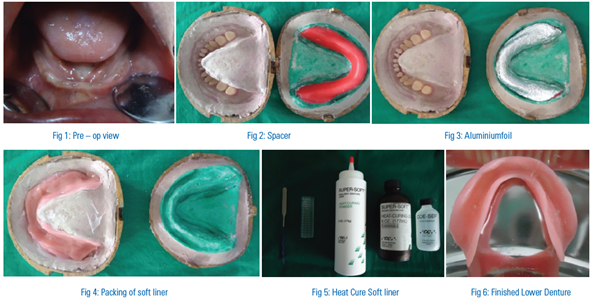
A 62 year old female reported to the department of prosthodontics, Institute of dental sciences Bareilly with a chief complaint of inability to chew properly with her existing dentures. Extra oral examinations reveal asymmetrical face with bilateral synchronous movement of the temporomandibular joint. Intra oral examination revealed completely edentulous maxillary & mandibular arches with knife edged and resorbed mandibular ridge (fig.1). Generally the problem encounter in fabricating the mandibular soft liner denture is unevenness of the liner which is being placed on the denture.
PROCEDURE
To overcome this problem below is the technique described for the fabrication of a mandibular denture –
- Maxillary & mandibular primary impressions were taken of both the arches with impression compound.
- After fabrication of the custom tray with auto polymerizing resin final impressions were made with zinc oxide eugenol impression paste.
- Jaw relations were done in a conventional manner & transferred to the mean value articulator.
- Try in procedures were completed after anterior and posterior teeth arrangement.
- Maxillary try in dentures were fabricated in a conventional manner with heat processed acrylic resin.
- Whereas Mandibular try in denture was processed through the wax elimination stage.
- Aluminium foil was adapted on the residual ridge area of the Mandibular cast in the drag part of the flask.
- Then an uniform thickness(1mm) of modelling wax was adapted on mandibular cast covering the aluminium foil.(fig.2)
- Following this one more sheet of aluminium foil was adapted over the layer of modeling wax & separating media was applied in the remaining area drag and cope area dental flask. .(fig.3)
- Now, Trial packing was done with heat cured acrylic resin using a thin sheet of cellophane.
- The cope and drag part of dental flask were separated and the layer of aluminium foil and modelling wax was removed.
- Followed by final packing with the heat curable soft lining material (SUPER – SOFTTM, Resilient Denture Liner) courtesy (GC AMERICA INC.ALSIP, IL 60803, Made in U.S.A.).(fig.4&5).
- Curing was done in conventional manner followed by finishing and polishing of the processed denture (fig.6).
- Final insertions of the dentures were done &patient was instructed on home care and prosthesis maintenance.
DISCUSSION
Many edentulous individuals bear resorbed residual ridges with thin and non – resilient lining mucosa unable to tolerate occlusal forces during functional and Para functional movements, resulting in complaining about pain during mastication[5]. The method used as a solution in these cases is utilization of permanent soft liners under hard acrylic denture bases. Soft liner distributes and absorbs load by a cushioning effect and as a result, decreases the amount of forces loaded on denture supporting structures, decrease pain during mastication, and enable the successful use of the prostheses for the patient.[6,7]
Various methods have been described for controlling the thickness of soft denture lining materials. However the procedure described in this article has certain advantages. This laboratory procedure reveals the benefit of using a modelling wax spacer as it permits uniform thickness of Soft denture liner. Aluminium foil had been used for the easy retrieval of the spacer and a wax gauge was used for maintaining the uniform thickness of the spacer.
As stated by Devans dictum – “Perpetual preservation of what remains is more important than the meticulous replacement of what is missing”. Therefore a good relationship between the occlusion and the neuro functionalbehavior of the masticatory muscles is important for any prosthesis.[8,9] To preserve the basal seat structure it’s important to avoid undue forces on it.
CONCLUSION
To many patients, the perception of their ill – fitting dentures is that the dentures have become the problem, not the changes that have occurred to the bony & soft tissue architecture. There are different methods of obtaining and controlling the thickness of the relining materials. The method discussed above has following advantages –
- The spacer can be made very easily.
- There is a very little chance of failure, because the soft lining material and the denture base have the similar chemical structure.
- Fracturing of such dentures is very much unlikely because the thickness is previously determined and equals everywhere therefore avoiding any uneven forces.
REFERENCES
- Carlsson GE. Masticatory efficiency, the effect of age, the loss of teeth and prosthetic rehabilitation. Int dent J; 1984, 34:93 – 7.
- Zarb GA. The edentulous milliew. J Prosthet Dent ; 1983, 49:825-31.
- Todd JE, Lader D. Adult dental health 1988 United Kingdom. London: HMSO;1991.
- Tyson KW, McCord JF. Chairside options for the treatment of complete denture problems associated with the atrophic (flat) mandibular ridge. Brith Dent J; 2000, 188:8-12.
- Murata H, Taguchi N, Hamada T, Kawamura M, McCabe JF.Dynamic viscoelasticity of softliners and masticatory function. J Dent Res 2002; 81: 123 – 28.
- Kimoto S, Kimoto K, Gunji A, Kawai Y, Murakami H, Tanaka K, et al. Effect of resilient denture liner in mandibular complete denture on the satisfaction ratings of patients at the first appointment following denture delivery. J Jpn Prosthodont Soc 2008; 52:160 – 66.
- Kasperski J, Zmudzki J, Chladek G. Denture foundation tissues loading criteria in evaluation of dentures wearing charateristics. Journal of Achievements in Materials and Manufacturing Engineering 2010; 43:324 – 32.
- Gruibwieser G, Flatz A, Grmnert I, Kofler M, Ulner H, Gausch K, Kulmer S. Quantitative analysis of masseter and temporalis EMG: a comparison of anterior guided versus balanced occlusal concepts in patients wearing complete dentures. J Oral Rehabil; 1999, 26:731.
- Gurnert L, Koffler M, Gausch K and Kronenberg M. Masseter and temporalis surface electromyography in patients wearing complete dentures comparing anterior and posterior occlusal concepts. J Oral Rehabil; 1994, 21:337.
Disclaimer from Guident
The views and opinions expressed in articles published in Guident are solely those of the authors and do not necessarily reflect the views of the editors, the editorial board or the publisher, Ivory India. Guident does not endorse any product, technique or treatment described. Clinical content is intended for qualified dental and medical professionals and is not a substitute for individual clinical judgement. Guident, its editors and the publisher accept no liability for any consequence arising from the use of information published in the journal.
How to cite this article
Dr. Devendra Chopra, Dr. Vaibhav Gupta. A Promising Solution for Edentulous Patients with Atrophic Ridges. Guident. 2013 Jun;6(8). Available from: https://guident.in/articles/prosthodontics/a-promising-solution-for-edentulous-patients-with-atrophic-ridges.html