
Single Step Management of Open Apices Using MTA Aggregate with Apical Matrix
Department of Conservative Dentistry and Endodontics Subharti Dental College Meerut, India
Abstract
Mineral Trioxide Aggregate is a biocompatible material, capable of providing a biological seal in open apices cases. Its use has also been recommended for cases such as pulp capping, regenerative endodontics, perforation repairs etc. Clinical use of MTA in humans has demonstrated their applicability in wet environments, preventing bacterial microleakage and alkalinizing the medium. On account of the predominant presence of calcium oxide in its formula, its biological properties show similarity to those of calcium hydroxide, making it useful for tissue healing. In the present study, a modified matrix concept in open apex closure using mineral trioxide aggregate has been portrayed.
INTRODUCTION
A major problem in performing endodontics in immature teeth with necrotic pulp and wide open apices is obtaining an optimal seal of the root-canal system. In the past, the initial aim of the therapy was to induce a hard tissue barrier at the tooth apex which is known as apexifcation1. The aim of this procedure is to limit bacterial infection and create an environment conducive to the production of mineralized tissue in the apical region2.Apexification can be defined as a method to induce a calcified barrier in a root with an open apex.
In the absence of a natural apical constriction, the production ofmineralized tissue in the apical region is importantto create an apical barrier and allow a three dimensional adaptation of obturating materialwithin the root canal system3. Calcium hydroxide pastes have been considered as the material of choice to induce the formation of a hard tissue apical barrier4. Many other authors have demonstrated its efficacy even in the presence of an apical lesion(Chosack et al. 1997, Felippe et al. 2006).However, calcium hydroxide has several disadvantages also, such as variability of treatment time (average 12.9 months) (Dominguez Reyes et al. 2005), difï¬culty of the patient’s recall management, delay in the treatment and increase inthe risk of tooth fracture after dressing with calcium hydroxide for extended periods (Andreasen et al. 2002,Felippe et al. 2005, Andreasenetal.2006)5.
Several alternatives to calcium hydroxide have been proposed; the most promising being mineral trioxide aggregate(MTA,ProRoot; DENTSPLY Maillefer, Ballaigues, Switzerland) which is a material recommended for several dental purposes1,6.
Mineral trioxide aggregate (MTA) has excellent sealing ability when used as a sealing material on accidental perforations or as a root-end ï¬lling material1 (Lee et al. 1993, Daoudi& Saunders 2002, Weldon et al. 2002, Mah et al. 2003, Mangin et al. 2003). Many in-vivo and ex-vivo studies have shown that MTA has excellent biocompatibility (Torabinejad et al. 1995, Saidon et al. 2003)1. Additionally, when MTA was used for direct pulp capping, it showed better interaction with dental pulp tissue than did calcium hydroxide or dentine bonding agents (Dominguez et al. 2003). Newly formed hard mineralized tissues were observed in direct contact with MTA in cases of pulp capping in-vivo (Ford et al. 1996, Andelin et al. 2003). Moreover, MTA has been shown to induce less pulp inflammation and more dentine bridge formation compared with calcium hydroxide cement (Faraco& Holland 2001)4,7.
MTA is the material of choice for apexification. However, a barrier in the apical canal is needed which can serve as a matrix so that MTA can be compressed against it.The Absorbable Collagen Wound Dressings (Abgel, Absorbable Gelatin Sponge USP) whichare soft sponges and are used in dental surgical cases can serve the purpose. Because of the coherent sponge structure, application of the dressings and their manipulation in the canal is easily controlled and it serves as a barrier or matrix in the apical canal8. The advantage of using Abgel over other membranes is that it is more economical and is firm in texture so it can be easily placed in the canal.
This case report demonstrates the use of MTA as an apical plug in immature open apex where apical matrix was created by an absorbable collagen wound dressing, Abgel.
CASE 1
A 21 year old male patient reported to the Department of Conservative Dentistry and Endodontics with a chief complaint of discoloured upper left maxillary central incisor with the history of trauma at the age of 12years. The concerned tooth did not respond to both electric pulp test and heat test.
The tooth was asymptomatic and clinical examination revealed physiologic mobility and slight discolouration. Detailed radiographic examination revealed a large blunderbuss canal with associated periapical lesion in relation to maxillary left central incisor(fig 1). There were two treatment options- either surgical removal of periapical lesion and retrograde filling or non-surgical root canal treatment followed by apexification using apical plug ofMTA.Considering the amount of surgical trauma, age and apprehensiveness of thepatient,nonsurgical treatment was decided
Access cavity preparation was done with the help of Endo access bur (DENTSPLY Maillefer Ballaigues, Switzerland), working length was determined with size ♯ 90 K file (DENTSPLY Maillefer Ballaigues, Switzerland) (fig2). Canal dedridement andcleaning was performed using circumferential filing technique with size # 120 K-file and copious irrigation with 5.25 % sodium hypochlorite and saline. Canal was dried using sterile paper points (DENTSPLY Maillefer Ballaigues, Switzerland).A BP knife blade was used to cut a 4mm diameter of Abgel, which was inserted in the canal with the help of pluggers. A slight discomfort shown by the patient revealed that the Abgel (fig 5) had reached the periapical tissue.

Subsequently, white MTA (Pro-Root MTA,DENTSPLY Maillefer Ballaigues, Switzerland) was mixed to a paste like consistency with distilled water and delivered to the canal using MTA gun (MAP system).After positioning of the MTA apical plug, the mixture was adapted to the canal walls using Schilder’s plugger(DENTSPLY Maillefer Ballaigues, Switzerland).To checkthe correct position of the MTA mixture, an IOPA radiograph was taken (fig 3).A wet cotton pellet with sterile water was then placed in the pulp chamber and the access cavity was closed with temporary filling material IRM (Caulk/DENTSPLY, Milford, DE, USA).On recall after 24 hours, the patient reported having no pain or discomfort in the treated tooth. The temporary filling was removed and the set of MTA was evaluated. The rest of the canal was backfilled with the thermoplasticized gutta percha and the procedure was done using Obtura II gun.(fig 4).The tooth was later coronally sealed with composite resin (3 M, ESPE, Filtek™ Z250, Universal Restorative System).A final radiograph was taken and patient was called after one week for follow up.


Fig 5: Abgel matrix
CASE 2
A 23-year-old man presentedwith a sinus tract in the vestibular mucosa in the region corresponding to the apex of the upper right central incisor that had a composite filling in the crown.The radiographic examination showed aprevious endodontic therapy,an open apex and a radiolucent lesionperiapically. Gutta percha was removed from the canal and debridement and cleaning was performed with the help of #120 K-file which was used with the circumferential technique. Irrigation was carried out with simultaneous application of 5.25% sodium hypochlorite and saline.Further, single step apexification was carried out with MTA using the same protocol as described in case 1(fig 6-9).
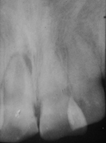
6(Case 2)- preoperative radiograph
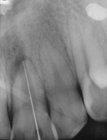
7- working length determination radiograph

8- apical MTA plug
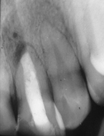
9- postoperative radiograph
DISCUSSION
The most important problem in the classic apexification technique with calcium hydroxide is theduration of the therapy, which is from 3 to 21months9. The duration depends on factors such as size ofthe apical opening, the traumatic displacement ofthe tooth and the repositioning methods used4. Calciumhydroxide creates an environment conduciveto the formation of an apical barrier formed by osteo-cementum tissue at the end of the root canal in teeth with open apices10. During apexification procedure the root canal is susceptible to reinfection because it is covered by a temporary seal. In addition, the canal is susceptible to fracture during treatment.5
To avoid this risk of fracture, apexification can be done in one visit, by placing a plug of MTA in apical 4 mm of the canal. Mineral trioxide aggregate (MTA) is a powder consisting of fine hydrophilic particles that bind in the presence of moisture3. Set MTA provides a good seal and excellent marginal adaptation. In vivo studies have confirmed biocompatibility of this material and have shown a hard tissue inductive effect5.MTA appeared to show good sealing ability, good marginal adaptation3, 11, a high degree of biocompatibility11 and a reasonable setting time (about 4 h)1,4. From a practical point of view, MTA can be used in the presence of moisture in the root canal. This property is important in teeth with necrotic pulps and inflamed periapical lesions because one of the problems found in these cases is the presence of exudate at the apex of the root12. Obturation of root canal system and coronal restoration in the tooth immediately are also regarded as key elements for long term conservation of treated teeth.
CONCLUSION
The use of MTA in combination with Abgel as matrix showed a positive initial outcome for the immature tooth. In such cases long term follow up is necessary to ensureand evaluate success. A better comprehension of the biological process andespecially about the role of MTA is necessary to understand the healing process and eventually to develop new clinical procedures.
REFERENCES
- Torabinejad M, Watson TF, Pitt Ford TR. Sealing ability of a mineral trioxide aggregate when used as a root end filling material. J Endod. 1993; 19:591–5.
- Matt GDet al. Comparative study of white and gray mineral trioxide aggregate (MTA) simulating a one-or two-step apical barrier technique. J Endod. 2004; 30:876-879.
- Torabinejad M, Chivian N. Clinical applications of mineral trioxide aggregate. J Endod.1999; 25:197–205.
- Pradhan DP, Chawla, Gauba K, Goyal A. Comparative evaluation of endodontic management of teeth with unformed apices with mineral trioxide aggregate and calcium hydroxide. J Dent Child.2006; 73(2):79–85.
- Felippe WT, Felippe MC, Rocha MJ. The effect of mineral trioxide aggregate on the apexification and periapical healing of teeth with incomplete root formation. Int Endod2006; 39:2–9.
- Ribeiro DA, Matsumoto MA, Duarte MA, Marques ME, Salvadori DM. Ex vivo biocompatibility tests of regular and white forms of mineral trioxide aggregate. IntEndod J.2006; 39:26–30.
- Koh ET, McDonald F, Pitt Ford TR, Torabinejad M. Cellular response to Mineral Trioxide aggregate. J Endod 1998; 24:543- 7.
- Al-Daafas A, Al-Nazhan S. Histological evaluation of contaminated furcal perforation in dogs teeth repaired by MTA with or without internal matrix. Oral Surg Oral Med Oral Pathol Oral Radiol Endod.2007; 103:92–9.
- Leonardo MR, Silva LA, Leonardo Rde, Utrilla LS, Assed S. Histological evaluation of therapy using a calcium hydroxide dressing for teeth with incompletely formed Apices and periapical lesions. JEndod. 1993; 19(7):348-52.
- Binniee WH, Rowe AHR. A histological study of periapical tissue of incompletely formed pulpless teeth filled with calcium hydroxide. J Dent Res 1973; 52:1110.
- Economides N, Pantelidou O, Kokkas A, Tziafas D. Short-term periradicular tissue response to mineral trioxide aggregate (MTA) as root-end filling material. IntEndod .2003; 36:44–8.
- Takita T, Hayashi M, Takeichi O, Ogiso B, Suzuki N, Otsuka K, Effect of mineral trioxide aggregate on proliferation of cultured human dental pulp cells. IntEndod J. 2006; 39:415–22.
Disclaimer from Guident
The views and opinions expressed in articles published in Guident are solely those of the authors and do not necessarily reflect the views of the editors, the editorial board or the publisher, Ivory India. Guident does not endorse any product, technique or treatment described. Clinical content is intended for qualified dental and medical professionals and is not a substitute for individual clinical judgement. Guident, its editors and the publisher accept no liability for any consequence arising from the use of information published in the journal.
How to cite this article
Dr. Sachin Gupta, Dr. Shikha Jaiswal, Dr. Namrata Sharma. Single Step Management of Open Apices Using MTA Aggregate with Apical Matrix. Guident. 2013 Jun;6(8). Available from: https://guident.in/articles/endodontics/single-step-management-of-open-apices-using-mta-aggregate-with-apical-matrix.html


