Fiber Reinforced Bridge
Department of Conservative And Endodontics Sree Balaji Dental College And Hospital Chennai, India
Abstract
The development of glass fiber reinforced with composite technology has created a new era in metal-free adhesive dentistry. Conservative chair side bridges can be fabricated by acid etching enamel and bonding a pontic to the adjacent natural tooth structure. These bridges are cost-effective and a viable alternative to conventional fixed bridges, especially where the edentulous space is no wider than one or two teeth. This article illustrates the use of glass fibers with case report.
Key words: Conservative bridge, vectris, glass fibers.
INTRODUCTION
Loss of anterior tooth may be an embarrassing situation for the patient. Rehabilitation of an anterior tooth space deems to be a challenging scenario. An immediate replacement is important to maintain facial esthetics and to provide a positive psychological feeling. A variety of treatment modalities are available for replacement of missing teeth, which includes a wide range of options from implant to conventional fixed prosthesis. Conservation of natural tooth structure, esthetics, minimal invasion and cost factor are some of the important factors that needs to be considered when replacing a missing tooth. However, there is an increasing patient demand for cost-effective and immediate replacement.1,2 All these demand has made the clinicians to choose alternate treatment avenues to meet this demand.3 The advancement in fiber-reinforced technique resin bridges have become a viable options to replace missing anterior teeth. The FRC bridges are adhesive, economic, minimally invasive. These glass fibers provide strength and stiffness while the surrounding matrix supports the reinforcement and provides workability.4 The fibers commonly used are glass polyethylene or carbon fibers. These fibers can be either in braided or in woven form.5 Thus the development of glass fiber has opened a new avenue in the field of adhesive dentistry to meet such demands. The commonly available glass fibers are embedded in di-metha-acrylate resin matrix. The other alternative system, is the use of different fiber interlaced glass filament (multiphase polymer), which in turn improve the impact and flexural strength of the material. Literature review suggests that FRC prosthesis has good longevity, especially if they are made by direct technique.5,3
Vectris, (Ivoclar) is a pre-impregnated synthetic glass fibers available both in unidirectional and in mesh form, which is being used in this following case. This case report illustrate a cost effective chair- side fiber reinforced composite fixed partial denture (FRC-FPD) to replace the missing teeth, an multidisciplinary approach to improve aesthetics.
CASE REPORT
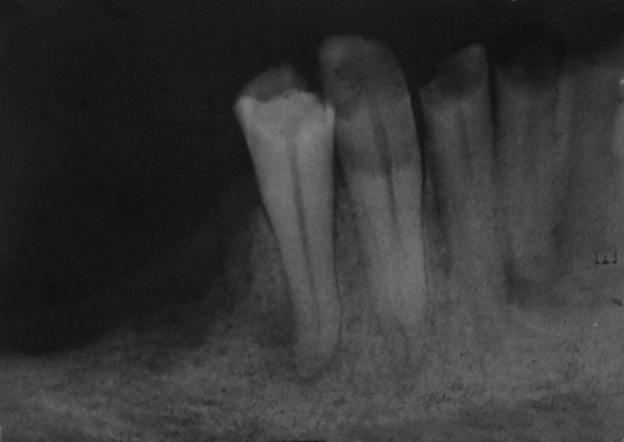
A 28-year-old male patient reported to the department with complaint of spacing between the lower anterior teeth. No relevant medical history was stated. Dental history revealed that there was a mild spacing present between the lower central incisors, which had gradually increased over a period of 4 years. On clinical examination, midline diastema was present between 31 and 41. It measured about 5-6 mm in width with no associated periodontal problem. Intra-oral periapical radiograph revealed a mild angular bone loss. Vital response was elicited in both 31 and 41 with EPT. Correlating the findings, a provisional diagnosis was made as pathological migration of 31 and 41. Since the patient insisted a

non-invasive procedure for the closure of the spacing and also due to time constrain, an immediate chair side conservative bridge was planned.
After through oral prophylaxis, the required length of fiber was predetermined by using a dental floss. Using the floss as a template, the required length of fiber was cut. Then the abutment teeth was roughened by using a coarse flame shaped diamond abrasive. They were then isolated and the pre-cut fiber was bonded in place with flowable resin composite. A direct resin composite pontic was fabricated onto the Vectris fiber. The excess resin cement was removed and the occlusal interference was checked both in centric and the eccentric position especially the anterior guidance. The finishing and polishing of the pontic was carried out by using composite finishing discs and stones. Oral hygiene instructions were given to the patient. This immediate chair side conservative bridge enabled the clinician to close the midline diastema in conservative manner and simultaneously it act as a splint, which in turn will prevent further migration of the teeth.6 The patient was recalledafter a week and was evaluated. It is two year since the completion of the treatment and the patient is satisfied with the outcome of the treatment.
DISCUSSION
The mild spacing reported in the above patient was treated using FRC-FPD, a long-term semipermanent restoration.7 The main advantage of this conservative bridge is preservation of natural tooth structure. However, in circumstances where cost factor, timeconstrain, aesthetics, age and clinical impracticality are considered this immediate conservative bridge is a viable alternative.
Several authors have reported on the clinical performance ofthis bridge.8,9 These FRC material effectively transfer the forces back to the resin thus providing excellent bonding and handling characteristic. The fiber provides increased flexural strength, which in turn resist cracking of the resin composite. Van Heumen et al has evaluated the outcome of this FRC-FPD and stated a survival rate of 64% after 5 years. The ideal site for this chair side bridge is space no wider than one or two teeth.10,11 Other criteria include oral
hygiene, periodontal condition, bite relation or any restorations in the abutment teeth.
Thus with the advancement in adhesive dentistry, fiber reinforced resin composite represent a low-cost alternative bridge to replace the edentulous space when compared to the traditional methods. In the follow-up period, the patient was recalled and was clearly informed about the importance of the oral hygiene to be maintained for the longevity of the restoration.10
CONCLUSION
This novel chair side fiber reinforced composite in combination with adhesive technique appear to be a promising treatment option for replacing missing teeth. Moreover this procedure requires proper case selection and precise technique. However further long-term clinical investigation is required to provide additional information.
REFERENCES
- Meiers JC, Kazemi RB. Chair side replacement of posterior teeth using a prefabricated fiber-reinforced resin composite framework technique:A case report. J Esthet Restor Dent 2005;17:335-42.
- Parolia A, Shenoy KM, Thomas MS, Mohan M. Use of a natural tooth crown as a pontic following cervical root fracture: A case report. Aust Endod J 2010;36:35-38.
- Garoushi S, Lassaila L, Vallittu PK. Resin-bonded fiber reinforced composite for direct replacement of missing anterior teeth: A clinical report. Int J Dent 2011;2011:845420.doi 10.1155/2011/845420.Epub 2011 Sep 20.
- Dyer SR, Lassila LV, Vallittu PK. Effect of cross-sectional design on the modulus of elasticity and toughness of fiber-reinforced composite materials. J Prosthet Dent. 2005; 94: 219-26.
- .Karbhari VM, Strassler H. Effect of fiber architecture on flexural characteristics and fracture of fiber-reinforced composites. Dent Mater. 2007; 23: 960-68.
- .Rappelli G, Putignano A. Tooth splinting with fiber-reinforced composite materials: Achieving predictable aesthetics. Pract proced Aesthet Dent 2002;14:495-500. More
Disclaimer from Guident
The views and opinions expressed in articles published in Guident are solely those of the authors and do not necessarily reflect the views of the editors, the editorial board or the publisher, Ivory India. Guident does not endorse any product, technique or treatment described. Clinical content is intended for qualified dental and medical professionals and is not a substitute for individual clinical judgement. Guident, its editors and the publisher accept no liability for any consequence arising from the use of information published in the journal.
How to cite this article
Dr. R. Mensudar. Fiber Reinforced Bridge. Guident. 2013 Jul;6(9). Available from: https://guident.in/articles/endodontics/fiber-reinforced-bridge.html