A Novel Impression Technique for Management of Partially Edentulous Mandible
Department of Prosthodontics A.B. Shetty Memorial Institute of Dental Sciences, Mangalore., India
Abstract
Rehabilitation is an essential phase of cancer care and it should be considered from the time of diagnosis. Surgical resection often creates large defects accompanied by dysfunction. Oral reconstruction of the subject who has a partially resected edentulous mandible is one of the most challenging procedures in front of a maxillofacial prosthodontist. Failure to restore the defect immediately after the surgery results in scar tissue formation, and also deviation of the mandible towards the resected side. This article presents the novel impression technique of a subject with partially resected and deviated dentulous mandible.
Key words: Partially resected edentulous mandible, deviated mandible, guiding flange, prosthodontic rehabilitation.
INTRODUCTION
Prosthetic rehabilitation of an acquired surgical mandibular defect presents the prosthodontist with a unique challenging experience. Since many subjects would have received radiation therapy either prior to or after surgery, the oral mucosa is atrophic and fragile, predisposing to irritation and ulceration, and the remaining mandibular segment may deviate medially. Speech, swallowing, control of saliva and mastication can be adversely affected. These cosmetic and functional impairments should be corrected or minimized, thereby allowing the patient to resume a normal working and social life.
CASE REPORT
A 58 yr old male subject(fig 1) was referred to the Department of Prosthodontics, A.B. Shetty Memorial Institute of Dental Sciences, Mangalore from Department of oral surgery. Patient underwent left hemimandibulectomy for Squamous Cell Carcinoma of the left mandibular alveolus two year ago.
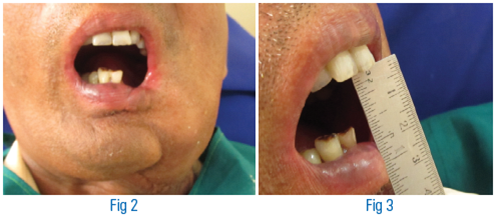
On intra oral examination, dentulous upper and lower arches with partially resected lower ridge on the left side was observed (fig 2). Restricted mouth opening of 10mm due to scar tissue formation on left corner of the mouth(fig 3).Deviation of the remaining mandibular segment towards left side was seen due to loss of mandibular continuity.
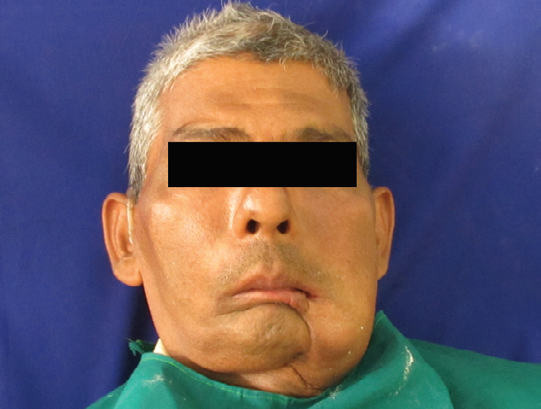
Fig 1
Radiographically the segmental resection of mandible was seen from left canine area to the subcondylar area. Extraoral examination revealed deviation of the mandible to the left side.
TREATMENT PLANNING
The main goal of mandibular rehabilitation is the reconstruction of form and restoration of the function. In this case as the deviation of the mandible was more than 8mm, maxillary guiding flange was planned initially, later with removable partial denture prosthesis to restore function and esthetics.
PROSTHODONTIC MANAGEMENT
As mouth opening was restricted to 10mm, conventional impression technique with stock tray was ruled out. To overcome this modified putty impression technique was planned to record both maxillary and mandibular impression in one step(fig 4). Putty was mixed and adapted to maxillary arch with fingers, and patient was guided to bite over it. After removal of impression from the mouth, cast was poured simultaneously on both the side (fig 5 & fig 6). The advantage of this impression was it also used as a bite to mount on the articulator(fig 7). Heat cure acrylic guiding flange was fabricated on maxillary arch and guided in the patient mouth(fig 8). Guiding flange

was relined every 15days by guiding the mandible from1.5mm to 2mm(fig 9). After three months 6mm of mandibular deviation was corrected(fig 10). Once the desired deviation was corrected a permanent cast partial denture will be fabricated.
DISCUSSION AND SUMMARY
The prosthetic rehabilitation of a hemi mandibul ectomy presents the prosthodontist with a unique challenging experience. A mandibular prosthesis which satisfactorily restores both functional and esthetic demands of that patient, provide a strong psychological mind frame for a socially isolated and depressed patient to lead a reasonably active socioeconomic life.
Surgical reconstruction by implants and grafts of various types is the ideal treatment when feasible. As the surgical reconstruction is not always feasible in every patient, prosthodontic approach has to be considered to restore the esthetic and function in such subject
These subjects need the definitive clinical and psychological support of the prosthodontist. Most of these subjects recognize the limitation of their rehabilitation and are appreciative of the efforts of the prosthodontist.
REFERENCES
- Beumer, J., III, Curtis, T. A. and Firtell, D. N. Maxillofacial Rehabilitation: Prosthetic and Surgical Considerations. C. V. Mosby, St. Louis, 1979
- Use of a guide plane for maintaining the residual fragment in partial or hemi mandibulectomy Robinson and Rubright, university of Chicago JPD 1964
- Swoope CC. Prosthetic Management of the resected edentulous mandibles. JPD 1969;21:197.
Disclaimer from Guident
The views and opinions expressed in articles published in Guident are solely those of the authors and do not necessarily reflect the views of the editors, the editorial board or the publisher, Ivory India. Guident does not endorse any product, technique or treatment described. Clinical content is intended for qualified dental and medical professionals and is not a substitute for individual clinical judgement. Guident, its editors and the publisher accept no liability for any consequence arising from the use of information published in the journal.
How to cite this article
Dr. Manoj Shetty, Dr. Krishna Prasad, Dr. Nirupama R.. A Novel Impression Technique for Management of Partially Edentulous Mandible. Guident. 2013 May;6(7). Available from: https://guident.in/articles/prosthodontics/a-novel-impression-technique-for-management-of-partially-edentulous-mandible.html