Local Drug Delivery
National Dental College & Hospital, Derabassi, Punjab, India, MM College of Dental Sciences & Research, Mullana (Ambala), Haryana, India, Department of Periodontology & Oral Implantology, National Dental College & Hospital, Derabassi, Punjab, India
ABSTRACT
Background: Local antimicrobial therapy has become an established part of the armamentarium for the reduction of plaque and gingival inflammation in the treatment of gingivitis. The inherent limitations of systemic or topical chemotherapies led to the development of local delivery systems for the administration of antimicrobials directly into the periodontal pocket.
Objective: The aim is to review the current methods and advances in local drug delivery of antimicrobial agents in periodontal diseases.
Methods: MEDLINE, google scholar and EMBASE was searched using terms local drug delivery, periodontal diseases, periodontitis.
Results & Conclusion: There is ample evidence to show that locally delivered antimicrobials can reduce clinical and microbial parameters to a level, if not better than, at least comparable to that of scaling and root planing. Mechanical instrumentation, whether in an opened or closed environment, can be technically demanding, time consuming, and in some periodontal defects, ineffective or incomplete. Local drug delivery on the other hand is simple to use and may conceivably in the future be delivered by the patients themselves, hence can be used as an adjunct to mechanical plaque removal.
KEY WORDS: Local drug delivery, periodontal diseases, periodontitis, scaling and root planning, probing depth, attachment level, gingival crevicular fluid(GCF), chlorhexidine(CHX)
INTRODUCTION
Periodontal diseases are a heterogenous group of diseases, proven to be caused by pathologic micro-organisms that organize to form a plaque associated biofilm on the tooth surface. The destruction of the periodontium is a result of interaction between micro-organisms and specific host defense mechanisms. Despite these differences and the complex interaction that exist between the bacteria and the host, a number of possible pathogens have been suggested on the basis of their association with disease progression in humans and other animals and their possession of virulence factors which could damage the tissues.
The concept of controlled-release local delivery of anti microbial agent was championed and developed into a viable concept primarily by Dr. Max Goodson.1 Goodson’s first delivery devices involved hollow fibers of cellulose acetate filled with tetracycline. These dosage forms or delivery systems are commonly referred to as sustained-release, controlled-release, prolonged release, timed-release, slow-release, sustained-action, prolonged-action or extended-action. These technologies assure therapeutic concentrations of the anti microbial in the sub gingival area for at least 3 days following a single application. In Periodontics, however, the application of currently available drugs to the sub gingival area may be appropriately described as local delivery or site-specific delivery.
CLASSIFICATION OF LOCAL DRUG DELIVERY SYSTEMS:
A) Classification based on the mechanism of action:
Langer & Pappas classified drug delivery into.3
- Diffusion – controlled devices
- Reservoirs (membrane devices)
- Matrices (monolithic devices)
- Chemically controlled systems
- Bioerodable systems
- Pendant chain systems
3.Swelling controlled systems
4.Magnetically controlled systems.
B) Classification based on the rate-controlling system:
Kornman2 classified controlled release delivery systems in Periodontics based on the release of the drug into:
- Reservoir without rate controlling system:
Includes devices such as hollow fibers filled with a therapeutic agent in which the agent is released simply by diffusion through the reservoir wall. These hollow fiber systems in periodontal pockets have been shown to release the drug so rapidly that they would qualify only marginally as sustained release devices.
- Reservoir devices with rate controlling system:
The most common forms include solvent action on coated drug particles, microporous polymer membranes or monolithic matrices, or erodable polymeric matrices. Delivery of coated particles usually involves preparation of the drug in a non-aqueous carrier and then coating granules of the material with various lipids such as bee’s wax or ethyl cellulose. The number of coats each granule receives will dictate its dissolution rate and therefore a mixture of coat thickness will produce granules that dissolve at varying rates. The rate of release of the drug may also be controlled by embedding the drug in an inert plastic matrix. The drug is granulated with an inert polymeric material such as polyethylene, polyvinyl acetate, or polymethacrylate. The drug is slowly released from the inert matrix due to leaching by the body fluids. The initially released drug is usually present on the surface of the polymer and is rapidly released; the more deeply embedded drug is leached out at a rate somewhat dependent on the concentration gradient.
C) Classification depending on the use:
Rams & Slots4 classified drug delivery into:
1. Personally applied (in patient home self care)
Non – sustained sub gingival drug delivery (Home oral irrigation)
- Sustained sub gingival drug delivery (None developed to date)
2. Professionally applied (in dental office)
- Non – sustained sub gingival drug delivery (Professional pocket irrigation)
- Sustained sub gingival drug delivery (Controlled – release device).
Advantages of local drug delivery
- Can attain 100 – fold higher concentration of an anti microbial agent in sub gingival sites compared with a systemic drug regimen.
- May employ anti microbial agents not suitable for systemic administration
- Reduces potential problems with patient compliance.
- Reduces systemic side effects.
- Reduces the risk of developing drug – resistant microbial populations at non – oral body sites.
Disadvantages of local drug delivery
- Difficulty in placing therapeutic concentrations of anti microbial agent into deeper parts of periodontal pockets and furcation lesions.
- Personal application of anti microbial agents by patients is frequently compromised by the patient’s lack of adequate manual dexterity, limited understanding of periodontal anatomy, poor compliance and performance with recommended procedures.
- Professional application in patients with numerous advanced lesions distributed throughout their mouth is time consuming and labour -intensive.
- Non -sustained sub gingival drug delivery is limited to brief exposure of the target microorganisms to the applied anti microbial agent.
- Do not markedly affect periodontal pathogens residing within adjacent gingival connective tissue and on extra – pocket oral surfaces, which increases the risk of later re infection and disease recurrence in treated areas.
EFFICACY OF LOCAL DRUG DELIVERY
Delivering of the anti microbial locally into periodontal pockets suppresses or eradicates the pathogenic micro biota or modulates the inflammatory response thereby limiting tissue destruction. In order to accomplish this, local application of pharmacological agents must fulfill the following criteria:
- The medication must reach the intended site of action.
- Remain at an adequate concentration.
- Last for a sufficient duration of time.
- Should have a sustained release.
PERIODONTAL CLEARANCE
Gingival crevicular fluid is an altered serum transudate found in the gingival sulcus. It has been estimated that the fluid present in a 5mm periodontal pocket is replaced about 40 times an hour. Thus if an anti microbial agent is placed subgingivally its local concentration is rapidly reduced.
The expected half-life of a pharmacological agent in the gingival crevice (i.e., the time necessary for the concentration to become half the original) is about 1 minute.
Gingival crevicular fluid flow into periodontal pockets averages 20μl per hour and markedly increases with gingival tissue inflammation. Total pocket fluid volume thus may turn over about 40 times an hour in a moderate sized periodontal pocket (0.5μl volume). Thus, controlled drug delivery systems are preferred for local drug delivery in Periodontics.
POSSIBLE DRUG RELEASE MECHANISMS FOR DRUG DELIVERY
The drug will be released over time either by diffusion out of the polymer matrix or by degradation of the polymer backbone. The continuous release of drugs from the polymer matrix could occur either by diffusion of the drug from the polymer matrix, or by the erosion of the polymer (due to degradation) or by a combination of the two mechanisms.
- By pure diffusion
- By chemical reactions
- By counter current diffusion
- By externally imposed controls.
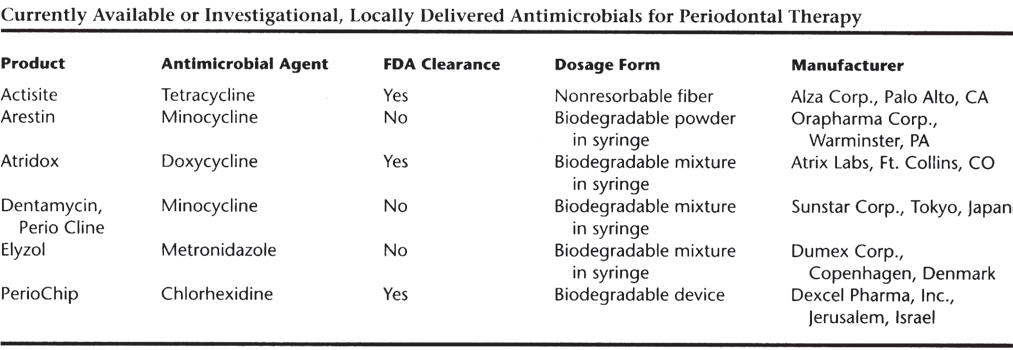
COMMERCIALLY AVAILABLE PRODUCTS
- Tetracycline fibers (Actisite, Alza Corp., Mountain view, California)
- Metronidazole gel (Elyzol, Dumex, Copenhagen, Denmark)
- Minocycline ointment (Dentomycine, Lederle, UK & Periocline, Sunstar, Japan)
- Chlorhexidine Chip (Perio chip Peno Products Ltd., Jerusalem, Israel)
- Doxycycline hyclate in a resorbable polymer (Atridox, Atrix Labs, CO)
- Minocycline microspheres (Arestin, Ora pharma, North Carolina, USA).
TETRACYCLINE CONTAINING FIBRES
The first local delivery product available in US was extensively studied, an ethylene /vinyl acetate copolymer fiber (0.5 mm diameter) containing tetracycline, 12.7 mg per 9 inches. When packed into a periodontal pocket, it was well tolerated by oral tissues, and for 10 days it sustained tetracycline concentrations exceeding 1300µg/ml, well beyond the 32-64µg/ml require to inhibit the growth of pathogens isolated from periodontal pockets in contrast to GCF concentrations of 4-8 µg/ml were reported after systemic tetracycline administration, 250 mg qid for 10 days.
Disadvantages
a. Length of time required for placement (≥ 10 minutes per tooth)
b. The considerable learning curve required to gain proficiency at placement
c. The need for a second patient appointment 10 days after placement for fiber removal.
d. Some studies showed placement of fibers around 12 or more teeth resulted in oral candidiasis.
SUBGINGIVAL DOXYCYCLINE
The FDA approved 10 % doxycycline in a gel system using a syringe (Atridox). It is the only local delivery system accepted by American Dental Association and is available in US and a number of other countries. In a 9 month multicenter study of 180 patients, treatment with 10% doxycycline gel alone was more effective than the other treatments with the exception of 3 month clinical attachment level value. Two multicenter clinical trials each studied 411 patients with moderate to severe periodontitis. At baseline, patients were randomized to one of four treatment groups: 10% doxycycline gel, vehicle control, oral hygiene only, and scaling and root planing. The results for all parameters measured were significantly better in the 10% doxycycline gel group compared with vehicle and oral hygiene only. Compared with SRP, the effects of 10% doxycycline gel as monotherapy on CAL gain and probing depth reduction were equivalent.
SUBGINGIVAL MINOCYCLINE
The FDA recently approved a new, locally delivered sustained – release form of minocycline microspheres (Arestin) for subgingival placement as an adjunct to SRP. The 2% minocycline is encapsulated into biresorbable microspheres in a gel carrier. This product (2% minocycline) is not available in US.
SUBGINGIVAL METRONIDAZOLE
A topical medication containing an oil- based metronidazole 25% dental gel (glyceryl mono-oleate and sesame oil) has been tested in a number of studies. This product is not available in the US. It is applied in a viscous consistency to the pocket , where it is liquidized by the body heat and then hardens again, forming crystals in contact with water. As a precursor, the preparation contains metronidazolebenzoate, which is converted into active substances by esterases in GCF. Two 25% gel applications at 1 week intervals have been used.
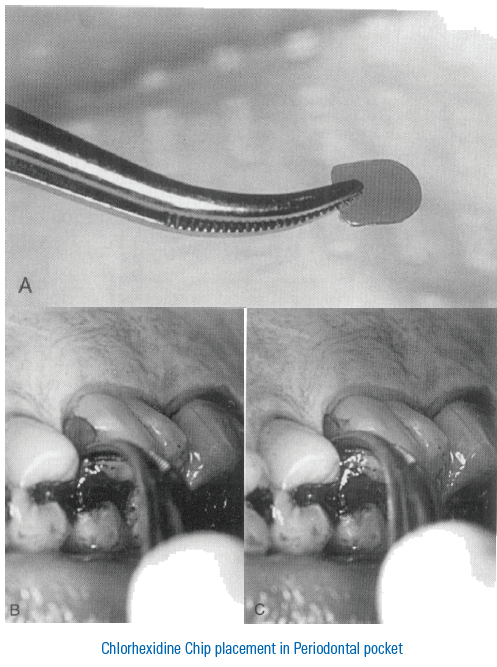
CHLORHEXIDINE CHIP
Periochip is a chip (4.0×5.0×0.35 mm) composed of a biodegradable hydrolysed gelatin matrix, cross-linked with glutaraldehyde and also containing glycerine and water, into which 2.5mg of chlorhexidine gluconate has been been incorporated per chip. The delivery systems releases chlorhexidine and maintains drug concentrations in the GCF greater than 100µg/ml for at least 7 days, concentrations well above the tolerance of most oral bacteria. Because the chip biodegrades in 7-10 days, a second appointment for removal is not needed. No signs of staining were noted in any of the previous three studies as a result of chlorhexidine chip treatment as measured by a stain index. Adverse effects were minimal, with a few patients who complained of slight pain and swelling in the first 24hrs after chip placement.
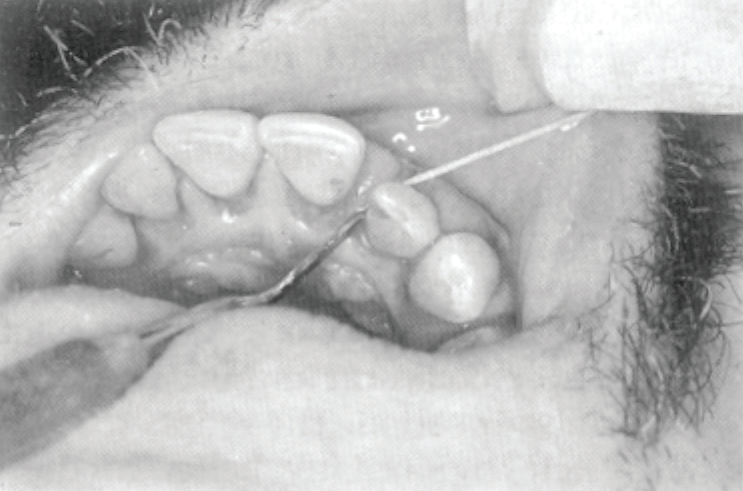
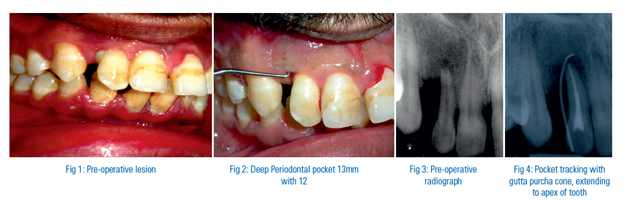
Tetracycline fibre placement in the periodontal pocket around the teeth
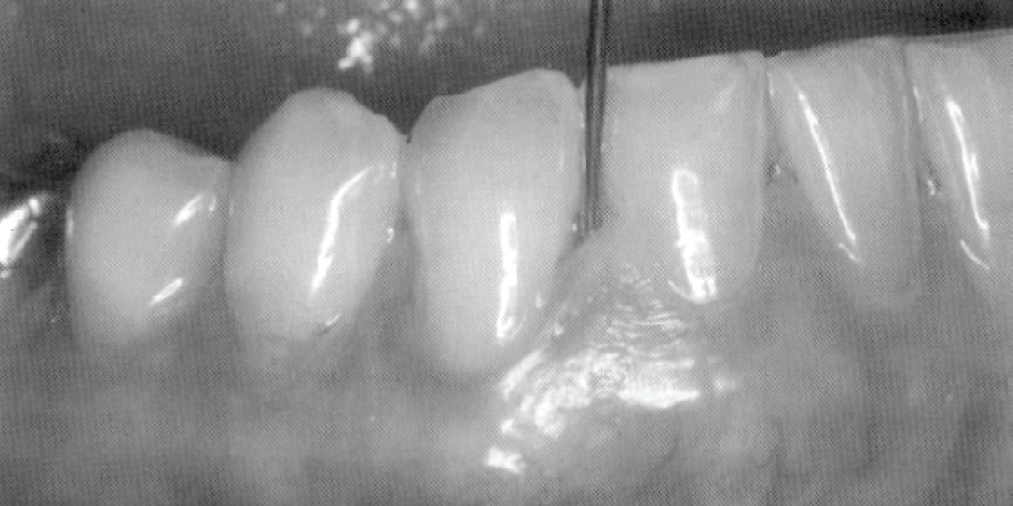
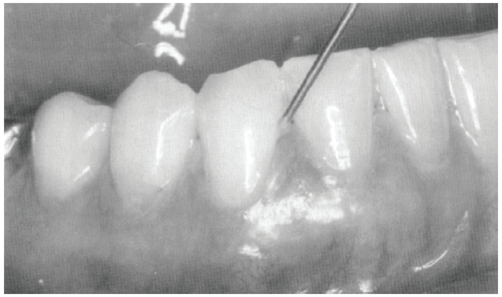
Local drug delivery agent (gel form) injected into the periodontal pocket
FUTURE DIRECTIONS IN CONTROLLED DRUG DELIVERY
The most exciting opportunities in controlled drug delivery lie in the arena of responsive delivery systems, with which it will be possible to deliver drugs through implantable devices in response to a measured blood level or to deliver a drug precisely to a targeted site. Much of the development of novel materials in controlled drug delivery is focusing on the preparation and use of these responsive polymers with specifically designed macroscopic and microscopic structural and chemical features.
Such systems include:
- Copolymers with desirable hydrophilic / hydrophobic interactions.
- Block or graft copolymers.
- Complexation networks responding via hydrogen or ionic bonding.
- Dendrimers or star polymers as nano particles for immobilization of enzymes, drug, peptides, or other biological agents.
- New bio degradable polymers.
- New blends of hydrocolloids and carbohydrate – based polymers.
These new biomaterials with desirable functional groups are being created by researches who envision their use not only for innovative drug delivery systems but also as potential lining for artificial organs, as substrates for cell growth or chemical reactors, as agents in drug targeting and immunology testing, as biomedical adhesives and bio separation membranes, and as substances able to mimic biological systems. Successfully developing these novel formulations will obviously require assimilation of a great deal of emerging information about the chemical nature and physical structure of these new materials.
A study assessed the feasibility of treating periodontal disease by controlled delivery of antimicrobial agents. Small diameter cellulose acetate hollow fibers were filled with tetracycline and tested under various conditions. Tests indicated that antibacterial levels could be sustained in the periodontal pocket for prolonged periods and could dramatically alter the microbial composition and decrease the clinical signs of disease without indications of local irritation. Furthermore, it was found that drug filled hollow fibers can be manipulated by dental personnel to provide drug therapy with less than 1/1000 the amount of tetracycline that would have been used for systemic therapy.5
A drug containing acrylic strips of antibacterial agents chlorhexidine, tetracycline, and metronidazole for local protracted drug delivery into periodontal pockets was developed. The in vitro release pattern of these acrylic strips was compared with that of dialysis tubing. At 30%, 40% and 50% admixtures and acrylic strips released the drugs up to 14 days. It was concluded that cold cured acrylic in the form of strips may be used to deliver drugs into periodontal pockets for protracted periods measured in days.6
A study was conducted to examine the release kinetics of chlorhexidine from a sustained release device (SRD) prepared from ethyl cellulose (fast SRD) or ethyl cellulose with polyethylene glycol (slow SRD) and to examine the effects on bacterial flora of pockets in patients with periodontal disease. It was shown that fast SRD’s released up to 80% of the chlorhexidine within the first 3 days of insertion. The rate of chlorhexidine released was dependent on the structure of SRD the drug concentration within the device, and the effective surface area.7
A study was conducted to develop a degradable sustained release device composed of a cross-linked protein containing chlorhexidine as the therapeutic agent. This work demonstrated that the release of chlorhexidine from a degradable delivery system and the degradation of the matrix could be controlled by variation in the formulation. This presented a new dental drug system that could be used as an adjunct in the treatment of periodontal diseases in future. These studies enable us to choose the pharmaceutical formulations for clinical trials to be conducted, testing the efficacy of this treatment modality.8
A comparison of the anti microbial effects of the application of chlorhexidine gel, amine fluoride gel and stannous fluoride gel in debrided periodontal pockets and concluded that sub gingival application of these gels did not augment the effect of mechanical debridement, bacteriological and clinical parameters during the experimental period, however the indicated treatments resulted in a facultative sub gingival micro flora which is compatible with the host.9
A study evaluated the role of local drug systems in the management of periodontal diseases. The efficacy of several local delivery devices (i.e. tetracycline fibers, metronidazole and minocycline gels, chlorhexidine chips and doxycycline polymer) with regard to their functional characteristics, effectiveness in mono therapy, as compared to scaling and root planing and ability to enhance conventional therapy were assessed. They suggested that local drug delivery following judicious pharmacologic principles along with controlled release properties had the potential to be used as a therapeutic component in the management of periodontal diseases.10
A study on the use of locally delivered chlorhexidine in the treatment of periodontitis and the clinical results was conducted. This report discussed this new bio degradable system containing chlorhexidine gluconate as the active agent-Periochip. Pharmacokinetics of the system and a review of the multi center studies in Europe and the United states were discussed. In these randomized clinical trials the chlorhexidine chip enhanced the effects of scaling and root planing.11
A study was conducted to evaluate the clinical and microbiological effects of three sustained release biodegradable polymers i .e. AtridoxTM, ElyzolR Denta Gel & PeriochipR delivered into periodontal pockets. They found a statically significant attachment level for AtridoxTM and a significant reduction in probing depth for all the three devices.12
They have given a systematic review on local anti infective therapy, stating that these agents combined with scaling and root planing appear to provide additional benefits in probing depth reduction and clinical attachment gain compared scaling and root planing alone.13
A study was conducted in vitro on controlled release cellulose acetate films for local delivery of chlorhexidine, indomethacin and meloxicam. They stated that cellulose acetate may be a suitable inert material for obtaining a prolonged local delivery of various anti inflammatory agents like meloxicam. Also added that further in vitro and in vivo studies are required before starting clinical applications of these controlled release formulations of anti inflammatory agents.14
CONCLUSION
An approach using local drug delivery system containing antimicrobials has been introduced. These systems allow therapeutic agents to be targeted to the diseased sites with minimal systemic effects.
There is ample evidence to show that locally delivered antimicrobials can reduce clinical and microbial parameters to a level, if not better than, at least comparable to that of scaling and root planing. Mechanical instrumentation, whether in an opened or closed environment, can be extremely technically demanding, time consuming, and in some periodontal defects, ineffective or incomplete. Local drug delivery, on the other hand, generally appears to be simple to use and may conceivably in the future be delivered by the patients themselves.
REFERENCES
- Goodson J. M, Haffajee A. and Socransky S. S. “Periodontal therapy by local delivery of tetracycline”. J. Clin. Periodontol; 1979; 83-92.
- Kenneth S. Kornman “Controlled release local delivery antimicrobials in periodontics: Prospects for the future” J. Periodontol, 1993; 64: 7825-791.
- Langer R, Peppas N. Present and future applications of biomaterials in controlled drug delivery systems. Biomaterials 1981; 2: 201-214.
- Rams TE and Slots J. Local delivery of antimicrobial agents in periodontal pockets. Periodontol 2000 1996; 10: 139-159.
- Goodson J. M, Haffajee A. and Socransky S. S. “Periodontal therapy by local delivery of tetracycline”. J. Clin. Periodontol; 1979; 83-92.
- Addy M, Rawle L, Handley R, Newman H. N. and Conventry J. F. “The development of in vitro evaluation of acrylic strips and dialysis tubing for local drug delivery”. J. Periodontol, 1982; 53: 693-699.
- Soskolne A., Golumb G., Friedman M. and Sela M. N. “New sustained release dosage form of chlorhexidine for dental use in periodontal therapy”. J. Periodontol Res. 1983; 18: 330-336.
- Steinberg D., Friendman M., Soskolne A., Sela M.N. “A new degradable controlled release device for treatment of periodontal disease – in vitro release study”. J. Periodontol. 1990; 61: 393-398.
- Oosterwaal P. J. M., Milex F. H. M., Vant Hof M. A. and Reunggli H. H. “Comparison of antimicrobial effect of the application of chlorhexidine gel, amine fluoride gel and stannous fluoride gel in debrided periodontal pockets”. J. Periodontol, 1991; 18: 245-251.
- Greenstein G. and Polson A. “The role of local drug delivery in the management of periodontal diseases – A comprehensive review” J. Periodontol, 1998; 69: 507-520.
- Killoy W. J. “The use of locally delivered chlorhexidine in the treatment of periodontitis, clinical results”. J. Clin. Periodontol 1998; 25: 953-958.
- Salvi GE, Mombelli A et al. Local anti-microbial therapy after initial periodontal treatment. A randomized clinical trial comparing three biodegradable sustained release polymers. J Clin Periodontol 2002; 29: 540-550
- Hanes PJ and Purvis JP. Local anti-infective therapy: Pharmacological agents. A systematic review. Ann Periodontol 2003; 8: 79-94.
- Cetin EO, Buduneli N et al. In vitro studies on controlled release cellulose acetate films for local delivery of chlorhexidine, indomethacin and meloxicam. . J Clin Periodontol 2004; 31: 1117-1121.
Disclaimer from Guident
The views and opinions expressed in articles published in Guident are solely those of the authors and do not necessarily reflect the views of the editors, the editorial board or the publisher, Ivory India. Guident does not endorse any product, technique or treatment described. Clinical content is intended for qualified dental and medical professionals and is not a substitute for individual clinical judgement. Guident, its editors and the publisher accept no liability for any consequence arising from the use of information published in the journal.
How to cite this article
Dr. Gurpreet Kaur, Dr. Rajat Dang, Dr. Deepak Grover. Local Drug Delivery. Guident. 2013 Jul;6(9). Available from: https://guident.in/articles/periodontics/local-drug-delivery.html