Tooth Implant Supported Prosthesis
Wisdom Dental Clinics Jaipur, India
ABSTRACT
A Dental prosthesis that involves the combination of dental implants and natural teeth to replace missing teeth can not only increase the retention of the prosthesis but also provide good stability and aesthetic outcomes in most of the situations. However, prudent incorporation of the biomechanical principles is necessary for the design and construction of the prosthesis. Certain issues can arise in the long-term success of the treatment that involves tooth-implant connection prosthesis due to the anatomical differences in the functioning of tooth and an implant.
Keywords: Fixed partial dentures, Rigid connection, Combination prosthesis, Implants, Full mouth rehabilitation
INTRODUCTION
Since many years dental Implant treatment has emerged as a universally accepted treatment modality by the clinicians worldwide. It has been proved that long term success rate of dental implant is more than 90% for treatment of both completely and partially edentulous patients.
However, the combination of natural teeth and dental implants to fabricate a prosthesis still remains a controversial issue as the survival rate of such prosthesis is lower compared with solely Implant supported prosthesis or tooth supported fixed dental prosthesis. The biomechanics of a dental Implant is different from that of a natural tooth, as dental implants integrate by the process of osseointegration that allows them to fuse with the supporting bone.
Whereas, in case of natural dentition, the surrounding periodontal ligament allows physiological mobilisation of the teeth. Dental Implants & natural teeth behave differently when exposed to masticatory load due to the difference in their biomechanics. However, sometimes in an unavoidable situation, an ideal prosthesis that involves only teeth cannot be given. Long term success of the Implant supported prosthesis is abundant whereas, limited data is available on the long term prognosis of a combination of a tooth & implant supported prosthesis.
CASE REPORT
A 59 year old healthy male reported with failing old bridge in upper front region. Many of the teeth underneath were decayed, non restorable while some of them are in healthy condition & can serve as long term pontic in the long edentulous span. (Figure. 1a, b)

(a)

(b)
Figure 1a, b: Pre-operative image of patient
It was planned to give Tooth-Implant supported prosthesis, and loading it immediately, subject to good insertion torque and biologic stability (ISQ).
So, grossly decayed right upper canine and left upper 3rd molar were extracted. Left upper canine and 2nd premolar were endodontically treated, which are going to serve as pontic. (Figure. 2)
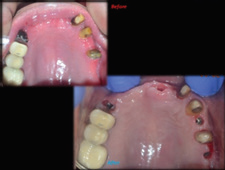
Figure. 2: Endodontic treatment done
After this, 4 Nobel active implants were placed free hand in 13, 21, 24 and 26 region.(Figure. 3) Good insertion torque of more than 40 NCM was achieved in all the implants with ISQ of 75, 74, 79 & 76 respectively.
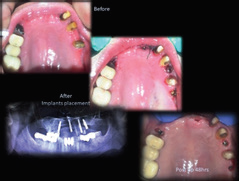
Figure. 3: Implant placement
Following this, implant level impressions were made on the same sitting. Two days later metal trial of the prosthesis was made, and passive fitting of the prosthesis was checked.(Figure. 4)

Figure. 4: Final prosthesis
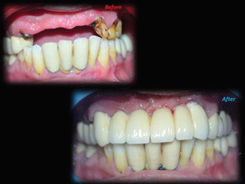
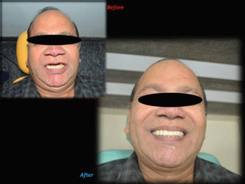
After minor adjustments, PFM prosthesis was delivered after four days. Prosthesis was in functional occlusion & checked for any premature contacts and irregularities. (Figure. 5a, b)
(a)
(b)
Figure. 5a, b: Post- op image of patient
Patient was strictly advised to be on soft diet for 2 months and take proper oral hygiene measures.
Recalled after 1 week, 1 month, 2 month, 6 month & then every 1 year. Acceptable hard and soft tissue architecture along with stable occlusion was seen at 1 year follow up. (Figure. 6)
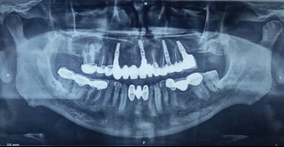
Figure. 6: One year follow up
DISCUSSION
A tooth implant combination prosthesis is supported by both dental implant and natural teeth. The distribution of remaining natural teeth in certain cases may not be favourable for the ideal fixed dental prosthesis. Hence, they are supplemented with dental implant as the last resort. Providing a combined prosthesis not only provide numerous advantages like additional support, proprioception, better load sharing but also reduces the financial burden on the patient. The potential risk involved in combination prosthesis is the difference in the biomechanics of the prosthesis supported by the natural teeth and the dental implants. In cases of prosthesis supported by natural teeth, the periodontal ligament transfer forces to the surrounding bone whereas in an implant the concentration of the force is at the crestal bone level. It is necessary to provide an implant protected occlusion in such scenarios to increase the long term prognosis.
CONCLUSION
In this case report , patient’s dentition was successfully restored by using a combination prosthesis supported by both, a dental implant and natural teeth. A Year Follow up revealed, no to negligible bone loss (Under Physiological Limits) at the crestal level surrounding the implant suggestive of equal distribution of load to the combined natural tooth and the implant. Proper designing & execution of the dental prosthesis can help the clinician overcome the problem associated with stress distribution.
REFERENCES
- Hobo S, Ichida E, Gacia LT. Osseointegration and occlusal rehabilitation. Tokyo: Quintessence; 1989.
- Carl E Misch. Contemporary Implant Dentistry. 3rd ed. Elsevier; 2007.
- Lang N, Pjetursson B, Tan K. A systematic review of the survival and complication rates of fixed partial dentures after an observation period of atleast 5 years, combined tooth implant supported FPDs. Clin Oral Implants Res 2004; 15(6): 643-53.
- Brunski JB, Puleo DA, Nanci A. Biomaterials and Biomechanics of oral/maxillofacial implants: Current status and future developments. Int J Oral Maxillofac Implants 2000; 15(1): 15-46.
- Palmer RM, Howe LC. Implant dentistry-prosthodontics: a prospective 3 year study of fixed bridges linking Astra tech ST implants to natural teeth. Clin Oral Implants Res 2005; 16(3): 302-7.
- El Charkawi Hussein G, Zerky Khaled A, Mohammed T.Elwakad. Stress analysis of different osseointegrated implants supporting a distal extension prosthesis.
J Prosthet Dent 1994; 72(6): 614-22. - Clelland NL, Ismail YH, Zaki HS, Pipko D. Three dimensional finite element stress analysis in and around the screw and implant. Int J Oral Maxillofac Implants 1991; 6(4): 391-8.
Disclaimer from Guident
The views and opinions expressed in articles published in Guident are solely those of the authors and do not necessarily reflect the views of the editors, the editorial board or the publisher, Ivory India. Guident does not endorse any product, technique or treatment described. Clinical content is intended for qualified dental and medical professionals and is not a substitute for individual clinical judgement. Guident, its editors and the publisher accept no liability for any consequence arising from the use of information published in the journal.
How to cite this article
Dr. Gaurav Gupta, Dr. D. K. Gupta, Dr. Neelja Gupta. Tooth Implant Supported Prosthesis. Guident. 2019 Dec;13(1). Available from: https://guident.in/articles/implantology/tooth-implant-supported-prosthesis.html