Fabrication of Hollow Maxillary Denture Using Caramel Spacer - an Innovative Method
Department of Prosthodontics and Crown-Bridge. College of Dental Surgery, B.P. Koirala Institute of Health Sciences, Dharan, Nepal.
ABSTRACT
Background Retention, stability and support are the basic principles on which the success of a complete denture relies on. Extreme resorption of the maxillary denture-bearing area leads to a narrower, constricted residual ridge with decreased supporting tissues and a larger restorative space between the maxillary and mandibular residual ridge. Rehabilitation in such cases may result in increased weight and height of the prosthesis further compromising its retention, support and stability. So, to prevent further resorption of ridges, the weight of the prosthesis needs to be reduced which can be achieved by making hollow prosthesis. This case report describes an innovative technique of fabricating hollow maxillary complete denture using a caramel spacer.
Keywords: Caramel Spacer Hollow denture, light weight denture
Introduction
Extreme resorption of the maxillary denture bearing area may lead to problems with prosthetic Rehabilitation. Fabrication of complete denture in such cases result in a heavy maxillary denture, which can lead to poor denture bearing capacity i.e. decreased retention and resistance.1 This problem can be overcome by reducing the weight of maxillary denture, by making it hollow. Denture can be made hollow by using a solid three dimensional spacer, including dental stone2, cellophane wrapped asbestos3, silicone putty4, modelling clay5 or salt6 during laboratory processes to exclude denture base material from the planned hollow cavity of the prosthesis.
Holt et al5 processed a shim of indexed acrylic resin over the residual ridge and used a spacer which was then removed and the two halves luted with auto polymerized acrylic resin.
O’Sullivan et al1 described double flask method for fabricating a hollow maxillary denture using silicone putty. Though this technique was useful in estimation of the spacer thickness, but removal of putty was found to be difficult especially from the anterior portion of the denture. Moreover, the openings made from the distal end had to be sufficiently large to retrieve the hard putty.
This article describes an innovative technique for the fabrication of a hollow maxillary denture using caramel spacer.7
CASE REPORT
A 68-year-old male patient reported to the Department of Prosthodontics and Crown-Bridge for prosthetic rehabilitation of maxillary and mandibular edentulous ridges. On examination, it was found that both the upper and lower arches were completely edentulous and severely resorbed. His upper lip was long, the inter-ridge distance was more than normal with increased interarch space. Hence it was decided to fabricate complete set of denture. The following treatment options for complete denture were available to the patient.
- Implant supported complete denture.
- Conventional Complete denture.
- Hollow maxillary complete denture and conventional mandibular complete denture.
Pros and cons of all options were explained to the patient. The patient approved hollow maxillary complete denture and conventional mandibular denture as treatment modality because it was light in weight, inexpensive and non-surgical procedure.
Procedures for Fabrication of Hollow Maxillary Denture.
- Preliminary and final impressions were made in conventional manner using impression compound and zinc oxide eugenol (DPI Impression paste, Mumbai, India) respectively.
- At the time of jaw relation, due consideration was given to adjust maxillary occlusal rims properly as to provide proper aesthetics to the patient with long upper lip. Teeth (Acry Pan, Ruthinium, India) were selected and arranged in balanced occlusion and try-in was done. The trial denture was duplicated in irreversible hydrocolloid (Zelgan 2002, DENTSPLY) and poured with die stone (Kalstone, Kalabhai Karson) (figure 1). A template of the duplicated trial denture was made with 0.5-mm thermoplastic sheet (Erkodent) in vacuum heat-pressed thermoforming unit ((Erkopress 300Tp). The trial denture was then processed in the standard manner up to the wax elimination stage.
- 2 mm modelling wax (Modelling wax, Dento kem, India) adapted over master cast to ensure adequate and uniform thickness of resin in the complete denture (figure 2).
- For the purpose of achieving the hollow cavity, first a temporary putty spacer (Zeta Plus, Zhermack) was made (figure 3).
- Template was placed over the putty spacer and an endodontic file with a rubber stop was used to measure the space between the template and the adapted modelling wax on master cast (figure 4).
- Putty spacer was lubricated with Vaseline and putty index was formed.
- Sugar was heated in a stainless steel bowl on an open flame till it became caramel and then poured into the putty index, and allow it to cool (figure 5).
- Caramel spacer was removed and its exact replication was verified by placing between the master cast with 2mm of modelling wax adapted over it and template (figure 6).
- After this, a trial closure was carried out using the temporary putty spacer (figure 7), the flask was opened and temporary putty spacer was retrieved (figure 8). The hollow space left by the temporary putty spacer was now filled with the caramel spacer and final closure of the flasks was achieved (figure 9). The denture was acrylized in conventional manner.
- The denture was retrieved. Two small openings were made distal to the most distal tooth (figure 10 &11). The denture was then immersed in a bowl of water overnight to allow dissolution of caramel spacer. The hollow cavity was air dried, and the openings were sealed using autopolymerizing acrylic resin.
- Dentures were then finished, polished, and delivered to the patient (figure12). The patient was reviewed after a week, and minor adjustments were made.
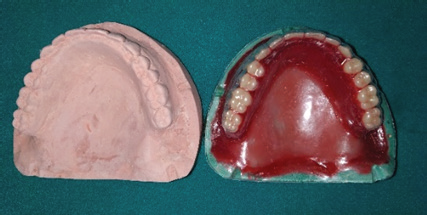
Fig 1: Trial denture and duplicated denture cast

Fig 2: Modelling wax adapted on master cast
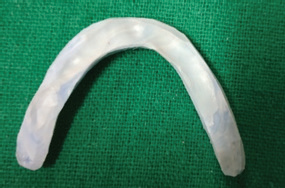
Fig 3: Putty Spacer
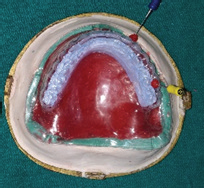
Fig 4: Template adapted on master cast with putty index and checked space using endodontic file with rubber stoppe

Fig 5: Caramel spacer poured on putty index
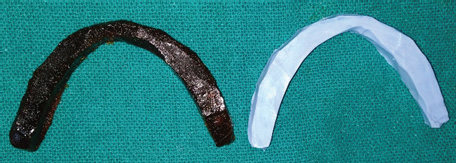
Fig 6: Caramel spacer and putty spacer

Fig 6: Caramel spacer and putty spacer

Fig 10: Processed FInal denture

Fig 11: Hollow denture

Discussion
The method described in this case has several advantages over previously described techniques for the hollow denture fabrication. Most of the methods described in the literature have either used two flasks which is time consuming and requires multiple measurements to achieve adequate thickness of acrylic resin.2-6 The technique described above used only single flask. The thickness of the acrylic resin can be controlled and uniform thickness can be acheived using this technique. This technique eliminates the requirement of two identical flasks and the extra step of fabrication of a permanent record base.
Caramel is a brown product originating from various sugars when they are heated. Caramel is used as a spacer in this case because it can be shaped as needed, it becomes hard as soon as it cools down, it does not adhere to or interact with acrylic resin, and can be easily retrieved from the putty index.
The major drawback of this technique is that solid caramel is brittle and therefore should be handled with care.7
Conclusion:
Hollow maxillary complete denture is boon to patients with increased inter ridge distance and severely resorbed ridges. It besides enhancing the retention considerably reduces the weight of the prosthesis and prevents transmission of detrimental forces to the underlying tissues. This technique overcomes the disadvantages of the older techniques. Hence, it’s a simple, economical, time-saving and a predictable technique.
References
- Sullivan M, Hansen N, Cronin RJ, Canga DRThe hollow maxillary complete denture: A modified technique. The Journal of Prosthetic Dentistry, 2004; 91(6): 591-594.
- Brown KE. Fabrication of a hollw bulb obturator. J Prosthet Dent 1969 Jan; 21(1): 97-103.
- Worley JL, Kniejski ME: A method for controlling the thickness of hollow obturator prostheses. The Journal of Prosthetic Dentistry. 1983; 50: 227-229.
- Gardner LK, Parr GR, Rahn AO: Simplified technique for the fabrication of a hollow obturator prosthesis using vinyl polysiloxane. The Journal of Prosthetic Dentistry. 1991; 66: 60-62.
- Holt RA Jr. A hollow complete lower denture. The Journal of Prosthetic Dentistry 1981; 45:452-454.
- Aggrawal H, Jurel Sk, Singh RD, Chand P, Kumar P. Lost salt technique for severely resorbed alveolar ridge. An innovative approach. Contemp Clin Dent 2012 july- Sep; 3 (3): 352-353.
- Bhushan P, Aras MA, Chitre V, Mysore AR, Mascarenhas K, Kumar S. The Hollow maxillary complete denture: A simple, precise single-flask technique using caramel spacer. J Prosthodont 2017; 28(1):1-5.
Disclaimer from Guident
The views and opinions expressed in articles published in Guident are solely those of the authors and do not necessarily reflect the views of the editors, the editorial board or the publisher, Ivory India. Guident does not endorse any product, technique or treatment described. Clinical content is intended for qualified dental and medical professionals and is not a substitute for individual clinical judgement. Guident, its editors and the publisher accept no liability for any consequence arising from the use of information published in the journal.
How to cite this article
Dr. Mira Singh, Dr. Pramita Suwal, Dr. Raj Kumar Singh. Fabrication of Hollow Maxillary Denture Using Caramel Spacer - an Innovative Method. Guident. 2019 Dec;13(1). Available from: https://guident.in/articles/prosthodontics/fabrication-of-hollow-maxillary-denture-using-caramel-spacer-an-innovative-method.html