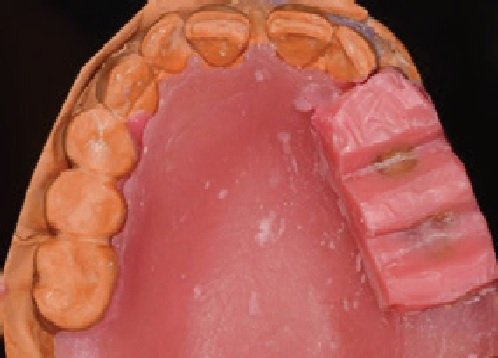
Placement of Immediate Dental Implant in the Anterior Maxilla
Department of Dentistry SIPS Superspeciality Hospital & Trauma Centre, Lucknow (U.P) INDIA
ABSTRACT
Implant placement in the anterior maxilla remains a challenge to even the most experienced clinician. Immediate implant placement is a risky procedure in itself and only successful in limited cases. To combine these modalities is expected to have a variety of complications and possible negative outcome. Due to the pressure of patients’ lifestyles and time constricting careers, there is an increased demand for combined procedures. Immediate implant placements have been researched extensively and with the increased success rate of dental implants it is becoming the preferred choice of treatment by clinician and patient. Optimal aesthetics is difficult to obtain after surgical implant placement, especially when treating the anterior maxillary incisor area. Various guidelines have been put in place with regards to the planning, surgical execution and restorative phases of implant treatments in order to optimize the clinical results. This clinical case study is representative of such instance, when following the correct guidelines; a successful outcome is made possible. The case report includes the planning, execution and outcome stages of an immediate implant in the anterior maxilla.
In the present case report a 26 year old male patient reported to our hospital with fractured upper right lateral incisor tooth. After careful examination and treatment planning immediate implant treatment was initiated. The teeth were extracted atraumatically. We placed one Ankylos implant into the extraction sockets and the defect was closed with Mucograft. The prosthetic rehabilitation was done with metal ceramic crown.
Keywords: Immediate Implant, Customized Impression Coping, Anterior Maxilla, Mucograft, Aesthetic zone
INTRODUCTION
Dental implants have become a standard treatment option for replacement of missing tooth. Originally, it was standard protocol to wait for a period of 6 to 8 months after tooth extraction, to place the dental implant. This was to allow for the healing of the alveolar bone.
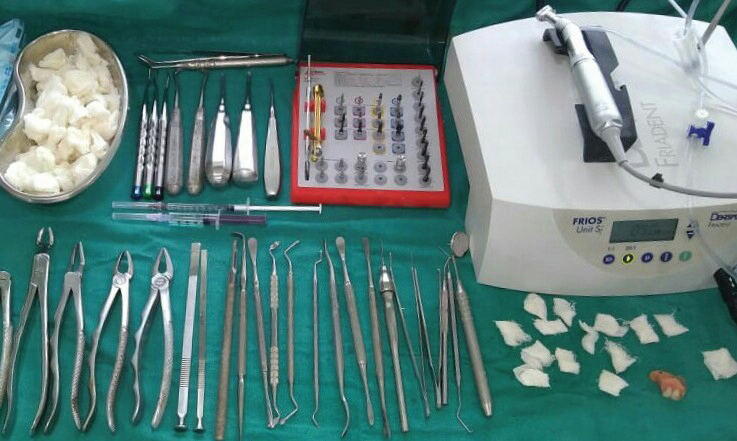
Fig. Instrument selection
- However this waiting period was a major disadvantage of this treatment modality. Subsequently, attempts were made to shorten this duration of waiting period. Techniques such as early placement, immediate delayed placement and immediate placement were developed.
- Moreover, the aesthetic requirement of the patient has to be taken into consideration for shortening the treatment time wherever anterior teeth were to be replaced. The immediate implant placement in an extraction socket was first described by Schulte and Heimke in 1976.
- Not only are the time period and number of operations reduced, several other advantages have been put forth including improved implant survival rates, better aesthetics, higher patient satisfaction as compared to delayed implants and prevention of undue resorption bound to happen post extraction.
- It also allows for maintenance of gingival form and promotes periimplant gingival tissue esthetics by maintaining the interdental papillae. Small osseous defects, which are frequently found adjacent to implants placed at the time of tooth extraction, can be grafted with autogenous or synthetic bone grafts. However, because of the nature of this treatment method, a higher risk of complications and failures may be expected.1 In this case report the harmony of hard and soft tissues was preserved by immediate implant placement.
CASE REPORT
A 26 year old male patient reported to the Department of dentistry, SIPS hospital, Lucknow (UP), with a complaint of fractured upper right lateral incisor tooth due to trauma. Relative medical history was sound. Unfavorable prognosis for the teeth was explained to the patient. The patient was informed about various treatment options. The patient being conscious about esthetics and early rehabilitation opted for immediate implant placement. Lab investigations were also done and everything was normal. Pre surgical radiographic evaluation was carried out with OPG and IOPAR for appropriate treatment planning. After measuring the socket lengths, implants (Ankylos) of size 3.5*13 mm were selected. After injecting 2% Lignocaine (1:80,000 conc.), the fractured teeth were atraumatically extracted using a periotome. However, during the extraction, sockets were evaluated for any osseous defects, infection or granulomatous tissue. The sockets were thoroughly debrided with saline solution and after sequential drilling with copious irrigation, the implants were placed. The residual gaps between the implants and the cortical bone, was filled with Mucograft. The closure of the site was done using 3-0 vicryl sutures. The second stage surgery was done after a healing period of 6 months. The implants were exposed carefully, without damaging the surrounding bone. The gingival former was placed and kept in place for 2 weeks, then removed. A closed tray impression was made, using implant analogues and transfer coping, using additional silicone impression material. The shade of the prosthesis was matched with Vita 3D Shade Guide. A metal ceramic prosthesis was fabricated. The crowns were cemented with Glass Ionomer luting cements on the abutment. Post operative x- ray was taken and follow up was done over a period of 18 months.
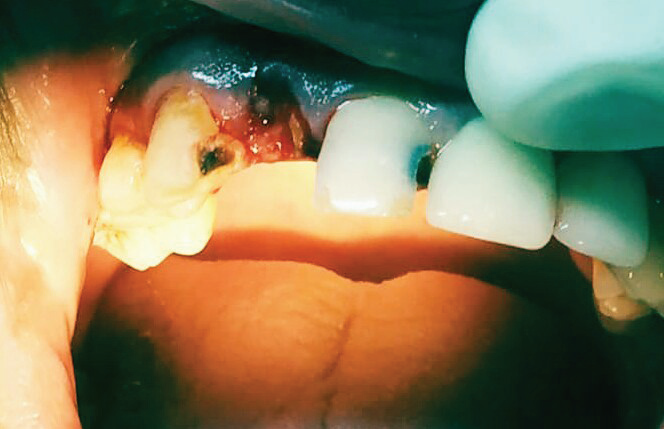
Fig. Pre- operative
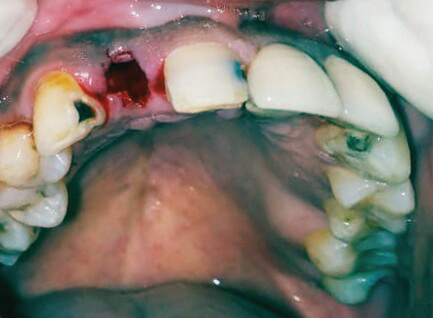
Fig. Extraction done
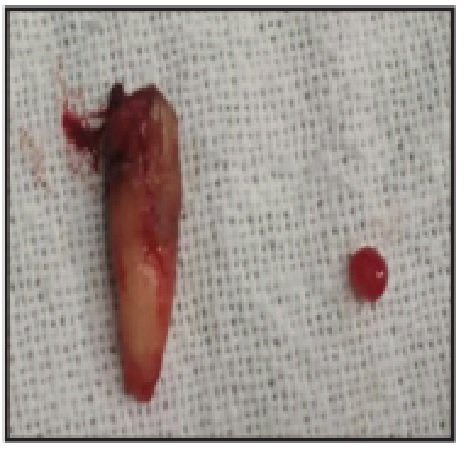
Fig. Extracted Lateral incisor
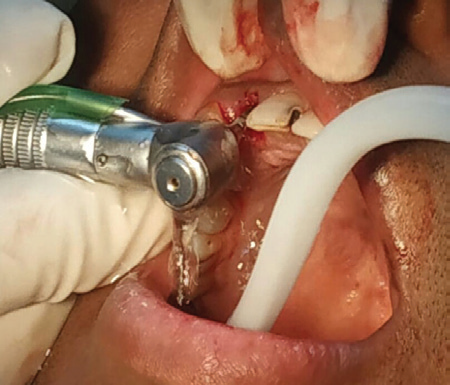
Fig. Socket Preparation
IMPLANT PLACEMENT
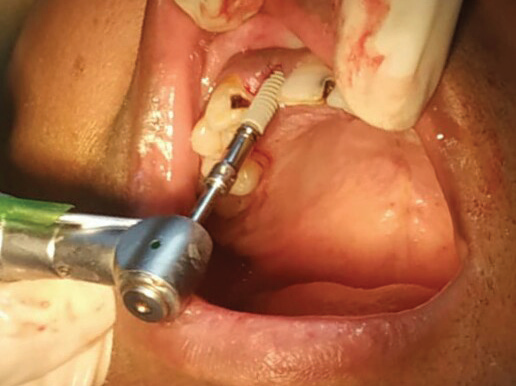
[A]

[B]
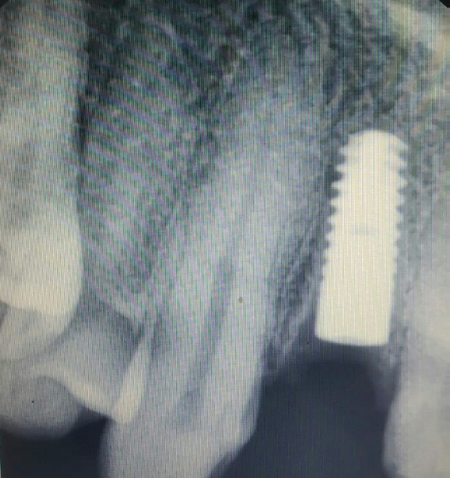
Fig. Post- op X-ray

Fig. Suturing
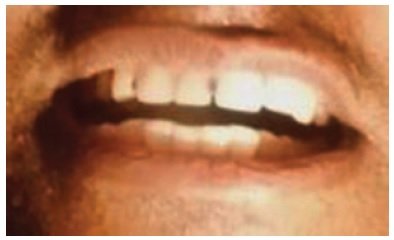
Final Result
DISCUSSION
[A]
[B]
Fig. Post- op X-ray
Fig. Suturing
Final Result
There is many indications for immediate implant placement such as tooth extraction due to root fracture secondary to trauma, root resorption, unfavorable crown root ratio. Contraindication includes acute infection, loss of bone in periapical region, and severe gingival recession. The proper case selection and surgical technique is important for success of immediate implants. There are several controversies about local pathology having an adverse effect on the treatment outcome. Chronic infection is not an absolute contraindication, but debridement of the alveolus is recommended. The use of antibiotic prophylaxis is useful in medically compromised patients. In the present study local pathology was not present.1 Initially, it was said that immediate placement of implants preserves alveolar bone.5 However this is considered to be controversial since morphologic hard and soft tissue changes of the post-extraction site may occur despite immediate placement. Also, slightly palatal or lingual placement of the implant in the extraction socket is recommended. This avoids exposure of the implant surface because buccal wall of socket is thin. Also, in order to preserve the alveolar bone, careful extraction is important and it is advised to section multi-rooted teeth before extracting.1 It is accepted that when a gap of more than 2mm is present between the implant and cortical bone, bone grafting is advised, because the potential for spontaneous bone formation in such defects is poor.6 Good results were obtained in our case, where we used Mucograft. It has been noted in the literature that immediate implant success rates in the maxilla is lower than that of the mandible. Therefore, extra caution must be exercised while working on the anterior maxillary region, especially with respect to bone preservation.7 There are multiple advantages of immediate implants, including reduction in the number of operations and the overall length of treatment. Other suggestive advantages include ideal orientation of the implant, preservation of the bone at the extraction site and other optimal soft tissue esthetics.6
CONCLUSION
It was found that the immediate implant therapy has several advantages such as reduced treatment length, preservation of soft and hard tissues surrounding the implant and reduced number of operations. Immediate implant treatment therefore has a great future in the treatment of aesthetic zones. In this case, our patient met all the indications for immediate implant placement. Using this technique, we were able to provide the patient with a desirable aesthetic and functional outcome. Immediate implant placement may be a highly technique sensitive procedure. However, careful case selection and treatment planning usually result in good success rates.
REFERENCES
- Branemark P-I. Introduction to osseointegration. In: Branemark P-I, Zarb G, Albrektsson T, eds. Tissue-integrated prostheses. Osseointegration in clinical dentistry. Chicago, Berlin: Quintessence Publishing Co., 1985:11–76.
- D Schwartz-Arad and G Chaushu. “The ways and wherefores of immediate placement of implants into fresh extraction sites: a literature review”. Journal of Periodontology 68.10 (1997): 915-923.
- V Joshi and S Gupta “Immediate implant placement in anterior aesthetic region and assessment using Cone-beam Computed Tomography Scan Technology”. Journal of International Oral Health 7.2 (2015): 99-102.
- K Hinds. “Custom Impression coping for an exact registration of the healed tissue in the Esthetic Implant Restoration”. The International Journal of Periodontics and Restorative Dentistry 17.6 (1997): 585-591.
- Flanagan D. Immediate placement of multiple mini dental implants into fresh extraction sites: A case report. Journal of Oral Implantol 2008, 37: 107-110
- Esposito MA, Koukoulopoulou A, Coulthard P, Worthington HV. Interventions for replacing missing teeth: dental implants International Journal of Scientific and Research Publications 2015; 5. ISSN 2250-3153 www. ijsrp.org [9] in fresh extraction sockets (immediate, immediate-delayed and delayed implants). Cochrane Database Syst Rev. 2006: CD005968.
- Lazzara RM. Immediate implant placement into extraction sites. Surgical and restorative advantages. Int J Periodontics Restorative Den 1989;9:333-343 5. Schwartz AD,Chashu G. The ways and wherefores of immediate placement of implants into fresh extraction sites. A literature review. J Periodontol 1997; 68: 915- 923
Disclaimer from Guident
The views and opinions expressed in articles published in Guident are solely those of the authors and do not necessarily reflect the views of the editors, the editorial board or the publisher, Ivory India. Guident does not endorse any product, technique or treatment described. Clinical content is intended for qualified dental and medical professionals and is not a substitute for individual clinical judgement. Guident, its editors and the publisher accept no liability for any consequence arising from the use of information published in the journal.
How to cite this article
Dr. Vikram Ahuja, Dr. Abhishek Kr. Pandey. Placement of Immediate Dental Implant in the Anterior Maxilla. Guident. 2019 Oct;12(11). Available from: https://guident.in/articles/implantology/placement-of-immediate-dental-implant-in-the-anterior-maxilla.html