Spark Erosion: A Spark in Implant Dentistry
Department of Prosthodontics & Implantology, K.D. Dental College & Hospital, Mathura (U.P) India
ABSTRACT
Spark erosion technology is the highly advanced system for producing the ultimate fi t of the prostheses frameworks. In this process metal is altered in a form using short circuit impulses created within a dielectric medium similar to light oil. The dental profession has adapted its uses for fabricating precision removable partial dentures, titanium crowns and implant retained overdentures.
INTRODUCTION
Spark erosion technology is a highly advanced system for producing the ultimate in precision fit of the prostheses frameworks. In this process metal is altered in a form using short-circuit impulses created within a dielectric medium similar to light oil. This process became more popular in the early 1940s in the tool and die industry. Since then, the dental profession has adapted its uses for fabricating precision removable partial dentures, titanium crowns, and implant retained overdentures.
Different techniques have been used to improve the fit of implant-supported prostheses, including welding and spark erosion. Welding techniques(gas-air torch, laser, and tungsten inert gas) are commonly used. These techniques involve the sectioning of the framework followed by indexing from the cast or intraorally. In contrast, spark erosion allows for significant fit improvements without sectioning the framework, thereby preserving the framework mechanical resistance and perhaps increasing their clinical longevity. Such a feature is an important advantage of spark erosion over welding techniques.
In spark erosion a metal is precisely contoured into a desired shape by erosionby using accurately controlled electric discharge through two conductive objects immersed in a liquid medium. Basically there are two types of EDM –wire and probe type, of which the latter can be effectively used in dentistry.
HISTORY
The idea for spark erosion came from watching lightening. In the 18th century, Sir Joseph Priestly considered this occurrence and its effect on metal. After World War II, the Russian Lazerenko brothers established their first electronic erosion apparatus. The spark erosion process became more popular in the early 1940s in the tool and die industry.
Rubeling introduced this in dentistry in 1982 to fabricate precision attachments. Windeler AS received its patent in the same year for improving the fit of cast restorations using EDM and since 1990 it has been widely used in implant prostheses.
WHAT IS PASSIVE FIT?
Passive fit (synonymous with“ideal fit”) is assumed to be one of the most significant prerequisites for the maintenance of the bone-implant interface. To provide passive fit or a strain free superstructure, a framework should, theoretically, induce absolute zero strain on the supporting implant components and the surrounding bone in the absence of an applied external load. This vital requirement may be provided by simultaneous and even mating of the complete inner surfaces of all retainers by all abutments. However, according to the current scientific evidence and with the efficacy of contemporary dental technology used for framework fabrication, it has been concluded that an absolute passive fit cannot be obtained.
Prosthetic complications such as gold (fixation) screw loosening or fracture, abutment screw fracture, gold cylinder, frameworks, and veneers have been documented and may be related to poor framework fit.“If it is assumed that misfit is a real problem when dealing with dental implants, Passive fit is the simultaneous and circumferential contact between components of prostheses. It is imperative to limit stresses induced by prostheses within physiologic limits.
A non-passive fit transmits undue tensile, compressive and shear stresses to the implant and bone. This is detrimental to long-term maintenance of osseo-integration and can cause crestal bone loss with possibility of screw loosening, pain, soft tissue irritation, implant fracture and prostheses fracture.
FACTORS CAUSING NON PASSIVE FIT
- Errors in impressions and impression techniques
- Elastic deformation of impression materials
- Stone or investment material expansion
- Wax distortion
- Casting defects
- Soldering inaccuracies,
- Non parallelism of abutments or implants
- Stresses induced on metal frame works during heat treatment of porcelain and manufacturer’s variance in implant components
- Passive fit ideally in the range of 10μm is essential for preventing biologic and technical failures of implants and fixed partial dentures
APPLICATIONS OF SPARK EROSION
Spark erosion can achieve passive fit of metal sub/superstructures and porcelain veneered frameworks which are to be placed on implant abutments and at the metal coping-tooth interface in fixed partial restorations.7
Swivel latch attachments,7 precision attachments,2 friction pins,7 titanium copings for Procera All-Titan system4 and telescopic crowns2 can also be fabricated with this technology. Spark erosion surface treatment for better metal-resin bonding8 is another important application being investigated.
Spark Erosion Machining Unit

In a spark erosion machining unit [Figure 1], an electrode to work piece relationship is maintained in a liquid medium (di-electric fluid). The electrode (anode or positive potential) is usually made of graphite, copper, tungsten or zinc and is shaped into the negative form of the desired shape by CAD/CAM or milling.
Mechanics Of Spark Erosion

Work piece (negative potential cathode) which is to be shaped into the desired form
- A space known as cutting gap is maintained between the electrode and the work piece throughout the machining process
- Electrode moves towards or away from work piece assisted by a hydraulic ram. Dielectric fluid acts as coolant and conductor. The power level selection is dictated by alloy properties used, size of object and amount of erosion required
- When the cutting gap is sufficiently small fluid ionization occurs allowing electric discharges. These electric discharges occur at regular intervals and such cycles takes place about 250000 times a second
- The subsequent build up of heat results in vapour cloud formation which gradually expands
- When voltage at the cutting gap exceeds the reference voltage the power gets cut off. This reduces the temperature triggering the collapse of the vapor bubble
- This generates a high energy spark of temperature ranging from 8000-12000ºC
- This sudden energy produced causes vaporization of the work piece.
SCOPE IN DENTISTRY
- Passive fit is the simultaneous and circumferential contact between components of prostheses.
- t is imperative to limit stresses induced by prostheses within physiologic limits.
- This implies that the fit of the prosthesis should be such that, the tooth or bone should be able to adapt or remodel to the stimuli.
- It is mainly applicable in implant prostheses where there is a lack of resiliency at the bone - implant interface.
- Only 0-5μm of horizontal movement is possible in implants as compared to 8-28μm at the bone-root interface in natural teeth.
- A non-passive fit transmits undue tensile, compressive and shear stresses to the implant and bone.
- This is detrimental to long-term maintenance of osseo-integration and can cause crestal bone loss with possibility of screw loosening, pain, soft tissue irritation, implant fracture and prostheses fracture.
PROCEDURE FOR ACHIEVING PASSIVE FIT OF IMPLANT SUPER-STRUCTURES
-
Günter Rübeling introduced the SAE Secotec Spark Erosion technique to implant dentistry in the early nineties.
This system is compatible with most implant systems. It consists of implant analogue sleeves, implant analogues (depending on the implant system used), copper implant electrodes that are identical to the implants used, plastic cylinders for waxing, insertion screws, torque wrench and short and long screws for the laboratory phase.
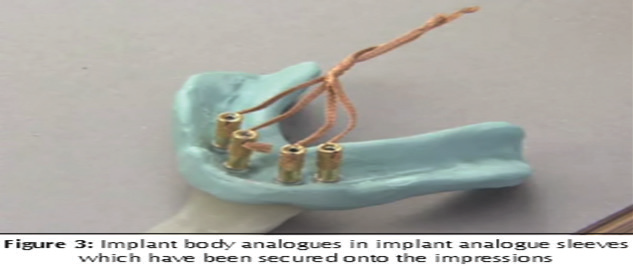
Impressions are made after the second healing stage. Implant body analogues are

Sheffield tests are carried out before machining to determine passivity. Then the most distal retaining screw should be tightened and the rest of the retaining screws should be kept out. If a gap appears between the remaining supporting implants or abutments and the metal sub-structure, it indicates that the metal framework does not fit passively.

The cast with the implant analogues is placed horizontally in the spark erosion unit
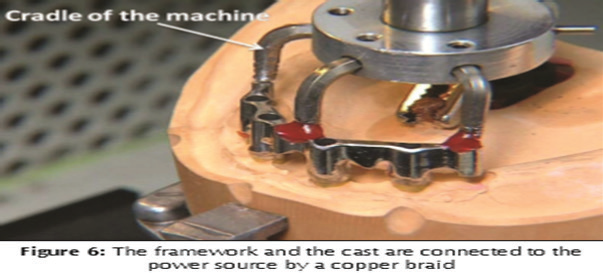
The cradle of the machine which can be moved in all planes is then aligned over the cast. The cast bar (the workpiece), is attached to the cradle of the machine with pattern resin. Cradle moves the bar towards and away from the electrodes during machining. The framework and the cast are connected to the power source by a copper braid

Copper electrodes, identical to the implant analogues are used to replace them
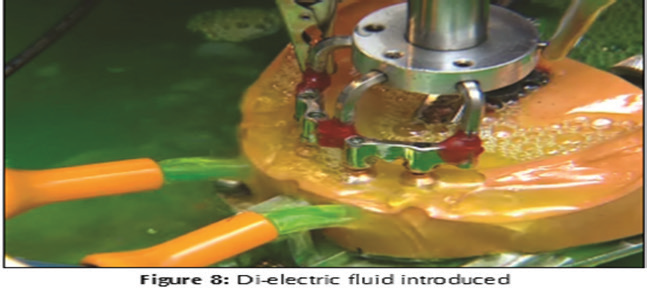
The torque setting for the wrench used to screw the copper electrodes should be the same as that used for tightening the implant analogues into the implant analogue sleeves. This avoids discrepancy in height or fit. The di-electric fluid is introduced after the cutting gap is set in the unit
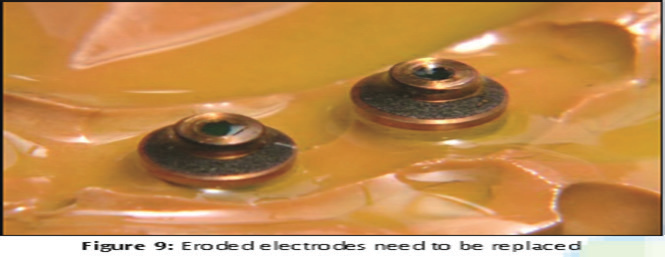
Then, the cradle moves the sub-structure onto the copper electrode and the erosion process is initiated. This takes place at the area where the sub- structure fits onto the implant abutment. The electrodes erode rapidly and need to be replaced during the process
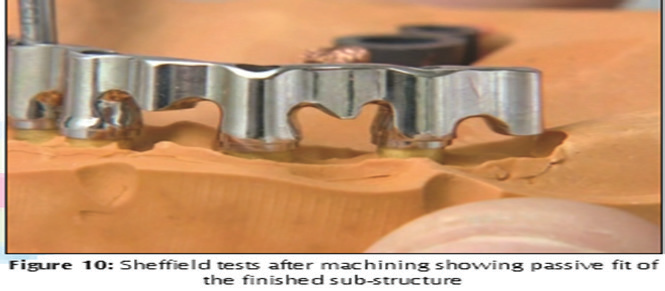
The finished sub-structure will exhibit a passive fit
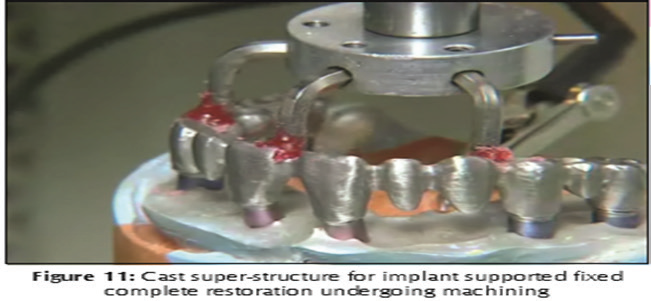
Spark erosion can also be used in an identical manner for implant supported fixed complete restorations. The cast super-structure on which porcelain is to be veneered is initially eroded at the implant abutment –super-structure interface as mentioned earlier.
ADVANTAGES OF SPARK EROSION
- Passive fit of restorations is achieved.
- Complex 3-dimensional structures can be shaped regardless of metal hardness since it is a thermal process.
- An extremely thin work piece can be machined without distortion as no mechanical forces are created.
- There is decreased stress on the work piece due to the cooling action of the di-electric fluid.
- Smooth finish of final restoration is ensured.
- There is decreased oxidation of metals during the procedure (especially useful in titanium to porcelain bonding).
- It is rapid, efficient and accurate (within 0.0254 mm).
- Frameworks with porcelain can be spark eroded without any stress on the porcelain due to the cooling action of the di-electric fluid.
DISADVANTAGES OF SPARK EROSION
- Eroding tends to affect the corrosion resistance of titanium.
- Skilled personnel and specialized lab equipment is mandatory.
- The high cost of the technique limits its usage.
CONCLUSION
Such advances in dental technology help attain a passive fit of implant prostheses and fixed partial restorations, which is imperative in avoiding failures. The cutting-edge accuracy thus achieved, helps perfect critical adjustments in individual components and the fabrication process, thereby increasing the quality of treatment and hence, patient contentment and clinical success.
REFERENCES
- Liju Jacob Jo. Spark Erosion. J Dent Implant. 2019;1(1):2-6
- Serman G. Practical guide to electro-discharge machining. 2nd ed. Geneva: Ateliers Des Charmilles SA; 1975, chapter 2.
- Rubeling G. Funkenerosion in der zahntechnik moglichkeiten und grezen. Dent Labor 1982;30:1697-702.
- Windeler AS. Method of Fabricating a Dental Prosthesis. United States Patent No.4, 363, 627, December 14, 1982.
- Roekel Ned BV. Electric discharge machining in dentistry. Int J Prosthodont 1992;5:114-21
- Misch CE. Natural teeth adjacent to multiple implant sites: Effect on diagnosis and treatment plan. Dental Implant Prosthetics, 3rd ed, St. Louis: Mosby; 2005.
- Misch CE. Principles of retained prostheses. Contemporary Implant Dentistry, 1st ed, St.Louis: Mosby; 1993.
- Rübeling G. New techniques in spark erosion: The solution to an accurately fitting screw-retained implant restoration. Quintessence Int 1999;30:38-48.
- Janda R, Roulet JF, Latta M, Damerau G. Spark erosion as a metal- resin bonding system. Dent Mat 2007;23:193-7.
Disclaimer from Guident
The views and opinions expressed in articles published in Guident are solely those of the authors and do not necessarily reflect the views of the editors, the editorial board or the publisher, Ivory India. Guident does not endorse any product, technique or treatment described. Clinical content is intended for qualified dental and medical professionals and is not a substitute for individual clinical judgement. Guident, its editors and the publisher accept no liability for any consequence arising from the use of information published in the journal.
How to cite this article
Dr. Shaivy Ambuj, Dr. Saurabh Pratap Singh, Dr. Siddharth Sissodiya. Spark Erosion: A Spark in Implant Dentistry. Guident. 2019 Sep;12(10). Available from: https://guident.in/articles/implantology/spark-erosion-a-spark-in-implant-dentistry.html