Immediate Implant Placement with Immediate Loading in Mandible
Wisdom Dental Clinics, Jaipur, India
ABSTRACT
Implant stability plays a analytical role for successful osseointegration. For functional dental implants successful osseointegration is a necessary. To determine the status of implant stability, continuous monitoring in an objective and qualitative manner is important. To measure implant stability two different stages are there: Primary and secondary. Primary stability is checked from mechanical engagement with cortical bone. Secondary stability is developed from regeneration and remodeling of the bone and tissue around the implant after insertion and affected by the primary stability, bone formation and remodelling. Implant stability is essential for the time of functional loading. Historically the gold standard method to evaluate stability were microscopic or histologic analysis, radiographs, however due to invasiveness of these methods and related ethical issues various other methods have been proposed like cutting torque resistance, reverse torque analysis, model analysis and most important ISQ which has the ability to monitor osseointegration and the life expectancy of an implant. ISQ is a valuable diagnostic and clinical tool that has far-reaching consequences on implant dentistry and we have this in our case for the proper assessment and good stability.
Keywords: Primary stability, ISQ, secondary stability
INTRODUCTION
Osseointegration is a direct bone anchorage to an implant body which can provide a foundation to support prosthesis.1,2 Implant stability is an important characteristic of osseointegration without which, long-term success cannot be achieved. Status of implant stability is determined by continuous monitoring in a quantitative and objective manner. Osseointegration is also a measure of implant stability which can occur in two stages: Primary and secondary.3 Primary stability is due to mechanical attachment with cortical bone and biological stability through bone regeneration and remodeling is secondary stability.4,5 Some features which affect primary stability are bone quality and quantity, surgical technique and implant geometry (length, diameter, surface characteristics) and secondary stability is affected by primary stability.6
In the recent years, implant dentistry has evolved from the conventional healing protocol of 3–6 months to the most recent trends of immediate and early loading of implants. The most crucial requirement for the immediate loading protocol is primary stability which is the mechanical interlocking of the implant threads with the bone.7 Primary stability measures the threshold of the bone-implant interface to withstand the micromovements at implant placement, thereby leading to undisturbed healing leading for the achievement of secondary stability, through bone regeneration and remodeling resulting in osseointegration.8 This is largely influenced by the factors related to the design, material and surface treatment of the implant, the placement protocol, and the quality and quantity of the bone.9
Methods to measure implant stability such are histological analysis, radiographs, cutting torque resistance, reverse torque analysis, model analysis, percussion testing, insertion torque, removal torque, percussion test, resonance frequency analysis (RFA ).To further contribute in this field, the aim of this study was to investigate the value obtained by ISQ in immediate functional implant placement.
CASE REPORT
A healthy 70 year old male patient came with the complain of unable to chew after failing of the bridge from upper left quadrant. Patient was advised for OPG.
OPG revealed decayed left upper 1st and 2nd premolars (Figure. 1a-d) and they cannot be restored back again with crown & bridges. Now patient who was eating only from left side, now was unable to eat.
Meanwhile, her bridge in 1st quadrant is stable but no antagonist. Because of long standing apprehension and anxiety, patient wanted to restore her occlusion back with implants quadrant wise. So it was planned to give her implant retained teeth in the 4th quadrant so that she can start having food from 1 side at least. For which CBCT was done to evaluate bone volume and other parmaeters.

(Figure.1 a-d Pre-operative condition)
Two Nobel biocare active RP implants were placed in good D1 bone and insertion torque of more than 45 NCM was achieved. (Figure. 2)

(Figure.2 - Implant placement)
Immediately ISQ was done, which showed very promising readings, based on which on the same day implant level impressions were made. (Figure.3 a,b)
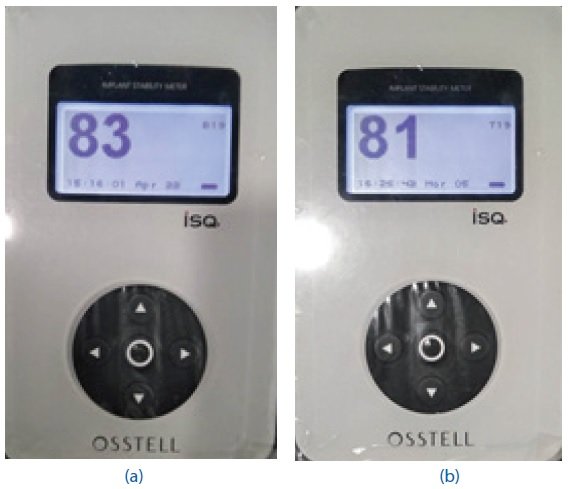
(Figure. 3 a,b - ISQ values of implant placed)
Two days later, screw retained functional crowns were loaded. (Figure. 4 a, b)

(Figure. 4 a, b - Screw retained functional crown placed)
Patient was advised to maintain proper oral hygiene and strictly restrict to soft diet especially from left size. Patient was recalled after 1 week, 1 month, 2 months, 3 months and then after every 6 months and it was found that satisfactory soft and hard tissue architecture was maintained along with stable occlusion.(Figure. 5)
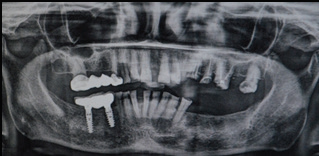
(Figure.5 – 6 months follow up)
DISCUSSION
Measuring implant stability by implant oscillation frequency on bone can be assessed by RFA. Meredith et al. 1998 described the noninvasive method of assessing implant stability utilizing the RFA device OSSTELL. OSSTELL devices have been designed since 1999 by the Integration Diagnostics Ltd, Sweden. Within the last decade, numerous generations of Osstell devices have evolved to improvise the implant stability measurements, namely, OSSTELL™, OSSTELL Mentor, and OSSTELL ISQ.
It is a noninvasive diagnostic technique that uses a piezoelectric transducer. It emits a sinusoidal signal within a specific frequency meant to make the implant vibrate. Implant’s resistance to vibration is measured by the device and transformed into ISQ value. ISQ is measured on a scale within 0–100, 100 being the maximum, and 0 lowest stability values.
The last and latest generation of this device was developed in 2009, OSSTELL ISQ, It includes a new control unit with a probe connected to it by means of a cable. Its use is progressively extending to register the implant stability measurement due to the ability of device to reproduce accurate values without intra and inter observer variability. The Osstell measurements are highly reliable and are alone sufficient to assess the status of implant success.
Nedir et al. 2004 evaluated the implant primary stability as a means of predicting osseointegration. However, they stated that all implants with an ISQi >49 osseointegrated when left to heal for 3 months. All implants with an ISQi >54 osseointegrated when immediately loaded. For implants with low ISQi values, decrease in implant stability should alert the practitioner to take precautionary measures. For implants with high ISQi values, reduction of implant stability during first 12 weeks of healing can be considered as a common event.10
Primary stability of implants which was assessed through RFA using OSSTELL Mentor devices was underestimated to analyze the comparability and reproducibility.11 But clinical trials concluded the almost perfect repeatability, reproducibility and highly reliability with one measurement.12
Evaluated the ISQ values using OSSTELL Mentor during implant integration in immediately and nonimmediately loaded implants concluded that RFA using OSSTELL Mentor may offer an objective method to determine the implant stability and for immediate loading.13 Comparibility and reliability of OSSTELL Mentor and OSSTELL ISQ in measuring implant stability was estimated and the mean values of ISQ for OSSTELL ISQ and OSSTELL Mentor were 72.87 and 72.04 respectively, suggesting perfect concordance, reproducibility and repeatability between these devices.14
Successful implant at insertion and after healing showed significantly different ISQ values as compared to implant failures or implants with prolonged healing. However, overlapping ISQ distributions at implant insertion demonstrated that there was no correlation among the data that could be used to predict successful osseointegration. The prognostic value of ISQ values were ambiguous.15
CONCLUSION
ISQ is a valuable diagnostic and clinical tool that has ability to monitor osseointegration and the life expectancy of an implant. RFA has attracted considerable scientific interest in recent years; it can also be used to evaluate the effect of early and delayed loading, assess stability over a period of time and early diagnosis of implant failure.
REFERENCES
- Albrektsson T, Zarb G, Worthington P, Eriksson AR. The long-term efficacy of currently used dental implants: A review and proposed criteria of success. Int J Oral Maxillofac Implants. 1986;1:11–25.[PubMed] [Google Scholar]
- Albrektsson T, Talbrektsson B. New York: Raven Press Ltd; 1983. Implant fixation by direct bone anchorage; pp. 87–97. [Google Scholar]
- Meredith N. Assessment of implant stability as a prognostic determinant. Int J Prosthodont. 1998;11:491–501. [PubMed] [Google Scholar]
- Brunski JB. Biomechanical factors affecting the bone-dental implant interface. Clin Mater. 1992;10:153–201. [PubMed] [Google Scholar]
- Sennerby L, Roos J. Surgical determinants of clinical success of osseointegrated oral implants: A review of the literature. Int J Prosthodont. 1998;11:408–20. [PubMed] [Google Scholar]
- Cochran DL, Schenk RK, Lussi A, Higginbottom FL, Buser D. Bone response to unloaded and loaded titanium implants with a sandblasted and acid-etched surface: A histometric study in the canine mandible. J Biomed Mater Res. 1998;40:1–11. [PubMed] [Google Schol
- Meredith N. Assessment of implant stability as a prognostic determinant. Int J Prosthodont 1998;11:491-501
- Sennerby L, Roos J. Surgical determinants of clinical success of osseointegrated oral implants: A review of the literature. Int J Prosthodont 1998;11:408-20
- Albrektsson T, Zarb G, Worthington P, Eriksson AR. The long-term efficacy of currently used dental implants: A review and proposed criteria of success. Int J Oral Maxillofac Implants 1986;1:11-25
- Nedir R, Bischof M, Szmukler-Moncler S, Bernard JP, Samson J. Predicting osseointegration by means of implant primary stability. Clin Oral Implants Res 2004;15:520-8.
- Snijders RS, van Wijk AJ, Lindeboom JA. A comparative study of the Osstell™ versus the Osstell Mentor™ to evaluate implant stability in human cadaver mandibles. J Oral Rehabil 2013;40:774-9
- Herrero-Climent M, Santos-García R, Jaramillo-Santos R, Romero-Ruiz MM, Fernández-Palacin A, Lázaro-Calvo P, et al. Assessment of Osstell ISQ’s reliability for implant stability measurement: A cross-sectional clinical study. Med Oral Patol Oral Cir Bucal 2013;18:e877-82
- González-Jaranay M, Moreu-Burgos G, Gómez-Moreno G, Rubio-Roldán J, Machuca-Portillo G, Perrotti V, et al. Changes in resonance frequency analysis assessed by Osstell mentor during osseointegration: Comparison between immediately loaded implants and control implants without load. J Osseointegr 2014;6:51-5.
- Jaramillo R, Santos R, Lázaro P, Romero M, Rios-Santos JV, Bullón P, et al. Comparative analysis of 2 resonance frequency measurement devices: Osstell mentor and osstell ISQ. Implant Dent 2014;23:351-6.
- Krafft T, Graef F, Karl M. Osstell resonance frequency measurement values as a prognostic factor in implant dentistry. J Oral Implantol 2015;41:e133-7
Disclaimer from Guident
The views and opinions expressed in articles published in Guident are solely those of the authors and do not necessarily reflect the views of the editors, the editorial board or the publisher, Ivory India. Guident does not endorse any product, technique or treatment described. Clinical content is intended for qualified dental and medical professionals and is not a substitute for individual clinical judgement. Guident, its editors and the publisher accept no liability for any consequence arising from the use of information published in the journal.
How to cite this article
Dr. Gaurav Gupta, Dr. D. K. Gupta, Dr. Neelja Gupta. Immediate Implant Placement with Immediate Loading in Mandible. Guident. 2019 Oct;12(11). Available from: https://guident.in/articles/implantology/immediate-implant-placement-with-immediate-loading-in-mandible.html