Non Vital Bleaching: A Case Series
Department of Conservative Dentistry and Endodontics, Seema Dental College And Hospital, Rishikesh
ABSTRACT
Non-vital bleaching, a minimally invasive approach, treats internal tooth staining. Common bleaching agents include hydrogen peroxide and sodium perborate. This case report illustrates this technique on discolored upper front teeth. Following isolation and root canal treatment of the maxillary central incisors, a barrier was created using a heated instrument and glass ionomer cement. Bleaching agent was applied within the canals and sealed. The process was repeated after a week to reach the desired shade. Non-vital bleaching effectively improves the appearance of discolored, non-living teeth with minimal invasiveness, though precautions are necessary to avoid complications afterward.
INTRODUCTION
Discoloration of a single tooth is a significant cosmetic issue for patients because it affects them psychologically and influences how they view their own appearance.1,2 The management of this issue involves different methods, taking into account aspects such as what caused the discoloration, the dentist's skill, the patient's budget and preferences, the amount of remaining tooth structure, and any prior treatments.2 Bleaching non-vital teeth is a generally safe method to enhance the appearance of teeth that have undergone root canal treatment. First documented by Garretson in 1895, who utilized chlorine as the bleaching agent, this intra-coronal procedure is popular for discolored, non-living teeth due to its effectiveness, simplicity, affordability, and ability to conserve tooth structure compared to prosthetic options. Hydrogen peroxide, carbamide peroxide, and sodium perborate are the bleaching agents most frequently used inside the tooth.3 Upon contact with the tooth, these substances release active components that penetrate the enamel and dentin, breaking down the pigments causing the discoloration through oxidation.4 For a successful and lasting result, a carefully crafted treatment plan is essential. This case report demonstrates a successful bleaching procedure on a non-vital upper central incisor with internal staining.
CASE REPORTS
Case Report 1
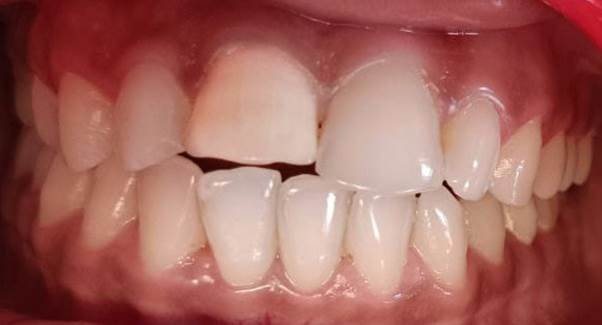
38 year old Patient reported to the Department of Conservative Dentistry and Endodontics with the chief complaint of discolored tooth in upper and lower front tooth region since 12 years.Patient had undergone RCT irt the same tooth 12 years back. On the basis of clinical examination non vital bleaching was planned ..
PREOPERATIVE IMAGE

POST OPERATIVE IMAGE
Case Report 2
27 year old female patient reported to the Department of Conservative Dentistry and Endodontics with the chief complaint of discolored upper right front tooth region since 4-5 years. Patient gave history of trauma in childhood. Based on clinical examination, investigation and radiographic examination, diagnosis of pulp necrosis with discoloured tooth was formed irt 11. Treatment plan formulated was Non surgical RCT with non vital bleaching irt 11.
PREOPERATIVE IMAGE
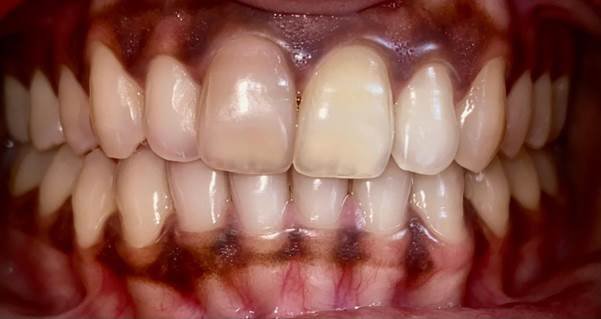
POST OPERATIVE IMAGE

DISCUSSION
Tooth discoloration can occur due to internal bleeding in the pulp caused by trauma, which results in blood components spreading into the dentinal tubules. The breakdown of blood releases iron-containing products like haemosiderin, haemin, haematin, and haematoidin. This iron reacts with hydrogen sulfide produced by bacteria, forming black ferric sulfide and staining the tooth. Bleaching works by using hydrogen peroxide, a strong oxidizing agent, to break down these pigments. It does this by forming free radicals, reactive oxygen molecules, and hydrogen peroxide anions, which split the large, dark-colored pigment molecules into smaller, lighter, and more easily diffused ones.3 When a tooth suffers trauma, internal bleeding in the pulp can happen, allowing blood components to seep into tiny channels within the tooth called dentinal tubules. As this blood breaks down, it releases iron-containing substances like haemosiderin, haemin, haematoidin, and haematin. This iron then interacts with hydrogen sulfide, a gas made by bacteria, creating black ferric sulfide that stains the tooth. Bleaching with hydrogen peroxide, a powerful oxidizing agent, reverses this by generating unstable molecules like free radicals, reactive oxygen species, and hydrogen peroxide anions. These molecules break down the large, dark pigment molecules into smaller, lighter ones that can diffuse out of the tooth structure.
Hydrogen peroxide's primary bleaching action comes from reactive oxygen produced through free radicals. The thermocatalytic technique, which used heat to enhance hydrogen peroxide's bleaching effectiveness by speeding up the reaction, was once employed for non-vital teeth. However, this method, along with high concentrations of hydrogen peroxide, is now less favored due to a higher chance of external cervical resorption. It's thought that hydrogen peroxide can travel through the dentinal tubules, cementum, and periodontal ligament to the surrounding bone, potentially triggering an inflammatory process that leads to resorption.7
The 'walking bleach' technique, introduced by Spasser in 1961, involved placing a paste made of sodium perborate and water inside the pulp chamber of a non-vital tooth and sealing it. Subsequently, in 1967, Nutting and Poe described a similar method using a sodium perborate and hydrogen peroxide mixture. Notably, studies have shown that sodium perborate mixed with water is just as effective as when combined with hydrogen peroxide. Overall, internal tooth bleaching is a minimally invasive, conservative, relatively straightforward, effective, and affordable way to treat discolored teeth that have had root canal treatment.1
Bleaching non-vital teeth carries several risks, including hydrogen peroxide penetrating the dentinal tubules, alterations in dentin structure and permeability, overall weakening of the tooth's hard tissues, fracture during the procedure, over-bleaching, the potential for the discoloration to return, and the most concerning: external cervical root resorption. Root resorption occurs when hydrogen peroxide travels through the dentinal tubules and tiny defects in the cementum to the cervical periodontal ligaments, leading to hard tissue destruction at the cementoenamel junction due to localized tissue death and inflammation. To mitigate this risk, glass ionomer cement was used as a barrier material shaped like a 'bobsled tunnel' when viewed from the front. This specific shape is important because it blocks all the dentinal tubules that run from the pulp chamber to the outer tooth surface below the gum line, keeping the bleaching agent contained within the tooth and thereby helping to prevent external root resorption.2,5
Following the bleaching process, it's crucial to neutralize the acidic environment within the tooth by placing a calcium hydroxide suspension for a week. This period allows for the release of any remaining oxygen and promotes dentin remineralization, which helps stabilize the color and ensures good bonding with the composite filling. While the average treatment time for bleaching a single tooth is typically 6–8 weeks, it can vary. Patients undergoing internal bleaching should be scheduled for follow-up appointments at least every two weeks to assess the dark tooth's response, manage any complications appropriately, provide reassurance and encouragement, and replace the bleaching agent inside the tooth if needed. The case described demonstrates the effectiveness of the walking bleach technique in achieving a successful and predictable cosmetic result for a discolored non-vital tooth. Therefore, the walking bleach technique can be considered a preferred, conservative treatment option for bleaching discolored non-vital teeth that have had root canal treatment, especially when compared to prosthetic solutions.1
CONCLUSION
The success of this treatment hinged on choosing the right patient and their adherence to instructions. Consistent clinical evaluations enabled us to observe the noticeable difference between the results before and after treatment. This case study suggests that non-vital bleaching therapy is a viable and successful alternative to prosthetic options.
REFERENCES
- Cohen JG, Greenwall LH. The single discoloured tooth: vital and non-vital bleaching techniques. Br Dent J. 2019;226(11):839–49. doi:10.1038/s41415-019-0373-9.
- Coelho AS, Garrido L, Mota M. Non-Vital Tooth Bleaching Techniques: A Systematic Review. Coatings . 2020;10(1):61. doi:10.3390/coatings10010061.
- Harshita C. Effects of Tooth Whitening Agents in Non Vital Teeth. J Pharm Sci Res. 2014;6(3):124–6.
- Singh N, Chaturvedi TP, Baranwal HC, Wang CK. Management of discolored nonvital tooth by walking bleach technique: A conservative approach. J Int Clin Dent Res Organ. 2020;12(1):67–71. doi:10.4103/jicdro.jicdro_52_19.
- Patil AG, Hiremath V, Kumar RS, Sheetal A, Nagaral S. Bleaching of a non-vital anterior tooth to remove the intrinsic discoloration. J Nat Sci Biol Med. 2014;5(2):476–9. doi:10.4103/0976-9668.136269.
- Badole GP, Warhadpande MM, Bahadure R. Aesthetic Rehabilitation of Discoloured Nonvital Anterior tooth with Carbamide Peroxide Bleaching: Case Series. J Clin Diagn Res. 2013;7(12):3073–6. doi:10.7860/JCDR/2013/6303.3857.
- Poyser NJ, Kelleher MGD, Briggs P. Managing Discoloured Non-Vital Teeth:The Inside/Outside Bleaching Technique. Dent Update. 2004;31(4):204–14. doi:10.12968/denu.2004.31.4.204.
- Pandey SH, Patni PM, Jain P, Chaturvedi A. Management of intrinsic discoloration using walking bleach technique in maxillary central incisors. Clujul Med. 2018;91(2):229–33. doi:10.15386/cjmed-852.
Disclaimer from Guident
The views and opinions expressed in articles published in Guident are solely those of the authors and do not necessarily reflect the views of the editors, the editorial board or the publisher, Ivory India. Guident does not endorse any product, technique or treatment described. Clinical content is intended for qualified dental and medical professionals and is not a substitute for individual clinical judgement. Guident, its editors and the publisher accept no liability for any consequence arising from the use of information published in the journal.
How to cite this article
Dr. Shubham Dalvi, Dr. Nikita Gupta, Dr. Anil Dhingra. Non Vital Bleaching: A Case Series. Guident. 2025 May;18(6). Available from: https://guident.in/articles/endodontics/non-vital-bleaching-a-case-series.html