
Non-Surgical Management of Endo-Perio Lesions: A Case Series
Department of Conservative Dentistry and Endodontics, Seema Dental College And Hospital, Rishikesh
ABSTRACT
Endo-perio lesions represent a challenging condition in dental practice due to their involvement of both the pulp and periodontal tissues. This review explores various case reports highlighting the diagnosis and management of such lesions through a multidisciplinary approach. Evidence from the literature emphasizes the importance of initiating endodontic treatment prior to periodontal therapy to enhance healing outcomes. Case studies demonstrate successful management using non-surgical, surgical, and regenerative techniques, often resulting in long-term tooth preservation. The findings underline the necessity of accurate diagnosis, individualized treatment planning, and collaboration between specialties to ensure optimal clinical results.
INTRODUCTION
The diagnosis of endo-perio lesions (EPL) is challenging due to the overlapping clinical features of endodontic and periodontal diseases, necessitating accurate classification for appropriate treatment.1,2,3 A thorough medical history, clinical assessment, radiographic evaluation, vitality testing, percussion, mobility assessment, and periodontal probing are crucial for differentiation.2,3
Unlike much of the literature focusing on endodontic therapy and periodontal surgeries like bone grafting, guided tissue regeneration (GTR), root amputation, and hemisection/bicuspidization, this case report emphasizes often-overlooked contributing factors in EPL cases.1,4,5 While Anand et al. recommend root canal treatment (RCT) followed by re-evaluation and periodontal therapy if healing is absent4, this study proposes a more comprehensive periodontal approach, including splinting, occlusal adjustment, correction of overhanging restorations, and periodontally favorable prosthetic design. These subtle factors significantly impact EPL treatment outcomes. Unexplained recurrent periodontal or periapical abscesses warrant occlusal evaluation. Treating such lesions with periodontal therapy alone, without addressing pulpal infection, may show initial healing but is prone to relapse if the endodontic component remains untreated.5 Recurrence in such situations is often due to the limitations of closed curettage, which primarily facilitates coronal tissue attachment, leading to apical abscess reformation.
The author utilized the trimeric model for periodontal treatment planning.15 Typically, RCT should precede periodontal therapy, as periodontal lesion resolution can follow successful endodontic treatment, whereas the reverse is less effective.1,5
Periodontal maintenance, scheduled at tailored intervals, is vital for preserving oral health and preventing relapse.6 Farooqi et al. questioned the universal “one-size-fits-all” maintenance interval in chronic periodontitis patients.7 Lang and Tonetti introduced a periodontal risk assessment model considering bleeding on probing (BoP), persistent pockets, tooth loss, age-related bone loss, systemic conditions, and environmental factors.8
CASE REPORTS
CASE REPORT 1
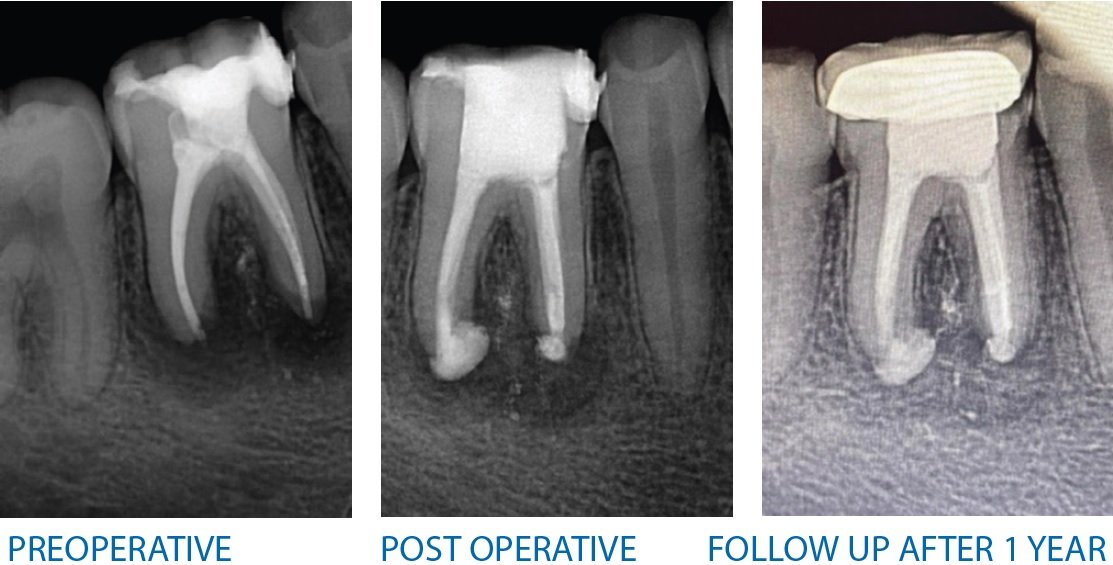
18 year old Patient named Happy reported to the Department of Conservative Dentistry and Endodontics with the chief complaint of pain in the lower right back tooth since 2 months. Upon clinical and radiographic examination, a diagnosis of primary endodontic lesion associated with secondary periodontal involvement was determined irt. 46. Treatment plan of nonsurgical endodontic retreatment was decided irt. 46 in which after GP removal & thorough irrigation & BMP, MTA plug formation irt. Distal & mesial roots of 46 was done, followed by obturation & PFM crown were delieverd to the patient.
PREOPERATIVE POST OPERATIVE FOLLOW UP AFTER 1 YEAR
CASE REPORT 2
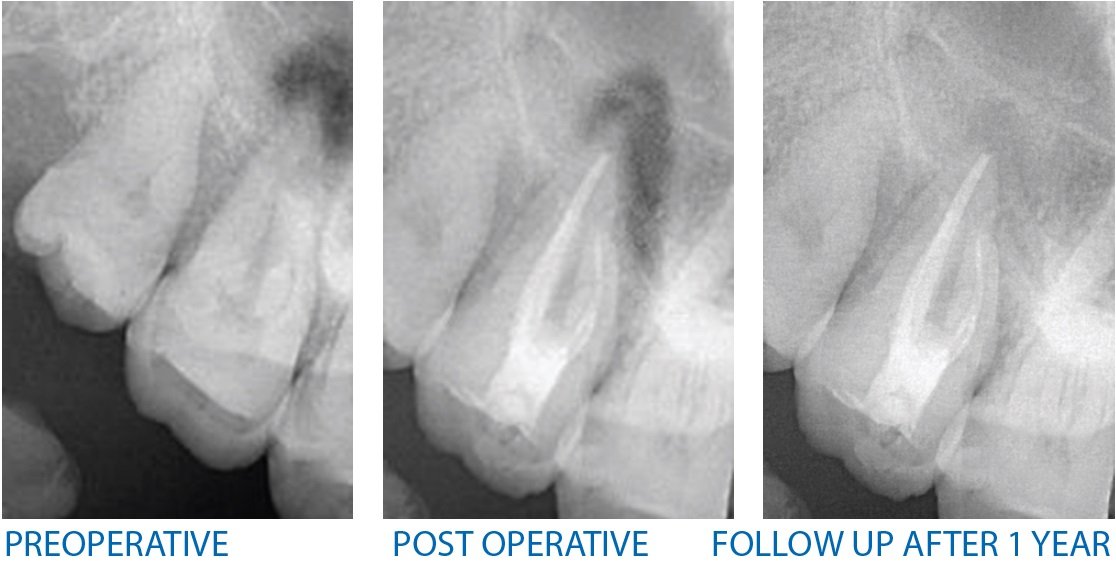
26 year old Patient named Harsh reported to the Department of Conservative dentistry and Endodontics with the chief complaint of Pain and mobility in upper right back tooth since 1 month. Upon clinical and Radiographic examination, a diagnosis of primary periodontal lesion with secondary endodontic involvement was determined irt. 16 & The treatment plan of nonsurgical endodontic treatment was decided irt 16 for the patient.
PREOPERATIVE POST OPERATIVE FOLLOW UP AFTER 1 YEAR
DISCUSSION
The complexity and interdisciplinary nature of managing endo-perio lesions, highlighting the need for accurate diagnosis and a carefully sequenced treatment approach.1,2 The Most successful outcomes were achieved by initiating endodontic therapy first, followed by periodontal management once healing had begun. Several reports, including those involving guided tissue regeneration and surgical interventions, demonstrate that even teeth with a seemingly poor prognosis can be retained long-term with proper care.4,5 The literature also stresses the value of follow-up, with some cases showing stable results even after four to five years. Overall, these studies reinforce the critical role of comprehensive evaluation and collaboration between endodontists and periodontists in achieving favorable treatment outcomes.
CONCLUSION
In conclusion, endo-perio lesions require a multidisciplinary and well-structured treatment approach to ensure successful outcomes. Early and accurate diagnosis is essential to differentiate between primary endodontic, periodontal, or true combined lesions. The reviewed case reports consistently show that initiating endodontic treatment before periodontal intervention often leads to better healing and prognosis. Long-term follow-ups further confirm the effectiveness of such coordinated treatment strategies. With proper planning and teamwork, even complex lesions can be managed successfully, preserving the natural dentition and improving patient satisfaction.
REFERENCES
- A. Bonaccorso and T. R. Tripi,“Endo-perio lesion: diagnosis, prognosis and decision-making,” ENDO, vol. 8, no. 2, pp. 105–127, 2014.
- P. Abbott and J. Salgado,“Strategies for the endodontic man-agement of concurrent endodontic and periodontal diseases,” Australian Dental Journal, vol. 54, Suppl 1, pp. S70–S85, 2009.
- H. Alshawwa, J. Wang, M. Liu, and S. Sun,“Successful man-agement of a tooth with endodontic-periodontal lesion: a case report,” World Journal of Clinical Cases, vol. 8, no. 20, pp. 5049–5056, 2020.
- A. Parolia, T. Gait, I. Porto, and K. Mala,“Endo—perio lesion: a dilemma from 19th until 21st century,” Journal of Interdisci-plinary Dental, vol. 3, no. 1, pp. 2–11, 2013.
- V. Anand, V. Govila, and M. Gulati,“Endo-perio lesion: part II (the treatment)—a review,” Archives of Dental Sciences, vol. 3, no. 1, pp. 9–16, 2012.
- K. G. Azouni and B. Tarakji,“The trimeric model: a new model of periodontal treatment planning,” Journal of Clinical and Diagnostic Research, vol. 8, no. 7, pp. 17–20, 2014.
- O. A. Farooqi, C. J. Wehler, G. Gibson, M. M. Jurasic, and J. A. Jones,“Appropriate recall interval for periodontal mainte-nance: a systematic review,” The Journal of Evidence-Based Dental Practice, vol. 15, no. 4, pp. 171–181, 2015.
- N. P. Lang and M. S. Tonetti,“Periodontal risk assessment (PRA) for patients in supportive periodontal therapy (SPT),” Oral Health & Preventive Dentistry, vol. 1, no. 1, pp. 7–16, 2003.
Disclaimer from Guident
The views and opinions expressed in articles published in Guident are solely those of the authors and do not necessarily reflect the views of the editors, the editorial board or the publisher, Ivory India. Guident does not endorse any product, technique or treatment described. Clinical content is intended for qualified dental and medical professionals and is not a substitute for individual clinical judgement. Guident, its editors and the publisher accept no liability for any consequence arising from the use of information published in the journal.
How to cite this article
Dr. Eva Mishra, Dr. Shalvini Kancha, Dr. Anil Dhingra. Non-Surgical Management of Endo-Perio Lesions: A Case Series. Guident. 2025 Apr;18(5). Available from: https://guident.in/articles/endodontics/non-surgical-management-of-endo-perio-lesions-a-case-series.html


