Coronal Pulpotomy Using MTA for Management of Irreversible Pulpitis in Mature Permanent Mandibular Molar: A Case Report
Department of Dentistry, GTB & UCMS Hospital, New Delhi
ABSTRACT
Vital pulp therapy procedures like pulpotomy offer a technically simpler and more economical option for management of patients with symptomatic irreversible pulpitis over conventional root canal treatment (RCT). There is growing clinical and histological evidence about the potential of pulpal regeneration using transformative materials such as calcium silicate based bioactive cements making treatment protocols such as coronal pulpotomy more favourable for dentists in everyday clinical practice. The current case report presents one such case of a young patient with irreversible pulpitis in mandibular molar treated with coronal pulpotomy using mineral trioxide aggregate (MTA).
INTRODUCTION
Root canal treatment is considered as the most common method for management of vital mature permanent teeth with irreversible pulpitis or carious pulpal exposure.1 Alternatively, vital pulp therapy procedures like pulpotomy have proven to be successful for treatment of immature permanent teeth, eventually leading to complete root formation (apexogenesis). However, there is extensive research which suggests that inflammation of pulp can be controlled allowing the tissue to heal, regardless of root formation, thus paving the way for more conservative and minimally invasive treatment protocols, apart from RCT.2
A pulpotomy is defined as “the removal of the coronal portion of the vital pulp as a mean of preserving the vitality of the remaining radicular portion”.3
With the help of biomimetic materials, conservative procedures like pulpotomy offer great advantages over root canal treatment such as: less challenging treatment protocol, minimal removal of tooth structure, preservation of proprioception sensation of the tooth, retention of regenerative and repair potential of the pulp, less time consuming and cost effective procedure for the patient as well as the dental practitioner.1,4
Calcium hydroxide was the most common material used for vital pulp therapy procedures due to it’s ability to stimulate reparative dentin formation. However, studies have reported tunnel defect formation leading to microleakage and failure of treatment. In the last few decades, bioactive calcium silicate-based materials, such as MTA and Biodentine, have become popular owing to their biocompatibility and excellent sealing ability and are considered as more suitable materials for pulpotomy in mature teeth.
This case report presents a successful pulpotomy performed using MTA in a mature permanent molar with carious exposure.
CASE REPORT
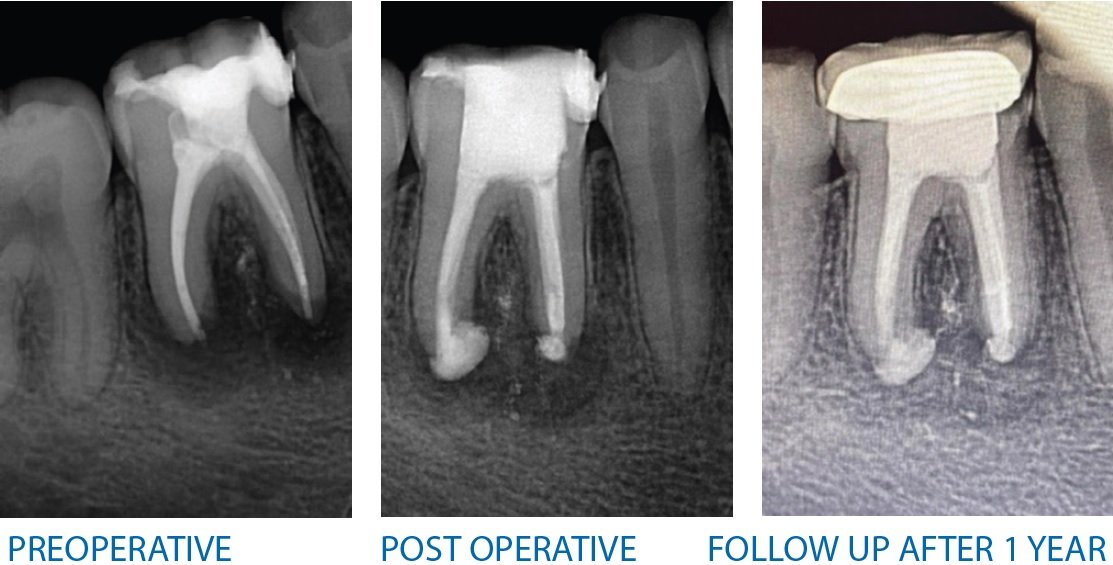
A 22 year old patient reported to the Department of Dentistry, GTB Hospital, New Delhi with the chief complaint of pain on food lodgement in lower left back tooth region. Clinical and radiographic examination revealed carious lesion in mandibular first molar, involving coronal portion of the pulp. (Fig 1)

The patient had no significant medical history. The patient was explained about the procedure and informed consent was taken for the same.
Local Anesthesia was given followed by rubber dam isolation. Access cavity was prepared after caries removal using a carbide round bur and an Endo Z bur to refine the cavity. (Fig 2)

Pulp excavation was performed till the level of canal orifices. Hemostasis was achieved using a cotton pellet saturated with sodium hypochlorite. MTA was mixed in the ratio of 3:1 (powder to liquid) and placed in the access cavity. (Fig 3)
It was then covered with a moist cotton and temporary restoration was placed to allow the setting of MTA.
In the next appointment, 2 days later, patient reported with no pain or discomfort, following which the temporary material was removed and the cavity was restored using composite. (Fig 4 and 5)

DISCUSSION
In the last few decades, there has been immense research in the field of pulp biology and regeneration in response to calcium silicate materials, paving the way for conservative treatment protocols such as coronal pulpotomy in cases even with irreversible pulpitis.5,6
MTA is a bioactive material with good physical characteristics and excellent sealing ability. Multiple studies have reported successful management of deep carious lesions using MTA.7,8 Hence it was chosen as an ideal material for pulp capping in this case.
Coronal pulpotomy has been proven to be highly successful offering an alternate treatment option compared to full pulpectomy owing to the less invasive nature along with utilisation of the pulp’s innate potential for regeneration using materials which promote the formation of a protective barrier to preserve the vitality of the radicular pulp. However, the success of the treatment depends on proper diagnosis of the case along with age and previous dental history. So proper case selection and strict guidelines for diagnosis and treatment is imperative for favourable treatment outcome.
CONCLUSION
In the current case, a successful coronal pulpotomy was carried out to manage a deep carious lesion in a mandibular first molar using MTA. Given the rise of minimal invasive procedures in everyday dental practice, coronal pulpotomy offers a great solution as a definitive treatment modality for cases with irreversible pulpitis, overcoming the need for more invasive endodontic treatment.
REFERENCES
- Lin L M, Ricucci D, Saoud T M, Sigurdsson A, Kahler B. Vital pulp therapy of mature permanent teeth with irreversible pulpitis from the perspective of pulp biology. Aust Endod J 2020; 46: 154–166.
- Taha N A, About I, Sedgley C M, Messer H H. Conservative management of mature permanent teeth with carious pulp exposure. J Endod 2020; DOI: 10.1016/j.joen.2020.06.025.
- Anonymous. AAE Position Statement on Vital Pulp Therapy. J Endod 2021; 47: 1340–1344.
- Duncan H F, Galler K M, Tomson P L et al. European Society of Endodontology position statement: Management of deep caries and the exposed pulp. Int Endod J 2019; 52: 923–934.
- Taha N A, Khazali M A. Partial Pulpotomy in Mature Permanent Teeth with Clinical Signs Indicative of Irreversible Pulpitis: A Randomized Clinical Trial. J Endod 2017; 43: 1417–1421. 40.
- Taha N A, Abdelkhader S Z. Outcome of full pulpotomy using Biodentine in adult patients with symptoms indicative of irreversible pulpitis. Int Endod J 2018; 51: 819–828. 41.
- Taha N A, Ahmad M B, Ghanim A. Assessment of Mineral Trioxide Aggregate pulpotomy in mature permanent teeth with carious exposures. Int Endod J 2017; 50: 117–125.
- Qudeimat M A, Alyahya A, Hasan A A. Mineral trioxide aggregate pulpotomy for permanent molars with clinical signs indicative of irreversible pulpitis: a preliminary study. Int Endod J 2017; 50: 126–134.
Disclaimer from Guident
The views and opinions expressed in articles published in Guident are solely those of the authors and do not necessarily reflect the views of the editors, the editorial board or the publisher, Ivory India. Guident does not endorse any product, technique or treatment described. Clinical content is intended for qualified dental and medical professionals and is not a substitute for individual clinical judgement. Guident, its editors and the publisher accept no liability for any consequence arising from the use of information published in the journal.
How to cite this article
Dr. Namrata Mehta, Dr. Kailash. Coronal Pulpotomy Using MTA for Management of Irreversible Pulpitis in Mature Permanent Mandibular Molar: A Case Report. Guident. 2025 Mar;18(4). Available from: https://guident.in/articles/endodontics/coronal-pulpotomy-using-mta-for-management-of-irreversible-pulpitis-in-mature-permanent-mandibular-molar-a.html