Artificial Intelligence in Dentistry
Department of Public Health Dentistry, K. D. Dental College and Hospital, Mathura, Uttar Pradesh, India
INTRODUCTION
Healthcare systems around the world face significant challenges in achieving the ‘quadruple aim’ for healthcare: improve population health, improve the patient's experience of care, enhance caregiver experience and reduce the rising cost of care.1 The scientific world has never really understood how to create a flawless model that mimics the human brain.2 John McCarthy originally introduced this field of applied computer science known as Artificial Intelligence in 1956.3 To design a model that will mimic just like the human brain has remained a big puzzle to solve for the scientific community. Constant effort and hard work of researchers from several years results in the evolution of ‘Artificial Intelligence’. The term was coined in 1950 and refers to the idea of designing machines that are capable of performing tasks that are normally done by humans. It is, at times, called machine intelligence.4 The "fourth industrial revolution," often known as artificial intelligence, employs computer technology to imitate critical thinking, decision-making, and intelligent behaviour that is similar to that of humans.5
AI is not a new term; the concept of AI can be dated back to 1950. However, it has not become a practical tool until two decades ago. Owing to the rapid development of three cornerstones of current AI technology—big data (coming through digital devices), computational power, and AI algorithm—in the past two decades, AI applications have been started to provide convenience to people’s lives.
AI has been adopted in many fields of industry, such as robots, automobiles, smart city, and financial analysis, etc. It has also been used in medicine and dentistry, for example, medical and dental imaging diagnostics, decision support, precision and digital medicine, drug discovery, wearable technology, hospital monitoring, robotic. and virtual assistants. In many cases, AI can be regarded as a valuable tool to help dentists and clinicians reduce their workload. Besides diagnosing diseases using a single information source directed at a specified disease, AI can learn from multiple information sources (multi-modal data) to diagnose beyond human capabilities.6
Artificial intelligence (AI) has the potential to replicate human intelligence to perform prediction and complex decision making in health care and has significantly increased its presence and relevance in various tasks and applications in dentistry.5
DEFINITIONS 7
ARTIFICIAL INTELLIGENCE: A term coined by “Emeritus Stanford Professor John McCarthy in 1955”, was defined by him as “the science and engineering of making intelligent machines”.
MACHINE LEARNING: Is the part of studying how computer agents can improve their perception, knowledge, thinking or actions based on experience or data. For this machine learning draws from computer science, statistics, psychology, neuroscience, economics. {Christopher Manning, September 2020.}
DEEP LEARNING: Is the use of multilayer (Artificial neural network), that competes with the continuous (real number) representation, a little like the hierarchically organised neurons in human brain.
HISTORICAL BACKGROUND OF AI: 8
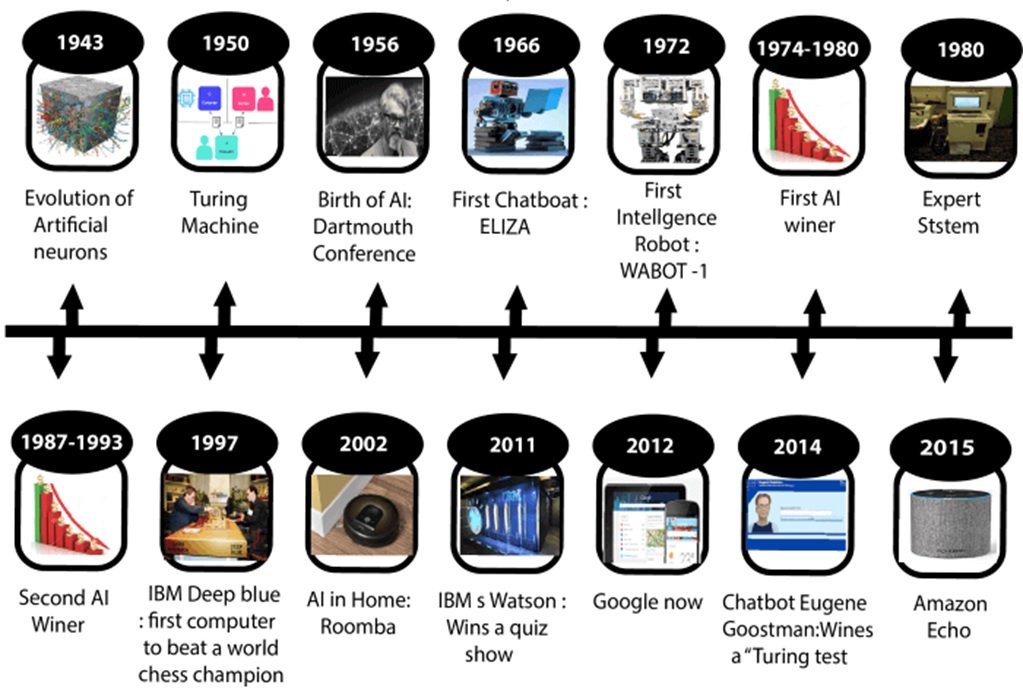
Fig: 1 HISTORY OF ARTIFICIAL INTELLIGENCE
Maturation of Artificial Intelligence (1943-1952)
- Year 1943: The first work which is now recognized as AI was done by Warren McCulloch and Walter Pits in 1943. They proposed a model of artificial neurons.
- Year 1949: Donald Hebb demonstrated an updating rule for modifying the connection strength between neurons. His rule is now called Hebbian learning.
- Year 1950: The Alan Turing who was an English mathematician and pioneered Machine learning in 1950. Alan Turing published "Computing Machinery and Intelligence" in which he proposed a test. The test can check the machine's ability to exhibit intelligent behaviour equivalent to human intelligence, called a Turing test.
The birth of Artificial Intelligence (1952-1956)
- Year 1955: An Allen Newell and Herbert A. Simon created the "first Artificial Intelligence program" which was named as "Logic Theorist". This program had proved 38 of 52 Mathematics theorems, and found new and more elegant proofs for some theorems.
- Year 1956: The word "Artificial Intelligence" was first adopted by American Computer scientist John McCarthy at the Dartmouth Conference. For the first time, AI was coined as an academic field.
At that time high-level computer languages such as FORTRAN, LISP, or COBOL were invented and the enthusiasm for AI was very high at that time.
The golden years-Early enthusiasm (1966-1974)
- Year 1966: The researchers emphasized developing algorithms which could solve mathematical problems. Joseph Weizenbaum created the first chatbot in 1966, which was named as ELIZA.
- Year 1972: The first intelligent humanoid robot was built in Japan which was named as WABOT-1.
The first AI winter (1974-1980)
- The duration between years 1974 to 1980 was the first AI winter duration. AI winter referred to the time period where computer scientist dealt with a severe shortage of funding from government for AI researches.
- During AI winters, an interest of publicity on Artificial Intelligence was decreased.
A boom of AI (1980-1987)
- Year 1980: After AI winter duration, AI came back with "Expert System". Expert systems were programmed that emulate the decision-making ability of a human expert.
- In the Year 1980, the first national conference of the American Association of Artificial Intelligence was held at Stanford University.
The second AI winter (1987-1993)
- The duration between the years 1987 to 1993 was the second AI Winter duration.
- Again Investors and government stopped funding for AI research due to high cost & not efficient result. The expert system such as XCON was very cost effective.
The emergence of intelligent agents (1997-2006)
- Year 1997: In the year 1997, IBM Deep Blue beat world chess champion, Gary Kasparov, and became the first computer to beat a world chess champion.
- Year 2002: For the first time, AI entered the home in the form of Roomba, a vacuum cleaner.
- Year 2006: AI came in the Business world till the year 2006. Companies like Facebook, Twitter, and Netflix also started using AI.
Deep learning, big data and artificial general intelligence (2011-present)
- Year 2011: In the year 2011, IBM's Watson won jeopardy, a quiz show, where it had to solve the complex questions as well as riddles. Watson had proved that it could understand natural language and could solve tricky questions quickly.
- Year 2012: Google has launched an Android app feature "Google now", which was able to provide information to the user as a prediction.
- Year 2014: In the year 2014, Chatbot "Eugene Goostman" won a competition in the infamous "Turing test."
- Year 2018: The "Project Debater" from IBM debated on complex topics with two master debaters and also performed extremely well.
- Google had demonstrated an AI program "Duplex" which was a virtual assistant and which had taken hairdresser appointment on call, and lady on other side didn't notice that she was talking with the machine.
DEVELOPMENT OF ARTIFICIAL INTELLIGENCE :
With Artificial Intelligence developments, the future of technology seems to be promising. Many new Artificial Intelligence concepts are being developed to make life more efficient and convenient. AI applications are widely employed in dentistry and evaluate their performance in terms of diagnosis, clinical decision-making, and predicting the prognosis of the treatment.9
Types of Artificial Intelligence10
Type 1
Artificial Intelligence today is accurately known as narrow AI (or weak AI), it is non-sentient machine intelligence, typically designed to perform a narrow task (e.g. only facial recognition or only internet searches or only driving a car).
The ultimate hypothetical goal is achieving superintelligence (ASI) which is far surpassing that of the brightest and most gifted human minds. Due to recursive self-improvement, superintelligence is expected to be a rapid outcome of creating artificial general intelligence.
Type 2 (based on functionalities)10
Purely Reactive
Reactive machines are basic in that they do not store ‘memories’ or use past experiences to determine future actions. They simply perceive the world and react to it. IBM’s Deep Blue, which defeated chess grandmaster Kasparov, is a reactive machine that sees the pieces on a chess board and reacts to them.
Limited Memory
Limited Memory machines can retain data for a short period of time. While they can use this data for a specific period of time, they cannot add it to a library of their experiences. Many self-driving cars use Limited Memory technology: they store data such as the recent speed of nearby cars, the distance of such cars, the speed limit, and other information that can help them navigate roads.
Theory of Mind
Psychology tells us that people have thoughts, emotions, memories, and mental models that drive their behaviour. Theory of Mind researchers hope to build computers that imitate our mental models, by forming representations about the world, and about other agents and entities in it.
Self-Awareness
Self-aware machines are the stuff of science fiction, though many AI enthusiasts believe them to be the ultimate goal of AI development. Even if a machine can operate as a person does, for example by preserving itself, predicting its own needs and demands, and relating to others as an equal, the question of whether a machine can become truly self-aware, or ‘conscious’, is best left for philosophers.

Fig: 2 SIMPLIFYING THE DIFFERENCE: MACHINE LEARNING VS DEEP LEARNING
MACHINE LEARNING, DEEP LEARNING, ARTIFICIAL NEURAL NETWORK:
- Machine learning11
It is a branch of Artificial Intelligence & computer sciences which concentrate on the use of data and algorithms to mimic the way human mind learns and gradually improve its accuracy.
Machine learning is typically created using frame work that accelerate solution development.
Machine learning is more dependent over human interventions to learn. Human experts recognise the set of features to understand the difference between data which required more structured data to interpret.
How machine learning works: - It consists of three parts:
Decision process: In general machine learning algorithms are used to make prediction or classifications, based on some data inputs which can be labelled or un-labelled
Error function: It evolutes the prediction of the model if there are known examples, an error functions can make a comparison to assess the accuracy of the model.
Model optimization process: If the model can fit better to the data points in the training set, then weight is adjusted to reduce the discrepancy between the known examples and the model estimates. The algorithm will repeat and optimize process, updating weights autonomously until a threshold of accuracy has been met.
VARIOUS METHODS OF MACHINE LEARNING :–
The model of machine learning falls in 3 categories:
- Supervised machine learning
- Unsupervised machine learning
- Semi-supervised machine learning
Supervised machine learning:
Defined by the usage of labelled data set to train algorithm to classify data to predict outcome accurately. as input id fed into the model, the model adjusts its weight until it has been fitted appropriately.
Unsupervised machine learning:
It uses machine learning algorithm to analyse and cluster in labelled data set. These algorithms discover the hidden pattern or data grouping without the need for human interventions.
Semi-supervised learning:
It offers a happy medium between supervised and un-supervised learning. During training it uses smaller labelled data set to guide classification and features extraction from large un-labelled data set.
- Deep learning11 Deep learning is a class of machine learning algorithms that uses multiple layers to progressively extract higher-level features from the raw input. For example, in image processing, lower layers may identify edges, while higher layers may identify the concepts relevant to a human such as digits or letters or faces.
Various tasks supported by the deep learning in daily life:
- Virtual assistant.
- Driverless vehicle.
- Chat bots
- Facial recognition
- Medical sciences
Artificial Neural Network (ANN)11:
The Artificial Neural Network is based on collections of units or NODES called artificial neurons, which closely models the neurons in a biological brain.
Characteristics of Artificial Neural Network are as follows:-
- Learning
- Parallel operations
- Mapping
- Generalisation
- Abstraction
- Applicability
- Classification of application
- Prediction of application
- Conceptualisation of application
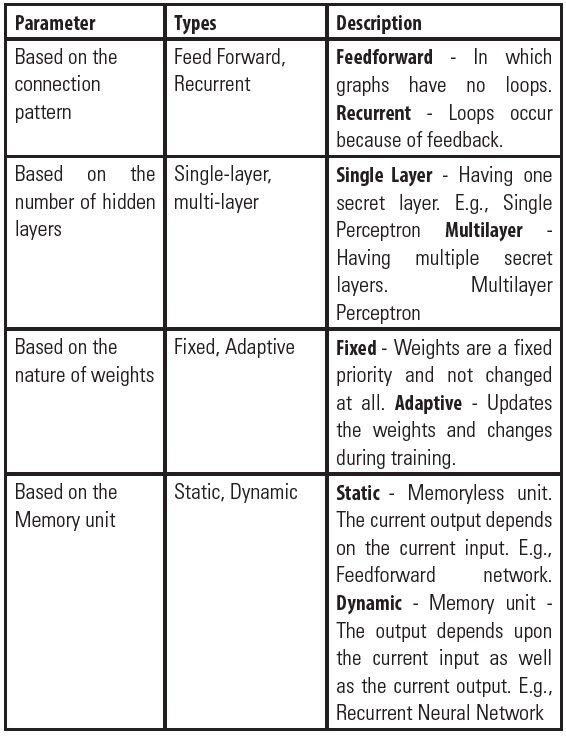
Types of Artificial Neural Network.6
ARTIFICIAL INTELLIGENCE {AI} IN DENTISTRY : 12
From a dental perspective, applications of AI can be classified into diagnosis, decision-making, treatment planning, and prediction of treatment outcomes. AI can make more accurate and efficient diagnoses, thus reducing dentists' workload.
ROLE OF ARTIFICIAL INTELLIGENCE IN PUBLIC HEALTH :
From a public health perspective, AI-based applications can benefit health education and promotion with accessible, cost-efficient, and interactive solutions. AI can assist in the self-management of chronic illnesses, including diabetes, hypertension, and asthma.13
Artificial Intelligence has been implemented in academic research and in inference tasks throughout the broader economic system with demonstrable success, however much less so for the core functions of public health, specifically protecting and promoting the health of populations. To date, vision statements at the future of public health have centred at the technical possibilities of Artificial Intelligence and much less on how social determinants would possibly have an impact on outcomes achieved with the aid of using it.

Fig 3. Diagram illustrating the role of Artificial Intelligence in Public Health
- HEALTH PROTECTION
- HEALTH PROMOTION
- INCREASING EFFICACY OF HEALTH SERVICES
- PUBLIC HEALTH SURVEILLANCE
CHALLENGES IN ARTIFICIAL INTELLENGENCE: 14
Although AI models sound quite impressive and promising, there are still some limitations, such as the need to validate their reliability with appropriate data from new patients or other dental services. It still requires constant human supervision as errors can occur.
Various challenges are as follows:-
- Computing Power
- Trust Deficit
- Limited Knowledge
- Human-level
- Data Privacy and Security
- The Bias Problem
- Data Scarcity

Fig 4. Diagram illustrating challenges in Artificial Intelligence.
ETHICS AND STANDARDS: 15
The widespread introduction of Artificial Intelligence (AI) in all aspects of healthcare is inescapable. AI described as delivering “simultaneous application of a telescope and microscope, harnessing large databases for smart, personalized precision treatments.
1.1 Considerations when adopting AI.
AI is meant to be an adjunct to clinical decision-making rather than a replacement for it. Programming AI requires careful consideration of all aspects of dentistry and patient care.
1.2 Dental curriculum integration.
The dental curriculum must incorporate and integrate courses to educate students on the ethical application of AI, including its risks and limitations.
1.3 Proposed curriculum model.
One potential curricular model in a medical school setting incorporates AI in an incremental, stepwise fashion throughout the program, building upon the strengths of a multidisciplinary team of individuals including clinicians, basic scientists, bioinformaticians, computer scientists, and bioethics professionals.
1.4 Guidance from dental organizations.
Considering the rapid development of AI in dentistry, an ADEA advisory group or task force on AI should be created to provide resources to dental educators to ensure a responsible AI-based curriculum.
FUTURE ASPECTS OF ARTIFICIAL INTELLENGENCE :
Future aims of AI research in the dentistry sector include not only raising the performance of AI models to expert levels but also detecting early lesions that are invisible to the human eye.16 As promising as the current state of AI in dentistry is, the future holds even more exciting possibilities and advanced imaging analysis: AI algorithms will become even more proficient at detecting complex dental conditions, including early-stage cancers and microscopic abnormalities.
Tele dentistry: AI-powered tele dentistry platforms will become more sophisticated, allowing remote consultations, treatment planning and follow-ups. This will increase access to dental care, especially in underserved areas.
- Customised treatment: AI can enable the creation of personalised treatment plans based on a patient's genetic and lifestyle factors. Treatment effectiveness will be optimised and adverse events will be minimised.
- Robot-assisted dentistry: Robotics combined with AI could lead to the development of robotic dental assistants capable of performing certain procedures with precision. This could enhance the capabilities of dental professionals and reduce the physical demands of dental work.
- Big data insights: AI can leverage vast datasets to uncover new trends and insights in oral health. Researchers will gain a deeper understanding of disease mechanisms and treatment responses.
- Patient engagement: AI-driven chatbots and virtual assistants can engage with patients, provide information and even schedule appointments. This enhances patient communication and satisfaction.
- Administrative efficiency: AI can automate administrative tasks, such as appointment scheduling and billing, reducing the administrative burden on dental practices.17
REFERENCES
- Junaid Bajwa, Usman Munir, Aditya Nori, Bryan Williams. Artificial intelligence in healthcare: transforming the practice of medicine. Future Health J 2021 July; 8(2): 188-194.
- Berwick DM, Nolan TW, Whittington J. The Triple Aim: care, health and cost. Health Affair 2008; 27:759–69.
- Bodenheimer T, Sinsky C. From triple to quadruple aim: care of the patient requires care of the provider J. Ann Fam Med 2014; 12:573–6.
- Feeley D. The triple aim or the quadruple aim? Four points to help set your strategy. institute for healthcare improvement .
- Alexander B, John S. Artificial Intelligence in Dentistry: current concepts and a peep into the future. Int J Adv Res. 2018; 30:1105–1108.
- Aminoshariae A, Kulild J, Nagendrababu V. J Endod. Artificial Intelligence in endodontics: Current applications and future directions 2021; 47:1352–1357.
- https://hai.stanford.edu/sites/default/files/2020-09/AI-Definitions-HAI.pdf (accessed on September 2023)
- https://www.javatpoint.com/history-of-artificial-intelligence(last accessed on September 2023)
- https://timesofindia.indiatimes.com/readersblog/mywriteexpress/artificial-intelligence-unleashing-the-power-of-innovation-56241 (last accessed on 30-3-2024)
- Ziyad Saleh, Artificial Intelligence Definition, Ethics and Standards, J. Electronics and Communications: Law, Standards and Practice 21 April 2018- 2019:1-10.
- https://www.ibm.com/topics/machine-learning (last accessed on November 2023).
- Hao Ding Jiamin Wu Wuyuan Zhao Jukka P. Matinlinna Michael F. Burrow James K. H. Tsoi. Artificial Intelligence in dentistry. J. Dent. Med 2023;4 (1):1-13.
- David Jungwirth. Artificial Intelligence and Public Health: An Exploratory Study. Int J Environ Res Public Health 2023; 20(5): 4541.
- https://medium.com/@upGrad/top-challenges-in-ai-explained-f685cbe4de5c(last accessed on february 2024)
- Clara S. Kim D, MS, Cheryl S. Samaniego , Saulo L. Sousa Melo , William A. Brachvogel, Krithika Baskaran BDS, Danielle Rulli . Artificial Intelligence (A.I.) in dental curricula: Ethics and Responsible Integration 2023;7(11):1570-1573.
- Alexander Muacevic and John R Adler Paridhi Agrawal, Pradnya Nikhade. Artificial Intelligence in dentistry: Past, Present, and Future Monitoring. Cureus 14(7) 2022; 14(7): e27405.
- K Dhingra. Artificial Intelligence in dentistry: current state and future direction. J. The Bulletin of the Royal College of Surgeons of England 2023 ;105(8): 370-416.18.
Disclaimer from Guident
The views and opinions expressed in articles published in Guident are solely those of the authors and do not necessarily reflect the views of the editors, the editorial board or the publisher, Ivory India. Guident does not endorse any product, technique or treatment described. Clinical content is intended for qualified dental and medical professionals and is not a substitute for individual clinical judgement. Guident, its editors and the publisher accept no liability for any consequence arising from the use of information published in the journal.
How to cite this article
Dr. Saurabh Malik, Dr. Navpreet Kaur, Dr. Roopali Gupta. Artificial Intelligence in Dentistry. Guident. 2025 Mar;18(4). Available from: https://guident.in/articles/general/artificial-intelligence-in-dentistry.html