
Microgravity and Oral Cavity – an Insight into Aeronautical Dentistry
Department of Prosthodontics, Kamineni Institute of Dental Sciences, Narketpally, Nalgonda, Telangana
ABSTRACT
Dentistry has put down its roots into all the specialities that deals with every aspect of tooth and its surrounding structures. All these specialities are considered when the patient is present on Earth with certain gravity. But what happens to those living in microgravity(µg)?
Micro -g environment / microgravity is the condition in which people or objects appear to be weightless, which can be seen in space.
There is a catalogue of literature explaining the health effects of micro -g environment including space motion sickness, musculoskeletal effects, cardiovascular effects, etc. Why not understand the mechanisms of µg and address the dental difficulties faced by space ventures and look into minimizing dental maladies of every single individual.
The current paper focuses on imminent branch related to dental medicine – Aeronautical dentistry and the effect of microgravity on oral cavity. It focuses on the reversible and irreversible effects of microgravity on oral and maxillofacial regions.
KEYWORDS –
Aeronautical dentistry, microgravity, micro-g environment, space venture, effects on oral cavity.
INTRODUCTION
According to NASA, Aeronautics is the study of the science of flight. Aeronautics is the method of designing an airplane or other flying machine. Human evolution has expanded so much that people started exploring space and are finding signs of life in another world. But can life there be same as that on the Earth? The answer is absolutely not and studies are showing that there is life beyond Earth. The survival is not as efficient as on Earth but civilization on other planets is being investigated. In order to study life outside Earth, astronauts are supposed to travel through space and find out what’s in for the life. But this travelling showed a huge impact on their health conditions.
A very little knowledge about the effect of space environment and atmosphere on the human tissues is available. The current article focuses on the medical changes in human’s body in aerospace and discusses about dental health in detail as microgravity is effective in changing the physiology of oral cavity and maxillofacial region6.
Human body is so magnificent that it adjusts to the surrounding environment. But this also has an exception. The physiology of the body changes in any conditions other than those that a normal body is acclimatized to. Various effects have been cited on human body when travelled through space.
Following are some changes that are seen in the general health.
A NASA astronaut, who was on a 6 month stay on international space station found the shift of his vision towards farsightedness along with his other crew members which is quoted as an “occupational hazard in spaceflight”
A comparison of MRIs of astronauts before and after spaceflight revealed narrowing of CSF spaces at vertex, enlargement of ventricular system and increased visual impairment and ventricular pressure1.
Absences of protective cocoon present on Earth, astronauts are subjected to heavy ion radiation that is modifying the self renewal capability of GI cells3.
Certain viruses remain dormant in human beings and are activated in immune compromised state. Depletion in immune cells elevates the chances of rejuvenation of slumbered viruses2.
The list remains incessant and unceasing but the consequences of microgravity on oral cavity remain inexplicable and obscure.
DENTAL CONSIDERATIONS
- Barodontalgia is the pain that occurs in the regions of teeth due to pressure changes which was first observed in air crews during World War II and has been referred to as aerodontalgia. This pain is attributed to changes in the fluid movement out of dentinal tubules and presence of carious lesions extending into dentin. Also pain is thought to arise due to changes in the microcirculation of the pulp.8
- In microgravity, there is a decrease in mechanical force on the skeletal tissues, leading to skeletal porosity and reduced bone density. These effects are also seen in temporomandibular joint associated with bone loss and associated psychological stress, sleep disturbances due to altered circadian rhythm.9
- Physiological changes seen due to microgravity are described as follows:
- The weightlessness in the outer space causes head ward shift of fluids leading to extravascular shift of protein and fluid. This brings rise to loss of albumin and metabolism after few days finally reducing oncotic pressure and the sequel is edema of face.
- Fluid shift along with other odors in space station alters the perception of taste5.
- Reduced oxygen levels cause xerostomia which can be attributed to the minimal moisture content in the oxygen provided in the space suits.
- Absence of gravity causes disruption of its primary function that is the process of bone maintenance. The altered mechanism causes lack of use atrophy, decreased proliferation and activity of osteoblasts, their reduced differentiation and response to bone related factors.
- Hypercalcemia, hypercalciuria and bone demineralization increases the proneness of jaw bones to fracture.
- Microgravity causes enhancement of acid tolerance ability which further causes modification of biofilm architecture and extracellular polysaccharide distribution of Streptococcus mutans through various gene expressions. A multispecies micro-ecological imbalance occurs and this causes initiation of dental caries in individuals residing in outer space for a longer time7.
- Increased bone resorption inturn causes increased salivary saturation of calcium salts namely calcium oxalate and calcium phosphate that enhances the formation of salivary stones.
- Microgravity reduces the muscle mass by removal of the muscle load. This causes muscle atrophy but is applicable to weight bearing leg muscles. Masticatory and cheek muscles hold up better in space.
- Talking about prosthesis, retention is achieved by the dentures due to atmospheric pressure. But this is lost in microgravity. Also, the crowns that are restored with resin cements show higher bonding strengths than those bonded with glass ionomer or zinc phosphate cement due to a chemical bond formed by resin cements.10
- Since the bone morphology and circulation of the alveolar bone are altered, the osseointegration of a dental implant also remains a question of interest. But the study focussing on peri implant bone changes in a French astronaut who spent six months in Russia’s space station concluded that there were no changes in the peri implant tissues and the implant as functionally effective.12
- Extended space missions and sustained microgravity exposure have been linked to various conditions affecting the oral mucosa and related structures. These include muscle wasting (sarcopenia) alterations in peripheral nerve function, dysfunction in the neuromotor control of masticatory muscles, and reduced strength in the lips, tongue, and cheeks. Additionally, astronauts may experience nociplastic pain associated with oral mucosal disorders, modifications in soft tissue health impacting mastication, adaptive neuroplastic changes in the cortical regulation of the tongue, and disturbances in swallowing mechanics.11
Dental emergenices during space flights include
- Crown displacement
- Lost fillings
- Dental pain
- Dental caries
- Barodontalgia
- Avulsion
- Pulpitis
- Displaced crown
- Tooth fracture
- Periapical abscess
- Periodontitis with tooth mobility
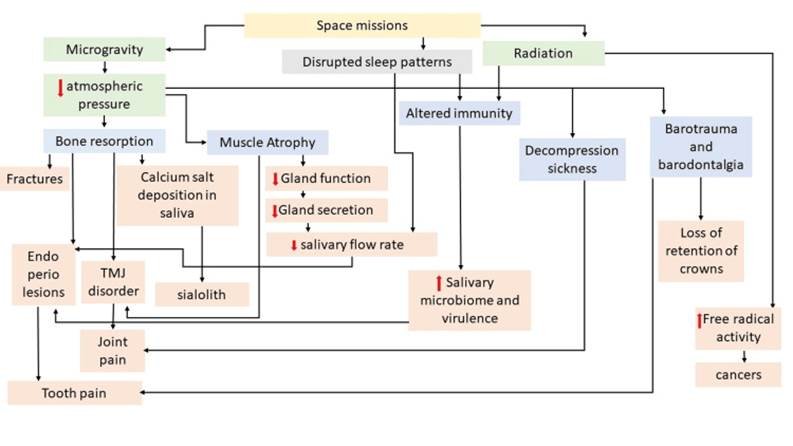
Divya Harika P, Mehta KH, Pulluri SS, Rana P, Rajani H, Aiman A. Oral Health in Zero Gravity: A Comprehensive Review of Orofacial Effects and Countermeasures in Spaceflights. Cureus. 2023 Nov 19;15(11):e49035.
WHAT IS BEING IMPLEMENTED IN SPACE STATIONS (NASA) BEFORE A MISSION?
- All the crew members are educated about the healthy diet and encouraged to practice thorough oral hygiene.
- Periodic check-ups are carried out, the crew members annual check-ups where radiographs like bite wing and orthopantamogram are evaluated.
- The astronauts are classified under three categories based on their oral health.
- CLASS I - Good oral health, no treatment required for next 12 months
- CLASS II – some oral conditions present but do not fall under emergency category
- CLASS III – oral conditions present, immediate treatment is required to prevent dental emergencies.
WHAT TO DO IN CASE OF DENTAL EMERGENCY DURING FLIGHT?
During space missions, astronauts undergo routine oral health assessments through remote diagnostic systems. Using intraoral cameras, images of their oral cavity are captured and transmitted to ground-based medical teams for evaluation. In the event of a dental emergency onboard the International Space Station (ISS), astronauts have access to a set of medical tools and devices designed for a range of dental interventions, along with comprehensive procedural guides.
Astronauts are specially trained on how to use dental kits and how to perform emergency procedures as well.
CONCLUSION
Catastrophic effects are seen in astronauts who are experiencing prolonged space flight to explore various regions in outer space. The functioning of various parts of human body is being modified that is posing a threat to serious complications later in life. A special emphasis is required on oral cavity as well which is not exclusion for the adverse effects causes by micro-g environment. The reversible and irreversible effects mentioned above require immediate attention to increase the quality of life of space ventures.
FUTURE SCOPE – Space dentistry will become an analogue to space medicine in the upcoming years and will permit an easier way to explore Martian expeditions and deep space adventures. Simulation through artificial microgravity will provide a deeper insight into what actually occurs in outer space and will help mitigate the oral health issues to maximum extent.
REFERENCES
- Roberts DR, Albrecht MH, Collins HR, Asemani D, Chatterjee AR, Spampinato MV, et al. Effects of spaceflight on astronaut brain structure as indicated on MRI. N Engl J Med. 2017;377(18):1746–53.
- Griffin A. Travelling to Mars and deep into space could kill astronauts by destroying their guts, finds Nasa-funded study. The Independent. 2018 Oct 1.Dormant viruses activate during spaceflight – NASA investigates. EurekAlert! 2019 Mar 15.
- Zeitlin C, Hassler DM, Cucinotta FA, Ehresmann B, Wimmer-Schweingruber RF, Brinza DE, et al. Measurements of energetic particle radiation in transit to Mars on the Mars Science Laboratory. Science. 2013;340(6136):1080–4.
- Vickers ZM, Rice BL, Rose MS, Lane HW. Simulated microgravity [bed rest] has little influence on taste, odor or trigeminal sensitivity. J Sens Stud. 2001;16(1):23–32.
- Taste in space. Educator section. NASA [Internet]. [cited 2025 May 14]. Available from: http://www.nasa.gov
- Stevens M, Keyhan SO, Ghasemi S, Fallahi HR, et al. Does microgravity effect on oral and maxillofacial region? Int J Astrobiol. 2020.
- Cheng X, Xu X, Chen J, Zhou X, Cheng L, Li M, et al. Effects of simulated microgravity on Streptococcus mutans physiology and biofilm structure. FEMS Microbiol Lett. 2014;359(1):94–101.
- Stoetzer M, Kuehlhorn C, Ruecker M, Ziebolz D, Gellrich NC, von See C. Pathophysiology of barodontalgia: a case report and review of the literature. Case Rep Dent. 2012;2012:453415.
- Divya Harika P, Mehta KH, Pulluri SS, Rana P, Rajani H, Aiman A. Oral Health in Zero Gravity: A Comprehensive Review of Orofacial Effects and Countermeasures in Spaceflights. Cureus. 2023 Nov 19;15(11):e49035.
- Bhavani TMS. Aviation dentistry: effect of microgravity on teeth and oral cavity – a review. Int J Recent Sci Res. 2017 Jun;8(6):17339–42.
- Bakr MM, Caswell GM, Hussein H, Shamel M, Al-Ankily MM. Considerations for oral and dental tissues in holistic care during long-haul space flights. Front Physiol. 2024 Jul 11;15:1406631.
- Hasin Abdul Samathu J, Mani R, Venkatesh V, Vaishnavi A, Sacrapani L. Smile Beyond the Stars: A Narrative Review Exploring the Challenges for Dentistry in Space. Cureus. 2024 Aug 10;16(8):e66591.
Disclaimer from Guident
The views and opinions expressed in articles published in Guident are solely those of the authors and do not necessarily reflect the views of the editors, the editorial board or the publisher, Ivory India. Guident does not endorse any product, technique or treatment described. Clinical content is intended for qualified dental and medical professionals and is not a substitute for individual clinical judgement. Guident, its editors and the publisher accept no liability for any consequence arising from the use of information published in the journal.
How to cite this article
Dr. Sahithi, Dr. Jayyarapu Dilip. Microgravity and Oral Cavity – an Insight into Aeronautical Dentistry. Guident. 2025 Jun;18(7). Available from: https://guident.in/articles/general/microgravity-and-oral-cavity-an-insight-into-aeronautical-dentistry.html