Implant Positioning and its Influence on Pink and White Esthetic Scores in the Esthetic Zone
Department of Prosthodontics and Crown & Bridge, K.D. Dental College & Hospital, Mathura, UP, India.
INTRODUCTION
The success of dental implants extends beyond functionality; in the esthetic zone, achieving a visually pleasing outcome is of paramount importance. In this context, the Pink and White Esthetic Scores (PES/WES) have emerged as critical tools to objectively assess both the peri-implant soft tissue (pink) and the implant-supported restoration (white). A key determinant of the overall esthetic success is the positioning of the implant. Proper implant positioning is crucial for creating a harmonious balance between the soft tissue and the prosthetic restoration, ultimately influencing the PES/WES. This article explores how implant positioning impacts both the pink and white components of esthetic evaluation in the anterior esthetic zone.
THE ESTHETIC ZONE: CHALLENGES AND IMPORTANCE
The esthetic zone refers to the area of the mouth visible when smiling, usually encompassing the anterior maxillary teeth. Implants placed in this area must not only function well but also blend seamlessly with the natural dentition. This is particularly challenging due to the high esthetic demands and the anatomical complexity of the region, where slight discrepancies in soft tissue or restoration appearance can be easily noticed. Achieving an optimal balance between form and function in the esthetic zone requires careful treatment planning, especially regarding implant positioning.
PINK ESTHETIC SCORE (PES)
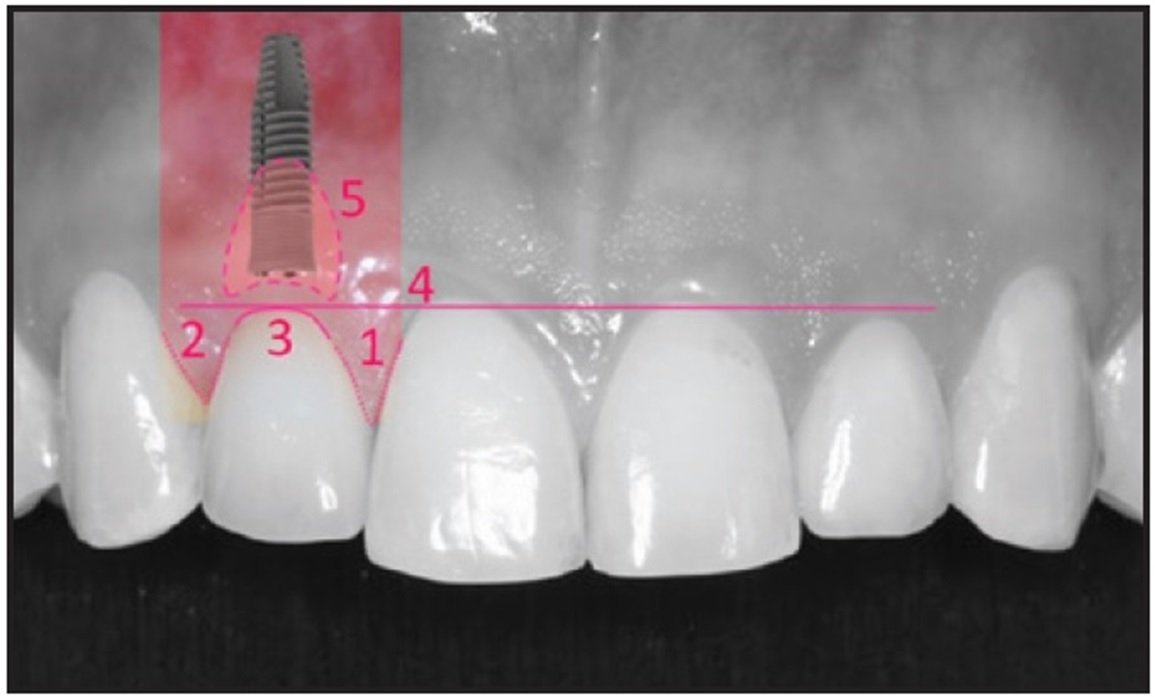
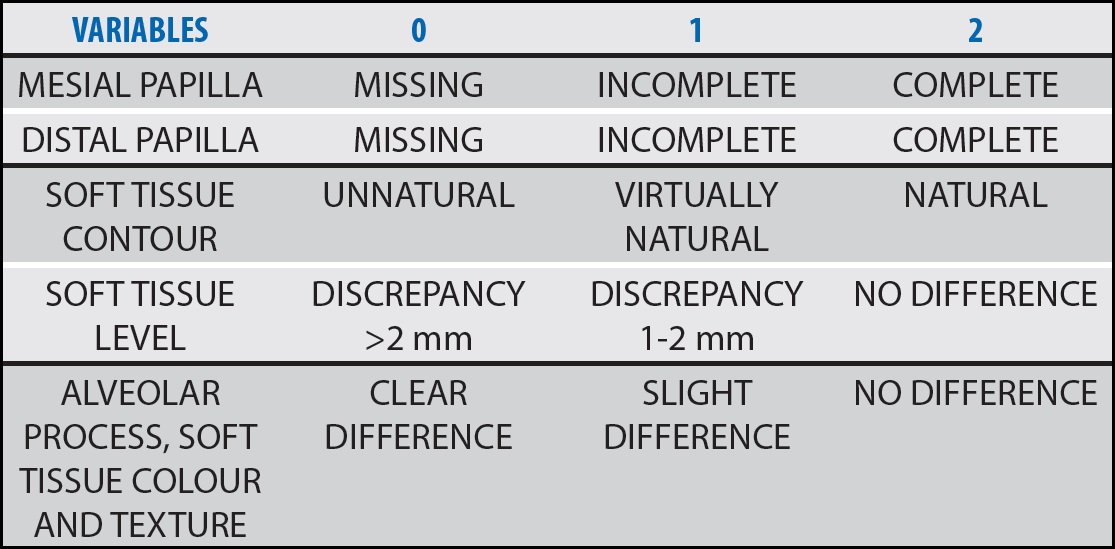
The Pink Esthetic Score (PES) is designed to evaluate the peri-implant soft tissues, focusing on the appearance of the surrounding gingiva. It assesses five key parameters:
- Mesial Papilla – The papilla between the implant and the adjacent tooth.
- Distal Papilla – The papilla on the opposite side of the implant.
- Curvature of the Facial Mucosa – The contour of the soft tissue around the implant, particularly its convexity or concavity.
- Level of the Facial Mucosa – The height of the gingival margin in relation to the adjacent teeth.
- Soft Tissue Color and Texture – The appearance of the peri-implant mucosa, focusing on its color matching and surface texture.
WHITE ESTHETIC SCORE (WES)
The White Esthetic Score (WES) focuses on the esthetic integration of the implant-supported crown with the adjacent teeth. It evaluates five main characteristics of the prosthetic restoration:
- Tooth Form – The overall shape of the implant crown compared to adjacent teeth.
- Tooth Volume – The size and proportion of the crown in relation to the natural teeth.
- Tooth Color (Hue and Value) – The shade of the implant crown and its match to the adjacent teeth.
- Surface Texture – The surface features and microtexture of the implant crown compared to neighboring teeth.
- Translucency and Characterization – The degree to which the crown exhibits translucency similar to natural teeth and the presence of individualized details, like staining or fissures.

Like PES, each WES parameter is scored from 0 to 2, with a maximum possible score of 10. A higher WES reflects a better integration of the crown with the adjacent natural teeth, contributing to an overall esthetic success.
COMBINED PES/WES SCORE
The combined PES and WES score provides a comprehensive evaluation, with a maximum score of 20. A score of 16-20 indicates excellent esthetic outcomes, while scores below 12 suggest esthetic improvement is needed. This system helps clinicians objectively assess both soft tissue and prosthetic success in implant restorations.
IMPLANT POSITIONING AND ESTHETIC OUTCOMES
Horizontal Positioning (Mesiodistal and Buccolingual)
Horizontal implant positioning plays a pivotal role in maintaining the soft tissue architecture and ensuring that the restoration matches the adjacent teeth. Proper mesiodistal positioning preserves the papilla between the implant and adjacent natural teeth, which is a critical factor in achieving a high Pink Esthetic Score (PES). If the implant is placed too close to an adjacent tooth, it may compromise the papilla height, resulting in a "black triangle" effect and a lower PES.
The buccolingual positioning is equally important. If the implant is placed too far buccally, the facial bone and soft tissue may be too thin, leading to recession of the gingival margin and a visible metal abutment, significantly lowering the PES. Conversely, if the implant is placed too far lingually, the restoration may appear too bulky, affecting both the Pink and White Esthetic Scores.
Vertical Positioning (Apicocoronal)
Vertical implant positioning has a direct influence on the soft tissue contour and the emergence profile of the restoration. Ideally, the implant should be placed 2-3 mm apical to the cementoenamel junction of the adjacent natural teeth. This allows sufficient room for the development of an appropriate emergence profile and helps maintain the peri-implant soft tissue. If the implant is placed too shallow, the prosthetic crown may appear elongated, negatively impacting the White Esthetic Score (WES). On the other hand, if the implant is placed too deep, it may cause excessive pressure on the peri-implant tissues, leading to recession and a reduction in PES.
Three-Dimensional (3D) Implant Positioning
Optimal implant placement involves not only precise mesiodistal, buccolingual, and vertical positioning but also a well-considered three-dimensional (3D) approach. 3D implant positioning ensures that the implant is aligned correctly with the surrounding soft and hard tissues, allowing for the proper development of both pink and white esthetics. Digital planning and guided surgery have become valuable tools for ensuring accurate 3D implant positioning, thus improving the esthetic outcome.
IMPACT ON PINK ESTHETIC SCORE (PES)
The Pink Esthetic Score evaluates the soft tissue around the implant, with parameters such as the mesial and distal papilla, the curvature of the facial mucosa, the level of the facial mucosa, and the color and texture of the soft tissue. Implant positioning is crucial in maintaining or regenerating these features. Key considerations include:
Papilla Preservation: Correct mesiodistal positioning allows for adequate space between the implant and adjacent teeth, promoting the formation of healthy papillae. The absence or flattening of papillae, due to improper positioning, results in low PES.
Gingival Contour: Buccolingual and vertical positioning affects the gingival contour around the implant. A natural-looking, convex contour enhances the PES, while soft tissue recession or an unnatural flat appearance can significantly lower it.
Gingival Level: The apicocoronal position determines the height of the gingival margin around the implant. If the implant is too shallow or too deep, the gingival level will not align with the adjacent teeth, leading to a poor esthetic outcome.
IMPACT ON WHITE ESTHETIC SCORE (WES)
The White Esthetic Score assesses the visible characteristics of the prosthetic crown, such as its form, volume, color, and texture, and how well it blends with the adjacent teeth. Implant positioning plays a vital role in the success of the WES:
Crown Proportions: Incorrect vertical positioning can result in an unnatural crown length or width. An elongated crown due to a shallow implant placement will result in a lower WES.
Emergence Profile: The buccolingual positioning of the implant determines the emergence profile of the crown. If the implant is placed too far buccally, the crown may appear bulky or overly prominent, negatively affecting the WES.
Color Matching: Implant positioning can influence how light reflects off the prosthetic crown. For example, poor positioning leading to gingival recession may cause the metal abutment to show through, compromising the color match with adjacent natural teeth and reducing the WES.
ROLE OF DIGITAL TOOLS AND GUIDED SURGERY
Advances in digital dentistry, such as computer-aided design/computer-aided manufacturing (CAD/CAM) and guided implant surgery, have significantly improved implant positioning accuracy. These tools allow for precise 3D planning of implant placement based on the patient's anatomical data, thus reducing the risk of misplacement and enhancing both PES and WES outcomes. By integrating digital technology, clinicians can achieve more predictable esthetic results in the esthetic zone, ensuring both functional success and patient satisfaction.
CONCLUSION
The positioning of an implant is a critical determinant of its esthetic success, particularly in the highly visible esthetic zone. Proper implant positioning, considering mesiodistal, buccolingual, and vertical dimensions, plays a fundamental role in achieving optimal Pink and White Esthetic Scores (PES/WES). Misalignment, poor planning, or improper placement can result in soft tissue deficiencies, unnatural crown proportions, and ultimately lower esthetic scores. By adhering to proper implant positioning protocols and utilizing modern digital planning tools, clinicians can achieve superior esthetic outcomes, improving both patient satisfaction and clinical success in implant dentistry.
REFERENCES
- Haas R, Mensdorff-Pouilly N, Mailath G, et al. Branemark single tooth implants: a preliminary report of 76 implants. J Prosthet Dent 1995;73:274–9.
- Oates TW, West J, Jones J, et al. Long-term changes in soft tissue height on the facial surface of dental implants. Implant Dent 2002;11:272–9.
- Tymstra N, Raghoebar GM, Vissink A, et al. Dental implant treatment for two adjacent missing teeth in the maxillary aesthetic zone: a comparative pilot study and test of principle. Clin Oral Implants Res 2011;22:207–13.
- Meijndert L, Meijer HJ, Stellingsma K, et al. Evaluation of aesthetics of implant-supported single-tooth replacements using different bone augmentation procedures: a prospective randomized clinical study. Clin Oral Implants Res 2007;18(6):715–9.
- Jemt T, Laney WR, Harris D, et al. Osseointegrated implants for single tooth replacement: a 1-year report from a multicenter prospective study. Int J Oral Maxillofac Implants 1991;6:29–36.
- Priest GF. The esthetic challenge of adjacent implants. J Oral Maxillofac Surg 2007;65:2–12.
- Belser UC, Grutter L, Vailati F, et al. Outcome evaluation of early placed maxillary anterior single-tooth implants using objective esthetic criteria: a cross-sectional, retrospective study in 45 patients with a 2- to 4-year follow-up using pink and white esthetic scores. J Periodontol 2009;80(1):140–51.
- Esposito M, Grusovin MG, Worthington HV. Agreement of quantitative subjective evaluation of esthetic changes in implant dentistry by patients and practitioners. Int J Oral Maxillofac Implants 2009;24(2):309–15.
- Palacci P, Nowzari H. Soft tissue enhancement around dental implants. Periodontol 2000 2000;47:113–32.
- Raj V. Esthetic paradigms in the interdisciplinary management of maxillary anterior dentition–a review. J Esthet Restor Dent 2013;25:295–304.
- Bhuvaneswaran M. Principles of smile design. J Conserv Dent 2010;13:225–32.
- Esposito M, Grusovin MG, Maghaireh H, et al. Interventions for replacing missing teeth: management of soft tissues for dental implants. Cochrane Database Syst Rev 2007;(18):CD006697.
- Ward DH. Using the RED proportion to engineer the perfect smile. Dent Today 2008;27:112, 114–117
Disclaimer from Guident
The views and opinions expressed in articles published in Guident are solely those of the authors and do not necessarily reflect the views of the editors, the editorial board or the publisher, Ivory India. Guident does not endorse any product, technique or treatment described. Clinical content is intended for qualified dental and medical professionals and is not a substitute for individual clinical judgement. Guident, its editors and the publisher accept no liability for any consequence arising from the use of information published in the journal.
How to cite this article
Dr. Shikha Shahi, Dr. Sanskriti Tomar, Dr. Manesh Lahori. Implant Positioning and its Influence on Pink and White Esthetic Scores in the Esthetic Zone. Guident. 2025 Mar;18(4). Available from: https://guident.in/articles/implantology/implant-positioning-and-its-influence-on-pink-and-white-esthetic-scores-in-the-esthetic-zone.html