The Occ Upational Safety and Health Administration in Prosthodontic Practice
Department of Prosthodontics Sardar Patel P G Institute of Dental &Medical Sciences Lucknow, India
Abstract
The intent of this article is to analyze the potential hazards and risks involved in persons exposed to prosthodontic practice. These risks include exposure to physical and chemical hazards, dental materials, infectious environment, inappropriate working pattern and psychosocial stress. The potential harm of these hazards and its prevention is highlighted. Prosthodontists, students, dental technicians, and others working in the prosthodontic clinics and laboratory should be aware of the specific risk factors and take measures to prevent and overcome these hazards.
The mission of the Occupational Safety and Health Administration (OSHA) is to ensure the safety and health of doctors,technicians and patients. Although OSHA's focus is on safety, there is a natural overlap into the infection control arena. The work practice control and personal protective equipment regulations are examples of OSHA safety topics that have a direct impact on dental infection control.
KEY WORDS:Health hazards; Occupational exposure; Occupational hazards; Risk management ;Prosthodontic practice
INTRODUCTION
Occupational hazard is defined as a risk to a person in his/her working environment. It can be a fatal accident, minor to severe injuries, allergic and systemic effects. Besides these consequences which occur immediately, there are those that appear at a latter period. According to The World Health Organization the term ''hazard'' refers to an inherent property of an agent, or situation having the potential to cause adverse effects when an organism, system, or population is exposed to that agent.(1)''Risk'', by contrast, means the likelihood of causing adverse health effects.The Occupational Safety and Health Administration (OSHA) requires that employers protect their employees from workplace hazards that can cause injury.
In prosthodontic clinics, the potential risk to irritant chemicals,inhalation of vapors, dust particles, injury from high speed rotary equipments and inflammable materials does exist.Thermal injuries from autoclaves, Bunsen burners, and furnaces can happen quite commonly. Methacrylates, rubber glove allergens, natural rubber latex proteins, and glutaraldehyde are potential allergens that lead to urticaria and occupational asthma in susceptible personnels.(1)
The mission of OSHA is to save lives, prevent injuries and protect the health of workers.(2) To assure safe and healthful conditions for working men and women by setting and enforcing standards and providing training, outreach, education and complianceassistance. Under the OSHA law, employers are responsible for providing a safe and healthful workplace for their workers. In December 1970, President Nixon signed the Occupational Safety and Health Act of 1970 (OSH Act) into law, establishing OSHA. Coupled with the efforts of employers, workers, safety and health professionals, unions and advocates, OSHA and its state partners have dramatically improved workplace safety, reducing work-related deaths and injuries by more than 65 percent.[3]Some of the things OSHA does to carry out its mission are:
- developing job safety and health standards and enforcing them through worksite inspections,
- maintaining a reporting and recordkeeping system to keep track of job-related injuries and illnesses,and
- providing training programs to increase knowledge about occupational safety and health.
- The intent of this conventional review is to highlight the occupational hazards and risks associated in Prosthodontic practice and to briefly discuss their management tactics in routine practice with a view to enhance awareness and take preventive measures to reduce the risk among the professionals.(1)
MANAGEMENT OF HAZARDS AND RISKS
The hazards in a prosthodontic practice may be broadly classified as infectious, non-infectious, ergonomic and psychosocial (Fig. 1).
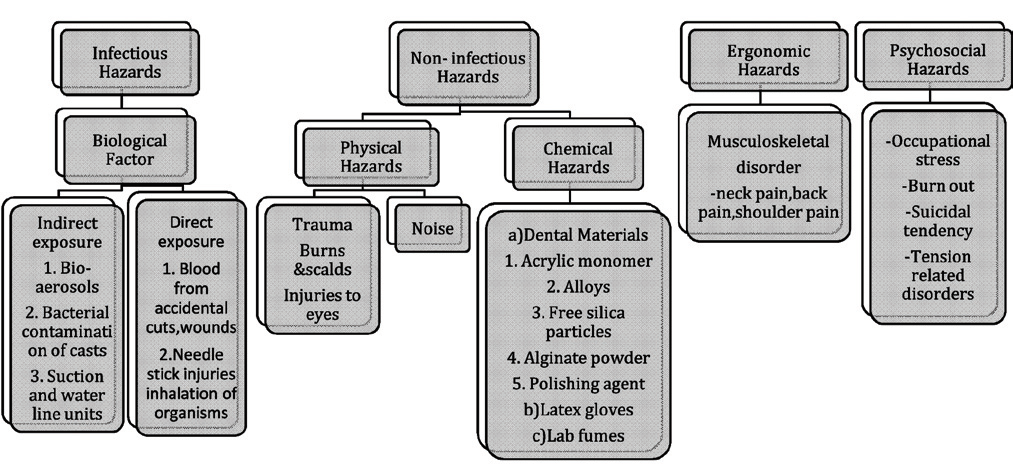
Fig 1: Types and sources of hazards and risks in prosthodontic practice.
Physical hazards
Physical hazards that are commonly encountered in prosthodontics practice include direct physical trauma, heat and fire injuries to the face and the scalp particularly to the eye. The direct physical trauma includes accidental skin cuts and abrasions due to the usage of blunt or broken instruments or high speed projectile during trimming and polishing denture. Such trauma can act as portal entry for infections or toxic material.
Prosthodontic clinics and laboratory requires the use of Bunsen burners, spirit lamps and blow torches. The most common injuries in an institutional set up were burns from Bunsen burners. This was followed by injuries to the eye from needles and blades. Common causes of sharps injuries were from cleaning of probes in the sterilizing room, two-handed injection needle recapping, and burs left in handpieces.(1)
Grinding and polishing with vibrating tools are common in prosthodontic practice. The grinding tools are generally of high frequency and it can cause direct injury to the face and upper extremities. The effects of vibration on the hand can alsoresult in vibration syndrome1or vibration white finger1. The main effects are narrowing of arteries in fingers and hands and damage to the ends of the nerves. Early symptoms include reduced blood circulation in the fingers, reduced sensitivity of the fingers to pain, touch, vibration and temperature, blanching of one or more finger tips.
Eye injuries
Traumatic injuries to the eye in prosthodontic practice are more common due to the usage of high speed rotating instruments which can generate projectiles up to 9 m/s which are often hot, sharp and infected. Symptoms include lacrimation, pain, conjunctivitis, corneal abrasion and blurring of the vision.1More significant hazards are caused by laboratory materials. Painful reactions are elicited when methyl methacrylate monomer or pumice which contains lime and quartz are accidentally splashed into the eye; in addition pumice can also cause abrasion.1
Curing lights are commonly used for polymerization of restorative resin materials. They emit intense blue light in the range of 400 to 500 nm wavelength. According to a report, the
increased ocular risk occurred at about 440 nm.1 High irradiance of blue light can be toxic to test animals, cellular structures, and human fetal retinas.1 When the blue light strikes the retina, they inhibit the formation of cytochrome-C-oxidase, which transports oxygen to photoreceptors and other retinal cells. Without cytochrome- C-oxidase, degeneration of retina occurs.1The effects of blue light exposure could be of cumulative or acute depending on its nature. Back reflectance of blue light from teeth and other reflective surfaces leads to cumulative exposure, while acute exposure results from direct exposure to the light source. Generally, 10 - 30% of the curing light is reflected towards the operator.1
Noise
Noise levels at a given intensity and duration in any environmental situation is a potential health hazard. Loss of hearing and tinnitus are the common side effects of noise beyond the permissible levels in a set up. According to OSHA, exposure to 85 dB of noise, known as an exposure action value, for more than eight hours per day, can result in permanent hearing loss.20Prosthodontists and laboratory technicians are exposed to noise of different sound levels
that are potentially damaging to hearing which include lowspeedhandpieces, high-speed turbine handpieces, ultrasonic instruments, high-velocity suction, and cleaners, vibrators and other mixing devices, and model trimmers.1These equipments can emit sounds ranging from 66 dB to 91 dB (Table 1).1
In a recent study, Mojaradet al. reported that the maximum noise level in dental offices, although often beneath the damaging noise level for the human ear, was very close to the limit of hearing loss (85 dB).1
Chemical hazards
In clinical prosthodontic practice and in the laboratory, a number of synthetic and naturally occurring chemicals which include eugenol-containing materials, alloys, polymer materials, acrylic resins, ceramics, cements, sealers, etchants, hypochlorite, waxes, and elastomeric impression materials are used.1Polymethylmethacrylate resins contain accelerators (amines), co-polymers, such as butyl-methacrylate, plasticizing agents such as di-butyl phthalate, and inhibitor such as hydroquinone and cadmium salt-based colouring agents. These ingredients do not pose any problem for the patients but is deleterious to the technicians during packing, grinding and finishing prostheses.1Metals, especially chromium, cobalt, nickel, beryllium and gold alloys are used for metal ceramic restorations. Dental technicians are exposed to respirable metal fumes and grinding dust during grinding and polishing of cast dental restorations.
Beryllium is added to some base metal alloys used for crowns, fixed and removable partial denture frameworks to facilitate castability by lowering the melting temperature and surface tension and to increase the porcelain metal bond strength. Exposure to beryllium vapor or particles is associated with contact dermatitis and chronic granulomatous lung disease, known as chronic beryllium disease (CBD).1
Tumors linked to beryllium include lung carcinoma and osteosarcoma.1 Potential hazards or risks from exposure to beryllium result from melting, grinding, polishing and finishing procedures. The risk is greatest during the casting process in the absence of an adequate exhaust and filtration system. OSHA reported occurrence of CBD among dental laboratory technicians and, advised to implement precautions to minimize exposure to beryllium-containing dust.4
Ceramic materials are generally regarded as inert, but dust particles from these materials during handling, manipulating, adjusting and finishing the restorations represent a potential problem for the laboratory and clinical personnel. NIOSH recommend exposure limit of 0.05 mg/m3 for such dust particles. Inhalation of dust containing free silica or silicon dioxide particles in ceramic laboratories leads to silicosis.1
Irreversible hydrocolloid powder contains about 60% diatomaceous earth. When fluffed, these particles in the size of less than 3 ㎛in diameter and greater than 20 ㎛in length can be inhaled and may prove to be a health risk (carcinogenic) over a long time span.1 Roberta et al. tested polyethers and vinyl polysiloxanes for cytotoxicity, and the polyether materials were found to be more toxic than vinyl polysiloxanes.1
Latex gloves dusted with corn starch powder are more often used in dental practice. Corn starch is allergenic and gives immediate allergic reactions. Starch particles combined with latex
protein allergens become airborne, and is inhaled, or absorbed by our skin.1In vitro evaluation of natural latex, synthetic rubber, and synthetic polymeric glove materials showed various degrees of cytotoxicity; this introduced silicone, powder free gloves which has less risk.1
Biological hazards
Bacterial contamination from spatter and aerosol dissemination generated by high-speed instrumentation remains a significant risk for dental personnel.1 The main entry points of infectionfor a dentist include epidermis of hands, oral epithelium, nasal epithelium, epithelium of upper airways, epithelium of bronchial tubes, epithelium of alveoli, and conjunctival epithelium.1
When plaster is poured into a contaminated impression, the microorganisms from its surface spread into the cast, and this infected cast is handled in the dental laboratory. The plaster dust from the infected casts gets into the respiratory tract, settles on clothes and environmental surfaces, and remains viable for a considerable time. For example, Mycobacterium tuberculosis remains dangerous for several weeks.1 McNeill et al. stated that impression material can act as a vehicle for the transfer of both pathogenic bacteria and viruses and cause cross contamination in the clinic and from the clinic to the laboratory.1
Other possible sources of infectious contamination are dental unit waterlines (DUWL), handpieces, saliva ejectors and suctions, other devices attached to air and waterlines, and radiology equipment.1
Ergonomic hazards
Ergonomic hazard is a physical factor within the environment that harms the musculoskeletal system. Dental professionals are notably affected with musculoskeletal diseases in their career.
The potential manifestations include various musculoskeletal disorders (MSD) that are characterized by the presence of discomfort, disability or persistent pain in the joints, muscles, tendons and other soft parts. The risk factors comprise repeated movements and prolonged awkward or forced body postures.1
Prosthodontists are at high risk of neck and back problems due to the limited work area and impaired vision associated with the oral cavity. These working restrictions frequently cause them to assume stressful body positions to achieve good access and visibility inside the oral cavity which result in awkward positions over long periods of time; which in turn result in back problems. The symptoms include low back pain, stiffness, and sciatica with neurological features such as tingling, paresthesia, and muscle weakness.1 An electromyographic study by Mileradet al. and coworkers identified that shoulder, neck and arm muscle were placed under the most stress by routine dental work.1 In another study, the Nebraskan dentists reported that crown and bridge work was most likely to evoke altered sensations in their upper limbs.1
Psychosocial hazards
Occupational stress such as coping with difficult or uncooperative patients, over workload, constant drive for technical perfection, dissatisfaction in treatment is common among dentists. Kay and Lowe reported that the most common factors contributing to stress at work were patient demands (75%), practice management/staff issues (56%), fear of complaints/ litigation (54%) and non-clinical paperwork (54%).1
The degree of risk might depend on several factors including age, personal susceptibility, total daily exposure, exposure measured over the years, and medication. It is the responsibility of professionals and technicians to understand the specific risk factors or hazard agents and formulate an effective preventive management protocol. Table 1-outlines management strategies to reduce the risk among professionals.

Modern prosthodontic practice is equipped with sophisticated work area designs with adequate ventilation and advanced armamentarium that could possibly reduce noise pollution andrisks associated with chemical and ergonomic hazards. Use of masks and aspirators, and mechanical removal of as much resin as possible before using rotary instruments may reduce the biological exposures. An orange shield used with the curing equipment adequately filters blue light between 350 nm to 500 nm. Apart from this, blue light filtering spectacle with side shields help to protect against reflectance and scatter. Decontamination of DUWL includes the state of the art method using ozone. Incorporation of ozone generating units into the dental treatment unit would be the logical extension of this technology. The integration of the use of ozone into a dental unit extends a system of disinfection and sterilization for DUWL into the clinical management and patient arena.(1) Measures to combat stress by relaxation, exercise, meditation, hobbies are recommended.
CONCLUSION
Several occupational hazards and risks remain a serious concern in a prosthodontic practice, like contact dermatitis, high speed projectiles and bio-aerosols. Understanding the various risks will educate the professional for a better work practice and care of personal health. A mere knowledge of such hazard and familiarity with its characteristics is not sufficientfor an individual to assess the potential threat. An understanding of the extent of exposure to the hazard, and strategies for minimizing the effects of occupational hazards and risks should be followed for a safe and healthy practice.
The basic goal of OSHA is to educate employers and employees about the work place hazards, risk assessment, and risk management strategies.(5) It is the responsibility of professionals and technicians to understand the specific risk factors or hazard agents and formulate an effective preventive management protocol.
REFERANCES
- Occupational health hazards in a prosthodonticpractice:review of risk factors and management strategies. Indumathi Sivakumar1*, MDS, KuthalingamSubbiah Arunachalam2, MDS, EGR Solomon3, MDS.J AdvProsthodont 2012;4:259-65
- OSHA Training Institute,Introduction to OSHA INSTRUCTOR GUIDE ,OSHA Directorate of Training and Education April 2010
- All About OSHA U.S. Department of Labor Occupational Safety and Health AdministrationOSHA 3302-01R 2013
- Occupational Safety and Health Administration: OSHA Hazard Information Bulletin (1999, September 2): Preventing Adverse Health Effects from Exposure to Beryllium on the Job. Availableat http://www.osha.gov/SLTC/beryllium/index.html. Accessedon February 16, 2012.
- Occupational Safety & Health Administration; About OSHA.Available at http://www.osha.gov/about.html. Accessed onApril 20, 2012.
Disclaimer from Guident
The views and opinions expressed in articles published in Guident are solely those of the authors and do not necessarily reflect the views of the editors, the editorial board or the publisher, Ivory India. Guident does not endorse any product, technique or treatment described. Clinical content is intended for qualified dental and medical professionals and is not a substitute for individual clinical judgement. Guident, its editors and the publisher accept no liability for any consequence arising from the use of information published in the journal.
How to cite this article
Dr. Anupama Nigam, Dr. Archana Singh. The Occ Upational Safety and Health Administration in Prosthodontic Practice. Guident. 2013 Mar;6(5). Available from: https://guident.in/articles/prosthodontics/the-occ-upational-safety-and-health-administration-in-prosthodontic-practice.html