Harnessing Retention Through Attraction
Department of Prosthodontics Dr. D.Y. Patil Dental College, Navi Mumbai, India
ABSTRACT
Accomplishing excellence in esthetics, stabilization, retention of the prosthesis with favorable distribution of forces for the preservation of remaining structures is a challenge in Prosthodontics. There are always group of patients for whom conventional Prosthodontic techniques have been inadequate to satisfy their needs. Many of the complete denture patients suffer from diseases and disorders which have their ill effecst on oral musculature leading to loss of retention ,stability and support of the prosthesis. One of the most effective way of preserving the residual ridge and the proprioceptive feedback is by retaining the roots and fabricating a prosthesis such as an overdenture. As an advanced retentive technique and a better alternative to conventional methods, magnetic attachments are applied in various types of extra oral and intra oral prosthesis. Magnet retained overdenture is one such method which satisfies dentist and patient needs. The desire to use magnetic retention is related to the simplicity of the clinical and laboratory procedures. This paper presents a case report of rehabilitation of a partially edentulous patient with a tooth supported overdenture using a magnetic attachment.
INTRODUCTION
Magnets have generated great interest within dentistry, and their applications are numerous. The 2 main areas of their use are orthodontics and removable prosthodontics. The reason for their popularity is related to their small size and strong attractive forces which allow them to be placed within prostheses without being obtrusive in the mouth. In complete denture prosthodontics, one of the most effective way of preserving the residual ridge and the proprioceptive feedback is by retaining the roots and fabricating an overdenture. History of dental treatments can compromise important jawbone characteristics. If possible, extractions should be avoided for all patients who already suffered extensive bone loss because of the reduced stability and retention of the future denture, especially mandibular denture. Implants are a good solution but a healthy root system of teeth deteriorated above the gum line always surpasses the value of the artificial root due to the presence of periodontal ligament which enable the transmission of axial forces towards the alveolar bone. The axial forces are essential in maintaining the height of alveolar bone.
An overdenture is any removable dental prosthesis that covers and rests on one or more remaining natural teeth, the roots of natural teeth, and/or dental implants. It is also called as overlay denture, overlay prosthesis or superimposed prosthesis.
Rationale for teeth preservation
- Alveolar bone preservation
- Proprioception
Proprioceptors of periodontal ligament provide discrete discriminating sensory input than the mucosa. This helps to sense position and movement of the mandible, prevent excessive occlusal load and thus improve the masticatory performance in comparison to conventional complete denture. To improve the stability and retention of the overdenture, attachments can be used. Various types of attachments like Intracoronal, Extracoronal, Anchors or studs, Bars and Auxiliary attachments are available and can be used depending on the available space for any attachment.1 Overdentures may also be held in by rare-earth magnets – samarium and neodymium.2,3 First introduced by Gillings in Australia, magnets are now used world-wide. They are usually less expensive than other attachments.4,5,6 The prefabricated “keeper”, has a post attached and cements into the endodontically treated tooth. A Magnet is an object or material that produces a magnetic field. Keeper is a piece of soft iron that is placed on or between the poles of a magnet, decreasing the reluctance of the air gap and thereby reducing the flux leakage from the magnet. The magnet itself attaches opposite in the denture using self curing acrylic.
Types of Magnetic Attachments
- Based on Alloys used
- Those containing cobalt
- Those not containing cobalt
- Based on ability to retain magnetic properties
- Soft (easy to magnetize or demagnetize) (less permanent)
- Hard (retain magnetism permanently)
- Based on surface coating
- Coated
- Uncoated
- Based on the type of magnetism
- Repulsion
- Attraction
- Based on type of magnetic field
- Open field
- Closed field
- Based on number of magnets in the system
- Single
- Paired
- Based on the arrangement of the poles
- Reversed Poles
- Non reversed poles
CASE REPORT
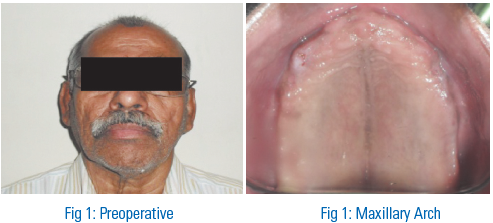
A 61 year old male patient (fig 1) presented to Dept of Prosthodontics, with the chief complaint of difficulty in chewing due to missing teeth and ill fitting prosthesis. Extraoral examination showed no abnormality. Intraoral examination revealed completely edentulous well formed maxillary ridge (fig 2) with minimal flabby tissue in maxillary anterior region and four teeth present in mandibular arch. The teeth present were 33,34,43,44. Patient was using an old ill fitting complete denture in maxillary arch and a distal extension removable partial denture in the mandibular arch. There was no bilateral stable occlusion due to wear of occlusal surface of acrylic teeth of both the prosthesis and hence poor retention and stability of the dentures. There was severe soft tissue undercut present in the mandibular anterior intercanine region. Examination of radiographs revealed that the existing teeth in mandibular arch were endodontically treated.
The different treatment options possible for this patient were-
- Extraction of remaining teeth followed by conventional complete denture.
- Cast partial denture with or without attachments
- Extraction followed by implant supported prosthesis
- Tooth supported overdenture with or without attachments
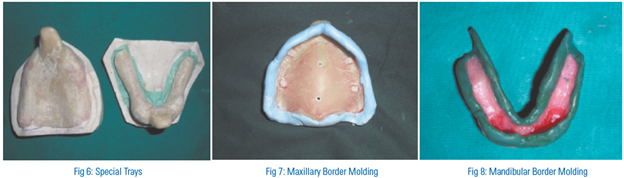
The location of the remaining teeth was favourable for an overdenture. A diagnostic jaw relation was taken to analyse the the amount of space available for any attachment. The space was found to be sufficient for using magnetic attachments. After confirming from the patient about the treatment options , it was decided to use the remaining teeth as abutments and fabricate an overdenture with metal copings and magnetic attachments owing to the obvious advantages of the retention of the roots. Attachment selected was MAGFIT DX 600 closed field type of size 4mm × 1.2mm depending on the available space. There are different sizes available for these attachments. Attachments were planned in 33 and 43 and metal copings on 34 and 44. Primary impression of the maxillary arch was made using medium fusing impression compound (fig 3). A full extension primary impression using irreversible hydrocolloid (Imprint ) was made for the mandibular arch arch and cast was obtained (fig 4).Thick spacer was applied over dentulous area in mandibular arch (fig 5). Special trays (fig 6) were fabricated on both the cast after application of sufficient wax spacer. Spacer of about 1.5mm was used for maxillary arch as Modified Massads impression technique was planned for making final impression to avoid excess pressure on flabby tissue. Before fabricating the special tray, rectangular perforations each of size 3mm × 4mm were made in maxillary wax spacer in bilateral premolar and molar regions for creating tissue
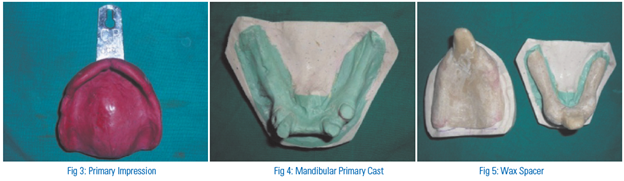
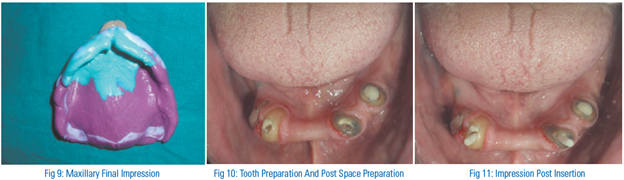
stops in special tray. Tissue stops were created as it was planned to use Modified Massads technique for maxillary final impression. One stage border molding was done using putty for maxillary arch to avoid constant trauma to tissues (fig 7). Final impression for maxillary arch was made using polyvinyl siloxane impression material (Light body-Aquasil by Dentsply,Medium viscosity-Aquasil by Dentsply).Low viscosity material for relief areas and medium viscosity material for stress bearing areas was used as per the tehnique. Both materials were dispensed simultaneously on the special tray on the desired ares and maxillary final impression was made (fig 9). Border molding using low fusing compound was done for mandibular arch (fig 8). Post space preparation was done
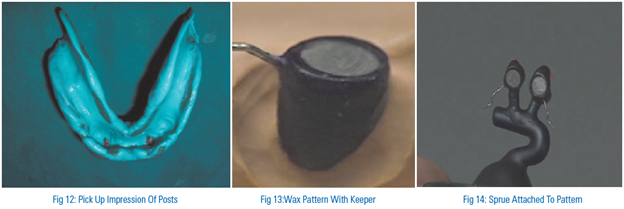
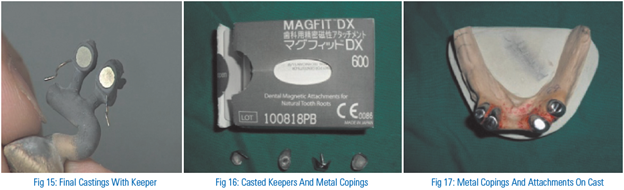
for teeth 33 and 43 and tooth preparation to receive metal copings was done for 34 and 44.Impression posts were selected for making impression of post space (fig 10). The impression posts were relined with pattern resin (GC Corp.) for uniformly recording the prepared post space (fig 11). Spacer wax was removed from the special tray. Final impression was made using low viscosity polyvinyl siloxane material and the posts were picked up in the final impression (fig 12).Both impressions were carefully poured in die stone and final casts were obtained. Cast post wax pattern with magnetic keepers was fabricated for 33,43 (fig 13) and wax pattern for metal copings was fabricated for 34,44.The patterns were invested (fig 14) and casted as per manufactures recommendations for magnetic attachments. The castings were removed and carefully inspected for any casting defects (fig 15). The castings were carefully trimmed and polished
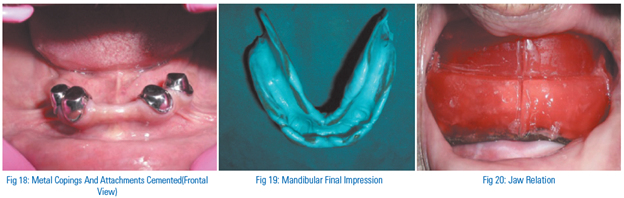
(fig 16,17). Before cementation of the cast posts with keepers, the tooth canal was carefully conditioned and irrigated using sodium hypochlorite. The metal copings and cast posts containing keepers were carefully cemented (fig 18) using Resin modified Glass ionomer cement (GC corp ). Excess cement was carefully removed without disturbing the cemented prosthesis. A full extension impression was made and a final cast with cemented prosthesis was obtained. Special tray was again fabricated, border molding was done and final impression made (fig 19). Occlusal rims were fabricated on final cast and Jaw relation was done(fig 20). After taking a face bow record (fig 21) and mounting the rims on the articulator, teeth were arranged and try in was done (fig 22). After the approval of try in by the patient, the denture was processed using Heat cure acrylic resin. The dentures were carefully trimmed and polished after retrieving from the flasks. Dentures were inserted in patients mouth and necessary adjacent were made. Border extensions and occlusion were checked. To incorporate magnets in the denture,the area on the impression surface of the mandibular denture corresponding to 33
and 43 region where magnets were need to be placed was scraped to make space for magnets. The magnets were positioned on the keepers in the mouth. Resin was added to the scraped area and the mandibular denture was placed over the magnets in mouth under
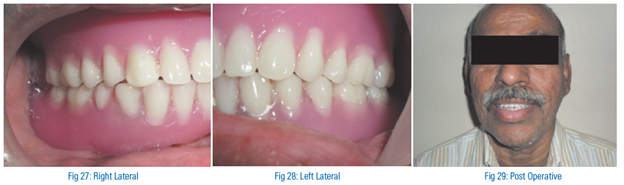
proper occlusion. After the resin was set, denture was removed with the magnets picked up in the mandibular denture. Excess resin was trimmed and denture polished (fig 23). After polishing,the denture was again placed intraorally and checked for comfort, occlusion and retention (fig 24,25,26,27,28). Due to severe soft tissue undercut in mandibular intercanine region, patient experienced pain in that region on insertion and removal of the denture. So the denture was trimmed in that region till just above the undercut. There was no loss of retention due to the presence of magnetic attachments and metal copings. Patient was instructed how to wear and remove the denture, on denture maintenance and oral hygiene as well. Patient was recalled after 24hrs, after 7 days and after 15 days. On recall it was observed that patient was satisfied with his new dentures and was able to masticate properly (fig 29).

DISCUSSION
The use of the attractive force between 2 magnets for denture retention was reported in the early 1960s.7,8 Early attempts at using magnets for denture retention were unsuccessful, mainly because of the large size of magnets at that time and the inadequate forces that they provided. However, since the introduction of rare earth magnets such as Sm-Co5,6 and Nd-Fe-B9,10 it has become possible to produce magnets with small enough dimensions to be used in dental applications and still provide the necessary force. This negates the need to implant the materials; consequently, interest in using magnets for denture retention has once again increased, as is demonstrated by the number of clinical reports on this subject.11 The magnetic attachment consists of the magnetic assembly and the keeper. The magnetic assembly is the main part of the magnetic attachment and consists of the magnet and its coating. The keeper is a metal part casted on the root cap which is attracted to the magnetic assembly. It has to be noticed that magnets increase retention of partial or complete dentures and overdentures regardless of the path of insertion. Magnets are easy to use alone or together with any type of retainers. The most important aspect to be cleared is the influence of magnetism to human body.
There are 2 possible ways by which a magnet can cause injury to the tissue.
- Physical effect due to magnetism.
- Chemical effect due to corrosion product.
Modern magnets were tested in many aspects (cell toxicity, cell growth, allergic response) and the results meet international standards. The magnetic field leakage is extremely weak compared to daily use magnetic appliances. For a long time the saliva corrosion of rare-earth magnets was the reason which determined the decrease of magnetic attractive force. The problem was solved through the enclosure of magnets in anticorrosive steel with a small percentage of iron. According to Gillings and Samant, magnetic retention presents very little risk of trauma to the root that supports the overdenture, and the lateral forces imposed on the root are very small. Additionally, the magnetic overdentures are more stable and retentive than conventional partial dentures and they are easily removed and seated without the patient having to grapple with clasps and complex paths of insertion, thereby improving esthetics, function and comfort.12,13 As such, a magnetically-retained overdenture may represent a good alternative for rehabilitating patients with reduced periodontal support. This type of retention is effective, as it dissipates lateral forces to these structures and provides esthetic rehabilitation to a partially edentulous patient. The magnetic attachments can be easily inserted in the prostheses, do not require any specialized manufacturing technique and facilitate oral hygiene because retentive areas of the dental biofilm are smaller.14
Advantages of Magnetic Attachments
- Small size within overdenture.
- Magnetic force work together with the negative pressure and adhesive retention of denture base.
- Increases the stability.
- Easily constructed without special technique.
- Insertion and removal of overdenture is easy.
- Reduces lateral forces on the abutment tooth.
Disadvantages of Magnetic Attachments
- Loss of retention due to corrosion or heat instability
- Requires encapsulation within inert alloys
- Difficult to repair
- Higher cost than few other attachments
- Limited force transmission - Magnets can slide on their keepers.
CONCLUSION
Overdenture therapy envisages essentially a ‘Preventive Prosthodontic’ concept since it attempts to conserve few remaining natural teeth. Magnets or any form of attachments do help in increasing the retention of the prosthesis and provides patient with proprioceptive, functional and mental satisfaction which helps to boost their health and confidence. The only concern regarding using magnetic attachments is the effect on body tissues and deterioration of magnetism over the period of time. The main risks of treatment with overdentures are caries and the progression of periodontal disease adjacent to the abutment and hence meticulous oral hygiene is to be stressed upon.
REFERENCES
- Precision attachments in prosthodontics. Prieskel, Harold.
- Rare earth magnetic attachments in the state of art in removable prosthodontics. Jackson Thomas R, Healey Kent W. s.l. : Quint Int, 1987, Vol. 18. 41-57.
- Magnetic retention for overdenture. Moghadam B K, Scandrett Forest. 1, s.l. : J Prosthet Dent, 1979, Vol. 41. 26-9.
- Magnetic retention for complete and partial overdenture.Part 1. RD, Gillings barrie. 5, s.l. : J Prosthet Dent, 1981, Vol. 45. 484-91.
- Magnetic retention for overdenture.Part 2. RD, Gillings barrie. 5, s.l. : J Prosthet Dent, 1983, Vol. 49. 607-18.
- Overdentures with Magnetic attachments. Gillings Barrie RD, Samant Asha. 4, s.l. : Dent Clin North Am, 1990, Vol. 34. 683-9.
- The implantation of magnets in the jaw to aid denture retention. SJ, Behrman. s.l. : J Prosthet Dent, 1960, Vol. 10. 807-41.
- Magnets implanted in the mandible: aid to denture retention. SJ, Behrman. s.l. : J Am Dent Assoc, 1964, Vol. 68. 206-5.
- New material for permanent magnets on a base of Nd and Fe. Sagawa M, Furimura S, Togowa N, Yamatoto H, Matsuura Y. s.l. : J Appl Phys, 1984, Vol. 55. 2083-7.
- Pr-Fe and Nd -Fe based materials:a new class of high performance permanent magnets. Croat JJ, herbst JF,Lee RW,Pinkerton FE. s.l. : J Appl Phys, 1984, Vol. 55. 2078-82.
- dentistry, Magnets in prosthetic. s.l. : J Prosthet Dent , 2001, Vol. 86. 137-2.
- Thean HP, Khor SK, Loh PL. Viability of magnetic denture retainers: a 3-year case report. s.l. : Quintessence Int. , 2001, Vol. 32. 517-0.
- Rockman RA, Hall KB, Fiebige M. Magnetic retention of dental prostheses in a child with ectodermal dysplasia. . and :. s.l. : J Am Dent Assoc, 2007, Vol. 138. 610-5.
- Sasaki H, Kinouchi Y, Tsutsui H, Yoshida Y, Ushita T. A magnetic attachment for overdentures. s.l. : J Prosthet Dent. , 1984, Vol. 51. 450-5.
Disclaimer from Guident
The views and opinions expressed in articles published in Guident are solely those of the authors and do not necessarily reflect the views of the editors, the editorial board or the publisher, Ivory India. Guident does not endorse any product, technique or treatment described. Clinical content is intended for qualified dental and medical professionals and is not a substitute for individual clinical judgement. Guident, its editors and the publisher accept no liability for any consequence arising from the use of information published in the journal.
How to cite this article
Dr. Rahul Patil Dr. Gaurang Mistry Dr. Omkar Shetty. Harnessing Retention Through Attraction. Guident. 2013 Apr;6(6). Available from: https://guident.in/articles/prosthodontics/harnessing-retention-through-attraction.html