Single Complete Denture in Maxillary Arch
Dehradoon, India
Abstract
Several difficulties are encountered in providing a successful , single complete denture treatment. This case report deals with successful rehabilitation of completely resorbed mandibular ridge opposing a full complement of natural teeth prosthetically incorporating metal denture base in place of the conventional Poly Methyl Methacrylate material to combat the masticatory forces from natural dentition and improve the longevity of the prosthetic rehabilitation, at the same time improving the strength of the mandibular denture base.
Keywords- residual ridge resorption, metal denture base, single complete denture
INTRODUCTION
Successful complete denture use by patients depends on many variables, but three factors stand out in terms of functional success: retention1, stability2, and support3. The Glossary of Prosthodontic Terms, seventh edition, defines retention as the quality inherent in the prosthesis acting to resist the forces of dislodgment along the path of placement; stability as the quality of a prosthesis to be firm, steady, or constant, to resist displacement by functional horizontal or rotational stresses; and support as the foundation area on which a dental prosthesis rests4. Of the three, it generally is agreed that stability is the most important factor. Occlusion that is not balanced in excursive movements will create instability of the denture, loss of retention, and, eventually, frustration to the patient 5,6. In addition, when a dentate arch opposes an edentulous arch, the edentulous arch is usually adversely affected because of the forces generated6. Koper7 believes that occlusal problems and denture-base fractures seen in the single complete denture are the result of one or all of the following: (1) occlusal stress on the maxillary denture and the underlying edentulous tissue from teeth and musculature accustomed to opposing natural teeth, (2) the position of the mandibular teeth, which may not be properly aligned for the bilateral balance needed for stability, and (3) flexure of the denture base.
The situation in which a patient has become entirely edentulous in one jaw while retaining either all or some of his natural teeth in the others is not uncommon. Neither is it uncommon to find that the successful complete denture for such a patient is often very difficult and unocassionally virtually impossible1.
There are two reasons for this difficulty. The first is related to firmness and rigidity with which the natural teeth are retained in the bone and the magnitude of the force they can resist or deliver without discomfort or displacement. This force has been recorded as high as 198lb on a single molar teeth. This is in sharp contrast with the force which a complete denture ,resting simply on the delicate mucosa of the ridge ,can resist or deliver. This force has been established as being a maximum static load of 26 lb 2.
The second reason is related to the occlusal form of the remaining natural teeth, which will of necessity dictate the occlusal form of the denture. The natural teeth may be overerupted or tilted and their cusps high and sharp. As a result ,occlusion and articulation will involve contacting of the inclined planes of the cusps in such a way that the denture will continually be thrust or dragged horizontally on the ridge2.
To overcome these problems, two things are necessary. First, full use must be made of every factor which favours success, and no minor error or imperfection which might perhaps have been tolerated in conventional complete denture construction should be accepted. Second , the forces to which the denture is subject must be reduced as much as possible by appropriate preparation or restoration of the remaining natural teeth so as to provide an acceptable occluding surface2.
CLINICAL REPORT
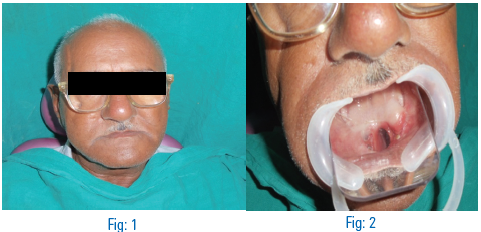
A 43 year old male reported to the Department of Prosthetic Dentistry of Darshan dental college and Hospital, Udaipur, Rajasthan with a chief complaint of completely edentulous mandibular arch. Intraoral examination revealed highly resorbed mandibular ridge (fig 1) and opposing full complement of natural dentition. Mucosa was normal and the opposing teeth required minor alterations. Saliva was of medium consistency and patient was co-operative and philosophical according to House classification. Hence ,metal mandibular denture was planned for this patient.
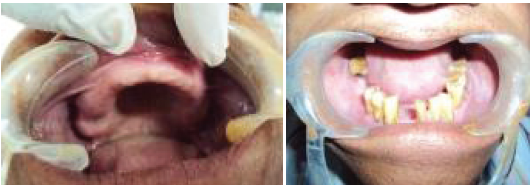
Fig 1&2: Preoperative Photograph
TREATMENT PROCEDURE
Impression of the upper natural teeth was made with a irreversible hydrocolloid impression material ( Neocolloid , Zermack clinical, Italy) and an artificial stone diagnostic cast was poured. Preliminary impressions of the edentulous mandible was made with a viscous mixture of two varieties of softened impression compound (3 parts impression compound + 7 parts greenstick compound) [McCord’s Technique] The impressions were washed and poured with the dental plaster. The custom tray was prepared with auto-polymerising acrylic resin (DPI –RR cold cure, Dental Products of India, the Bombay Burmah Trading Corporation limited)) for making secondary impression. The seconday impression was made using green stick compound for border moulding ( DPI Pinnacle Tracing Sticks,Bombay,India) and medium body as impression material (Impregnum Penta Medium Body, Pearson Dental Supplies) .Master cast was made with
Dental stone type III (Kalastone, Kalabhai Dental Private limited) and the mould of the same was made with reversible hydrocolloid ( Agar Agar) . A refractory cast was poured with ethyl silicate bonded investment material. On the refractory cast ,the denture base pattern wax was adapted and the sprues were attached and invested( fig 2 & fig 3) . The denture base was casted with cobalt chromium metal.(fig 5)
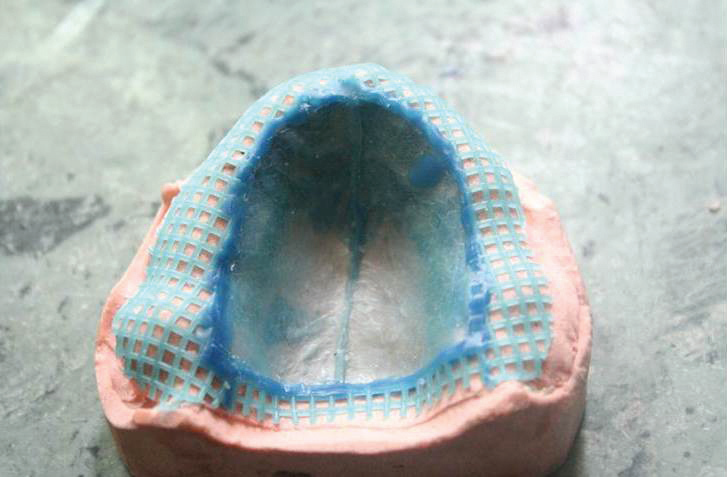
Fig 3: Wax Pattern
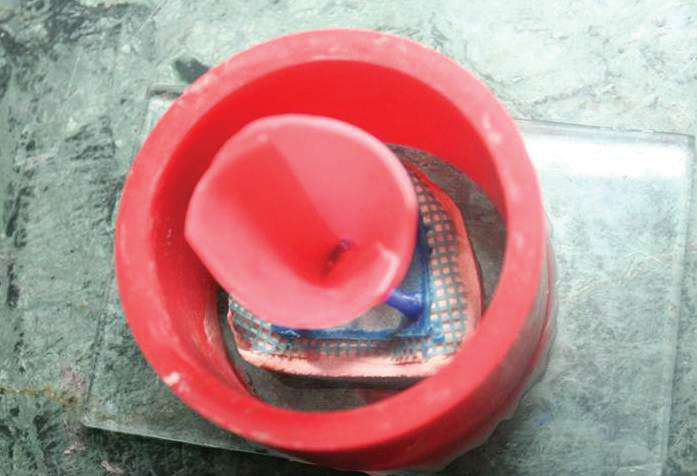
Fig 4: Sprue Placement

Fig 5: Unfinished Metal Denture
The jaw relations were recorded. Face Bow transfer and jaw relations were then verified and secured in a Semiadjustable articulator for teeth arrangement. Teeth were arranged in centric occlusion so that the centric relation records could be verified. The anterior teeth were arranged provisionally for esthetics. The eccentric relation records were made in wax ant the condylar elements of the articulator was adjusted. Posterior teeth were rearranged to satisfy the requirements of balanced occlusion. Adjustments in the artificial teeth were incorporated in preference to making natural teeth. Though a perfect balanced occlusion is impossible to achieved in such cases with involvement of natural teeth, a maximum effort was made to get an occlusion which was as close to balanced occlusion.
A trial of waxed up mandibular denture was made ( fig 4) followed by acrylization of the complete denture with heat polymerizing acrylic resin( Trevalon, Dentsply, Gurgaon ,India) (fig 5 ). The interferences in the denture were eliminated and denture given to the patient. Post insertion instructions were given to the patient regarding its maintenance, nutrition and hygiene( fig 7,8,9 ).
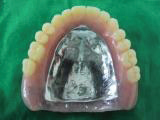
Fig 6: Metal Denture Base
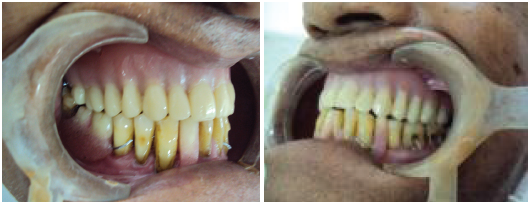
Fig 7 & 8: Postoperative Photograph
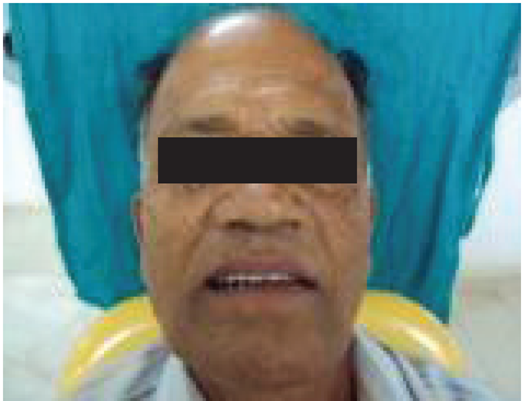
Fig 9: Happy Patient
DISCUSSION
When fabricating complete dentures for completely edentulous patients, the dentist has control of the steepness of the incisal guidance, compensating curve, cusp height, and occlusal plane. He can alter these factors to obtain balance. When the dentist is faced with fabricating only a single denture, however, control of these elements is limited and may adversely affect the attainment of bilateral balance. Situations in which the dentist may be fabricating only a single complete denture include an edentulous arch opposing a complete dentate arch, a partially edentulous arch, or a previously existing denture.
The position of the remaining natural teeth may create interferences in excursive movements of the single complete denture and create instability that would not be a problem in a patient with natural dentition in both arches and with anterior guidance. Correcting these interferences may be as simple as an occlusal adjustment or as severe as extraction of the offending tooth.
OCCLUSAL DISCREPANCIES
The proposed changes to occlusal discrepancies are best planned ahead of time in the dental laboratory on properly articulated casts to prevent unnecessary and irreversible alterations to the dentition. Making adjustments to the dentures after fabrication is notadvisable because changes to the arrangement of the denture teeth are no longer possible. Patients also may view these postdelivery adjustments as an attempt to make the natural teeth fit a poorly made denture 6.
The most common area of adjustment is the molar area where teeth have been extracted and the teeth distal to the site have drifted forward, creating a supraeruption of the distal cusps 12. This repositioning of teeth will result in an unfavorable occlusal plane, teeth with excessively steep inclines, and often is accompanied by an enlarged buccolingual width of the natural teeth13. The steep inclines may result in dislodgement of the denture in excursive movements, myofacial pain, and loss of retention and stability6. Treatment of the tilted molars may include orthodontics, odontoplasty, endodontics, crowns, or, in severe cases, extraction. When extractions are necessary, a distal extension removable partial denture or implants may be an alternative treatment option.
Tooth selection
Anatomic teeth usually are chosen in the single complete denture to enhance esthetics but also to allow for some tooth stock to adjust. The decision as to which cusped tooth to choose is based on evaluation of the condylar guidance and incisal guidance and therefore is selected after anterior tooth setup. In patients who present with a full dentition on the mandible, the condylar guidance, occlusal plane, and compensating curve are already preset, so the only variables that the dentist can easily control are the incisal guidance and the cusp height14. The incisal guidance can be evaluated with esthetics and phonetics15. The cusp height can be chosen by either of two methods: (1) cusp height is equal to the sum of condylar guidance and incisal guidance divided by two, or (2) Swenson’s formula16. In patients with flat occlusal tables, teeth can be reshaped or non-anatomic teeth maybe chosen17. Plastic teeth are chosen over porcelain teeth because the amount of adjustment that is sometimes required may weaken the porcelain teeth and make them unable to withstand the occlusal forces from the natural teeth. In addition, the wear characteristics of plastic teeth are more similar than those of porcelain teeth to the wear patterns of natural teeth6.
CLASSIFICATION
The following proposed classification system can simplify the identification and treatment of these patients.
Class 1: patients for whom minor, or no, tooth reduction is all that is needed to obtain balance
Class 2: patients for whom minor additions to the height of the teeth are needed to obtain balance
Class 3: patients for whom both reductions and additions to teeth are required to obtain balance. The treatment of these patients usually involves a change in vertical dimension of occlusion
Class 4: patients who present with occlusal discrepancies that require addition to the width of the occluding surface
Class 5: patients who present with combination syndrome as described by Kelly18.
first method, described by Swenson16, is performed with casts articulated at the correct vertical dimension and with maxillary teeth set, one at a time, to an ideal setup. As interferences arise, the opposing teeth on the cast are adjusted to allow for the ideal maxillary tooth positioning. The adjustments are marked on the cast, and the same adjustments are made in the mouth at the time of delivery of the maxillary denture. In this manner, changes are more precise and less arbitrary, and proposed adjustments can be evaluated ahead of time rather than clinically, when it may be found that proposed changes are not feasible. The second method, described by Yurkstas, involves the use of a curved U-shaped occlusal metal template that is positioned on the incisal edges and cusp tips of the casts to identify potential interferences or areas that are below the occlusal plane and require buildup of some sort . These areas are adjusted to conform to the curve of the template, and then the denture teeth are set against this plane. This method is quicker but more arbitrary and more prone to error. The correct occlusal template should be selected after the condylar guidance and incisal guidance are determined to allow for easier balance. Cobalt chromium bases in mandibular denture reduces functional deformation and thrust to the supporting tissues occurring in the anterior part of mandible8. Besides rigidity and fracture resistance these metal bases have several other advantages like excellent strength to volume ratio, good adaptation to the supporting tissues ,enhanced plaque control, high thermal conductivity, very little dimensional changes in time through fluid absorption9 .
SUMMARY
The single maxillary denture is a complex prosthesis that requires a complete understanding of the basics of denture occlusion. Theilemann’s formula must be applied to each individual patient, and appropriate treatment must be taken to assure complete balance in all excursive movements. The basic principles of retention, stability, and support should not to be taken for granted, and steps must be completed so that all components are working in harmony for success of the maxillary denture. Treatment of various patients has been illustrated to allow the reader to comprehend better the modalities that can be employed for preparing the oral environment before denture insertion thereby ensuring better success in treating these classes of patients.
REFERENCES
1. Jacobson TE, Krol AJ. A contemporary review of the factors involved in complete denture retention, stability, and support. Part I: retention. J Prosthet Dent 1983;49(1):5–15.
2. Jacobson TE, Krol AJ. A contemporary review of the factors involved in complete dentures. Part II: stability. J Prosthet Dent 1983;49(2):165– 72.
3. Jacobson TE, Krol AJ. A contemporary review of the factors involved in complete dentures. Part III: support. J Prosthet Dent 1983;49(3):306– 13.
4. The glossary of prosthodontic terms. J Prosthet Dent 1999;81(1):39– 110.
Disclaimer from Guident
The views and opinions expressed in articles published in Guident are solely those of the authors and do not necessarily reflect the views of the editors, the editorial board or the publisher, Ivory India. Guident does not endorse any product, technique or treatment described. Clinical content is intended for qualified dental and medical professionals and is not a substitute for individual clinical judgement. Guident, its editors and the publisher accept no liability for any consequence arising from the use of information published in the journal.
How to cite this article
Dr. Harpreet Singh Kukreja Consultant, Dr. Laxman Singh Kaira. Single Complete Denture in Maxillary Arch. Guident. 2013 Feb;6(4). Available from: https://guident.in/articles/prosthodontics/single-complete-denture-in-maxillary-arch.html