Treatment of Class 11 Malocclusion Using Twin Block Appliance
Department of Orthodontics & Dentofacial Orthopaedics, Department of Orthodontics & Dentofacial Orthopaedics, Department of Prosthodontics, Government Dental College, P.G.I.M.S Rohtak, India
Abstract
Ameloblastoma is a slow growing benign tumor of the jaw and patients usually present late after the tumor achieved considerable size to cause facial disFigment. Diagnosis mainly from tissue biopsy and characteristic findings on plain X-rays does assist in differentiating between types of ameloblastoma. The management of this patient was done by marsupialization in 1990 and in 2003 she was followed up with dental implants; moreover, patient revisited after 20 years and remarkably showed no signs of recurrence.
Key words: Ameloblastoma, marsupialization, dental implants
INTRODUCTION
The twin-block appliance, described by Clark in 1982, is currently the most popular functional appliance all over the world. Recent evidence suggests that it may also be considered the most successful in the treatment of Class II, division 1 malocclusions1.
Twin block appliances are simple bite blocks which achieve rapid functional correction of malocclusion by the transmission of favourable occlusal forces to occlusal inclined planes that cover the posterior teeth. The forces of occlusion are used as the functional mechanism to correct the malocclusion. The ultimate goal of a twin block appliance is to produce a technique that could maximize the growth response to functional mandibular protrusion by using an appliance system that is simple, comfortable and aesthetically acceptable to the patient1.
The occlusal inclined plane acts as a guiding mechanism causing the mandible to be displaced downward and forward with the appliance in the mouth2. The patient cannot occlude comfortably in the former distal position and the mandible is encouraged to adopt a protrusive bite with the inclined planes engaged in occlusion3.
The treatment is divided in two phases:
- Active phase
- Support phase
ACTIVE PHASE
Twin blocks are worn full time. The objective is to correct arch relationships in the anterior-posterior, vertical and transverse dimensions.
Normally overjet and overbite are corrected within 6 months and the lower molars have erupted into occlusion into 9 months.
The average time is 6 – 9 months
SUPPORT PHASE
The aim is to retain the corrected incisor relationship until buccal segment occlusion is fully established and an upper removable appliance with steep anterior inclined guide plane is given after removal of the twin block appliance.
The average time is 3-4 months
CASE REPORT
A 12 year old boy with the chief complaint of retrusive lower jaw reports to the OPD. The patient mother reported a history of thumbsucking in her son which he had discontinued years ago.The mother also reported no family history of similar malocclusion.
Extra-oral examination:
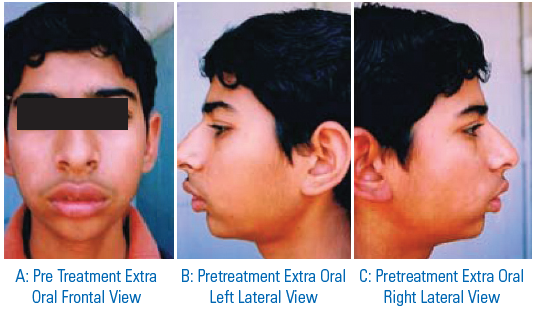
The patient presented with a symmetrical face and a moderate degree of lip strain in an attempt to achieve lip seal. He had a convex profile and average lower anterior facial height, retuded lower jaw, deep mento labial sulcus and pouted lips(Fig1, A B & C)
Intra-oral examination
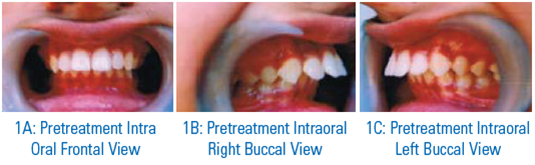
:The patient presented in the permanent dentition with a class 11 div 1 malocclusion, a 9mm overjet and a 5mm over bite.The upper dental midline was coincident with the facial midline but the lower midline was slightly deviated towards the left side.
Radiographic examination:
The cephalometric evaluation showed anteroposterior skeletal discrepancy , having skeletal class 11 on account of normal maxilla and a retrognathic mandible average growth pattern but slightly proclined lower anteriors.
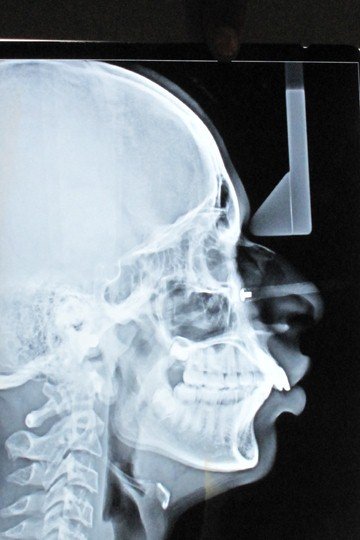
Fig3: Pretreatment Lateral Cephalogram
PROBLEM LIST
- Skeletal class 11 on account of retrognathic mandible
- Acute naso labial angle
- Bilateral class11 molar relationship
- Increased overjet and over bite
DIAGNOSIS
Class II skeletal base with retrognathic mandible with Class II molar and canine relation with bimaxillary dentoalveolar proclination with incompetent lips having a convex facial profile and an average growth pattern
TREATMENT PLAN
Orthopedic correction using twin block therapy followed by fixed orthodontic treatment using preadjusted edgewise appliance for final finshing and detailing of occlusion.
TREATMENT PROGRESS
The twin block appliance were fabricated and inserted in the patients mouth . The mandibular block was extended on to the incisal edges of the mandibular teeth to prevent their proclination. Contact was maintained between the appliance and the maxillary posterior teeth, but the mandibular posterior teeth were encouraged to erupt by progressively trimming the acrylic on their occlusal and lingual aspect
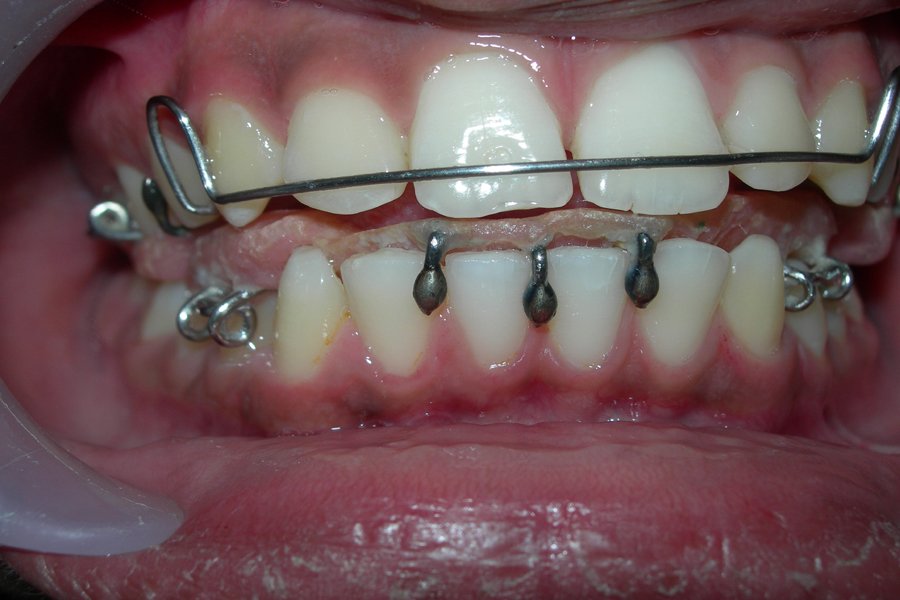
Fig 4: Mid Treatment Intra Oral Photograph With Appliance.
After 12 months of treatment with the twin block appliance, a significant improvement in the soft-tissue profile was evident, and labial competence was achieved.With the overbite and the overjet reduced, the sagittal relationship between the arches improved along with the achievement of bilateral Class I molar relationship.
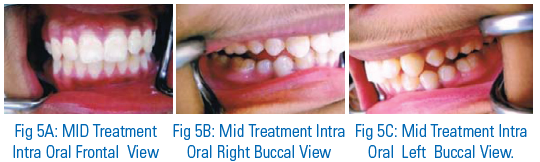
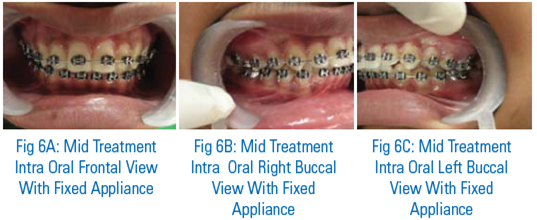
POST TREATMENT RESULTS
:The effects of the twin block appliance therapy were evaluated cephalometrically after about two years of treatment . A reduction of 4° in ANB was achieved, mainly by a forward displacement of the mandible .
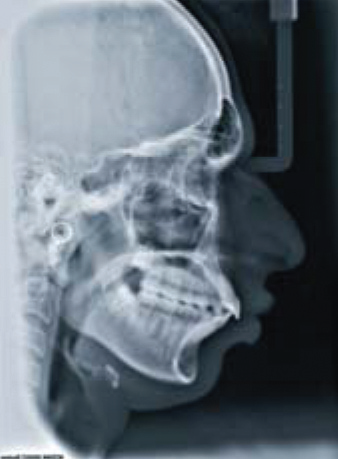
Fig 7: Post Treatment Lateral Cephalogram
A Class I molar and canine relationship was obtained, and the overjet and overbite were corrected

CONCLUSION
The use of twin block in Class II therapy is that they not only correct the malocclusion, but are also effective in improving the soft-tissue profile and the inter maxillary relationship. Early treatment can eliminate etiologic factors such as sucking habits, restoring normal growth and reducing the severity of skeletal abnormalities. Once the growth period is over, treatment options become more limited.
Disclaimer from Guident
The views and opinions expressed in articles published in Guident are solely those of the authors and do not necessarily reflect the views of the editors, the editorial board or the publisher, Ivory India. Guident does not endorse any product, technique or treatment described. Clinical content is intended for qualified dental and medical professionals and is not a substitute for individual clinical judgement. Guident, its editors and the publisher accept no liability for any consequence arising from the use of information published in the journal.
How to cite this article
Dr. Manisha Kamal, Dr. Ajit Kumar, Dr. Shweta Chowdhary. Treatment of Class 11 Malocclusion Using Twin Block Appliance. Guident. 2013 Feb;6(4). Available from: https://guident.in/articles/orthodontics/treatment-of-class-11-malocclusion-using-twin-block-appliance.html