
Partial Foot Prosthesis-a Case Report
Department Of Prosthodontics And Crown & Bridge, Chhattisgarh Dental College & Research Institute, Rajnandgaon, Chhattisgarh
ABSTRACT
Loss of any body part because of trauma, systemic or local disease, any infection effects greatly general well being of a person.
Rehabilitation of lower limb presents with complex challenges and requires inter-disciplinary approach.
The present case was rehabilitated using silicone material, which was medical grade and room temperature vulcanizing (RTV). The clinical and laboratory steps involved in fabrication of any maxillofacial prosthesis have been successful employed in this case to fabricate partial foot prosthesis which has benefitted the patient tremendously improving patient’s way of living. The patient was instructed well on maintenance of prosthesis and was kept on regular follow-ups.
KEY WORDS: Partial foot prosthesis, silicone prosthesis.
INTRODUCTION
Prosthetic restoration of facial defects in an ancient art. Now a days, maxillofacial prosthodontictcs has been tremendously integrated with oral oncology, trauma and deformity. With advancement in material science and skills it is not limited to face but progressing towards makeover and also towards rehabilitating other body parts like a hand or foot.
This article describes a humble attempt of fabricating a partial foot prosthesis overcoming the challenges involved in rehabilitating a long lost foot.
CASE REPORT
A 65-year-old male patient reported with a chief complaint of missing teeth and wanted to get his teeth replaced.
On clinical examination it was examined that the patient had missing fingers of left foot (Figure 1) due to injury from an axe 20 years back. Because of which patient later suffered from a paralysis of left side of the body.
During history taking, patient expressed his wish to get his long lost fingers of left foot restored.
On examination the amputed fingers appeared normal with no signs of infection (Figure 1) and patient was referred to the general surgeon for his expertise in proceeding with prosthesis fabrication.
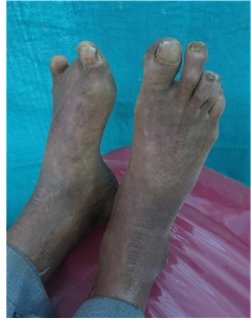
Figure 1: Pre Operative
After a thorough history and diagnosis and with consent of General surgeon, it was decided to fabricate silicone partial foot prosthesis.
TECHNIQUE
IMPRESSION (Figure 2):
A wax mold was prepared to contain hydrocolloid impression material. To prevent impression material from adhering to the skin petroleum jelly was applied.

Figure 2: Impressions
Then the mold was filled with impression material and hydrocolloid impression material was reinforced with gauge cloth and plaster. Impression of contralateral side was also made, to be served as standard for fabrication of wax pattern of affected side.
A positive replica was obtained by investing the impressions with type III dental stone (Neelkanth dental stone plaster class III) (Figure 3).
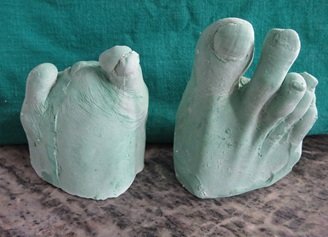
Figure 3: Molds
STUMP MOLD MODIFICATION & WAX PATTERN FABRICATION (Figure 4 & 5):
Stump mold was duplicated and to remove all undercuts duplicated model was modified.
A wax pattern was fabricated over the modified stump mold resembling the contralateral side.
Nails were fabricated using self-activated methacrylate resin and at this stage nails were not characterized, as they were made only to maintain the anatomy of foot during flasking and silicone packing.
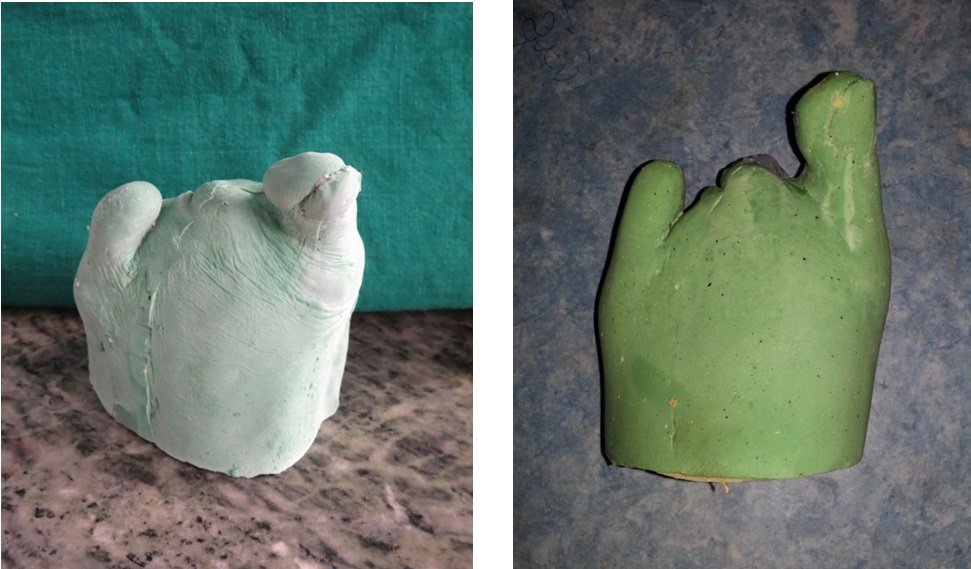
Figure 4: Stump Mold Modifications

Figure 5: Wax pattern
DIE MAKING (Figure 6):
Die of a modified stump was made using class III dental stone (Orthokal - Kalabhai) and wax pattern along with nails were adapted over the die and the margins of the pattern was thinned out by merging the wax with the die using a carver so that margins of final prosthesis merges with that of the skin.

Figure 6: Die making
FLASKING & DEWAXING:
Wax pattern with nails along with the die was invested in a flask using dental plaster.
De-waxing was carried out by placing the invested flask assembly in boiling water at 100o C for 30 minutes.
After de-waxing mold was obtained in which silicone material was packed.
SILICONE PIGMENTATION & PACKING (Figure 7):
The medical grade silicone (Cosmesil series material) was used for the prosthesis.
Shade matching was done separately for the dorsal and ventral sides of the foot in patient’s presence under natural light. Small amount of silicone material was taken intrinsic stains were added in different concentration to match the exact skin coloration.
The dorsal and ventral side of the foot were characterized individually and packed separately.
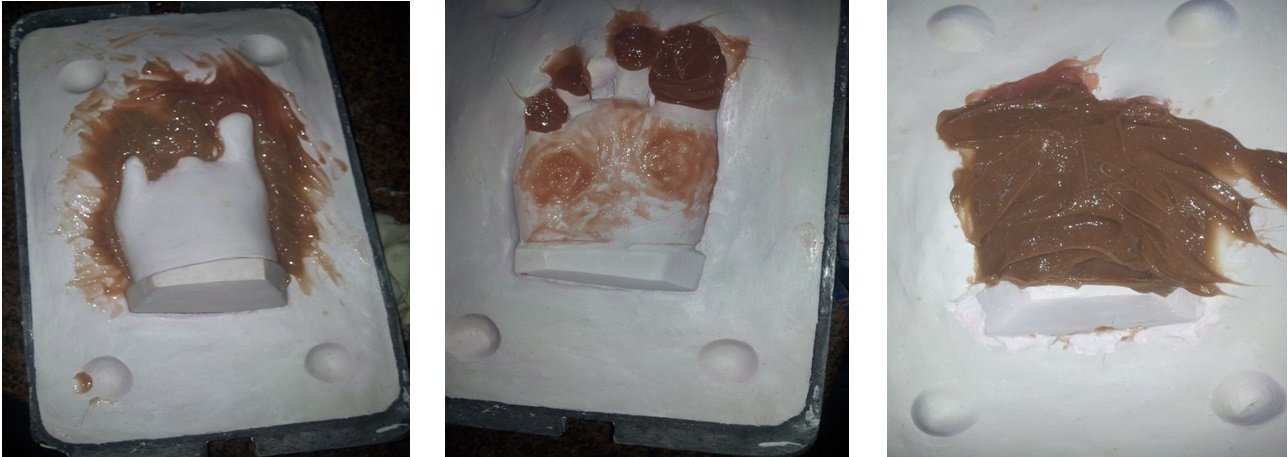
Figure 7: Silicone Pigmentation & Packing
Curing (Figure 8):
The silicone material was allowed to cure for 24 hours at room temperature.
Completion of polymerization was ensured from the residual silicone outside the flask.

Figure 8: Curing
FINISHING:
Final prosthesis was retrieved, cleaned, excess was trimmed using sharp knife and final finishing was carried out using silicone burs (DFS GmbH).
NAIL IMPLANTATION 1 :
Artificial nails were fabricated using self-activated polymethacrylate and was characterized using cyanoacrylate adhesive to get natural appearance.
FINAL PLACEMENT (Figure 9, 10 ):
The final prosthesis was placed over the patient’s foot.
The result achieved after placement of prosthesis was gratifying and patient expressed his satisfaction and was content with the outcome.
The patient was educated regarding the donning and doffing of the prosthesis.
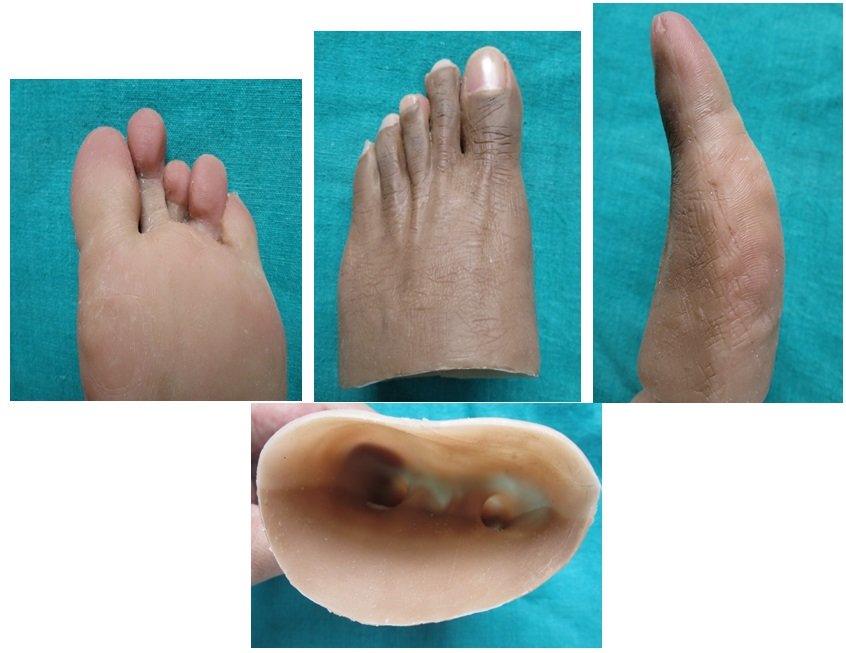
Figure 9: Final Prosthesis
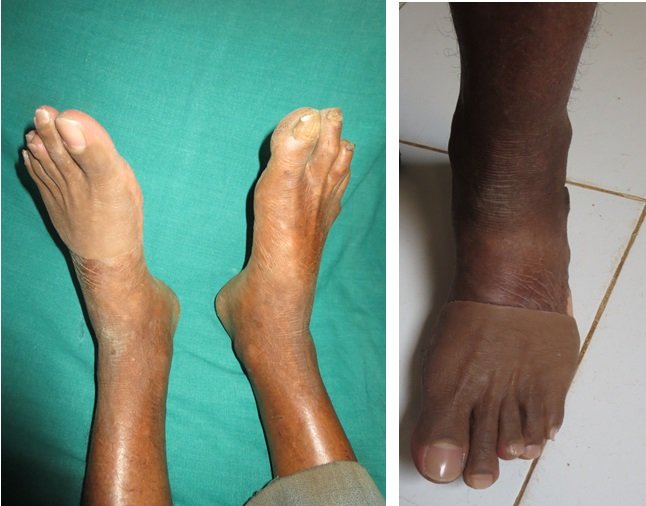
Figure 10: Prosthesis Insertion
Patient was also instructed on maintenance of the prosthesis and instructed to report on any concerns including4
- Redness of the tissue that does not subside after 30 minutes of removal of the prosthesis.
- Any noise from prosthesis on walking
- Discomfort while use of prosthesis
- On any signs of wear of prosthesis.

Figure 11a & b
DISCUSSION
Partial foot amputations include a variety of different anatomic levels that result in different functional capabilities for the amputee. Types of amputations include toe or digit amputations, ray resections, and metatarsal amputations and surgical disarticulation at Chopart’s and LisFranc’s levels.2
Various materials have been employed in the fabrication of the prosthesis namely, carbon, polyethylene, polyurethane, polystyrene and silicone.3
Medical grade silicone material is durable, biocompatible and resilient material with high esthetic value henceforth is capable to give natural appearance to the prosthesis imparting great psychological benefit to the patient and is also economical as compared to other rehabilitative modalities.
Retention of prosthesis is often concerning and good retentive prosthesis contributes to function and aesthetics of prosthesis. Depending upon the defect and goals to rehabilitate various Articulating and non-articulating designs are available. In this case, vacuum from stump has been employed as a mode to provide retention and that has yielded satisfactory outcome.
However, to fabricate prosthesis using silicone material requires fine skills and vast knowledge about the material is required. Silicone prosthesis imparts good patient comfort and patient complies in maintaining the prosthesis well. Functioning of the body with silicone prosthesis is very limited, these prosthesis benefits the patient psychologically tremendously.
CONCLUSION
In the present case clinical and laboratory techniques usually performed in the specialty of prosthodontics have been employed for the fabrication of partial foot prosthesis.
Customized silicone prosthesis restores the anatomy close to the natural existing appearance, economical, easy to maintain, given to resilient nature of the silicone material restores the functionality to certain extent and tremendously benefits the patient psychologically and socially. Because of affordability of the silicone and techniques used in fabrication of foot prosthesis, makes it possible to rehabilitate patient with such defect satisfactorily
REFERENCES
- Leow ME, Ng WK, Pereira BP, Kueh KA, Pho RW. A technique of acrylic nail fixation in multilayered silicone finger prostheses. Prosthet Orthot Int 1997;21:199-201.

- Yonclas PP, O’Donnell. Prosthetic management of the partial foot amputee. Clin Podiatr Med Surg 2005 Jul;22(3):485-502.
- Dathan PC, Kumar TM, Ravindran S, Nair KC, Kumar A. Prosthetic Rehabilitation of Lower Limb with RTV Silicone Using Prosthodontic Clinical and Laboratory Techniques - A Case Report. J Clin Diagn Res. 2016 Aug; 10(8): ZD35–ZD37.
- Dillon MP. Partial Foot Amputation: Aetiology, Incidence, Complications, Prosthetic Intervention and a characterization of gait. In Stone JH, Blouin M. editors. International Encyclopedia of Rehabilitation;Springer: 2010;Newyork. Available Online : http://cirrie.buffalo.edu/encyclopedia/en/article/154/ accessed on January 9, 2016
- Rangi MK, Motwani BK, Shetty RM, Sahu SK. Fabrication of Silicone Hand Prosthesis: A Case Report. Int Res J Cli Med 2016;1(4):30-33.
Disclaimer from Guident
The views and opinions expressed in articles published in Guident are solely those of the authors and do not necessarily reflect the views of the editors, the editorial board or the publisher, Ivory India. Guident does not endorse any product, technique or treatment described. Clinical content is intended for qualified dental and medical professionals and is not a substitute for individual clinical judgement. Guident, its editors and the publisher accept no liability for any consequence arising from the use of information published in the journal.
How to cite this article
Dr. Manupreet Kaur. Partial Foot Prosthesis-a Case Report. Guident. 2021 Apr;14(5). Available from: https://guident.in/articles/prosthodontics/partial-foot-prosthesis-a-case-report.html


