Intellectual Disability: Challenges, Strategies and Managment of Oral Health
K.D Dental College, Mathura, U.P, India
World could be a better place when we see ability in the word disabilility.
Intellectual disabilities such as mental retardation, autism, epilepsy and cerebral palsy are manifested during childhood and often affects a life time. They affect the mind, body and skills thereby affecting the functionality by limiting the child physically and mentally. They are often very dependent on their care taker or family for performing the routine task and well, maintaining oral health is no exception.
With high awareness and acceptance level, there also has been lot of deinstitutionalization i.e. lot of children are seen living as a part of community and have intricately webbed into the society. Therefore it becomes even more mandatory for oral health providers to get adapted to the skills required to deal with these children. The current article deals with oral care management of children with mental retardation and appeals to drop the word R.
The term MR can be defined by a collection of symptoms, traits or characteristics. It has been renamed many times throughout the history. It is not a disease, nor should it be confused with mental illness. Mental retardation and intellectual disability are two names for the same thing but intellectual disability is gaining currency as the preferred term.
In fact, the American Association on Mental Retardation changed its name in 2007 to the American Association on Intellectual and Developmental Disabilities
Intellectual disability is a disability characterized by significant limitations both in intellectual functioning and in adaptive behavior, which covers many everyday social and practical skills. This disability originates before the age of 18. Intellectual functioning—also called intelligence—refers to general mental capacity, such as learning, reasoning, problem solving, and so on (AAIDD 2002).
There are many challenges a clinician goes through while diagnosing and treating children, few of them have listed here.
CHALLENGES & STRATEGIES
Obtaining the patients medical history and assembling an accurate data to determine the complete physical health.
Do a pre-appointment homework in association with the patient’s caretaker and his pediatrician to know the complete health status, vaccination status, known allergies so that necessary arrangements and modifications can be made prior to appointment. It also saves a patient from unnecessary visits. The patient’s physician should be consulted regarding: Timing and dental treatment, Patient’s physical status, Use of restraints or mental abilities General anesthesia or sedation, Potential drug interactions, Mental competency, Antibiotic prophylaxis, Existing allergic conditions.
Determine the mental capabilities of the patient as to allow them to go through the dental appointment smoothly.
Talk to the patient’s caretaker about the patient ability towards oral health care. Be receptive towards child’s behavior. Have a friendly attitude and give them time to get comfortable with the operatory and associated surroundings. Communicate clearly, repeat instructions slowly using a more simple language.
Addressing their behavioral issues as they can range from fear and anxiety to violent and self injurious behavior.
Create a friendly environment that makes patient more receptive. Avoid treating the child on first visit unless the child is in pain or its an emergency visit. Arrange desensitizing visits that makes the child more familiar to the entire programme. Gain cooperation by exhibiting various techniques such as tell-show-do, modeling, euphemisms, or as simple as providing them by favorite toy or by care taker holding their hand.
Understand their limitations as their attention span is very less and they can get highly irritable, keep their appointments short. Praise and reinforce the positive behavior. Avoid using physical restrains as it is not always required, don’t use it as convenience. It should be only used when it is necessary to protect patient and while doing so, please explain the use to parent. This type of modality should be adopted in the failure of other techniques such as desensitization, TSD, etc. and should be documented simultaneously in the form of informed consent. However, this modality should only be used:
- When necessary
- Should be the least restrictive alternative method
- Should not be used as punishment
- Should not be used for the convenience of the staff
- Should cause no physical injury to the patient.
Degree of Mental retardation (DSM-IV)
Mild - also known as the “educable” category. The child appears to be normal, with a pleasant smile, follows instructions and complies with it. The IQ range is 55–70.This is the highest functioning level and the largest category. Accounts for approximately 85% of individuals in this category.
Moderate - also known as the “trainable” category. The child again is cooperative, pleasant to interact, tries to follow the command but needs repeated instructions. The IQ range is 40–55. This is the second-highest functioning level. Accounts for approximately 10% of individuals in this category. Achievement beyond the second-grade level is not possible.
Severe - the IQ range is 25–40. The children in this category have poor understanding. They are dependent on their caretaker for their basic needs. This is a lower functioning level. Accounts for approximately 3–4% of individuals in this category. Speaking ability may develop with to minimal self-care skills.
Profound - The IQ range is less than 25. Child cannot understand anything, mainly violent; mental age is below 2 years. In grown up children they are difficult to control. This is the lowest functioning level. Accounts for approximately 1–2% of individuals in this category.
ETIOLOGY
Genetic
- Chromosomal abnormalities: Mongolism, Partial trisomies, Partial deletion and Translocations.
- Cryptic chromosomal abnormalities: Deletions, Duplications and Contiguous gene syndrome.
- Gene defects: Prader-Willi syndrome, Angelman syndrome.
Epigenetic
- Maternal intoxications, Fetal alcohol syndrome, Drugs, Trauma
- Premature delivery.
ORAL MANIFESTATIONS
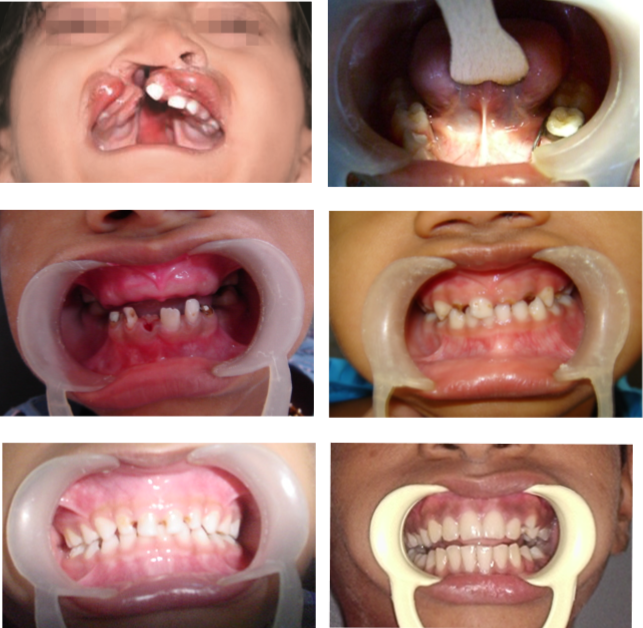
- Nursing bottle caries or early childhood caries occurs frequently as the medication is taken mostly in the form of syrup. (Figure 1& 2)
- A night-time feed containing infant formula, juice or any fermentable carbohydrate can lead to rampant decay.
- Altered salivary flow in these patients is manifested due to multiple medications and can aggravate the dental decay
- Congenitally missing permanent teeth and enamel hypoplasia are commonly seen manifestations.
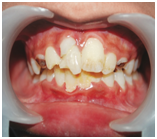
- Traumatized dento-alveolar structures are common, presence of long standing fractured non-vital teeth has also been reported due to multiple falls and delayed treatment of the associated tooth.(Figure 3)
- Loss of space for the permanent dentition causing significant malocclusions,orthodontic problems, abnormal jaw development, change in mastication, affecting esthetics and a development of poor self-image.
- Speech impairment due to early loss of tooth structure, secondary caries, trauma and habits.
- Poor oral hygiene, increased plaque and calculus may give rise to intense halitosis and accumulation of food debris in teeth and mucosa due to soft diet
- Soft tissue complications are seen due to self mutilating habits or self injurious behavior in severe to profound cases.Lip biting is one of the most common clinical feature along with biting of buccal mucosa. Self injurious behavior such as biting the digits (Figure 4) and Lesch-Nyhan syndrome can be found very commonly in greatest mental impairment (Severe and profound) and should be controlled with behavior modification, restrain and sedation.
- Gingival overgrowth because of drugs (hydantoins), chronic infections, inflammation, traumatic occlusion, dental abrasion and hypersensitivity are commonly seen. Halitosis also rises due to food remnants and food impaction on fissured tongue.
GENERAL MANAGEMENT
Children with MR often have many other associated problems, thus it is necessary to come to a definite diagnosis with the help of specialists from different areas, e.g.
- Child psychiatrist
- Pediatrician
- Pediatric dentist
- Social worker
- Special education teacher
- Speech therapist
This type of interdisciplinary team approach is relatively new and is essential for comprehensive assessment, treatment, and management of affected children. Educational initiatives require the involvement of parents and professionals in early intervention services. A family-centered approach begins with an assessment of the child obtaining school history from parents and school records, family and parenting history along with community resources. Medical, developmental and psychiatric histories are obtained.
Behavioral analysis, psycho educational, speech and language testing are completed. Medical and neurological assessments are performed. To assess the child, history in multiple forms is collected, i.e. medical development and psychiatric, further analyses are conducted on speech and behavior.
Cases for MR are basically done in three important steps
1. Medical care
2. Associated referral made as per pediatrician advice
3. Supportive and palliative therapy.
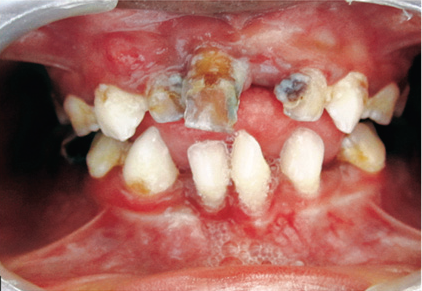
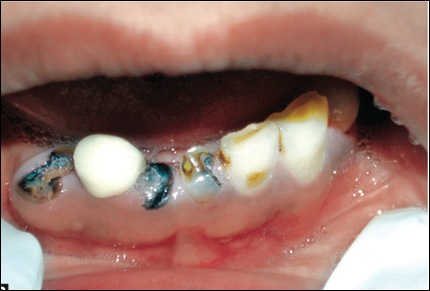
Fig 1 and 2: Showing deep dentinal caries along with smooth surface caries,rotation and attrition of lower incisors

Fig 3: Showing vertical fracture of central incisor due to trauma
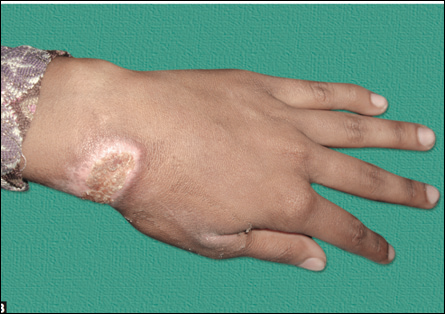
Fig 4: Showing injury on patient’s own hand due to self injurious behavior
DENTAL MANAGEMENT
General Considerations
- Comprehensive oral examination
- Mental age of their patient
- Understanding and communication level
- Psychological needs
- Physical limitations
- Accessibility issues
- Behavior management
- Medical conditions
- Potential drug interactions/allergies
- Antibiotic prophylaxis
- Consent issues
- Financial considerations
CLINICAL CONCERNS AND MODIFICATIONS
- Gingivectomy may be considered for the patient with drug-induced gingival overgrowth if the tissues interfere with occlusion or oral hygiene.
- Generally periodontal packs may not be well tolerated; in that case electrosurgery or laser surgery techniques should be considered as an option.
- Due to poor oral hygiene, frequent recall examinations and prophylaxis are often indicated as often as every 2 or 3 months.
- Glass ionomer restorations may be more appropriate for patients with a high caries rate due to fluoride release.
- Stainless steel crowns may be more appropriate for restoring severely damaged teeth, when the patient’s lack of cooperation precludes more complicated procedures required for fixed prosthodontics or where lack of funds is a consideration.
- Bonded restorations can eliminate the need for pins and thereby reduce the overall time for the procedure.
- Individuals who cannot tolerate a removable prosthesis will benefit from maintaining even severely worn teeth as occlusal stops.
- Endodontic treatment should be considered when a tooth is restorable and the patient can cooperate.
- Single-appointment procedures are advisable.As working-length radiographs would be difficult to obtain, an apex locator would be helpful.
- Fixed prosthodontics is more appropriate than removable one if patient’s oral compliance is there.
- Resin bonded bridges are more useful and less time- consuming for tooth preparation.
- Fixed prosthesis is absolutely contraindicated for epileptic patients as it may lead to trauma and aspiration during event.
- Patients must be able to remove, clean and place removable prostheses.
- Removable prosthesis and complete denture are also contraindicated for patient whose seizures are poorly controlled.
- Complete dentures are contraindicated in poor muscle control and in severe and profound MR.
FOLLOW UP CARE
- Individuals should be evaluated at least annually by a neurologist or a pediatrician with respect to management.
- To maximize the individual’s functional independence, the following areas should be addressed by the physician at least annually: Treatment of associated impairments, Pharmacotherapy, Behavior management, Educational services, Recreational needs, Family counseling.
- The annual visit well requires routine preventive medicine specialized services such as dental and gynecologic care under sedation.
- Supplemental vaccines are particularly important for those in residential placements.
- The health maintenance schedule for individuals should be organized along with ongoing monitoring, function tests. Other emerging conditions are of critical importance.
Disclaimer from Guident
The views and opinions expressed in articles published in Guident are solely those of the authors and do not necessarily reflect the views of the editors, the editorial board or the publisher, Ivory India. Guident does not endorse any product, technique or treatment described. Clinical content is intended for qualified dental and medical professionals and is not a substitute for individual clinical judgement. Guident, its editors and the publisher accept no liability for any consequence arising from the use of information published in the journal.
How to cite this article
Dr. Priya Verma Department of Pedodontics and Preventive Dentistry. Intellectual Disability: Challenges, Strategies and Managment of Oral Health. Guident. 2018 Jan;11(2). Available from: https://guident.in/articles/pedodontics/intellectual-disability-challenges-strategies-and-managment-of-oral-health.html