Management of Cerebral Palsy
K.D Dental College, Mathura, U.P India
Cerebral palsy (CP) is a nonprogressive disorder due to trauma to the fetal brain causing posture disorders. The abnormalities are manifested in musculoskeletal system in the early years of life. The injury can occur at any point, i.e. during the intrauterine life, at the time of delivery or post delivery.
According to the American Academy for Cerebral Palsy and Developmental Medicine, cerebral palsy is nonprogressive disorder of the development of movement and posture, causing activity limitations that are attributed to nonprogressive disturbances that occurred in the developing fetal or infant brain.
Cerebral palsy is a blanket name given to variety of nonprogressive motor impairment that occurs consequently to the brain injury. Nevertheless the lesion occurred is permanent and irreversible. Progressive musculoskeletal pathological findings occur in most affected children.
The etiology can be described by using four P’s: Prenatal, Perinatal, Postnatal and Prematurity. Common prenatal, perinatal and postnatal causes of CP include:
Prenatal
Congenital brain malformations ,In utero vascular events, e.g. stroke ,Congenital cytomegalovirus infection.
Perinatal
Hypoxic encephalopathy of neonate, Severe neonatal infections (ie Viral encephalitis, Meningitis), Antepartum hemorrhage, Severe hypoglycemia, untreated jaundice.
Postnatal
Accidental head trauma and injuries, Anoxic insult, meningitis and septicemia, Child abuse, Cerebrovascular accidents.
Prematurity
Premature deliveries, Low birth weight, Maternal infections.
Other Factors
Late risk factors such as chronic lung disease, multiple pregnancies, breach/ectopic pregnancies, role of inflammatory mediators.
Although perinatal causes received the most attention in the past, the perinatal cause formed the minority of cases but was given quite or attention due to inability to rule out the etiological factors for the same thereby failing to reduce the incidents.
MANAGEMENT
A team of experts is required to manage the multiple impairments that consists of pediatricians, neuro physicians, surgeons, physiotherapists, speech therapists, counselors and social workers.
Goals of Management
The ultimate goal is to minimize disability, promote functionality so that the patient can meet the basic criteria of being independent in the society. All treatment efforts are done to establish quality of life, i.e. attending school, earning a living and being socially acceptable (Table 3.4).
0 and 2 years: Management should include physiotherapy, stimulation of infant, positioning and education for parents.
2 to 5 years: Ways to decrease muscle tone should be encouraged to make the child ambulatory.
5 years onward: Orthopedic intervention can be started as pain and discomfort secondary to spasticity, become predominant during the teenage years.
MEDICAL MANAGEMENT
Spasticity
- Managing spasticity is a large part of treating children who have CP. The treatment of spasticity normally begins with the application of therapeutic modalities.
- Daily exercise movements and therapeutics decrease muscle tone and prevent contractures.
- Casting and splinting are often used as adjuncts, casting for 2–3 weeks can improve range of motion for few weeks.
- Botulinum toxin blocks neuromuscular transmission essentially causing reversible denervation atrophy and duration of action is 3–6 months. Side effects include fever, excessive weakness, pain and bruising.
- Phenol is another injectable modality. It denatures proteins and causes tissue necrosis. Duration of action is 2–36 months. Side effects include pain during the injection, chronic dysesthesias, edema, deep venous thrombosis, excessive motor weakness and sensory loss.
- Patients whose spasticity is refractory to conservative measures, orthopedic surgery may be necessary. Surgery should be deferred until the major growth spurt has finished.
- Selective dorsal rhizotomy has shown to improve range of motion and gait in young children who have spastic CP.
- An implantable pump that infuses the drug directly into the thecal sac. Intrathecal baclofen (ITB) binds to receptors in the spinal cord causing inhibition of spinal reflexes. ITB decreases lower-extremity spasticity much more than upper extremity spasticity. The decreased spasticity has been shown to improve the gait in ambulatory patients treated with ITB.
- ITB has also improved the dystonia in patients who have dyskinetic CP. Phonetics patient care and overall quality of life was also improved in dyskinetic patients. The most common side effects are drowsiness, dizziness, nausea, hypotension and headache, but are less frequent than with oral dosing. Unfortunately, complications can be life-threatening.
Gait
- Almost all people who have CP have some abnormality of gait. Spasticity management is an important component in any program designed to improve gait in CP. An ankle-foot orthosis (AFO) is commonly prescribed to help stabilize gait. AFOs can be used to control spastic equinus, promote alignment of the hind foot, and control foot and knee position. Walkers, strand, crutches, or canes are also often prescribed to help improve stability
DENTAL MANAGEMENT
Role of the Dentist
- Schedule appointments early mornings.
- Obtain medical records prior to the first appointmentand arrange necessary consultation.
- Make the child comfortable in the operatory.
- Use behavior management technique to obtain desired behavior such as voice control tell-show-do (TSD) modeling.
- Repeat commands in case of severely affected child.
- Explain the visually impaired child verbally to alleviate fear and anxiety.
- Use sedation if medical evaluation permits or schedule them under GA.
- Communication can also be accomplished using nonverbal techniques.
- Recording dental radiographs may be difficult as these patients have severe gag reflex.
- Extra oral techniques can be instituted in such patients such as oblique head plate and reverse bitewing technique (Fig 1-3 ).
- In oblique plate technique, cassette is placed on check with titled and rotated head and the cylinder is placed at the inferior and posterior angle of mandible on the opposite side.
- Reverse bitewing technique places the X-ray between teeth and buccal mucosa and places the cylinder at lower border of inaudible on the opposite side.
- Prefer placing stainless steel crowns over restorations when molars are involved.
- Patient with the history of epilepsy should avoid wearing fixed partial denture as it may result in trauma during the seizure.
- Prefer myofunctional therapy during the growing years as it strengthens the musculature and turns the inactive lip into active one. It further helps in keeping the tongue in place and prevents flaring and malocclusion.
- Counsel the parents about maintaining oral hygiene, growth and development of orofacial discrepancies occurring due to condition.
- Emphasize the importance of diet.
- Preventive therapies such as fluoride and importance of recall appointments and timely treatment.
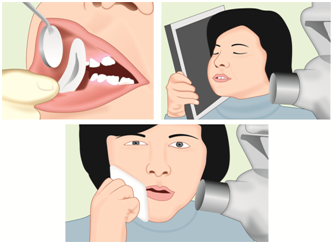
fig 1-3 Extra-oral technique: Placement of reverse bitewing and 45° oblique head plate for patients having severe gag reflex
Home Dental Care for Children with Cerebral Palsy
- Ask the patient to choose place where the oral cavity is easily accessible with light.
- Always support the head of the patient while brushing.
- Encourage patient while brushing, this will help them doing a good job even in the absence of caretaker once in a while.
- Brush teeth and tongue after every meal.
- Dispense only a pea size fluoridated tooth paste uptill the age of 4 as the swallowing reflex is not well developed and patient tends to ingest it.
- Encourage swishing after medications as syrup contains a lot of sugar.
- Dental evaluation of the eruption of first teeth followed by biannual evaluation
- Avoid fruit juice as it increases sugar exposure.
- Provide healthy balanced meals.
- Avoid snacking and in between meals.
- Prefer anticariogenic diet such as cheese products.
ORAL HEALTH CONCERNS
Oro motor dysfunctions cause malnourishment due to improper coordination of lips, cheek and tongue. Most of the times, these children have self-damaging habits such as pica and luminators pouching. Cerebral palsy children demonstrate self-influencing damaging habits such as bruxism, lip, cheek and arm biting, finger and hand chewing.
Drooling: Cerebral palsied children generally have drooling not because of the excessive production of saliva but due to underdeveloped and improper swallowing pattern; this is due to hypotoxicity of the muscles.
Bruxism also known as clenching and grinding is a frequent finding in CP. This condition can be treated by wearing mouth guards that prevent further destruction of the teeth.
Pouching is the placing of food between the teeth and buccal mucosa that is the major cause of dental caries in these patients.
Rumination is the rechewing of the already ingested food that has been regurgitated in oral cavity. The contents are highly acidic and cause demineralization of the tooth, therefore, making them susceptible to dental decay.
Pica: A disorder which leads to a craving of inedible items such as chalk, led pencils, sand dust thereby causing serious oral implications.
CONCLUSION
The medical care of a child who has CP can be both challenging and rewarding. Families and patients can benefit from an understanding physician or pediatrician who can look past complexities of the medical condition and address important social and emotional issues that are overlooked when care is fragmented among multiple specialists. Although CP is a complex disorder that frequently requires special care, knowledge of specific classes and musculoskeletal features of CP, examination techniques, medications and therapy options can help in facilitating care in a caring and appropriate manner. Three key points about caring of the children with CP are:
- It is a nonprogressive lesion—early recognition can have good prognosis.
- Occupational, physical and speech-language therapy are frequently beneficial in managing CP.
- Support of the family and caregivers is essential in maintaining the oral health of the involved child.
Disclaimer from Guident
The views and opinions expressed in articles published in Guident are solely those of the authors and do not necessarily reflect the views of the editors, the editorial board or the publisher, Ivory India. Guident does not endorse any product, technique or treatment described. Clinical content is intended for qualified dental and medical professionals and is not a substitute for individual clinical judgement. Guident, its editors and the publisher accept no liability for any consequence arising from the use of information published in the journal.
How to cite this article
Dr. Priya Verma Department of Pedodontics and Preventive Dentistry. Management of Cerebral Palsy. Guident. 2018 Apr;11(5). Available from: https://guident.in/articles/pedodontics/management-of-cerebral-palsy.html