Role of Dentist in Disaster Management
K.D Dental Collge & Hospital, Mathura
INTRODUCTION
Dentists along with other health professionals can act as first responders well prepared to play an important role in response to catastrophic events as they areexperts in infection control, trained and skilled in administering drugs by injection, Skilled in placing sutures and controlling bleeding, able to participate in interdisciplinary professional groups; and managing uncomfortable patients1.
Roles of dentist in disaster management are as follows:
1. Dental Surveillance - Bioterrorism attacks and pandemics often have relatively indistinguishable beginnings and ends with unpredictable effects on a population. A wide distribution of dental offices in nearly every community makes them less vulnerable to complete elimination in a catastrophic disaster.
2. Triage Services - Triage is derived from the French, meaning to sort out, and can be applied to various situations ranging from everyday triage of emergency department patients to large scale disasters.A major earth quake struck China on May 12, 2008. Of the 4,582 patients, 408 (8.9%) sustained a total of 482 facial injuries. The dental team participated in triage in the field, in medical patrol service at support sites in many areas including dental offices, and as additional staff members in the hospitals.
3. Definitive Treatment - They are especially experienced in treating dentoalveolar injuries and facial fractures. An Oral and maxillofacial surgeons team is capable of administering anaesthetic and surgical services to patients with many types of injuries. Oral and maxillofacial (OMS) practitioners are qualified trauma surgeons who can provide first aid, including endotracheal intubation and cardiopulmonary resuscitation.

Figure no.1 Endotracheal Intubation
4. Immunization - Dentists can participate in mass immunization programs with minimum of additional training and may be critical factor in the success of urgent programs. Dental offices can be used as immunization sites to minimize the concentration of potentially infected persons.To limit the spread of infectious agents, whether from a natural pandemic, a deliberate bioterrorism attack, or contamination as a result of a local event, rapid immunization of great numbers of individual may be required in a short amount of time2.
5. Forensic odontology:
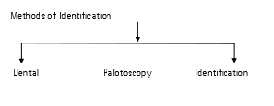
1. DENTAL IDENTIFICATION
Dental identification of a person is based on unique individual characteristics of the dentition and dental restorations, relative resistance of the mineralized dental tissues and dental restorations to changes resulting from decomposition and harsh environmental extremes such as conditions of temperature and violent physical forces.
METHOD OF DENTAL IDENTIFICATION
Collection and preservation
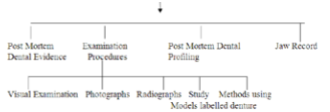
1) COLLECTION OF PRESERVATION
a) Post Mortem Dental Evidence - The post mortem dental examination is conducted by the authority and under the direction of the medical examiner, typically a forensic pathologist. Thus, the protocol for the collection of post mortem dental evidence, particularly decisions to incise the facial tissues for access or resect the jaws, is subject to approval by Medical examiner.
b) Examination Procedures - The central dogma of dental identification is that post-mortem dental remains can be compared with ante mortem dental records, including written notes, dental impressions, radiographsetc to confirm identity. Clearly individuals with numerous and complex dental treatments are often easier to identify than those individuals with little or no restorative treatment.
i) Visual examination and dental charting
It is recommended that all charting designations for the individual teeth be made in the universal numbering system.
ii) Photographs
Dental photographs are very helpful in preserving the evidence, especially when there is some unique dental feature. Photographs of front teeth may be useful for comparisons to ante mortem photographs which show unusual features of these teeth3.
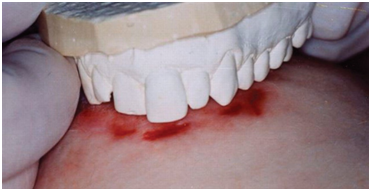
Figure no. 2Dental photograph of Bite Mark
iii) Radiographs
Every post-mortem dental examination should include the taking of radiographs (X ray films). A completely accurate dental charting without radiographs is not possible since there are many conditions that are not detectable by this method and dental films are the hard evidence that will be needed to substantiate any conclusions in the case. The radiographs are solid objective recordings of the actual dental characteristics. The radiographs to be taken are:
- Bitewing radiographs
- Periapical radiographs
- Panoramic radiographs.
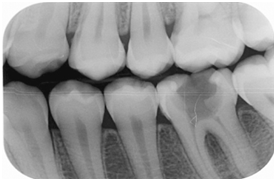
Figure no. 3 Radiograph
iv) Study Models
Study models are seldom used to preserve evidence in identification cases. Due to fragility of the teeth in some situations and the breakdown of soft tissue in others, taking impressions can, under certain circumstances, alter the existing evidence4.
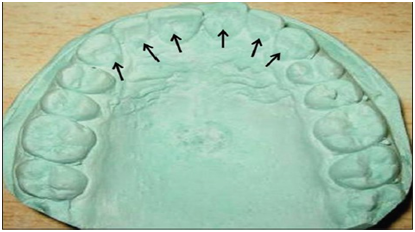
Figure no. 4Maxillary Cast as Study Model
v) Method using labelled denture
Labelled dentures can be of great assistance in the identification of individuals. Other dental appliances, such as removable orthodontic braces have also been used for identification purposes.Dental materials have provided clues to assist identification. SEM-EDX (Scanning electron microscopy with and without energy-dispersive X-ray analysis) has been to identify the composition of a glass-ionomer restoration. This technique had potential for detecting residual restorative materials in facet areas and in determining the existence and composition of unrecovered adjacent restorations.
c) Post Mortem Dental Profiling
A post mortem dental profile will typically provide information on the deceased’s age, ancestry background, sex and socio-economic status. In some instances it is possible to provide additional information regarding dietary habits, habitual behaviours and occasionally on dental or systemic diseases.
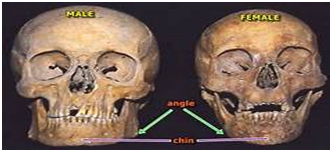
Figure no. 5 Gender wise Post Mortem Dental Profiling
d) Jaw Resection
Facial dissection or jaw resection, which may be necessary for full access to dental structures, is done only with approval of medical examiner5.
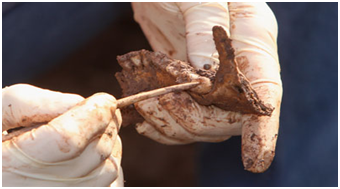
Figure no. 6Jaw Resection
2. PALATOSCOPY
When traffic accidents, acts of terrorism or mass disasters occur in which it is difficult to identify a person according to fingerprints or dental records, palatine rugae may be an alternative method of identification. The palatine rugae are permanent and unique to each person and can establish identity through discrimination (via casts, tracings or digitized rugae pattern). Palatal rugoscopy was first proposed in 1932, by Spanish investigator named Trobo Hermosa.
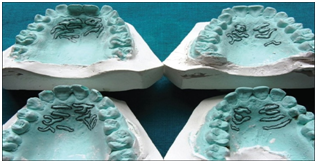
Figure no. 7Palatoscopy
CLINICAL SIGNIFICANCE OF PALATOSCOPY
1)Forensic identification
Establishment of person’s identity can be a difficult task in cases of traffic accidents or acts of terrorism or in mass disaster situations. The application of palatal rugae patterns for personal identification was suggested by Allen in 1889. The anatomical position of the rugae inside the mouth—surrounded by cheeks, lips, tongue, buccal pad of fat, teeth and bone—keeps them well-protected from trauma and high temperatures. Thus, they can be used reliably as a reference landmark during forensic identification.
2)Burn cases
Muthusubramanian et al. did a study to examine the extent of palatine rugae preservation for use as an identification tool in burn victims and cadavers. Patients with third-degree were examined within 72 hours after their accident. The study results showed that among the subjects with third-degree burns, 93 percent of the palatine rugae were normal. They concluded that the palatine rugae could be used as a reference landmark during forensic identification of an individual 6.
CONCLUSION
Dentists are well versed in the daily practice of infection control, taking and using information from medical histories to guide their actions, taking and interpreting radiographs, administering injections, suturing wounds, managing infections, prescribing medications and making diagnosis on the basis of clinical signs and symptoms. All of these skills apply directly to catastrophe response. Members of the established public health systems and medical community must understand that, in medical surge events, members of dental profession are an additional source of assistance in response activities.Inculcating emergency response to a disaster in the dental undergraduate curriculum and continuing educational programs for practitioners can prepare them well in advance in the wake of any unforeseen circumstance.
REFERENCES
- Park K. Park’s Textbook of Preventive and Social Medicine. 21st edition. Jabalpur: M/s Banarasi Das Bhanot, 2011; 736-43.
- Guay AH. The role dentists can play in mass casualty and disaster events, Journal of Dental Clinic of North America 2012; 51:767–778.
- Ramandeep Singh Gambhir. Disaster Management: Role of dental professionalsInternational Journal of Medical Science and Public Health 2013; 2 (2):169-174.
- Javier Ata-Ali, Fadi Ata-Ali. Forensic dentistry in human identification: a review of the literature, Journal of Oral Medicine and Pathology2014;6(2):162-7.
- C Stavrianos. Methods for human identification in Forensic Dentistry: a review,The International Journal of Forensic Science 2008; 4(1):1-8.
- Ines Caldas, Americo Santos Afoma. Establishing identify using cheiloscopy and palatoscopy,Journal of Dental and Medical Sciences 2014:165 (4):1-9.
Disclaimer from Guident
The views and opinions expressed in articles published in Guident are solely those of the authors and do not necessarily reflect the views of the editors, the editorial board or the publisher, Ivory India. Guident does not endorse any product, technique or treatment described. Clinical content is intended for qualified dental and medical professionals and is not a substitute for individual clinical judgement. Guident, its editors and the publisher accept no liability for any consequence arising from the use of information published in the journal.
How to cite this article
Dr. Kriti Verma Dr. D. J . Bhaskar Dr.Navpreet Kaur Department Of public Health Dentistry. Role of Dentist in Disaster Management. Guident. 2018 Apr;11(5). Available from: https://guident.in/articles/general/role-of-dentist-in-disaster-management.html