Root Morphology and Difficulty in Tooth Extractions
Burhani Hospital, Surat, India
INTRODUCTION
Not all the teeth have same internal anatomy. Variations in anatomy of roots do play a major role like number of roots, number of root canals or even the shape of the roots and their canals.
Success of dental treatment depends upon a thorough knowledge of dental anatomy and understanding their potential variants. Inability to recognise the variation in morphology of tooth roots may lead to root/tooth fracture while extractions or may lead to endodontic failures.
Indications for extraction, Firstly where most of the periodontal attachment is still intact, such as deep crown-root fracture, are more likely to be associated with a challenging extraction procedure. Secondly, the degree of difficulty of an extraction is also determined by the anatomy of the tooth. Canine teeth have a large bulbous root with an extensive periodontal attachment. The curved roots of multirooted teeth make an extraction technically more difficult. Anatomical variations, such as a supernumerary root, are common for certain teeth and may complicate the extraction procedure. Thirdly, the nature of the pathology present also greatly influences the degree of difficulty.
Additional factors in evaluating the anticipated degree of difficulty of a dental extraction include the quality of the surrounding bone and the vicinity of important anatomical structures.
DEFINITION OF EXTRACTION
It is the painless removal of tooth or root from its alveolar socket with least trauma to the surrounding hard and soft tissues and with no complication.
Indications-
Teeth are important for aesthetic purposes and for maintaining masticatory function. Accordingly, all efforts to avoid tooth extraction must be exhausted before the decision is made to proceed with removal of a tooth.
Nevertheless, there are circumstances in which it is clear that a tooth must be extracted, such as the following:
- A tooth that cannot be restored, because of severe caries
- A mobile tooth with severe periodontal disease, pulp necrosis, or periapical abscess, for which root canal treatment is required that the patient cannot afford (or for which endodontic treatment failed)
- Overcrowding of teeth in the dental arch, resulting in orthodontic deformity.
Other conditions that may necessitate extraction include the following:
- Malposed teeth causing soft tissue trauma to the cheek
- Cracked teeth from trauma
- Supernumerary teeth
- Teeth adjacent to a pathologic lesion that must be excised
- Planned radiation or intravenous (IV) bisphosphonate treatment, warranting prophylactic extraction
- Teeth in the line of fracture
- Aesthetic considerations (e.g., teeth with endogenous staining)
- Economic considerations (e.g., teeth for which extensive restoration is required that the patient cannot afford.
ROOT MORPHOLOGY
It is an important factor in determining the degree of difficulty in the extraction of an erupted tooth as well as of an impacted tooth.
CONSIDERATIONS
- ROOT LENGTH-
- 1/3rd-2/3rd of root formed, blunt roots
- Shorter roots will tend to rotate
- Longer roots might have some abnormal morphology
ROOT CURVATURE-
a) Straight or slightly curved roots
b) Dilacerations {severely curved roots}
- ROOT FUSION-
Fused conical roots or widely separated root.
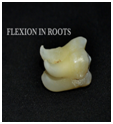
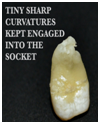
RADIOGRAPHIC EXAMINATION CAN HELP WITH- assessment of apical area of tooth (small, abnormal, sharply hooked roots).

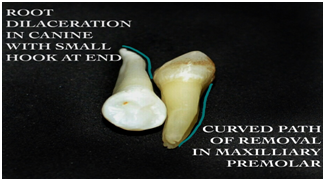


Molar with difference in root forms, fused roots
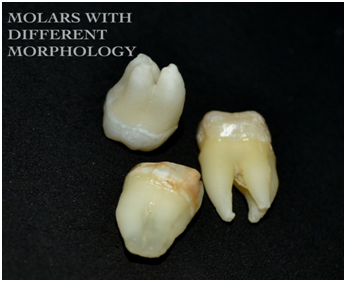
Molars with conical roots with widely separated roots Molar with fused roots.
CONCLUSION
- Removal of a tooth is a surgical procedure, which may be accomplished with forceps, elevators or a trans-alveolar approach.
- Extraction is irreversible and occasionally associated with complications. It should be employed only when all alternatives have been excluded.
- However, on occasion, teeth must be extracted and extraction is part of the function of the dental practitioner.
- Extractions may pose various problems and it is wise to anticipate difficulty and prepare for it.
- It is assumed that at this stage you will have knowledge/competencies in the following areas:
- Anatomy (including radiographic features) of structures surrounding the teeth (including the periodontal ligament)
- root morphology (including common variations)
- The relationships of roots to the maxillary antrum, inferior alveolar nerve and mental foramen.
Disclaimer from Guident
The views and opinions expressed in articles published in Guident are solely those of the authors and do not necessarily reflect the views of the editors, the editorial board or the publisher, Ivory India. Guident does not endorse any product, technique or treatment described. Clinical content is intended for qualified dental and medical professionals and is not a substitute for individual clinical judgement. Guident, its editors and the publisher accept no liability for any consequence arising from the use of information published in the journal.
How to cite this article
Dr. Kalpana Sinsinbar Department of Prothodontics. Root Morphology and Difficulty in Tooth Extractions. Guident. 2018 May;11(6). Available from: https://guident.in/articles/general/root-morphology-and-difficulty-in-tooth-extractions.html