Dental Originated Speech Defects
K.D Dental College, Mathura, U.P, India
INTRODUCTION
Of all human capabilities, verbal communication is one of the most valued and sufficiently complexed system. The oral cavity is intimately associated with speech processes—both normal and abnormal. The dentist who treats the children should be familiar with the physiology of speech and the means of correcting speech defects. Many of the dental/speech pain physiologies may be prevented, corrected or minimized when the dentist and the speech pathologists work together cooperatively in identification, diagnosis and treatment of speech disorders.
Speech is the skilled, willful and elaborate movement of muscles used for initiating sounds plus the molding of these sound into meaningful oral communication. Speech involves the person’s lips, teeth, tongue, throat, vocal chords, lungs, as well as additional body processes.
Letters are symbols that represent sounds. Letters, in particular combinations, form words, with each word standing for something. Words in combinations make sentences, allowing for complex communication.
A speech or language impairment means an impairment of speech or sound production, fluency, voice or language which significantly affects a child’s educational performance or this social, emotional or vocational development.
ETIOLOGY
Functional
- Environment
- Psychological development
- Habit
- Intelligence
Organic or (structural variation)
- Primary organic voice disorder
- Asymmetry of vocal fold
- Neuromotor disorders
- Trauma to vocal fold
-Cysts
-Polyps
-Senile atrophy
Secondary organic voice disorders: These are consequences of temporary or chronic abuse of vocal cords and, if not advanced, is reversible
- Mucosal irritation
- Recurrent laryngitis
- Chronic hypertrophic laryngitis.
DENTAL ORIGINATED SPEECH DEFECTS
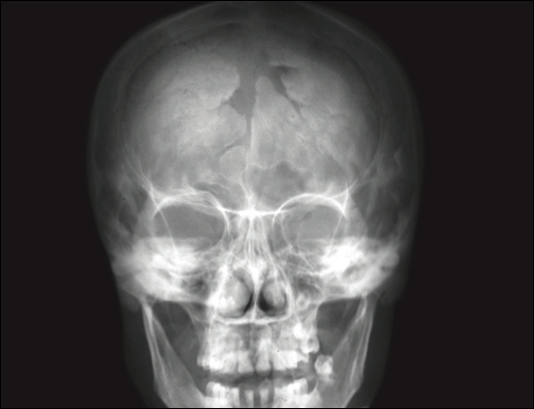
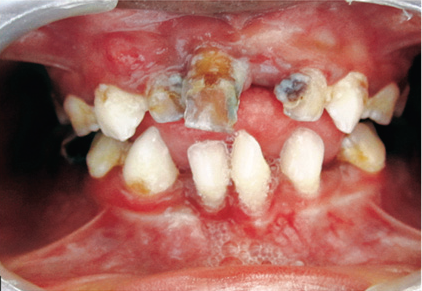
Teeth and tongue and oral structures play an important role in the pronunciation of the consonants f, v, s, z, etc. Speech defects can occur either due to the faulty dentition or sometimes an already existing speech pathology can give rise to dental problems, both ways speech and dentition are affected. Children can generally compensate for minor oral issues and have no problems with speech but some dental issues are more extreme and may hinder pronunciation. Therefore it becomes imperative for the clinician to know and manage both the aspects: (Figure1-6)
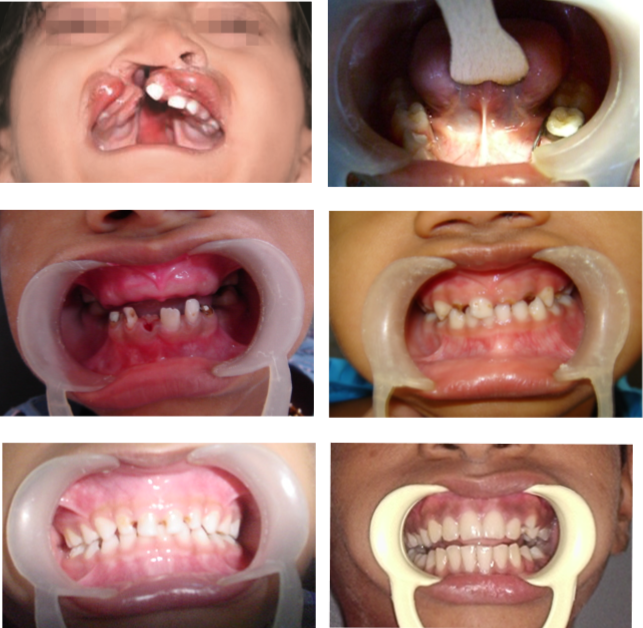
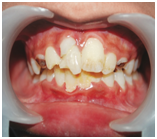
FIGURE 1-6 SHOWING SPEECH DEFECTS OCCURRING DUE TO DENTAL CONDITIONS (1) CLEFT LIP AND PALATE;(2) SHORT LABIAL FREENUM;(3) CONGENITALLY MISSING TEETH;(4) TEETH MISSING DUE TO CARIES;(5) MULTIPLE CARIOUS LESIONS;(6)OPEN BITE AND TONGUE THRUSTING
- Cleft lip and palate: is a congenital anomaly associated with non fusion of lip process and palatal shelves thereby preventing the formation of proper lips and palate, the closure is generally achieved by surgery but the teeth lying in the line of defects are either missing or hypoplastic, rotated that produce lateral and interdental sibilants. CLP generally gives rise to Narrow palate due to which sound s, z, th are affected.
- Short lingual frenum is the attachment under the tongue, which can be so short that the tongue is actually attached at the tip to the tissue at the bottom of the mouth. The tongue needs to move and touch different areas to produce t,d,n,l,r sounds. This can usually be relieved with a small surgery done by dentist or the Ent specialist
- Malocclusion: A prognathic mandible can affect tongue tip placement that ultimately results in tongue blade realizations. Class III malocclusion causes around 50% of severe articulation deviation as compared to 20% in class II and 2.7% in class I..
- Open Bite is also a type of malocclusion in which the front teeth fail to make an overlap together.Many speech sounds require closed front teeth to enunciate and causes interdental production of alveolar sounds. S, sh, z, zh, th, t, d are affected in anterior open bite. In a similar way Overbite can also affect tongue tip sounds or production of sibilants.
- Missing teeth resulting due to trauma, caries or by birth are also one of the cause of speech defect.
- Loss of front teeth can make it extremely difficult to produce sounds well. Any sound that makes contact with lingual teeth are severely impacted.
- Anterior spacing: All dental sounds except “n” and “y” are affected. s, sh, z, zh and th are severely affected.
- Thumb Sucking: Prolonged thumb sucking can push front teeth forward, cause an open bite, and deform the palate. This combination can make proper speech development a challenge. thumb sucking gives rise to High palate due to which s, z, th, r, l, k, g sounds are affected
- Tongue Thrust:This is when the tongue, during swallowing or speaking, pushes through the teeth.
- If not addressed with orthodontics, myofunctional therapy, or orthodontic appliances, the problem will cause movement of teeth and increased difficulty with speech. Tongue thrust needs to be diagnosed by your dentist
SPEECH EVALUATION
History: It emphasizes on developmental, family and medical history. Social/emotional history required for adaptive behavior assessment.
Assessment:Assessment must be standardized and should be reliable. Cognitive/intellectual abilities:Required for children with language disorders.
Communicative abilities: If a speech or language disability is suspected further assessment(s) and diagnosis of an order must be made by a speech pathologist. Once diagnosed, the speech language pathologist can request for additional evaluations that may also include medical references such as–
- Evaluation of oral-peripheral speech mechanism
- Language, i.e. both receptive and expressive areas must be assessed. Cognitive or intellectual abilities assessment is required when language delay is identified.
- Evaluation of articulation if any disorder is suspected
- Voice evaluation
- Fluency evaluation
- Alternative communication should be included in evaluation.
Medical referral to otolaryngologist is required when voice disorder is suspected.
Programming(One criterion or curriculum-based measure in the area of communicative abilities required for children with a language disorder).
Children ages 3–5 years are considered to have a Speech or Language Impairment when they demonstrate a measurable, verifiable discrepancy between expected performance for the child’s chronological age and the current level of performance. In analyzing communi- cative abilities, the speech-language pathologist should be aware of factors which represent communication differences rather than disorders. Communication differences refer to regional, social or cultural speech and language variations that are not considered communication disorders.
After analyzing the evaluation data pertaining to the child’s communicative abilities, inclusive of screening information, the speech-language pathologist will submit the information to the committee in the form of a written report.
DENTAL MANAGEMENT
- Generally children with impaired speech also have impaired hear loss; this should be kept in mind while treating such patients.
- Evaluation should be made regarding their speech disorder and assessment the level of impairment.
- Differentiation should be made if the impairment really exists or it is a delayed milestone.
- Make use of nonverbal communication.
- Pen, pencil and notebook should be handy for the child to convey his doubts and queries.
- The dentist must ensure that communication is established at all time during the treatment.
- Make sure that child’s vision is not hampered and non obstructive at all time.
- Well-lit clinic so that the child’s visibility is maintained. Any spoken instructions should always be supplied with written instruction so that it is handy for the child. Be sensitive toward the patient and do not make him feel impaired.
- Avoid being over-sympathetic toward the child.
- If you suspect speech disorder, make the family aware about it and offer speech therapy by a speech therapist or pathologist.
- If mild disorder like structuring, explain the simple exercises at home.
- Assess if the speech pathology is due to underlying dental problem such as spacing, molecules, crossbite and open bite.
- Increased incidences of caries, poor oral hygiene and periodontal problems are seen in these children. Awareness regarding the same should be given to child and caretaker.
- Slowly wean off the child from parent/caretaker once a direct communication is established and child is comfortable with you.
- Give child more opportunity to speak and express rather than listing from parent.
- Do not interrupt while they are talking or try to fill gaps. Be patient and good listener.
Disclaimer from Guident
The views and opinions expressed in articles published in Guident are solely those of the authors and do not necessarily reflect the views of the editors, the editorial board or the publisher, Ivory India. Guident does not endorse any product, technique or treatment described. Clinical content is intended for qualified dental and medical professionals and is not a substitute for individual clinical judgement. Guident, its editors and the publisher accept no liability for any consequence arising from the use of information published in the journal.
How to cite this article
Dr. Priya Verma Department of Pedodontics and Preventive Dentistry. Dental Originated Speech Defects. Guident. 2018 Feb;11(3). Available from: https://guident.in/articles/pedodontics/dental-originated-speech-defects.html