The Effects of Chlorhexidine-Gel Use on Gingival Inflammation in a Chronic Periodontal Disease
University of Tetova, Faculty of Dentistry, Tetova, Republic of Macedonia, Faculty Of Dentistry, Skopie, Republic of Macedonia
ABSTRACT
Objectivies: evaluation of the impact therapeutic effect of the gel which contain Chlorhexidine Gluconate on the gingival inflammation through comparative analysis in patients with the application of the conventional method (CM) and conventional therapy supported with Chlorhexidine Gluconate Gel (KM-G) .
Materials and Methods: For the realization of our aim was included 30 patients from both genders, aged 20-50 years, in which radiographic and clinically was diagnosed chronic periodontal disease with a periodontal pocket depth of 3 mm but not exceeding 5 mm. The subjects are divided in two groups: in the first was used only the conventional method and in the second the subjects were treated with KM - G. In both groups included in this study we have determined the index by Loo-Sillnes and the index of the gingival inflammation by Sillness – Loo in four time points: the first during the initial treatment at the first examination. Then after 5th day, after 10th day and on the end after the 30th day from the first treatment. The Chlorhexidine Gluconate Gel in patients was administered at the beginning during the first examination. The numerical statistical was analyzed with descriptive statistics methods ( Mean ± Standard deviation . , ± 95 % CI , Min . , Max . ), while the interactive effects between the two examined methods after the first treatment during the first examination , at 5th, at 10th and at 30th day, were analyzed with the Repeated measures Anova ( F ) / Post - hoc Bonferroni test ( p ) .
Results. The results show reduction of the dental plaque and of the gingival inflammation in both groups after the 5 th, 10 th and after the 30th days from the initial treatment in comparison with the first examination. The comparison of the dental plaque index and the index of gingival Inflammation on the 5th, 10th and 30th day between the both groups, demonstrate significantly better therapeutic efficiency in the group treated with KM which was supported with using of the Chlorhexidine Gluconate Gel.
Conclusion: The subjects treated with the KM- G , as opposed to those treated with KM, had an significantly improved clinical effects which were observed through decreased gingival inflammation and trough dental plaque reduction in all stages of our research .
Key words: chronic periodontal disease, gingival inflammation, conventional therapy, chlorhexidine gluconate gel .
INTRODUCTION
Bio film as unavoidable etiologic factor in its content and structure contains bacterial conglomerate which with toxins, enzymes and other associated factors cause gingival inflammation i.e. progressive destruction of connective tissue attachment and alveolar bone1.
The control of dental plaque through daily maintenance of oral hygiene, removing the newly emerging supra and sub gingival plaques are one of the ways to act preventive or curative when the gingival inflammation appears or to preserve the achieved therapeutic success2.
Irregular and unskilled mechanical instrumentation can damage the hard tissues where the sign is the appearance of gingival recession4.
In therapeutic treatment despite of removing plaque microorganisms mechanically, in clinical practice is used chemotherapy antimicrobial local or systemic therapy.
On these objectives are used many methods which in this occasion would apostrophized CIST- protocol.
CIST-protocol or otherwise named, modify the conventional (basement) periodontal method, as a therapeutic procedure which includes antimicrobials assets or modern antiseptic assets in the form of a gel, in which the leadership belongs to chlorhexidine.
Based on the latest scientific knowledge and proven results on the effectiveness of local administration antiseptic assets in gel form, we set the goal of this research, we follow the therapeutic effect of chlorhexidinegluconate gel on gingival inflammation through comparative analysisof patients using conventional therapy (KM) and conventional therapy aided by chlorhexidinegluconate gel (KM-G).
MATERIAL AND WORKING METHOD
For realization ofthis goal, the research is implemented in the dental office “Fjollamedica” in cooperation with the Clinic for mouth and periodontal Diseases in Dental Faculty, wherewere followed 30 patients of both sexes aged 20-50 years where was diagnosed with X-ray and Periodontopathy insecond clinical stage.
From all examinees were taken anamnestic data and was carried out clinical examination by analyzing the x-ray.
Examineeswhowere a part of this study were divided into 2 groups:
- Examinees from the first group were treated with conventional method (KM)- standard method (removing local irritation, dental plaque, tartar and processing periodontal pockets). In this group the toilet of periodontal pocket was consisted of rinsing with 3% hydrogen and maintaining oral hygiene.
- Examinees from the second group were treated with combined method conventional- method and application of chlorhexidinegluconate gel (KM-G), following processing periodontal pockets.
Patients who formed the group treated by KM-G were given instructions after application of the gel, maintaining good oral hygiene.
Chlorhexidinegluconate gel product on the market known as CHLO-SITE contains 1.5% chlorhexidinein the form of xanthan whose producer is the Ghimas Company from Italy.
The research was made in several stages: with the first examination of the patient, after 5, 10 and 30 days of the conventional procedure and the same procedure aided by chlorhexidine gel therapy.
To all examinees were made clinical examinations through the evaluation of dental plaque and gingival inflammation index.
The Gingival inflammation index is determinate by the Loe-Silnes method.
The findings were compared between the two groups in different examined groups i.e. after admission, 5, 10 and 30th day of the treatment. All obtained results were statistically processed.
In series with numerical marks are assessed: Descriptive statistics (Mean±Std.Dev.,±95%CI,Min.,Max.), while the interactive effects of the two examined methods after the treatment due to the first examination, after 5, 10 and 30 days were examined according to the Repeated measures Anova (F)/Post-hoc-Bonferroni test (p).
RESULTS
Table 1 presents gingival inflammation (during the first examination, after 5, 10 and 30 days), on patients with KM and KM-G. The given results of this research are shown in table 1 and chart 1)
For F=88,23 and p<0,001 (p=0,000) in given distribution there was significant difference (table 1 and chart 1)
The patients treated with KM-G after 5th day of the control for p<0,001 (p=0,000) there was significant lower gingival inflammation (0,27) , compared with the first examination (1,48). We found identical results after the 10th controlling day, for p<0,001 (p=0,000) with gingival inflammation (0,13) compared with the first examination (1,48). Significant gingival inflammation p<0,001 (p=0,000) was noticed even after the 30th day of the treatment.
Table 1.Display of gingival inflammation to the examined groups in different time periods on patients treated with both methods.

Chart 1.Therapeutic efficacy of the use of various therapeutic modalities in both groups in different time periods

The given results show reduction of gingival inflammation to all examinees that were treated with KM and KM-G in all stages of research, after 5, 10 and 30 days, against results of the first examination. Comparison between two groups showed improved clinical results in the group treated with KM-G.
Table 2. Display of gingival inflammation – Post-hoc Test/Bonferroni test/ on both examined groups compared with receipt day, 5, 10 and 30 day of treatment.
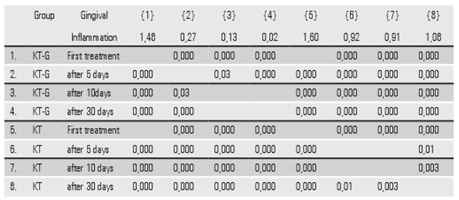
From table 2. Evident is better therapeutic result in the group treated with KM-G against KM after 5, 10 and 30 day of the treatment.
Table 3. Display of dental plaque on the examined groups in different time periods in patients treated with both methods.

On table 3. Display distribution of dental plaque (examination control after 5, 10 and 30 days) to the patients treated with KM method and to the patients treated with KM-G).
For F=1,47 and p>0,05 (p=0,23) in the shown distribution do not exist significant difference (table 3 and chart 2)
Chart 2. The presence of dental plaque among respondents after application of different treatment modalities in both groups in different time periods
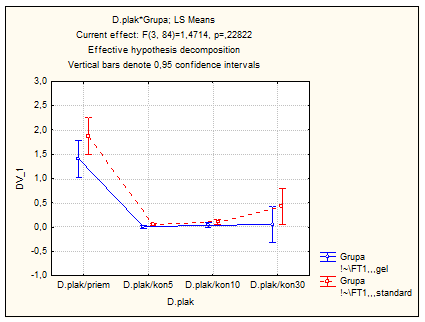
Table 4: Are displayed values of dental plaque – Post-hoc Test/Bonferroni test/ on the both groups compared with the day of receipt, 5, 10 and 30 day of the treatment.
Table 4. Display of dental plaque – Post-hoc Test/Bonferroni test/ on the both groups compared with the day of receipt, 5, 10 and 30 day of the treatment.
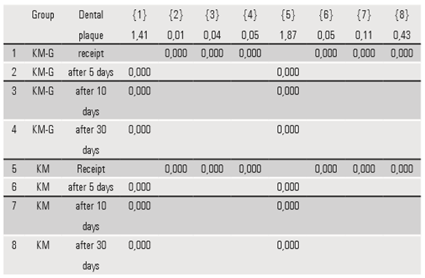
There isn’t any significant difference (p>0,05) for the dental plaque, between two groups from the first treatment.
The patients who were treated with KM-G after the 5th day for p<0,001 (p=0,000) they have significantly lower presence of the dental plaque (0,01) compared with the reception day (1,41). Identical results were observed on the patients treated with KM-G after the 5th day of control, for p<0,001 (p=0,000) they have significantly lower presence of dental plaque (0,01), compared with the patients treated by KM, (0,04), as well as the control after the 10th day to the examinees who were at KM-G for p<0,001 (p=0,000) they have much lower presence of dental plaque (0,04) compared with those who were treated with KM (0,11).
The patients treated with KM-G after the 30th day for p<0,001 (p=0,000) they have significantly lower presence of dental plaque (0,05), compared with the group treated on KM (0,43).
DISCUSSION
Dental plaque as an important segment in the etiology of many dental and periodontaldiseases we say it is organic layer of teeth, colorless, opalescent and slimy substance made up of many micro-organisms that cause the initial vascular changes in gingival tissue and otherpathogenic events that ended with the loss of collagen tissue and apical migration on epithelial connection.
In fact, most of the authors confirm the connection between plaque and gingival inflammation and definitely confirm the theory of periodontal pockets and periodontal disease.
This study, analyzed the difference in the presence of dental plaque using the both methods: conventional and conventional plus chlorhexidine gel. The results showed that there was no significant difference in the presence of dental plaque between those two groups after the first examination of the patients, but there was significant difference in the presence of dental plaque after the 5th day of the treatment. After the 10th and 30th day it was the same situation between the both groups.
After the complete treatment regardless in what period was made and which method was used, it was evident the reduction of index value of dental plaque.
Statistics showed that patients treated with classic method after the 5th (0,05), the 10th (0,11) and the 30th day (0,43), were having much lower presence of dental plaque compared to the first examination (1,42). The same results we found when we analyzed the patients treated with conventional method adding the gel after the 5th (0,01), 10th (0,04) and 30th day (0,05). In this case was recorded much lower presence of dental plaque compared with the first visit1.
Especially evident fact of this research was the magnificent lower values of the dental plaque in the group treated with KM-G in all stages of this research.
Our results wereobtained in accordance to the results of many authors1 and they confirmed that the application of chlorhexidine gel in the treatment of periodontal disease effectively had influence on the clinical symptomatology.
Actually, the CIST-protocol or otherwise named, modification on conventional periodontal method, highlights the antimicrobial effect on this modern antiseptic asset in the form of the gel, specially in cases where the periodontal pockets are from 3-5 mm deep, and in cases when we lose periodontal bone to 2 mm11.
Its therapeutic effect is followed in the study of Eit12 who claims that the therapeutic effect on the chlorhexidinegluconate as an adjuvant asset in the treatment of periodontal disease is having a positive effect on gingival.
In this study after the treatment made on the both groups there was a difference in the application of KM and KM-G in terms of gingival inflammation.
The presence of dental plaque nearby the gingiva causes inflammation of the gingiva.
Gingival inflammation in the same time means the introduction to the periodontopathy and the reason more to emphasize the accumulation of dental plaque, who through the factors of inflammation contributes to increase the level of osteoresorptive factor in inflamed gingival, with progression of chronic periodontal diseas1.
The results of gingival inflammation after the use of both methods KM and KM-G showed that there is significant difference in the index of gingival inflammation between the two groups after the 5, 10 and 30 days from the treatment.
The patients that were treated with KM-G after the 5th (0,27), 10th day (0,13) and 30th day (0,02), were registered much lower values of the gingival inflammation compared with the first examination (1,48), but the patients that were treated with KM after the 5th day (0,92), after the 10th (0,91) and after the 30th day of control (1,08) were having significant lower values of the gingival inflammation compared with the first examination (1,60).
Similar to those results the patients who were treated with KM-G after the 5th day of control (0,27), 10th day (0,13) and after the 30th day (0,02) were registered significant lower values of the gingival inflammation compared with the values on the patients who were treated with KM after the 5th day of control (0,92), 10th day (0,91) and after the 30th day (1,08).
The results of this research showed positive therapeutic effect in patients treated with KM-G. We think that the evident improvement in clinical symptoms first in gingival inflammation is because of the chlorhexidine gel like a adjuvant asset in the treatment of periodontal disease.
The chlorhexidine gel is the local antiseptic that directly reduces the qualitative and quantitative composition of the microorganisms in bio films, and thus have positive influence on the gingival and periodontal status12.
Actually, the gel chlorhexidine contains the range of local antimicrobial ingredients and the most important is xanthan. The xanthan in contact with water is decomposing and is slowly forming the resistant gel coating which acts favorably by 30 days max.
We, relying on this scientific results explain also our results that goes in addition to the group treated with chlorhexidine gel.
In accordance to our obtained results and interpretations here are the results of12,14,15,16,17,18,19 .
In connection with this, Chetan2 following the effect of hlosit xanthan gel due to the clinical and microbiological parameters she came to the conclusion that after the curettage of the periodontal pockets and hlosit use the clinical improvements were significant as well as the reduction in the number of bacterial colonies Fusobacterium nucleatum, Porphiromonas gingivalis and Tanerella forsythesis.
Biodegradable xanthan gel composed of chlorhexidine digluconate and chlorhexidine dihydrochloride (1:2)leads to a rapid decrease of the sub gingival concentration on periodontal bacteria21.
Actually, the reduction of microorganisms in dental plaque is the key role for the lower values of the plaque and have satisfactory effects on gingival.
CONCLUSION
Based on the results we can conclude that the examinees treated by KM-G, against those treated only with KM, were having significantly better clinical results in all phases of this research . Because of the easy application, easy degradable power, nontoxic and we could definitely recommend it like an adjuvant of the conventional treatment on periodontal disease.
LITERATURE
- Haffajee AD, Socransky SS, Patel MR, Song. Microbial complexes in supragingival plaque Oral Microbiol Immunol 2008;23(3):196-205.
- Newman MG. Socransky SS. Predominant Cultivable Microbiota in Periodontitis. Jperiodontal Res 1977;12:120-127.
- Ljushkovic B. Paradontologija i oralna Medicina Voeno izdavacki zavod,Beograd 2009:149- 52.
- Gurinsky BS. Concepts in periodontology, Winter,Texas, 2009:2-3.
- Sbordone L, Bortolaia C. Oral Microbial Biofilms and Plaque-Related Diseases.Clin Oral Research 2003;7:.181-188.
- Zhou T, Xie H, Yue Z. Relationships of five periodontal pathogens causing subgingival plaque in patients with chronic periodontitis under different periodontal conditions].Hua Xi Kou Qiang Yi Xue Za Zhi. 2013;31(5):518-21.
- Wang J, Chen W, Jiang Y, Liang J. Imaging of extraradicular biofilm using combined scanning electron microscopy and stereomicroscopy.Microsc Res Tech. 2013;76(9):979-83.
- Mancl KA, Kirsner RS, Ajdic D.Wound biofilms: lessons learned from oral biofilms.Wound Repair Regen. 2013;21(3):352-62.
- Killoy GW. Assessing the effectiveness of locally delivered chlorhexidine in thetreatment of periodontitis. JADA, 1999;130:567 - 570.
- Angst PD, Piccinin FB, Oppermann RV, Marcantonio RA, Gomes SC.Response of molars and non-molars to a strict supragingival control in periodontal patients.Braz Oral Res. 2013;27(1):55-60.
- Galgut P. Periodontal diseases. School of Dental Hygiene, University College Dental Hospital, London, U.K. 2009;26-28.
- Eit HAA,Usama M, Gouda MM. Al-Abdaly,The evaluation of Topical Application of CHLO-SITE (Chlorhexidine gel) in Management of Chronic Periodontitis, ED Journal, 2010;56(2.3):120-129.
- Yue Y, Liu Q, Xu C, Loo WT, Wang M, Wen G, Cheung MN, Bai LJ, Dou YD, Chow LW, Hao L, Tian Y, Li JL, Yip AY, Ng EL.Comparative evaluation of cytokines in gingival crevicular fluid and saliva of patients with aggressive periodontitis.Int J Biol Markers. 2013;28(1):108-12.
- Bollen CM, Quirynen M. Microbiological response to mechanical treatment in combination with adjunctive therapy. A review of the literature, J. Periodontol.1996; 67: 1143±1158.
- Benedettis M and Grassi R, Clinical and microbiologic effects of subgingival controlled-release delivery of chlorhexidine chip in the treatment of periodontitis: a multicenter study. J Periodontol. 2008;79(2):271-82.
- Bromberg LE, Buxton DK, Friden PM. Novel periodontal drug delivery system fortreatment of periodontitis. J Control Release. 2001;71(3):251-9.
- Greenstein G. Polson A. The role of local drug delivery in the management of periodontal diseases: a comprehensive review. Department of Periodontology, University of Medicine and Dentistry, Newark, NJ, USA. J Periodontol. 1998;69(5):507-20.
- Abrishami M,Iramloo B, Ansari G, Eslami G, Akbarzadeh AB, Anaraki M. The effect of locally delivered xanthan based CHLOSITE gel with scaling and root planning in the treatment of chronic periodontitis : microbial findings J DentResearch 2008;5(2): 47-52.
- Soskolne WA. Citation Information Modified-Release Drug Delivery Technolog Edited by Michael J . Rathbone , Jonathan Hadgraft , and Michael S . Roberts Informa ealthcare 2002: 99–400.
- Chetan C, Effect of chlosite (xanthan gel with chlorhexidine) on clinical & microbiological parameters in smokers - A case series Year. 2010; 4(2):165-98.
- Senel SI, Kas GG, Yousefi-Rad A, Sargon MF, Hıncal AA. Chitosan films andhydrogels of chlorhexidine gluconate for oral mucosal Delivery.
Disclaimer from Guident
The views and opinions expressed in articles published in Guident are solely those of the authors and do not necessarily reflect the views of the editors, the editorial board or the publisher, Ivory India. Guident does not endorse any product, technique or treatment described. Clinical content is intended for qualified dental and medical professionals and is not a substitute for individual clinical judgement. Guident, its editors and the publisher accept no liability for any consequence arising from the use of information published in the journal.
How to cite this article
Dr. Sahmedin Sali, Dr. Fidoski Jasmine MDS University of Skopie. The Effects of Chlorhexidine-Gel Use on Gingival Inflammation in a Chronic Periodontal Disease. Guident. 2018 Jan;11(2). Available from: https://guident.in/articles/research/the-effects-of-chlorhexidine-gel-use-on-gingival-inflammation-in-a-chronic-periodontal-disease.html