
Overcoming Frustrations in Construction Bite Technique: A Simplified Approach
Department of Orthodontic and Dentofacial Orthopaedic, Darshan Dental College and Hospital Udaipur (Raj.), India
ABSTRACT
Construction wax bite records inter jaw relationship in all the planes. Making a precise construction bite for an appliance can be a tedious procedure. This paper introduces a new technique for registration of construction bite, which overcomes the shortcomings of conventionally employed methods. After thorough examination the clinician or orthodontist determines to advance the mandible by X mm and open the bite by Y mm. On study models lines 1 and 2 were marked by using black and blue pencils respectively representing the existing and desired inter-arch relation with their vertical referencing limits measured and marked with the aid of manual vernier calipers. The laboratory bite fabrication was executed with X mm advancement and Y+0.5 mm vertical opening. Patient was trained to position the teeth looking into a mirror, so as to produce the required intermaxillary relation. Now previously fabricated wax bite is placed on lower teeth and patient is asked to bite upon the indentations of both the arches utilizing the proprioceptive reflexe. This procedure besides being accurate, reduces much frustration of the amateur clinician and helps to ease the apprehensive juvenile patients.
INTRODUCTION
Construction bite is an intermaxillary wax record used to relate mandible to maxilla in the three dimensional space.1 It is an indispensable record to correct functional malocclusions like functional retrusion and protrusion.2 Taking an accurate construction bite for fabricating an appliance can be frustrating and time consuming.3 This presentation introduces a new technique for registration of construction bite, which overcomes the shortcomings of previously used methods.
MATERIALS AND METHODS
- Modeling wax sheet
- Rubber bowl
- Vernier calipers
- Lecron carver
- B.P. handle and blade no 11
- Dividers and millimeter Scale
- Pencil
- Spirit lamp

Figure 1. Armamentarium
FABRICATION
After examination, diagnosis and treatment planning, the clinician or orthodontist decides to advance the mandible. Impressions were made with Alginate for both arches recording the entire depth of vestibule. Study models are obtained by pouring with orthodontic stone Class III. It was decided to advance the mandible by x mm and open the bite by y mm. Midline was marked on study model before taking the construction bite then, marking is first made for existing molar relationship (line1made with black pencil) and second marking (line 2 is made with blue pencil) is made, which denotes the required sagittal advancement of x mm. For the vertical opening two cross marks are made along line1on the right side of models, one on the maxillary and other on the mandibular cast. This distance between the marks is measured and transferred along line1on the left side. (Fig 2.) An vertical opening of y mm beyond this measurement is desired. Now to construct the bite, wax is fashioned into a horseshoe shape and adapted to the lower study model. Midline is marked on the wax bite and upper study model is oriented accordingly to match the midline anteriorly and line2 posteriorly on both sides. After stabilizing the upper model gently press it to the level, so that vertical opening of y+ 0.5 mm is achieved. (Fig 3.) An extra opening of 0.5mm is kept so that patient can bite firmly on wax during chair side procedure.

Figure 2. Line 1 are marked and arbitrary cross mark on along line 1 both side

Figure 3. Line 2 are marked
The patient is trained to position the teeth so as to produce an accurate construction bite. By marking the edges to one upper and one lower incisor with an indelible-ink pen and practice to lining up the marks and closing to the required position in front of a mirror. The wax bite which was constructed on study model is now placed in the patient's lower arch and asked to close to the required trained position of advancement and opening. (Fig 4.)
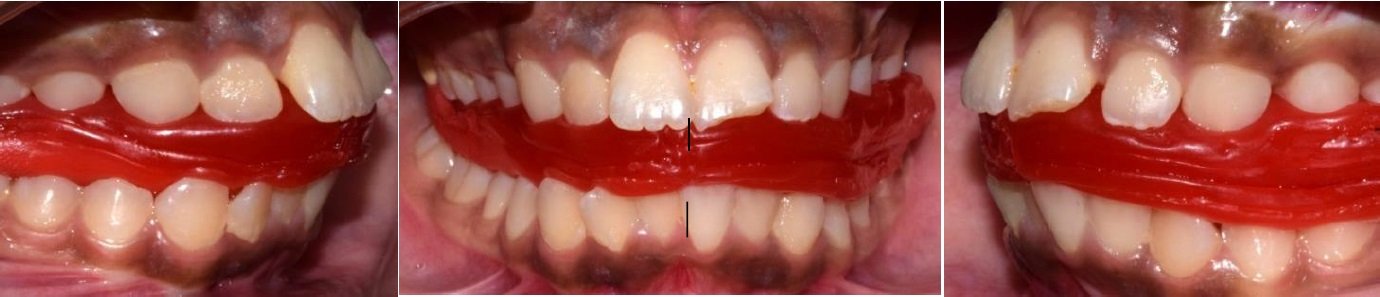
Figure 4. Intra oral photo with wax bite.
CONCLUSION
The goal of the construction bite is to produce maximum physiological response with minimum trauma to the tissue and discomfort to the patient. Even after many years of clinical experience, however, the correct position of the construction bite is still a matter of controversy.
The new technique can locate and register the construction bite with less reliance on operator competence and patient cooperation than the traditional freehand method.
ADVANTAGE
- Better patient compliance during clinical construction , due to patient following accurate indentations in the bite ahance by proprioception.
- Reduce the frustration of amateur clinician and apprehensive juvenile patients.
- Efficacious utilization of the during chair side time.
REFERENCES
- Kalra V. Taking construction bites for functional appliances. J Clin Orthod. 1994;24:245.
- George PT. A new instrument for funtional appliance bite registration. J Clin Orthod. 1992;26:721-723.
- Kachoei M, Behroozian A. A new appliance device for registration of construction bite. Dent Res J. 2012;9(6):826-827
Disclaimer from Guident
The views and opinions expressed in articles published in Guident are solely those of the authors and do not necessarily reflect the views of the editors, the editorial board or the publisher, Ivory India. Guident does not endorse any product, technique or treatment described. Clinical content is intended for qualified dental and medical professionals and is not a substitute for individual clinical judgement. Guident, its editors and the publisher accept no liability for any consequence arising from the use of information published in the journal.
How to cite this article
Dr. Manish Bishnoi. Overcoming Frustrations in Construction Bite Technique: A Simplified Approach. Guident. 2024 Nov;17(12). Available from: https://guident.in/articles/orthodontics/overcoming-frustrations-in-construction-bite-technique-a-simplified-approach.html


