
Sealing the Unsealed: Management of Immature Apex: A Case Series
Department of Conservative Dentistry and Endodontics, Seema Dental College And Hospital, Rishikesh
ABSTRACT
Use of an apical plug is an alternative treatment for open apices, and this has gained popularity in recent years, employing mineral trioxide aggregate (MTA) for optimal results. Here we report the successful treatment of permanent molar and central incisors that had open apices and periapical lesions using MTA apical plugs.
KEYWORDS: Mineral Trioxide Aggregate, Apical Plug, Immature Apex
INTRODUCTION
Following tooth eruption, the tooth continues to build its entire root and close the apical foramen for up to three years. Pulp necrosis may occur in young permanent teeth if the pulp is harmed before the apical foramen closes. Wide dentinal tubules in developing teeth allow bacteria and their irritants to enter. As a result, these teeth have root resorption immediately following trauma. To prevent the resorption of the roots, root canal therapy should be performed as soon as possible. Getting an apical seal is the major challenge in the endodontic treatment of these teeth.
Apexification therapy is used on nonvital, immature teeth in order to encourage the development of a strong tissue barrier at the root apex. MTA has been demonstrated to be a highly effective root filling material for sealing young root canals with open apices that could otherwise present technical issues in achieving proper obturation. By stimulating the development of hard tissue, MTA can aid periradicular healing.
The following clinical cases describe the use of MTA as an apical plug. Root canal treatment and follow-ups of nonvital immature permanent teeth.
CASE REPORT 1
A 17-year-old female reported with food lodgement in the left mandibular 2nd molarsince 7 to 8 months . Hard tissue examination revealed presence of deep proximal caries in relation to the lower left back 2nd molar. The tooth did not respond to electric and thermal testing. Radiographic examination revealed deep proximal radiolucency involving pulp and presence of immature apex Apexification using MTA apical plug technique was opted.
Straight line access was made and working length was determined radiographically. Minimum instrumentation using hand files was done under irrigation using 2.5% NaOCl and saline. Intracanal medicament, that is, Ca(OH)2 and iodoform combination dressing, was given. After 2 weeks the patient remained asymptomatic, the tooth was reaccessed, and canals were irrigated. The canals were dried with paper points and MTA was mixed according to the manufacturer’s instructions and applied to the apical portion of canal.
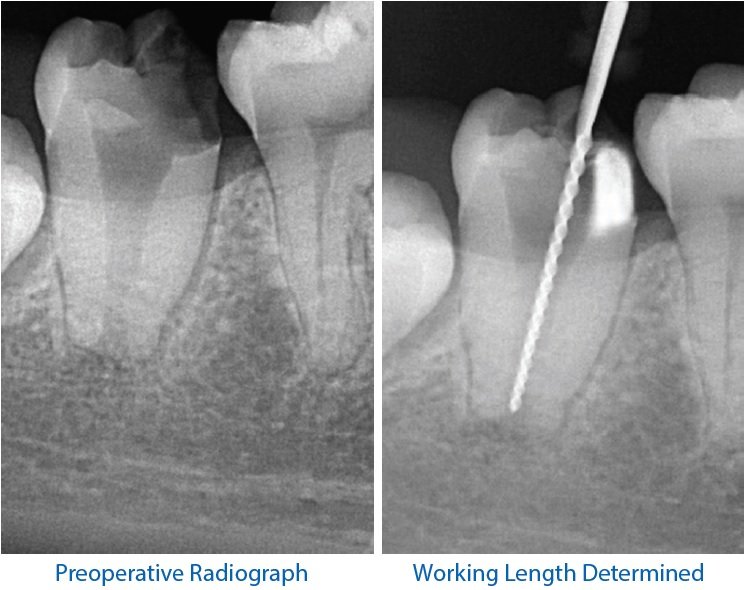
Repeated radiographs were obtained to check adequacy of MTA . The blunt end of a large paper point was moistened with water and left in the canal to promote setting for 72 hours. A cotton pellet was placed in chamber and the tooth restored with temporary cement.
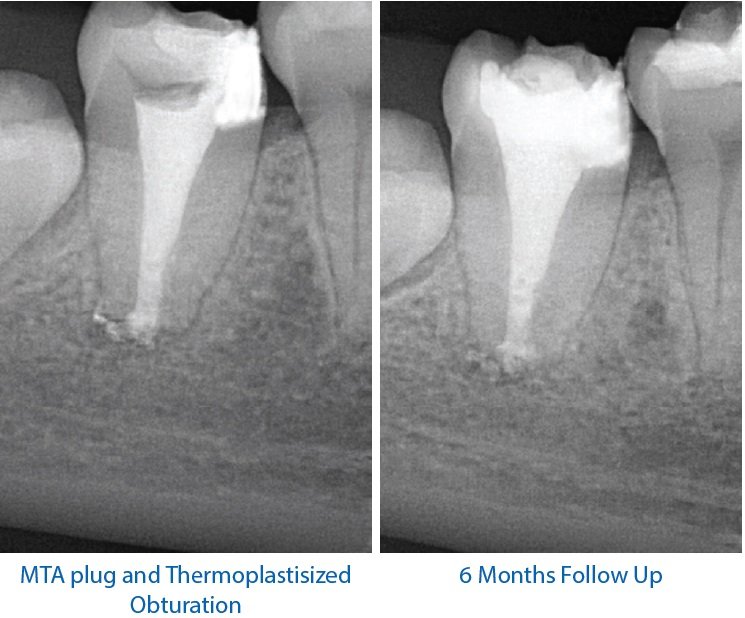
After72 hours, the tooth was isolated and accessed as before. A hand plugger was lightly tapped against MTA plug to confirm a hardened set. The canals were dried using sterile paper points and obturated injectable thermoplasticized gutta-percha.
6 month follow up showed normal pdl space and lamina dura.
CASE REPORT 2
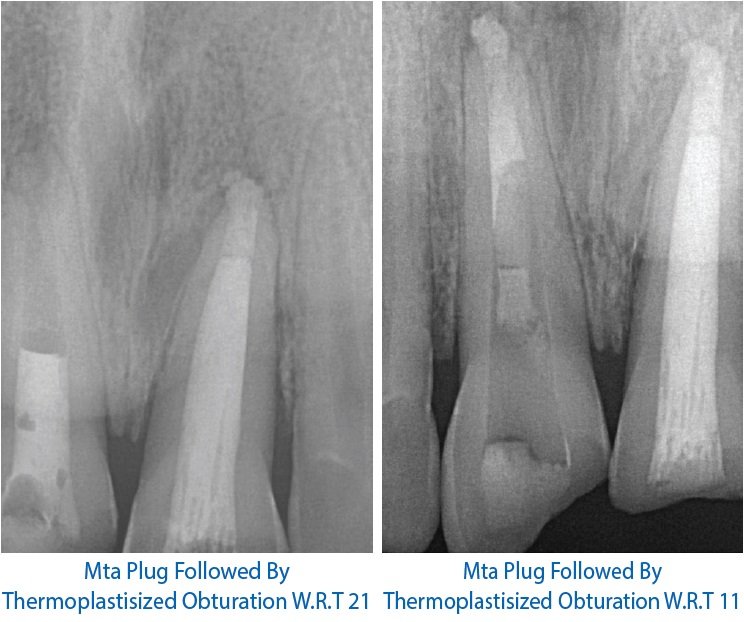
An 17 year old male patient reported with a chief complaint of discoloration and broken teeth in the upper front tooth region since 4 years. On recording the history,it was revealed that patient had met with an accident 4 years back falling from a bike. On clinical examination there was ellis class III fracture w.r.t 11 and 2. on performing the pulp vitality tests the concerned teeth (11 and 21) did not respond to both electric and cold test (11 and 21). The radiographic examination revealed large blunderbuss canals w.r.t 11 and 21 with periapical lesion.Apexification with MTA was planned. Access opening was prepared and working length was determined ; irrigation was done with saline. Biomechanical preparation was carried out using 70 size k file with circumferential filing motion. Root canals debridement was done using alternative irrigation with 2.5% NaoCl and saline. Calcium hydroxide was placed in the root canals and patient recalled after 14 days. At subsequent appointment, canal was irrigated with 2.5% NaoCl and 2% CHX .The canals were dried with paper points and MTA was placed with pluggers until thickness of 5 mm . A wet cotton pellet was placed in the canal and access cavity was sealed with temporary cement. In next appointment, root canals were obturated with using thermoplaztisized gutta percha.

DISCUSSION
The most used material for apexification is calcium hydroxide. There are various drawbacks to this information. One of them is that the course of treatment takes somewhere between three and twenty one months. The amount of time needed depends on the size of the open apex, the speed of tooth displacement, and the technique used to realign the teeth following trauma.
The leakage of the temporary coronal filling has the potential to reinfect the root canal over an extended period of time. In teeth with subpar coronal filling, the success rate drops by 10%.Hence, executing a permanent treatment is preferable since it prevents the root canal from becoming infected again. The fracture resistance decreases after more than 30 days of calcium hydroxide treatment in the root.
As an alternative to lengthy apexification therapy, MTA apical plug creation in one visit has recently been advocated for the treatment of nonvital immature permanent teeth. In the above cases MTA was placed. This material was initially introduced to the dentistry literature in 1993 by Lee and colleagues.MTA is a material that is more biocompatible, has better antibacterial qualities, reduced leakage, a high marginal adaption, a quick setting time ( 4 hours), and a pH of 12.5. MTA offers scaffolding for the hard tissue barrier. MTA, a bioactive substance, promotes the synthesis of cytokines and interleukins. It can therefore encourage the production of rigid tissues. After MTA has been set, the dentist may repair the tooth. As a result, teeth with thin dentinal walls become more fracture-resistant.
Maroto et al. have reported successful apexification with MTA in a tooth that did not respond favorably after 3 years of therapy with Ca(OH)2.
CONCLUSION
When treating nonvital, immature permanent teeth, the MTA apical plug approach is beneficial since it requires less time, appointments, and radiographs and has better fracture resistance.
REFERENCES
- Güne? B, Aydinbelge HA. Mineral trioxide aggregate apical plug method for the treatment of nonvital immature permanent maxillary incisors: Three case reports. J Conserv Dent. 2012 Jan;15(1):73-6
- Khatavkar RA, Hegde VS. Use of a matrix for apexification procedure with mineral trioxide aggregate: Case report. J Conserv Dent. 2010;13:54–7.
- D’Arcangelo C, D’Amario M. Use of MTA for orthograde obturation of nonvital teeth with open apices: Report of two cases. Oral Surg Oral Med Oral Pathol Oral Radiol Endod. 2007;104:e98–101.
- Erdem AP, Sepet E. Mineral trioxide aggregate for obturation of maxillary central incisors with necrotic pulp and open apices. Dent Traumatol. 2008;24:e38–41
- Tait CM, Ricketts DN, Higgins AJ. Weakened anterior roots-intraradicular rehabilitation. Br Dent J. 2005;198:609–17
- Holden DT, Schwartz SA, Kirkpatrick TC, Schindler WG. Clinical outcomes of artificial root-end barriers with mineral trioxide aggregate in teeth with immature apices. J Endod. 2008;34:812–7
- Schwartz RS, Mauger M, Clement DJ, Walker WA., 3rd Mineral trioxide aggregate: A new material for endodontics. J Am Dent Assoc. 1999;130:967–75
- Torabinejad M, Pitt Ford TR. Root-end filling materials: A review. Endod Dent Traumatol. 1996;12:161–78
Disclaimer from Guident
The views and opinions expressed in articles published in Guident are solely those of the authors and do not necessarily reflect the views of the editors, the editorial board or the publisher, Ivory India. Guident does not endorse any product, technique or treatment described. Clinical content is intended for qualified dental and medical professionals and is not a substitute for individual clinical judgement. Guident, its editors and the publisher accept no liability for any consequence arising from the use of information published in the journal.
How to cite this article
Dr. Sugandha Sati, Dr. Ayushi Bangari, Dr. Anil Dhingra. Sealing the Unsealed: Management of Immature Apex: A Case Series. Guident. 2023 Mar;16(4). Available from: https://guident.in/articles/endodontics/sealing-the-unsealed-management-of-immature-apex-a-case-series.html


