
Endocrowns: A Minimalistic Approach- a Case Series
Department of Conservative Dentistry and Endodontics, Seema Dental College And Hospital, Rishikesh
INTRODUCTION
Endodontically treated teeth are commonly restored with conventional full-coverage crowns. However, this approach often requires significant tooth reduction, which can compromise the remaining tooth structure and increase the risk of root fractures. Endocrowns offer a more conservative alternative that preserves more tooth structure while providing adequate strength and durability. In this article, we will discuss the concept of endocrowns, their indications, preparation, and advantages over conventional crowns along with series of cases.
CASE REPORT
Case 1: Endocrown i.r.t 26

Crown preparation

Endo-crown cementation
Case 2 : Endocrown i.r.t 37
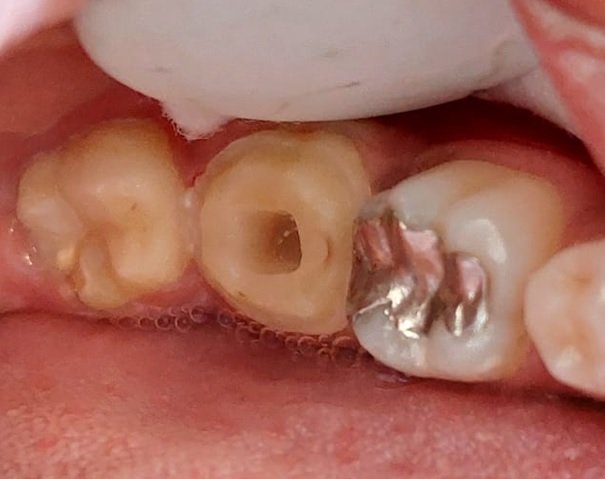
Crown preparation

Endo-crown cementation
DISCUSSION
Endocrowns are a type of restoration that combines the functions of a crown and a core buildup into a single unit. They are designed to provide a more conservative approach to restoring endodontically treated teeth by preserving more of the remaining tooth structure. Endocrowns are typically indicated for teeth with minimal remaining tooth structure, where a conventional crown would require extensive tooth reduction.
Indications for Endocrowns
Endocrowns are indicated for a variety of situations, including:
- Teeth with minimal remaining tooth structure
- Teeth with large pulp chambers or thin dentin walls
- Teeth with short clinical crowns
- Teeth with unfavorable crown-to-root ratios
- Teeth with parafunctional habits
- Teeth with vertical root fractures
Preparation of Endocrowns
The preparation of endocrowns involves removing the existing restoration and any remaining caries or decay. The pulp chamber is then cleaned and shaped to receive the endocrown. The walls of the pulp chamber are reduced to a thickness of 1.5 to 2 mm, leaving the pulp floor intact. The preparation is then recorded in an impression to fabricate a custom endocrown.
Advantages of Endocrowns
Endocrowns offer several advantages over conventional crowns, including Preservation of tooth structure, Increased retention due to the bonding of the endocrown to the tooth, Reduced risk of root fractures, Reduced chair time compared to conventional crowns
Disadvantages of Endocrowns
While endocrowns have many advantages, they do have some disadvantages, including:
- Limited availability of long-term clinical data
- Limited applicability to molars due to their complex anatomy
- Increased difficulty in preparation and placement compared to conventional crowns
Clinical Considerations
Endocrowns require a high level of precision during preparation and placement to ensure a successful outcome. Adequate isolation and moisture control are essential during the bonding process to achieve a durable bond. Proper occlusal adjustment is also critical to prevent premature wear and fractures.
CONCLUSION
Endocrowns offer a conservative and effective approach to restoring endodontically treated teeth with minimal remaining tooth structure. While they have some limitations, they offer many advantages over conventional crowns, including increased retention, improved esthetics, and reduced risk of root fractures. As with any restoration, careful case selection, proper preparation, and placement techniques are essential for long-term success.
REFERENCES
- Goracci C, Ferrari M. Current perspectives on post systems: a literature review. Australian Dental Journal. 2011;56 Suppl 1:77-83. doi: 10.1111/j.1834-7819.2010.01298.x
- Fokkinga WA, Le Bell-Rönnlöf AM, Kreulen CM, Lassila LV, Vallittu PK, Creugers NH. Ex vivo fracture resistance of direct resin composite complete crowns with and without posts on maxillary premolars. International Journal of Prosthodontics. 2004;17(2):224-8.
- Reeh ES, Messer HH, Douglas WH. Reduction in tooth stiffness as a result of endodontic and restorative procedures. Journal of Endodontics. 1989;15(11):512-6. doi: 10.1016/s0099-2399(89)80019-4
- Smaïl-Faugeron V, Courson F, Durieux P, Muller-Bolla M, Glenny AM, Fron Chabouis H. Pulpless teeth restored with posts: a systematic review of the survival of restorations. Journal of Dentistry. 2016;45:1-7. doi: 10.1016/j.jdent.2015.11.001
- Fennis WM, Tezvergil A, Kuijs RH, Roeters FJ, Creugers NH. In vitro fracture resistance of fiber reinforced cusp-replacing composite restorations in premolar teeth. Dental Materials. 2005;21(6):565-72. doi: 10.1016/j.dental.2004.09.019
- Magne P, Dietschi D. Optimization of posterior ceramic bondings using a new combination of a zirconia post and a lithium disilicate ceramic. Journal of Esthetic and Restorative Dentistry. 2013;25(1):26-33. doi: 10.1111/jerd.12006
- Radovic I, Monticelli F, Goracci C, Vulicevic ZR, Ferrari M. Self-adhesive resin cements: a literature review. Journal of Adhesive Dentistry. 2008;10(4):251-8.
- Kaur H, Pavitra V, Gupta M, Miglani S. Endocrowns: a comprehensive review. Journal of Clinical and Diagnostic Research. 2016;10(3):ZE12-6. doi: 10.7860/jcdr/2016/16262.7362
- Sorrentino R, Zarone F, Apicella D, Valentino B, Ferrari M, Aversa R. Effect of post-retained composite restoration of MOD preparations on the fracture resistance of endodontically treated teeth. Journal of Adhesive Dentistry. 2007;9(1):45-51.
- Bitter K, Noetzel J, Neumann K, Kielbassa AM. Effect of prosthetic treatment modalities on the biomechanical behavior of upper premolars with intrusive cervical resorption. Journal of Endodontics. 2007;33(12):1507-12. doi: 10.1016/j.joen.2007.08.016
Disclaimer from Guident
The views and opinions expressed in articles published in Guident are solely those of the authors and do not necessarily reflect the views of the editors, the editorial board or the publisher, Ivory India. Guident does not endorse any product, technique or treatment described. Clinical content is intended for qualified dental and medical professionals and is not a substitute for individual clinical judgement. Guident, its editors and the publisher accept no liability for any consequence arising from the use of information published in the journal.
How to cite this article
Dr. Pallabi Sarkar, Dr. Aryama Balodi, Dr. Anil Dhingra. Endocrowns: A Minimalistic Approach- a Case Series. Guident. 2023 Apr;16(5). Available from: https://guident.in/articles/endodontics/endocrowns-a-minimalistic-approach-a-case-series.html


