
Non Vital Tooth Bleaching: A Case Report
Department of Conservative Dentistry and Endodontics, Seema Dental College And Hospital, Rishikesh
ABSTRACT
Intrinsic discoloration of a non-vital permanent incisor tooth due to trauma may have a significant esthetic and social impact on children and adolescents. Treatment options for discolored Non-vital teeth are bleaching, crowns or veneers. However, this restorative crown or veneer approach has a significant drawback of being an invasive technique. Intervention should be minimal destruction of tooth structure and should not compromise future restorative options. The advantage bleaching over crown is that it offers simple conservative approach in removal of stain and whitening discolored teeth without damaging tooth structure.
Keywords: Bleaching, crown, endodontic treated tooth, non-vital, tooth discoloration, veneers
INRODUCTION
The appearance and colour of the teeth are indicators of overall health. The innate and extrinsic influences on tooth colour are numerous.1 In addition to established local and systemic causes, intrinsic discolouration of the tooth can result from trauma, vitality loss, endodontic therapy, and restorative operations.2,3,4 Poor dental brushing habits, smoking, eating meals high in tannins, using chlorhexidine mouthwash excessively, and/or ingesting metal salts can all cause extrinsic tooth stains.1,5
For the objective of managing discoloured non-vital teeth, numerous treatments have been developed.6 When opposed to using restorations, the inside/outside bleaching procedure is one of these methods that is both efficient and conservative.7,8,9 With this method, bleaching is done both within and outside the tooth at the same time. This is a report.
CASE REPORT
A 30-year-old female patient came to the department of censervative dentistry and endodontics with a chief complained of discoloured tooth in the upper front tooth region since 4 years. The right and left central incisors of the maxilla was structurally sound and undamaged upon inspection. Negative results from the vitality test and mild surface abrasion. A full root canal obturation without periapical disease was visible on an intraoral periapical radiograph.The patient received an explanation of the bleaching process and gave her agreement to get both inside and outside in-office power bleaching therapy to treat stained teeth.10
The tooth that was to be bleached was isolated using a rubber dam, cleaned with pumice, and the shade was selected. Up to 2 mm of the obturated material was taken out of the tooth's gingival edge. Over the gutta-percha, 1 mm of glass ionomer cement (type 1, GC Corporation, Singapore) was applied. Dentinal tubules were opened after the pulp chamber was etched with 37% phosphoric acid for 30 to 60 seconds, cleaned, and dried. After that, a thick paste containing 38% hydrogen peroxide (Pola Office Ultradent, USA), a bleaching agent, was promptly applied to the tooth's exterior labial surface and pulp chamber.
The tooth was cleaned and the remaining bleach inside was removed with water and a powerful suction machine after 10 to 15 minutes. Immediate tooth's shade was assessed. Utilising tooth-colored composite resin, the access and the pulp chamber that was only partially empty were repaired.

PRE OPERATIVE

SHADE SELECTION

ISOLATION

GP SHEARED OFF
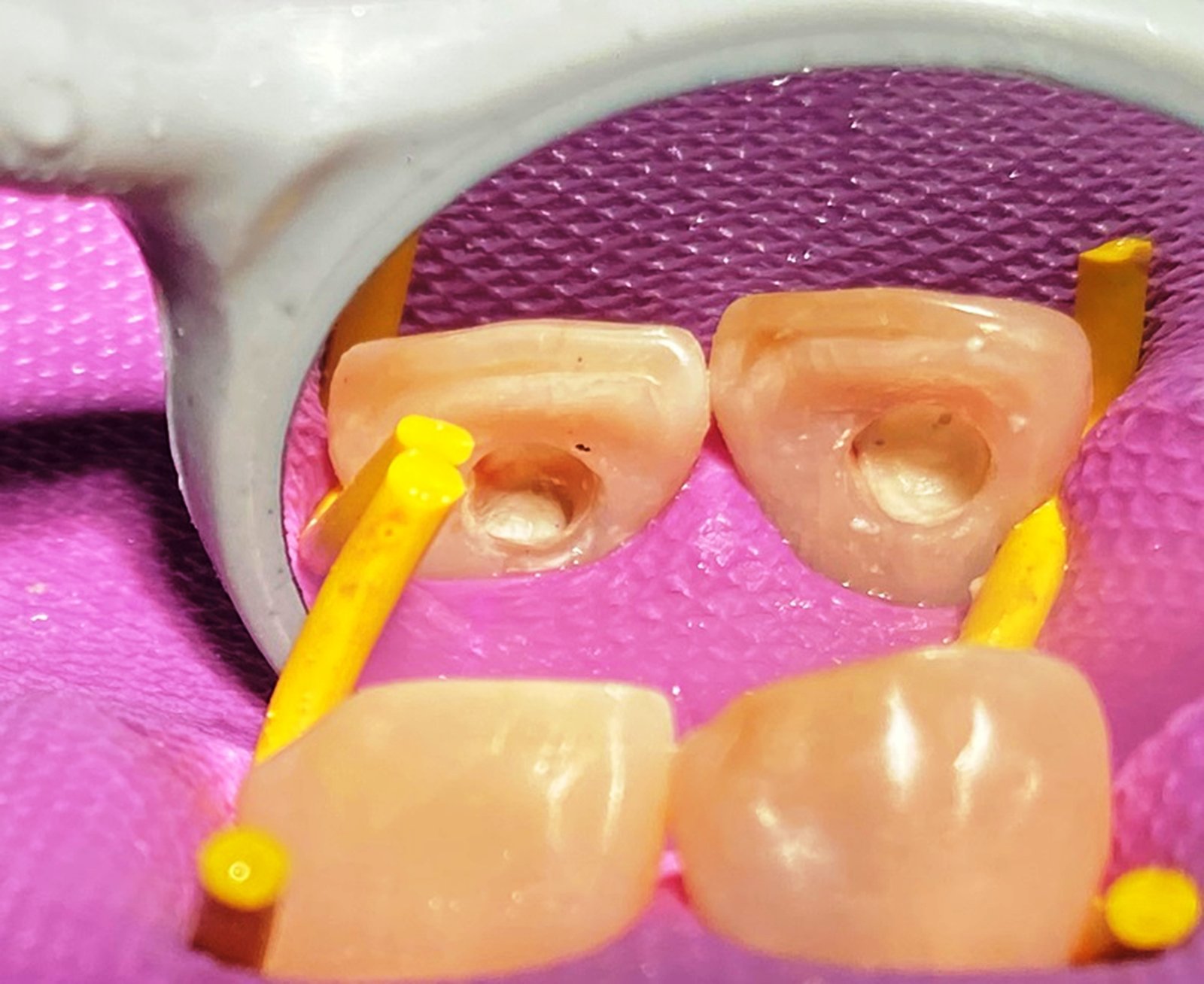
INTRA ORIFICE BARRIER

BLEACHING AGENT

PRE OPERATIVE

POST OPERATIVE
DISCUSSION
Treatment methods for discoloured anterior teeth that have undergone endodontic treatment vary.6 The bleach can be used in-office and has numerous benefits over traditional methods. It is particularly effective in treating tooth discolouration and the crown of the tooth. This article talks about the bleach that was used in-office on this patient. When a tooth is reasonably intact and has become discoloured as a result of devitalization, bleaching is preferred over crown implantation.11 The majority of the residual tooth structure, not the dowel, may provide strength and resistance to fracture for the endodontically treated tooth, according to in vitro research.12
A laminate veneer might be a less harmful option than a crown. It might conceal the discoloration but it might also crack, debond, or marginal leak. But it necessitates teeth preparation and is permanent.13
Given the aforementioned factors, in-office bleaching was planned for this patient, and the patient was satisfied with the results. The main benefits of this strategy are that it is more conservative, more effective at removing stains, and considerably enhances the colour of teeth. Therefore, the dentist should use in-office bleaching the most frequently since it gives them total control over the procedure during the entire procedure.14
CONCLUSION
Pulp involvement may or may not occur following anterior tooth trauma, fracture, or fractures. When choosing a form of therapy, a type of restorative material, and a type of tooth preparation, the quantity of tooth structure lost, the position of the fracture, and the severity of discolorations are taken into account. When an anterior tooth is stained and non-vital but structurally sound, endodontic treatment with a small cavity opening and bleaching on both the interior and outside is preferred. This method requires less tooth structure to be removed from the teeth than total ceramic, ceramic fused to metal, or veneers, which are also more expensive and cause irreparable damage. This type of bleaching offers patients good aesthetics and financial advantages. The intrinsic stain's type can have an impact.
REFERENCES
- Watts A, Addy M. Tooth discolouration and staining: A review of the literature. Br Dent J. 2001;190:309–16. [PubMed] [Google Scholar]
- Ten Bosch JJ, Coops JC. Tooth color and reflectance as related to light scattering and enamel hardness. J Dent Res. 1995;74:374–80. [PubMed] [Google Scholar]
- Walton RE, Torabinejad M. 3rd ed. USA: Saunders; 2002. Principles and Practice of Endodontics. [Google Scholar]
- Wray A, Welbury R. Faculty of Dental Surgery, Royal College of Surgeons. UK National Clinical Guidelines in Paediatric Dentistry: Treatment of intrinsic discoloration in permanent anterior teeth in children and adolescents. Int J Paediatr Dent. 2001;11:309–15. [PubMed] [Google Scholar]
- Nathoo SA. The chemistry and mechanisms of extrinsic and intrinsic discoloration. J Am Dent Assoc. 1997;128(Suppl):6S–10S. [PubMed] [Google Scholar]
- Leith R, Moore A, O’Connell AC. An effective bleaching technique for non-vital, discoloured teeth in children and adolescents. J Ir Dent Assoc. 2009;55:184–9. [PubMed] [Google Scholar]
- Nixon PJ, Gahan M, Robinson S, Chan MF. Conservative aesthetic techniques for discoloured teeth: 1. The use of bleaching. SADJ. 2008;63(332):334–7. [PubMed] [Google Scholar]
- Lee SS, Zhang W, Lee DH, Li Y. Tooth whitening in children and adolescents: A literature review. Pediatr Dent. 2005;27:362–8. [PubMed] [Google Scholar]
- Attin T, Paqué F, Ajam F, Lennon AM. Review of the current status of tooth whitening with the walking bleach technique. Int Endod J. 2003;36:313–29. [PubMed] [Google Scholar]
- Settembrini L, Gultz J, Kaim J, Scherer W. A technique for bleaching nonvital teeth: Inside/outside bleaching. J Am Dent Assoc. 1997;128:1283–4. [PubMed] [Google Scholar]
- Standlee JP, Caputo AA, Hanson EC. Retention of endodontic dowels: Effects of cement, dowel length, diameter, and design. J Prosthet Dent. 1978;39:400–5. [PubMed] [Google Scholar]
- Trabert KC, Caput AA, Abou-Rass M. Tooth fracture – A comparison of endodontic and restorative treatments. J Endod. 1978;4:341–5. [PubMed] [Google Scholar]
- Goldstein CE, Goldstein RE, Feinman RA, Garber DA. Bleaching vital teeth: State of the art. Quintessence Int. 1989;20:729–37. [PubMed] [Google Scholar]
- Boksman L. Current status of tooth whitening: Literature review. Dent Today. 2006;25(74):76–9. [PubMed] [Google Scholar]
Disclaimer from Guident
The views and opinions expressed in articles published in Guident are solely those of the authors and do not necessarily reflect the views of the editors, the editorial board or the publisher, Ivory India. Guident does not endorse any product, technique or treatment described. Clinical content is intended for qualified dental and medical professionals and is not a substitute for individual clinical judgement. Guident, its editors and the publisher accept no liability for any consequence arising from the use of information published in the journal.
How to cite this article
Dr. Ayushi Bangari, Dr. Anil Dhingra. Non Vital Tooth Bleaching: A Case Report. Guident. 2023 May;16(6). Available from: https://guident.in/articles/endodontics/non-vital-tooth-bleaching-a-case-report.html


