Nonsurgical Anterior Open Bite Correction: A Case Report
Wisdom Dental Clinics ®, Jaipur, India
ABSTRACT
Dental anterior open bite girl visited clinic for Orthodontic presented with anterior open bite along with increased lower anterior facial height. Other features included incompetent lip, deficient incisor display during rest and smile, irregular upper and lower anteriors. The following case report illustrates nonsurgical management of anterior open .There was no recurrence of anterior open bite, and a balanced occlusion was maintained during the follow up of next 2 years after treatment completion which suggested a long-term stability of occlusion
Keywords: Dental Anterior Open Bite, Non-extraction Treatment, Balanced occlusion
INTRODUCTION
Acute malocclusion can be caused in many ways, including mid- and lower facial fractures. Even when there is no fracture, traumatic injuries to the face occasionally produce intracapsular temporomandibular joint (TMJ) effusion or hemarthrosis. Other etiologies of acute malocclusion include repeated subluxations of the mandible, internal derangements of the TMJ, rapidly progressing condylar degeneration, and very occasionally, masticatory muscle spasm.1 In addition, significant occlusal changes can occur as a result of iatrogenic causes such as inappropriate use of partial-coverage oral appliances. Malocclusions can occur immediately after the triggering event, or progressively within days to months. They can manifest in different forms, and the specific features are generally dependent on the underlying etiology. While the etiology of an acute malocclusion is usually easily identified, some can be elusive and present challenges in diagnosis and management.
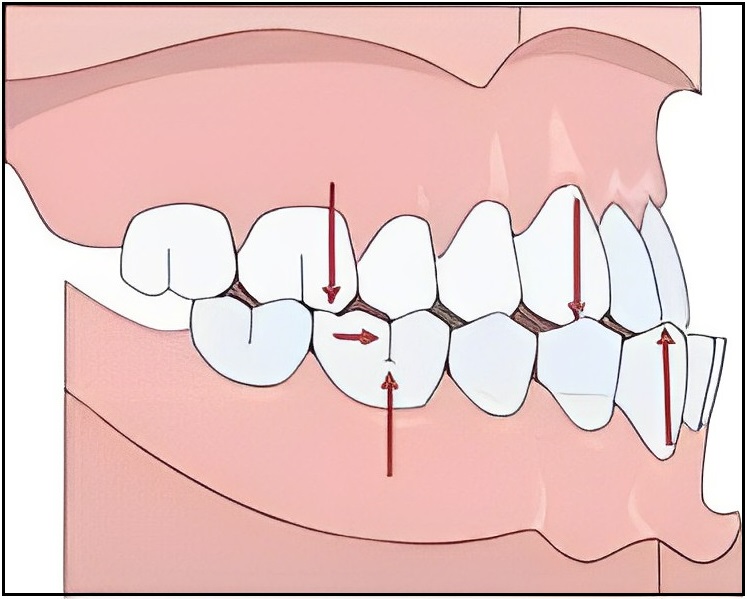
Anterior open bite is often associated with over-erupted posterior teeth and long lower face height.2 In this type of malocclusion, intrusive mechanics are required for optimal esthetic results. Before the introduction of skeletal anchorages, a reduction of the posterior vertical dimension can be achieved by orthognathic surgery. The intrusion of posterior teeth became possible by the use of skeletal anchorages. However, the treatment duration and retention of the treatment results are still issues.3
Stability of the final occlusal and facial results is dependent on control of the factors that caused the anterior open bite. One possible explanation could be the influence of the tongue on the corrected tooth positions. If the tongue as an etiologic factor is ignored, the relapse of the anterior open bite closure could be caused by the tongue function or posture. Huang et al.4 showed that crib therapy over a several year periods was helpful in achieving stability of the orthodontic correction of the open bite malocclusion. So, if stable correction of the open bite malocclusion is to be achieved, tongue posture and function must play a role. It is important that an assessment of the intraoral musculature is always critical but especially for the patient who has an open bite malocclusion. The tongue habit or tongue thrust is an abnormal positioning of the tongue that can develop or maintain anterior open bites.
We present a case of an acute-onset anterior open bite with equivocal clinical findings that required extensive workup based on a combination of historical report, imaging, and functional analysis in order to reach a diagnostic conclusion. Here we present a case of anterior open bite and its non-surgical management without relapse
CASE REPORT
A 18 year old girl visited clinic for Orthodontic treatment with chief complaint of irregularly placed upper and lower front teeth not meeting together. On extraoral clinical examination patient showed a convex profile with potentially incompetent lip, Intraoral examination revealed anterior open bite with Angle’s Class I molar relationship. [Figure 1A,1B,1C]

Figure 1: Post-operative photographs
Treatment objectives
The treatment objectives were
- To improve the anterior open bite with ideal overjet and overbite
- To establish an acceptable functional occlusion
- To correct upper and lower inclinations
- Improve aesthetic smile
TREATMENT PLAN AND APPLIED ORTHODONTIC MECHANICS
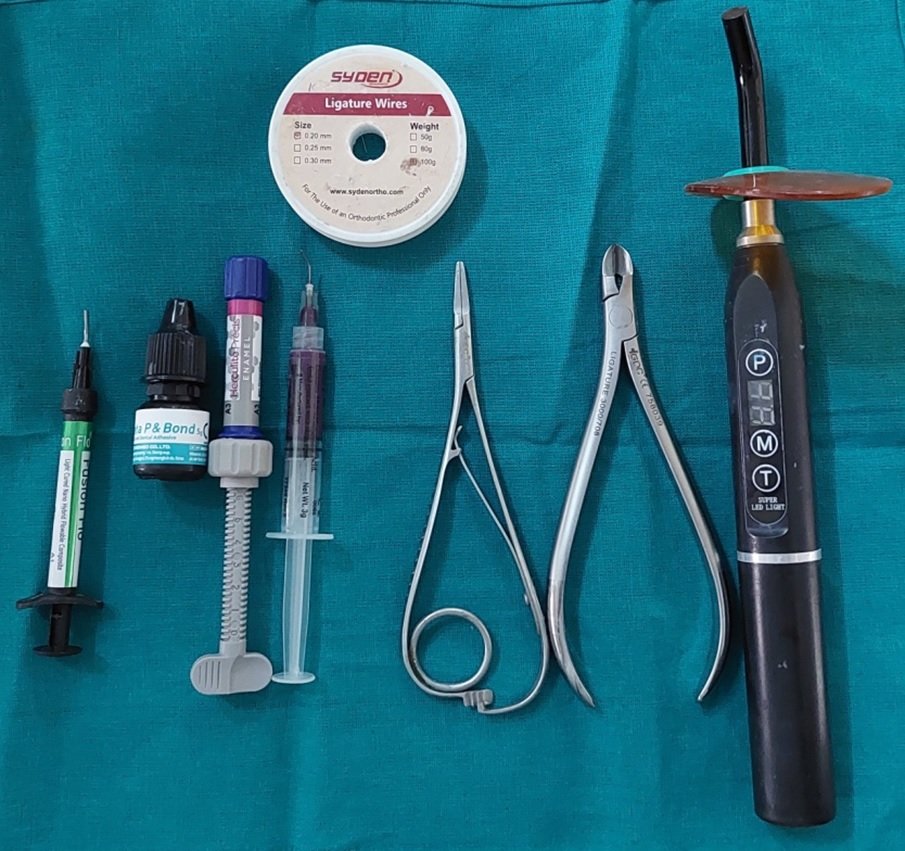
The selected treatment plan was conservative, commensurate with the patient and parents’ wishes. Pre-adjusted brackets were bonded on all the teeth. Levelling and alignment were achieved with NiTi and stainless-steel arch wires starting from 0.012” NiTi till 0.017” x 0.025” SS. [Figure 2A,2B].

Figure 2: Alignment of teeth
For retention, upper modified Hawley’s retainer was given. The patient was instructed to wear the removable retainers for at least 24 months. [Figure 3A,3B,3C]

Figure 3A,3B,3C: Final photographs
RESULT
The post-treatment facial photograph showed a change in smiling view of the patient, with more upper incisor teeth visible and upper lip rested on gingival margin during smiling. Intraoral photograph showed acceptable occlusion with improved overbite. The periodontal tissues remained healthy during and after active orthodontic treatment. After two years of retention, there was no relapse tendency of anterior open bite.
DISCUSSION
Skeletal open bite is ideally treated with a combination of orthodontics and orthognathic surgery. The advantages of the surgical option are that the overbite can be overcorrected, a gummy smile can be resolved, and post-treatment stability will be improved.5 In a nonsurgical plan, orthodontic treatment involves camouflaging the skeletal discrepancies, so that overcorrection and ideal esthetics and function can be achieved to the extent possible. Nonsurgical correction is more complicated and usually requires longer treatment.6
The high relapse tendency of anterior open bite cases is approximately 20% whether it is corrected by surgical or non-surgical.6 There is not obvious justification for this instability and the complex interaction of all possible etiologic factors of the open bite cases. If the management does not address the possible etiologic factor, relapse is more prone to happen.7 Furthermore, overcorrection is highly recommended for such malocclusion and should incorporate upper and lower fixed retainers that include the first premolars as a retention of this malocclusion.
In order to understand this patient’s intracapsular pathology that produced her observed occlusal change, a focused comprehensive literature search on acute malocclusion was performed using MeSH terms “malocclusion”, “acute”, “temporomandibular”, “joint”, and “anterior open bite” in PubMed, Cochrane Library, Embase, and Google Scholar. There were no restrictions on publication period, language, and publication type. This search was complemented with manual searches of published peer-reviewed literature, and yielded only 8 pertinent results.8 Dupont’s article was a narrative review that discussed various causes and patterns of acute malocclusion; however, anterior open bite was not discussed. Marinho’s article9 was a case report of 2 acute unilateral posterior open bite situations arising as a result of joint effusion. Fahmy reported a single case of a sudden posterior unilateral open bite secondary to a spontaneous ipsilateral hemarthrosis, while Hes10 described a malocclusion secondary to hemarthrosis without an anterior open bite. The latter11 reports present a distinctly different mechanism compared to the present case in that a significant space-occupying entity (articular fluid or blood in these reports) caused an ipsilateral posterior open bite. Such space-occupying processes are readily identifiable on imaging as increased joint space, leaving characterization of the space-occupying entity (by history and specimen collection with or without histologic analysis) the only remaining diagnostic endeavor. Umebayashi12 reported a case with a posteriorly displaced disc observed by imaging that was a reasonable explanation for the anterior open bite malocclusion. After conservative measures and arthrocentesis failed to resolve the anterior open bite, a discectomy was performed and resulted in restoration of the premorbid occlusion. Westesson13
Stability is a concern with any open-bite malocclusion. Studies of long-term results of orthodontic treatment by Lopez-Gavito and colleagues17 and surgical treatment by Denison and colleagues14 indicate that the relapse rate can range from 35% to 42.9%. The latter study suggested that the relapse was caused by dentoalveolar rather than skeletal changes.Although these data may seem discouraging, they included some patients who experienced overbite reduction after treatment, but did not progress to an open bite. Chang and Moon reported that extraction treatment is more stable than nonextraction treatment.15 It is important to maintain the treatment results with fixed or removable retainers, especially to prevent labial flaring of the incisors. Retainers with occlusal coverage may be helpful in preventing further molar eruption, particularly in patients with remaining growth.
Although correction of an open bite cannot always be perfectly maintained, there are many patients who will benefit considerably from treatment with only orthodontic appliances. Prudent case selection and adherence to sound orthodontic principles can produce acceptable and, at times, outstanding treatment results.
CONCLUSION
Open bite is considered one of the most complicated malocclusions in orthodontic treatment. In this study, the authors successfully treated total open bite. The important factors that are involved in open-bite treatment are a proper diagnosis of the etiologic factors causing the malocclusion and a complete assessment of the underlying dental and skeletal manifestations. The clinician must first determine whether the molar intrusion should be performed in the mandible or in the maxilla, or, in both This patient was successfully treated non surgically. The retention protocol is one of them most important factors ensuring long-term stability of a severe open-bite correction.
REFERENCES
- DuPont JS. Acute malocclusion. Gen Dent 2006 Mar-Apr;54(2):102–4.
- Cangialosi TJ (1984) Skeletal morphologic features of anterior open bite. Am J Orthod 85(1):28–36
- Xun C, Zeng X, Wang X (2007) Microscrew anchorage in skeletal anterior open-bite treatment. Angle Orthod 77(1):47–56
- Huang GJ, Justus R, Kennedy DB et al. Stability of anterior open bite treated with crib therapy. Angle Orthod. 1990;60:17?24.
- Denison, T.F.; Kokich, V.G.; and Shapiro, P.A.: Stability of maxillary surgery in openbite versus nonopenbite malocclusions, Angle Orthod. 59:5-10, 1989.
- Hiller, M.E.: Nonsurgical correction of Class II open bite malocclusion in an adult patient, Am. J. Orthod. 122:210- 216, 2002.
- Sbtelny J, Sakuda M. Open bite: Diagnosis and treatment. Am J Orthod Dentofac Orthop. 1964;50:337?358.
- DuPont JS. Acute malocclusion. Gen Dent 2006 Mar-Apr;54(2):102–4.
- Marinho LHM, McLoughlin PM. Lateral open bite resulting from acute temporomandibular joint effusion. Br J Oral Maxillofac Surg 1994.
- Fahmy MD, Gupta A, Abdelkader A, MacKinney T, Sewall S. Clinical pathologic conference: acute onset malocclusion and facial pain. Oral Surg Oral Med Oral Pathol Oral Radiol 2018 Oct;126(4):301–6.
- Hes J, Baart JA. Sudden open bite resulting from hemarthrosis: report of a case. J Oral Maxillofac Surg 1988 Jun;46(6):513–5.
- Umebayashi M, Ohba S, Miura KI, Koga T, Shidou R, Kawasaki T, Asahina I. Discectomy for malocclusion with anterior open bite due to posterior discdisplacement without reduction. J Oral Maxillofac Surgery, Med Pathol 2018;30:142–5.
- Westesson P-L, Larheim TA, Tanaka H. Posterior disc displacement in the temporomandibular joint. J Oral Maxillofac Surg 1998 Nov;56(11):1266–73. Discussion 1273-4.
- Denison, T.F.; Kokich, V.G.; and Shapiro, P.A.: Stability of maxillary surgery in openbite versus nonopenbite malocclusions, Angle Orthod. 59:5-10, 1989.
- Hiller, M.E.: Nonsurgical correction of Class II open bite malocclusion in an adult patient, Am. J. Orthod. 122:210- 216, 2002.
Disclaimer from Guident
The views and opinions expressed in articles published in Guident are solely those of the authors and do not necessarily reflect the views of the editors, the editorial board or the publisher, Ivory India. Guident does not endorse any product, technique or treatment described. Clinical content is intended for qualified dental and medical professionals and is not a substitute for individual clinical judgement. Guident, its editors and the publisher accept no liability for any consequence arising from the use of information published in the journal.
How to cite this article
Dr. Gaurav Gupta, Dr. D.K. Gupta, Dr. Neelja Gupta. Nonsurgical Anterior Open Bite Correction: A Case Report. Guident. 2023 Mar;16(4). Available from: https://guident.in/articles/orthodontics/nonsurgical-anterior-open-bite-correction-a-case-report.html