Saving the Hopeless-Management of Avulsed Permanent Incisor with Closed Apex.: A Case Report
Department of Conservative Dentistry and Endodontics, Seema Dental College And Hospital, Rishikesh
INTRODUCTION
The majority of dental injuries occur between the ages 8 and 11 years; falling accidents in a school environment are very common and are the main cause of dental trauma. Tooth avulsion is the complete displacement of a tooth from its socket due to accidental or non-accidental injury; avulsion occurs in 1-16% of all dental injuries and may cause the loss of healthy teeth. Avulsion is the most serious form of dental trauma.1
Tooth avulsion results in attachment damage and pulp necrosis. The tooth is “separated” from the socket due mainly to tearing of the periodontal ligament that leaves viable periodontal ligament cells on most of the root surface.
Treatment of avulsions is directed at avoiding or minimizing the effects of the two main complications of the avulsed teeth, namely attachment damage and pulpal infection.
When a tooth is avulsed the apical blood supply is severed and the periodontal ligament is damaged severely. While it is not possible for the original blood supply to be re-established after avulsion, under special circumstances it is possible for the replanted tooth to become revascularized. If the tooth is immature with an open apex, efforts should be made to promote revascularization of the pulp. In the tooth with a closed or open apex in which revascularization is unsuccessful, treatment efforts should be aimed at elimination of potential bacterial toxins from the root canal space.2
The single most important factor to ensure a favorable outcome after replantation is the speed with which the tooth is replanted. Of utmost importance is the prevention of drying, which causes loss of normal physiologic metabolism and morphology of the periodontal ligament cells. Immediate replantation is widely accepted as the most appropriate treatment for a treatment for a traumatically avulsed permanent tooth.
If this is not feasible,
- The prognosis remains good if replantation is carried out within 30 minutes of avulsion.4
- Maintenance of the periodontal membrane vitality is the factor critical to successful replantation4
- This is the best achieved by keeping the tooth moist and by avoiding unnecessary handling of the root.4
Emergency Treatment at the Accident Site Replant:
If possible or place in an appropriate storage medium. There are many solutions that have been proposed and/or tested as storage media for avulsed teeth. The following were identified and reviewed as a result of the literature search: Hank’s balanced salt solution (HBSS), Eagle’s medium (EM), milk, ViaSpan, Gatorade, propolis, tooth rescue box (Dentosafe), conditioned medium, contact lens solution, tap water, egg white, saliva, normal saline, ORS, and coconut water.3
Every effort should be made to replant the tooth within the first 15–20min.3
CASE REPORT
A 17-year-old female came to the Department of Conservative Dentistry and Endodontics (Seema Dental College and Hospital) after a bicycle accident that resulted in dental trauma. The avulsed tooth was not placed in any storage medium and was brought to the clinic dry 5 hours after the accident. Any concomitant systemic disease is not defined by the patient’s parents; there was no history of loss of consciousness or vomiting. On examination, no extra-oral injury was detected. The intraoral examination revealed that the mandibular right central right permanent lateral incisor (tooth 42) was avulsed (Figure 1). The patient had permanent dentition, with mild crowding in lower anterior teeth. No carious lesions were detected clinically, and his oral hygiene was fair.

Fig.1: Avulsed mandibular right incisor
Periapical and panoramic radiographs revealed no alveolar bone fracture. Examination of the avulsed tooth revealed that the crown was intact and that the root had a closed apex.
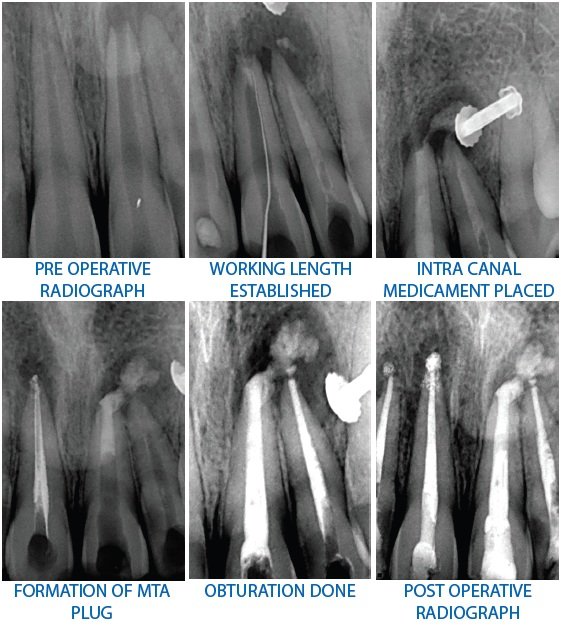
After examination, the treatment guideline for avulsed permanent teeth with closed apexes and prolonged extra-oral time for avulsed teeth were followed.5 The root canal treatment was completed at this appointment extra-orally, and the root end filling was done with MTA (Figure 2). Post endodontic restoration was done. The necrotic and dried remnants of periodontal tissue were carefully removed from the root surface of the tooth. Local anesthetic was administered, and the empty socket was lightly irrigated with sterile physiological saline. The tooth was replanted in the socket using light pressure (Figure 3). A periapical radiograph was taken to ensure that the tooth had been correctly positioned in the socket (Figure 4). The teeth were splinted from canine to canine with Interlig Fibers.
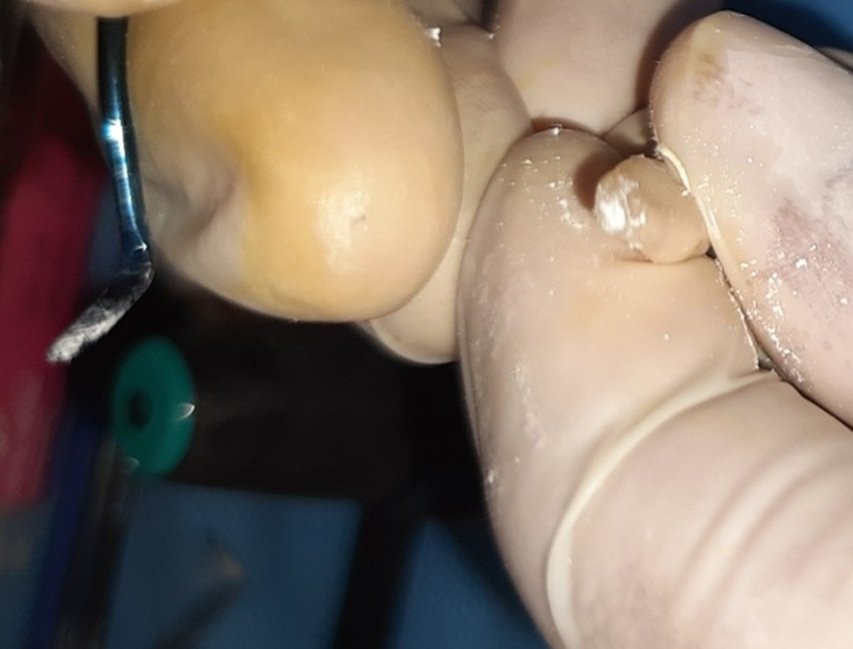
Fig.2: Root end filling with mta
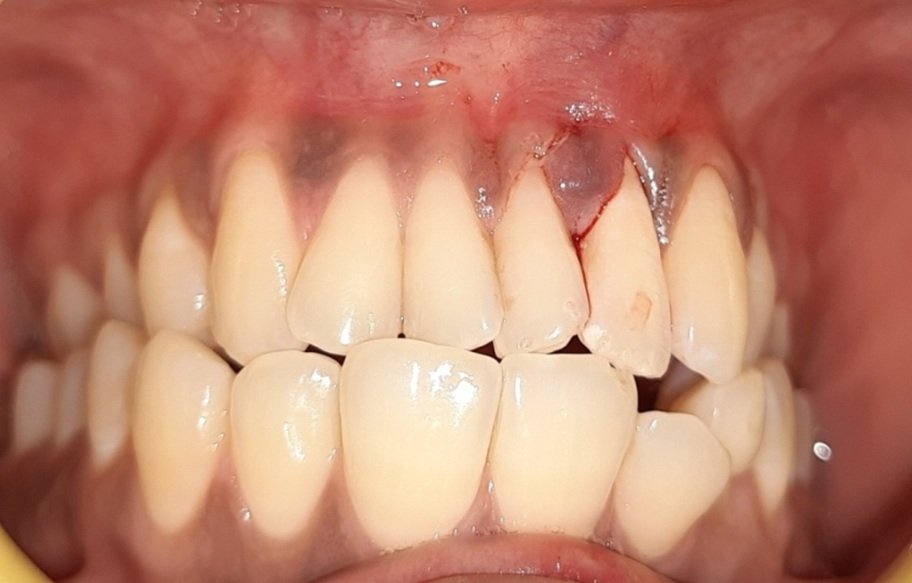
Fig.3: Reimplantation of avulsed tooth
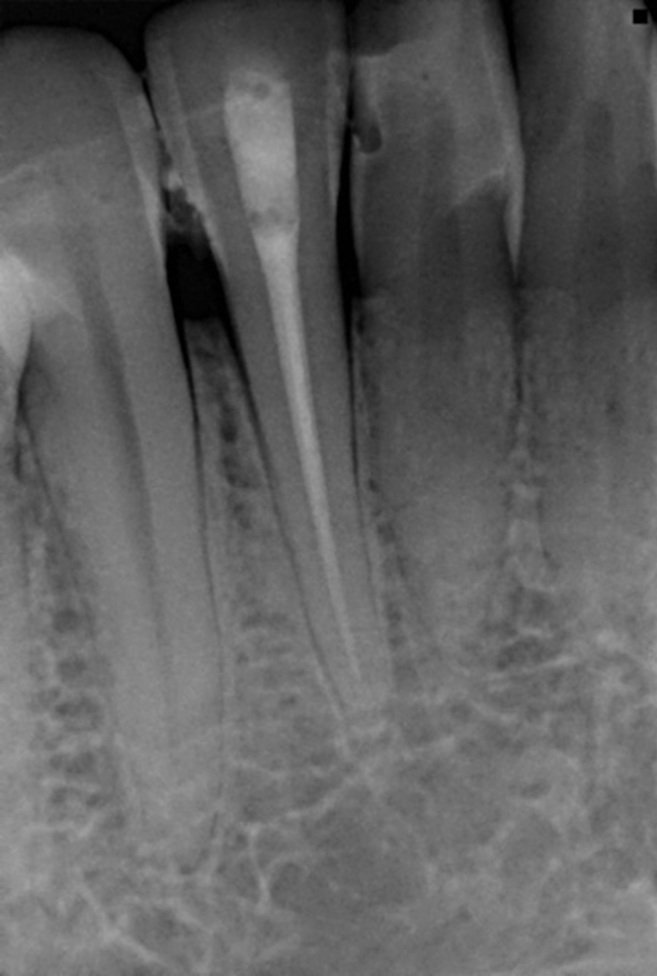
Fig.4: Post operative radiograph
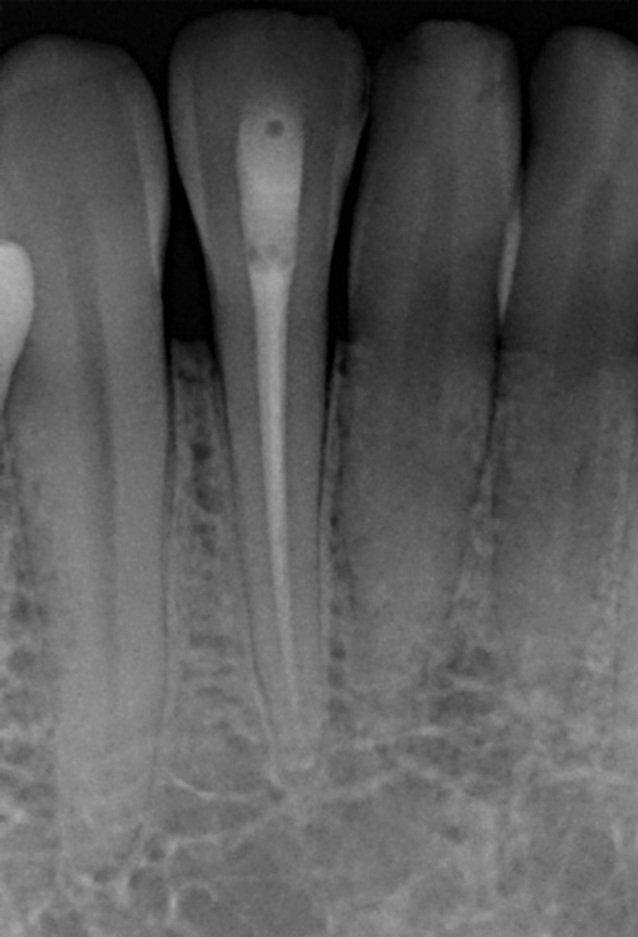
Fig.5: One month follow up
The parents were informed about the importance of maintaining meticulous oral hygiene and regularly returning for clinical and radiographic follow-up. Moreover, oral hygiene instructions and advice about a soft diet and the need to use a chlorhexidine mouth rinse during the stabilization period were provided at this time. Prophylactic antibiotic therapy was prescribed for one week. The patient was also referred for an antitetanus booster.
The parents were informed about the importance of regularly returning for clinical and radiographic follow-up. The patient was reviewed after one month, and no clinical or radiological pathological changes were detected. The patient was seen again 8 weeks after replantation, and the splinting wire was removed at this appointment.
DISCUSSION
Immediate replantation strongly contributes to favourable healing of the PDL. In this case, the avulsed tooth was kept in a dry environment for 5 hours. Prolonged extraoral dry storage time is seen to be associated with inflammatory root resorption. In an experiment conducted by Andreasen, no viable cells were seen on the root surface after an extraoral period of 2 hours.6 The influence of the storage time appears to be mediated by necrosis of PDL cells. According to a study by Andresen, the thickness of PDL tissue layer also depends upon dry storage. A thick PDL layer tolerates a dry period better, before the layer close to the cementum is destroyed.6 The physiologic medium used in this case was saline. It was decided to treat the tooth endodontically as the goal was not immediate replantation considering the prolonged extra oral time of the tooth. The chances of retention and prevention of replacement resorption are improved when endodontic treatment is carried out on an avulsed tooth before replantation.7 The root surface of the avulsed tooth was washed with saline and scrapped with a scalpel to get rid of the PDL remnants.
Splinting technique should allow physiologic movement of teeth during healing as this reduces the incidence of ankylosis.8 In a study conducted by Andresen, the duration of splinting was more crucial than the type of splint on PDL healing. Splinting for 6 weeks or more resulted in less desirable prognosis.9 In this case, the tooth was splinted with composite resin for 2 weeks using Interlig – Angelus Fibers. Clinically, gingival healing or level of attachment must be examined to recognize any pathology related to the attachment apparatus.
CONCLUSION
In conclusion, the presence of the natural tooth, for as long as possible, enables better bone support for prosthetic replacement in the future. In cases of avulsion of mature teeth stored in nonphysiologic media for >60 minutes, replantation in accordance with trauma guidelines is a worthy procedure in a growing child. Emergency room physicians should be informed of the critical timeline in management of avulsed permanent teeth and the appropriate storage media for avulsed teeth.
REFERENCES
- Fujita, Yuko; Shiono, Yasuhiro; Maki, Kenshi (2014). Knowledge of emergency management of avulsed tooth among Japanese dental students. BMC Oral Health, 14(1), 34–.
- Lee Y J, William F, Sigurdsson A (2000) Management of avulsed permanent incisors: A decision analysis based on changing concepts. Pediatric Dentistry – 23:3, 2001
- Martin Trope (2002). CLINICAL MANAGEMENT OF THE AVULSED TOOTH: PRESENT STRATEGIES and FUTURE DIRECTIONS. , 18(1), 1–11.
- Alastair N. Stokes; Heather K. Anderson; Tony M. Cowan (1992). Lay and professional knowledge of methods for emergency management of avulsed teeth. , 8(4), 160–162.
- Lars Andersson; Jens O. Andreasen; Peter Day; Geoffrey Heithersay; Martin Trope; Anthony J. DiAngelis; David J. Kenny; Asgeir Sigurdsson; Cecilia Bourguignon; Marie Therese Flores; Morris Lamar Hicks; Antonio R. Lenzi; Barbro Malmgren; Alex J. Moule; Mitsuhiro Tsukiboshi (2012). International Association of Dental Traumatology guidelines for the management of traumatic dental injuries: 2. Avulsion of permanent teeth. , 28(2), 88–96.
- Andreasen JO. Effect of extra-alveolar period and storage media upon periodontal and pulpal healing after reimplantation of mature permanent incisors in monkeys. Int J Oral Surg. 1981;10(1):43−53.
- Ize-Iyamu IN, Saheeb B. Reimplantation of avulsed dry permanent teeth after three days: A report of two cases. Niger J Clin Pract. 2013;16(1):119−122.
- Finucane D, Kinirons MJ. External inflammatory and replacement resorption of luxated, and avulsed replanted permanent incisors: A review and case presentation. Dent Traumatol. 2003;19(3):170−174.
- Andreasen JO, Borum MK, Jacobsen HE, et al. Replantation of 400 avulsed permanent incisors- Factors related to periodontal ligament healing. Endod Dent Traumatol. 1995;11(2):76−89.
Disclaimer from Guident
The views and opinions expressed in articles published in Guident are solely those of the authors and do not necessarily reflect the views of the editors, the editorial board or the publisher, Ivory India. Guident does not endorse any product, technique or treatment described. Clinical content is intended for qualified dental and medical professionals and is not a substitute for individual clinical judgement. Guident, its editors and the publisher accept no liability for any consequence arising from the use of information published in the journal.
How to cite this article
Dr. Unnati Nautiyal, Dr. Annil Dhingra. Saving the Hopeless-Management of Avulsed Permanent Incisor with Closed Apex.: A Case Report. Guident. 2021 Dec;15(1-2). Available from: https://guident.in/articles/endodontics/saving-the-hopeless-management-of-avulsed-permanent-incisor-with-closed-apex-a-case-report.html