Efficacy of Tooth Brushes with Different Designs in Plaque Elimination-a Cross over Study.
Department of Periodontology, Department of Oral and Maxillofacial Surgery, Department of Prosthodontics and Implantology, K. D Dental College & Hospital Mathura, UP, India
ABSTRACT
Background: The aim of this cross-over study was to compare the efficacy of four different toothbrush models in plaque removal.
Methodology: Four tooth brush with different bristle arrangements were evaluated for the efficacy of plaque removal. Twelve subjects were selected as per the inclusion and exclusion criteria and all the subjects were given instruction to follow a standard brushing technique and use standardized dentifrice. The four different bristle arrangements were 1) multi angle zigzag 2) premium 3) multilevel 4) curved . A single calibrated person recorded before and after brushing plaque scores according to the criteria’s of Turkeys and Gilmore modification of Quigley-Hein plaque index and were subjected to statistical analysis.
Results: A significant reduction in the plaque scores after tooth brushing was seen in the four groups but there was no statistical significant difference between the different bristle designs.
Conclusion: It can be concluded that different bristle design is not of paramount importance it is the ability of person manual dexterity and time needed to master the technique.
Key words: Dental plaque, Toothbrush, Bristle
INTRODUCTION
Dental plaque is recognized as the primary etiologic agent for the development of periodontal disease. Bacterial plaque, the primary etiologic agent in gingivitis and supragingival plaque formation, appears to be necessary for the initial colonization of the subgingival environment.1 The removal of microbial deposits from the tooth surface is the principle aim in the control and prevention of periodontal disease and dental caries. The toothbrush remains the most efficient of all cleaning devices in the removal of dental plaque.2
Toothbrushing is the most widespread mechanical means of personal plaque control in the world and is considered to be an important factor in the long-term maintenance of periodontal health.3 The manual toothbrush as we know today, with plastic handle and synthetic filaments, was introduced in 1920s. Thus toothbrush became an affordable oral hygiene device for the public and brushing with toothpaste has become the most universal oral hygiene habit in developed countries. Since their beginning and particularly in the last decade, there have been various new designs of toothbrush. Most variation has been with the brush head design both in shape and filament configuration.4
As on today in the market there are numerous manual toothbrush designs and the media abounds with claims of superiority for plaque removal by individual brands. However, world workshops on plaque control and oral hygiene practices have consistently concluded that there is insufficient evidence to support any one brush design as superior to another.5 Because of the varieties of brushes currently available and the constant development of new brushes, common man are in dilemma of choosing their toothbrushes hence the dental professional must maintain a high level of knowledge of these products and advice the patients appropriately. Hence the aim of the present study was to compare the single time plaque-removing efficacy of four toothbrushes and to recommend the best manual brush of the four based on the findings of the clinical study.
MATERIALS AND METHODS
Study Subjects:
A total of 12 subjects attending the outpatient department of K.D.Dental college and hospital were considered for the study, and screened with the following study criteria’s:-
Inclusion criteria’s:
1. Patient with good general health and a minimum of 24 intact teeth.
Exclusion criteria’s:
1. Subjects undergoing orthodontic treatment.
2. Having more than four carious teeth.
3. Advanced periodontal disease.
4. Subjects with a history of antibiotic usage at least 2 weeks prior to the study.
Subjects fulfilling the study criteria’s were randomly allocated to different toothbrush bristle designs. Necessary ethical clearance was obtained from ethical clearance committee of K.D.Dental college and hospital. All the participants were explained about the study details and purpose and a written informed consent was obtained before the start of the study.
Toothbrushes: Four different types of commercially available manual toothbrushes were selected for the study. These selected tooth brushes differed in their pattern of bristle arrangement.
The four different designs of brushes are:
Group I: Curved bristle arrangement
Group II: Multi angled Zigzag bristle arrangement
Group III: Premium bristle arrangement
Group IV: Multi level bristle arrangement
The bristles of all the toothbrushes were of “medium" type.
All the participants were taught, the Bass method of brushing before commencement of the study. The study was conducted in four periods. A non – participating dentist was requested to carry out the randomization procedure. Each toothbrush was given a code and the codes were decoded only at the end of the study. On each experiment day, all participants were asked to use a common type tooth brush bristle design after which a wash out period of 4 days was given and the similar experiment using other brush bristle design was followed. During each time subjects were assessed for plaque prior to brushing according to the criteria of Turesky and Gilmore modification of Quigley-Hein plaque index by using the two tone disclosing agent, after which the subjects were asked to brush for 2 minutes and again scored for dental plaque using the same index. Mean plaque index for each subject was determined by adding all the individual plaque scores (two per tooth) and dividing the sum by the total number of surfaces examined.
THE FOUR DIFFERENT DESIGNS OF BRUSHES ARE:
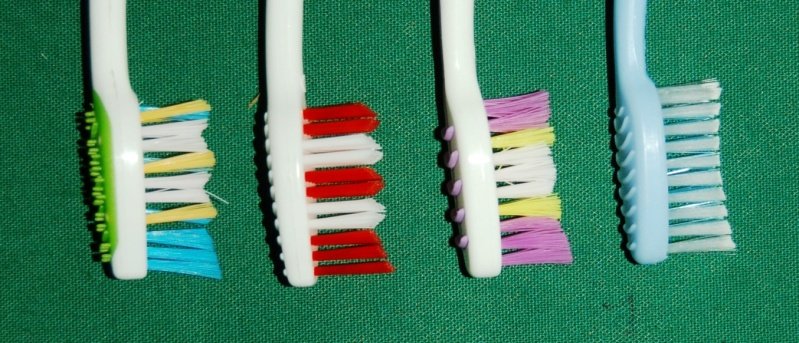
ZIGZAG PREMIUM MULTILEVEL CURVED
RESULTS
All of the subjects satisfactorily completed the study, the mean plaque scores of modified Quigley Hein plaque index were 1.59±0.76,1.72±0.76,1.93±0.77,1.86±0.57 before brushing, for group I – IV respectively, an analysis of variance (ANOVA) between different groups revealed that there was no statistical significant difference in the plaque scores of before brushing.
The mean plaque scores of modified Quigley Hein plaque index, after brushing were 0.86±0.48,0.90±0.37,0.89±0.43,1.23±0.46 for group I – IV respectively. After applying ANOVA test in post brushing plaque scores it was found that there was no statistically significant difference between groups, also the reduction in plaque scores was similar with group I, II and group III, while there was a slightly greater reduction with group III.
Table I shows before and after brushing plaque scores in different test groups.
Table II shows the percentage reduction of plaque after brushing among different test groups.
Table III & IV shows ANOVA value before and after brushing in different test groups respectively.
Table V shows Paired t test used to compare the significant difference of before and after brushing with in different tooth brush designs.
Graph I shows before and after brushing plaque scores in different test groups.
Graph II shows the percentage reduction of plaque after brushing among different test groups.
Table I: Pre - and post-brushing plaque scores
|
Sl No |
Curved |
Multi angled Zigzag |
Premium |
Multi level bristles |
||||
|
Before brushing |
After brushing |
Before brushing |
After brushing |
Before brushing |
After brushing |
Before brushing |
After brushing |
|
|
1 |
0.4137 |
0.086 |
0.482 |
0.189 |
0.482 |
0.189 |
1.051 |
0.672 |
|
2 |
0.983 |
0.387 |
1.903 |
0.806 |
1.225 |
0.419 |
2.241 |
1.112 |
|
3 |
2.109 |
0.906 |
2.531 |
1.125 |
1.953 |
0.921 |
1.39 |
1.093 |
|
4 |
0.843 |
0.375 |
1.453 |
0.718 |
2.046 |
0.406 |
1.515 |
1.125 |
|
5 |
1.827 |
0.767 |
0.603 |
0.172 |
1.793 |
0.965 |
1.12 |
0.758 |
|
6 |
0.859 |
0.734 |
1.796 |
1.125 |
1.375 |
0.671 |
1.843 |
0.859 |
|
7 |
1.283 |
0.816 |
1.7 |
1.016 |
1.433 |
0.983 |
1.916 |
1.15 |
|
8 |
1.714 |
1.089 |
1.714 |
1.089 |
2.392 |
1.482 |
2.392 |
1.482 |
|
9 |
3.045 |
1.987 |
3.26 |
1.414 |
2.87 |
1.12 |
1.98 |
1.45 |
|
10 |
1.76 |
1.112 |
2.08 |
1.018 |
3.043 |
1.674 |
3.01 |
2.342 |
|
11 |
1.687 |
0.944 |
1.187 |
1.02 |
2.937 |
0.98 |
1.56 |
0.98 |
|
12 |
2.598 |
1.23 |
1.987 |
1.154 |
1.657 |
0.87 |
2.34 |
1.77 |
|
MEAN |
1.59 ± 0.76 |
0.86 ± 0.48 |
1.72 ± 0.76 |
0.90 ± 0.37 |
1.93 ± 0.77 |
0.89 ± 0.43 |
1.86 ± 0.57 |
1.23 ±0.46 |
Table II. Mean Plaque Scores and Percentage Reduction in Plaque Scores before and after Brushing With Different Tooth Brush Designs.
|
Before brushing |
After brushing |
Percentage reduction in plaque scores |
|
|
Curved |
1.59 |
0.86 |
45.91 |
|
Multiangled Zigzag |
1.72 |
0.90 |
47.67 |
|
premium |
1.93 |
0.89 |
53.88 |
|
Multi level |
1.86 |
1.23 |
33.87 |
Table III. Before brushing ANOVA value of different tooth brush groups.
|
Groups |
Mean plaque scores |
F |
Sig. |
|
Curved |
1.59 ± 0.76 |
0.522 |
0.670 NS |
|
Multi angled Zigzag |
1.72 ± 0.76 |
||
|
premium |
1.93 ± 0.77 |
||
|
Multi level |
1.86 ± 0.57 |
NS – Non Significant, p<0.05.
Table IV. After brushing ANOVA value of different tooth brush groups.
|
Groups |
Mean plaque scores |
F |
Sig. |
|
Curved |
0.86 ± 0.48 |
1.826 |
0.156 NS |
|
Multi angled Zigzag |
0.90 ± 0.37 |
||
|
Premium |
0.89 ± 0.43 |
||
|
Multi level |
1.23 ±0.46 |
NS – Non Significant, p<0.05.
Table V: Paired t test for intra group comparisons
|
Groups |
Mean before plaque scores |
Mean after plaque scores |
Paired t value |
p value |
|
Curved |
0.86 ± 0.48 |
0.86 ± 0.48 |
6.685 |
0.000 HS |
|
Multiangled Zigzag |
0.90 ± 0.37 |
0.90 ± 0.37 |
5.997 |
0.000 HS |
|
Premium |
0.89 ± 0.43 |
0.89 ± 0.43 |
6.909 |
0.000 HS |
Graph I: Mean plaque scores before and after brushing in different groups.
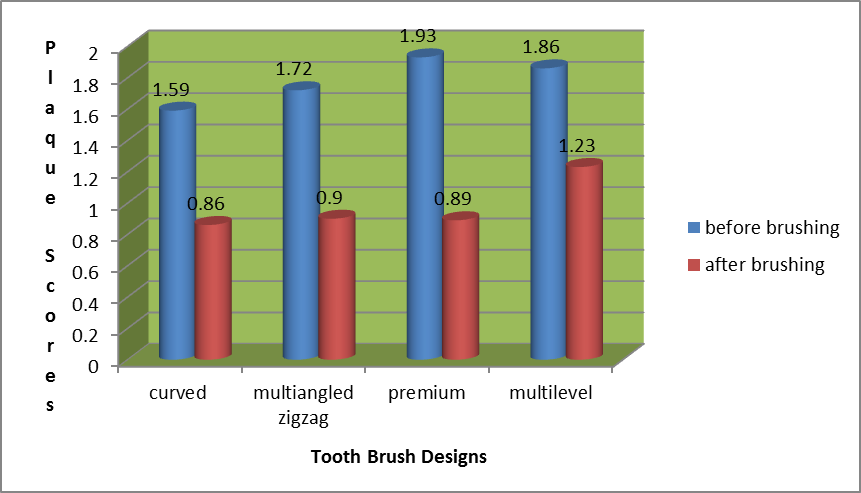
Graph-1
Graph II. Percentage reduction in plaque scores with different groups.

Graph-2
DISCUSSION
Although there is general agreement among dental professionals that efficient plaque removal is the key for preventing and controlling periodontal diseases, many people still have difficulty in maintaining this task with conventional oral hygiene aids. When making recommendations to patients, the dental professional must also consider factors related to patient compliance and hygiene efficiency, as they also play an important role in treatment outcomes. Manufacturers claim advanced design toothbrushes including improvements in handles, bristle trim arrangement, and brush head design allow penetration into dental embrasures and gingival margins that result in more effective plaque removal. However, several workshops and reviews have consistently concluded that there is no superior design of manual toothbrush.5,6
The results of the present clinical study indicated that all the toothbrushes reduced plaque scores significantly compared to the baseline scores and yet no significant differences were observed between the brushes. The reduction of the mean plaque scores reached approximately 45% compared to the baseline plaque scores.
Similarly, the results of the present study were in consistent with the study conducted by Claydon and Leech who compared and conducted a single-use study to compare the efficacy of a double-textured prototype manual toothbrush with three branded products and found that all four brushes removed about 50% of the accumulated plaque and there was no significant superiority of one toothbrush design over the other.
Designing a short-term clinical study to test the efficacy of plaque removal is complicated since, many different factors such as the duration of toothbrushing, hand pressure, manual dexterity, motivation, the frequency of toothbrushing and the frequency of brushing influences the results.1
Overall, the results of the present study showed that all four brushes with different bristle design were equally effective in reducing the plaque scores. This further supports the conclusions of various workshops and reviews that there is no one superior design of manual toothbrush; the major variable being the user.
CONCLUSION
Clinical there is a difference between the plaque reduction efficacies of the different toothbrush designs tested however statistically it is not significant. When making recommendations to patients, the dentist must consider factors related to patient acquiescence and hygiene efficiency, as they also play an significant role in treatment outcomes.
REFERENCES
- Kieser J, Groenveld H. A clinical evaluation of a novel toothbrush design .J Clin Periodontol 1997;24:419-423
- Bastian RJ .Comparison of the clinical effectiveness of a single and a double headed toothbrush. J Clin Periodontol 1984;11:331-339
- Addy M, Willis L, Moran J. Effect of toothpaste rinses compared with chlorohexidine on plaque formation during a 4 day period. J Clin Periodontol 1983:10:89-99
- Claydon N, Leech K, Addy M,Newcombe RG et al. Comparison of a double textured prototype manual toothbrush with 3 branded products. A professional brushing study. J.Clin Periodontol 2000;27:744-748
- Claydon N, Addy M.Comparitive single use plaque removal by toothbrushes of different design . J Clin Periodontol1996;23:1112-1116
- Claydon N, Addy M, Scratcher C, Ley F, Newcombe R. Comparitive professional removal study using 8 branded toothbrushes. J Clin Periodontol 2002;29:310-316
Disclaimer from Guident
The views and opinions expressed in articles published in Guident are solely those of the authors and do not necessarily reflect the views of the editors, the editorial board or the publisher, Ivory India. Guident does not endorse any product, technique or treatment described. Clinical content is intended for qualified dental and medical professionals and is not a substitute for individual clinical judgement. Guident, its editors and the publisher accept no liability for any consequence arising from the use of information published in the journal.
How to cite this article
Dr. Aditya Sinha, Dr. Priyanka, Dr. Manesh Lahori. Efficacy of Tooth Brushes with Different Designs in Plaque Elimination-a Cross over Study. Guident. 2021 Dec;15(1-2). Available from: https://guident.in/articles/research/efficacy-of-tooth-brushes-with-different-designs-in-plaque-elimination-a-cross-over-study.html