Importance and Need of Biometrics in Healthcare System
Associate-IT, Delhi
ABSTRACT
Online attendance system using Bio-metric is a web-based attendance system that specifically developed for small and medium Medical Colleges & Organizations. The Biometric application can manage recordings, controlling and monitoring of students/ employees presence. The purpose is to make sure that the student & staffs are punctual and do their jobs on time. Currently, in mostly colleges there is no proper marking system to monitor the presence. Where it’s working the role of its administrator is very mild and can be changed at any time so there has been always a challenge of tracking the staff and students in front of college administration. Besides, the companies still use the paper-based system to store the records of its employees and students.
HISTORY OF BIOMETRICS & FINGERPRINTS
The practice of using fingerprints as a method of identifying individuals has been in use since the late nineteenth century when Sir Francis Galton defined some of the points or characteristics from which fingerprints can be identified. These “Galton Points” are the foundation for the science of fingerprint identification, which has expanded and transitioned over the past century. Fingerprint identification began its transition to automation in the late 1960’s along with the emergence of computing technologies. With the advent of computers, a subset of the Galton Points, referred to as minutiae, has been utilized to develop automated finger print technology. In 1969, there was a major push from the Federal Bureau of Investigation (FBI) to develop a system to automate its fingerprint identification process, which had quickly become overwhelming and required many man-hours for the manual process. The FBI contracted the National Bureau of Standards (NBS), now the National Institute of Standards and Technology (NIST), to study the process of automating fingerprint classification, searching, and matching
Procedure used in Fingerprint Processing
- Fingerprint Acquisition
- Fingerprint Feature Extraction
- Minutiae Extraction
At the enrolment phase, the fingerprints would be acquired such that the print of the texture of the first finger (that is the pointing finger) is obtained twice and analyzed for processing. The fingerprint samples would be stored in a Microsoft SQL Server database with the aid of an interfaced fingerprint reader/scanner. The fingerprints are then to be saved inside a database to cater for subsequent need for the various fingerprint analysis during matching.
In any fingerprint image, there are dark lines which are called ridges, whereas the spaces in between those dark lines are called valleys. Ridges and valleys often run in parallel but there are two things that happen to any print. It is either, the ridges and the valleys terminate or they bifurcate. Termination of a fingerprint is simply the situation in which a particular ridge ends abruptly while bifurcation is the situation by which the line splits into two. In the analysis of the fingerprint images during matching (authentication), the pattern of the fingerprint exhibits one or more regions where the ridge lines assume distinctive shapes; which are: loop, delta and whorl. If the fingerprint scan matches any one stored in the database at the enrolment phase, the staff with the fingerprint will be updated as present for the lecture.
Each fingerprint images in the database after enrolment will be processed in order to extract a unique feature called minutiae. It is this unique feature that will be compared at the (authentication) matching phase. This requires the fingerprint grey-scale image to be converted into a binary image. The binary images obtained by the process are submitted to a thinning stage which allows for the ridge line thickness to be reduced to one pixel. Finally, a simple image scans allows the detection of pixels that correspond to minutiae through the pixel-wise computation of crossing number.
WHY BIOMETRICS?
The term biometrics comes from the Greek words bios, meaning life, and metrics, meaning measure. Biometrics can be defined as measurable physiological and/or behavioral characteristics that can be utilized to verify the identity of an individual, and include fingerprint verification, hand geometry, retinal scanning, iris scanning, facial recognition and signature verification. Biometric authentication is considered the automatic identification, or identity verification, of an individual using either a biological feature they possess physiological characteristic like a fingerprint or something they do behavior characteristic, like a signature. In practice, the process of identification and authentication is the ability to verify and confirm an identity. It is accomplished by using any one or a combination of the following three traditional identification techniques: something you possess; something you know; or something you are.
Something you possess: Often referred to as a token and can be produced from a multitude of different physical objects. There are two basic types of tokens in use today: manual and automated. If a token is described as manual it means that the identification process requires some form of human intervention; in other words, a person will make the final decision of whether an identity is approved or not. Good examples of manual tokens are paper ID documents and passports. Automated tokens, on the other hand, do not involve human intervention in the identification process, but rather the identity is verified by a system/computer such as magnetic-stripe cards, memory cards, or smart cards.
Something you know: The knowledge should not be commonly held, but secret. Examples of regularly used secrets are passwords, pass-phrases, and personal identification numbers PINs.
Something you are: Recognizing an entity through what "they are" requires measuring one or more of their biological features. Biological features can be either physiological characteristics like fingerprints or behavioral traits like an individual's signature.
The following table outlines a comparison between passwords vs. tokens vs. biometrics.
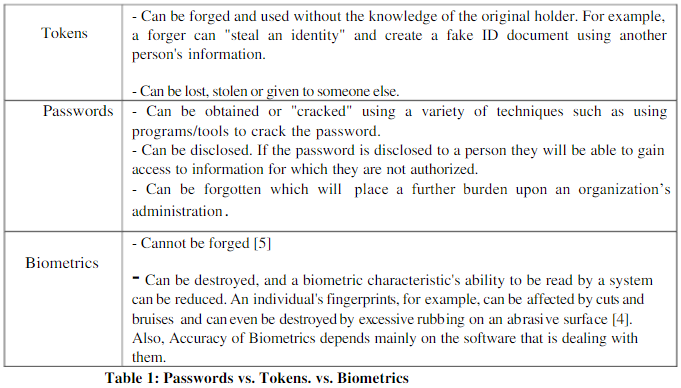
Fig 1
Biometric characteristics can be separated into two main categories.
Physiological characteristics: Physiological characteristics are related to the shape of the body. The trait that has been used the longest, for over one hundred years, are fingerprints; other examples are face recognition, hand geometry and iris recognition.
Behavioral characteristics: Behavioral characteristics are related to the behavior of a person. The first characteristic to be used that is still widely used today is the signature.
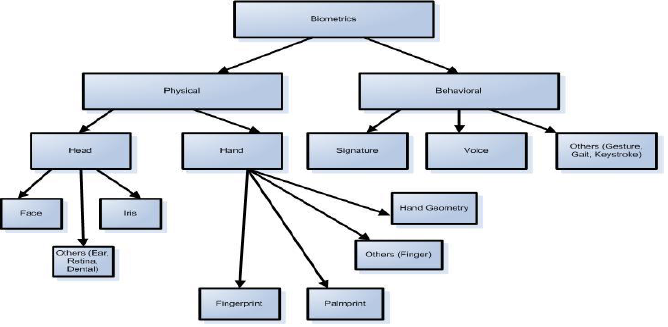
Fig 2
The following table briefly compares the 5 biometrics according to 7 parameters.
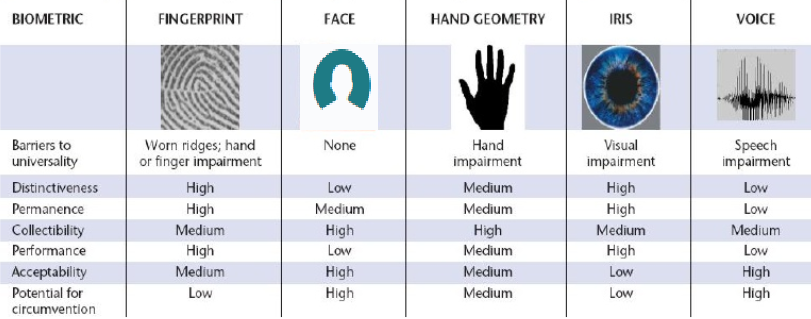
Table2: Comparison between all biometric recognition devices.
Health Informatics & Ethics to use the Biomedical Tool
Biomedical ethics address issues similar as sequestration and confidentiality, conflicts of interest, detriment to cases and the nature of the connections between the croaker and the case which need to be balanced between implicit detriment and benefits of use of IT.
Biometric identification system
- Background
- Other features
- This project is used by types of user
Attendance tracking using biometric device is software developed for maintaining the attendance of the Student/ Employees on the daily basis in the collage. Here the admin staffs, who are handling the job, will be responsible to mark the attendance of the employee. Each staff will be given with a separate username and password based on their role they handle. An accurate report based on the students/ employee attendance is generated. This system will also help in calculating salary criteria of an employee. Report of the employee’s attendance on weekly and monthly basis is generated.
• Reduced operational time.
• Increased accuracy and reliability.
• Increased operational efficiency.
• Data security.
• Admin staff.
• Employees.
• Coordinators.
• Head of department.
• Dean.
Everyone can access the system by providing there valid ID and Password. They can access modules such as viewing their own profile, employee’s profiles, and view their time of entering college, attendance of employee, reports, and events.
Tools used & Software Hardware Requirements
ZK4500 Fingerprint Scanner
- Features
- Functions
ZK4500 is a stable and excellent fingerprint scanner. The device can capture fingerprint image and upload to the PC by USB interface. It supports Windows 2000/XP/2003/Vista/7/10 (32/64bit) and Linux OS. SDK is also provided. The developer can integrate the hardware into their own system. This device is widely used in social insurance, public security, time attendance, fingerprint encryption, embedded system and other fields of application.
- High-performance, maintenance-free optical fingerprint sensor.
- Readily accessible for any finger
- High quality industrial-class ABS plastic material with scratchproof texture surface treatment
- High speed USB interface
- LED indicates the status of the device
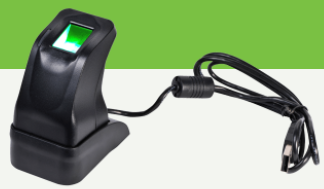
Fig 3
|
Memory |
Minimum: Express Editions: 512 MB All other editions: 1 GB Recommended: Express Editions: 1 GB All other editions: At least 4 GB and should be increased as database size increases to ensure optimal performance. |
|
Processor Speed |
Minimum: x86 Processor: 1.0 GHz x64 Processor: 1.4 GHz Recommended: 2.0 GHz or faster |
|
Processor Type |
x64 Processor: AMD Opteron, AMD Athlon 64, Intel Xeon with Intel EM64T support, Intel Pentium IV with EM64T support x86 Processor: Pentium III-compatible processor or faster |
|
Finger Print Sensor |
ZK Optical Sensor (No Film) |
Software Requirements
|
Network Specification: |
Server Configuration: ASP.Net Server (web) |
|
Operating System |
Certified Distribution of WINDOWS 10 |
|
Programming Language |
Visual C# |
|
Application Development Environment |
Microsoft Visual Studio 2010 Ultimate |
|
Database Environment |
Microsoft SQL Server 2008 R2 |
|
ZK finger Print SDK |
Resolution: 500 DPI/256 gray Image Size: 280×360 pixel Interface: USB1.1/2.0 Sensor: ZK Optical Sensor |
How to implement this system?
We can understand this by the given diagram
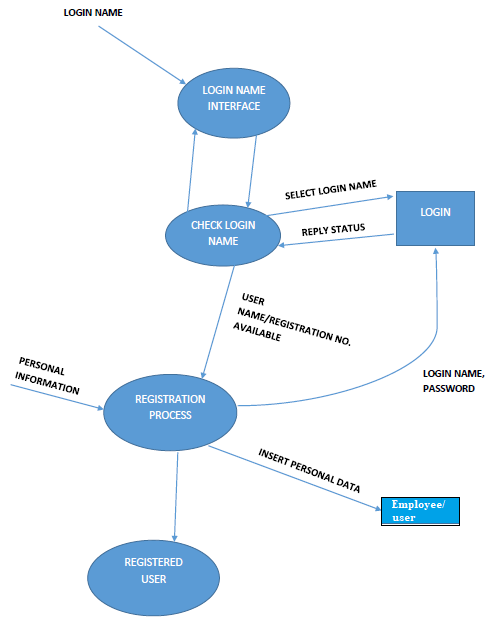
Fig 4
RESULTS & DISCUSSIONS
This research work has several advantages when compared with the conventional manual attendance control system. Some of its benefits are highlighted below
- Improved security: the developed software work was able to guide against unauthorized person gaining access to manipulate the system or impersonate.
- Improves employee’s performance: Implementation of this software system in an institution will curb tardiness of lecturer’s to the lecture rooms and make them regular. This will equally help to improve the performance of the students and lecturers.
- Fast and easy retrieval of data: The system enhances fast retrieval of attendance data. The report can be generated at any point in time. It reduces loss of data since all data are saved in a database.
- Easy monitoring: Staff attendance is monitored at a single point. The administrator does not need to go about staff data or attendance sheet; at a click of a button, all data will be made available.
- Reduce paper work: Conventional method of taking attendance involves the use of several papers which makes it more cumbersome. The automated system reduces paper work and makes the attendance system less cumbersome.
- Avoidance of Impersonation: the conventional method gives room for impersonation whereby a lecturer takes attendance for another lecturer. The automated process with the aid of fingerprint biometrics does not give room for impersonation. Once enrolled, it can’t be verified by another person.
System Maintenance
The system developed will stand the test of time if properly maintained. The most important maintenance is to make sure that the fingerprint scanner is kept in a very good condition; its USB cable must be kept well. The OS on the computer should be upgraded as at when due to avoid system crash. In case the school wants to use the developed system on the school’s network, network maintenance will be very important to enhance communication between the networked computers; servers should be physically repaired or replaced when damaged, software for server too should be consistently updated. All these maintenance practices should be done on a regular or semi-regular schedule, often during non-peak usage hours, and keep servers running smoothly.
CONCLUSION
Traditionally, lecturer’s attendance is taken using the manual method which involves pen and paper registers. This research mainly comprises of development of staff attendance management system using fingerprint biometric technique. Attendance management system is very helpful in saving valuable time of students and lecturers, saving paper and generating report at required time. This research has presented a framework in which attendance management has been made automated. Furthermore, it can curb tardiness of lecturers in the institution and make them regular if implemented. It can be concluded from the above discussion that a reliable, secure, fast and efficient system has been developed replacing a manual and unreliable system. Results have shown that this system can be implemented in an institution for better results regarding the management of attendance. This system will save time, reduce the amount of work the administrator has to do and replace the stationery material with electronic devices. Hence, a system with expected results has been developed but there is still room for improvement.
REFERENCES
- C Camara, P Peris-Lopez, JE Tapiador - Security and privacy issues in implantable medical devices: A comprehensive survey -Journal of biomedical informatics, 2015 – Elsevier
- AE Flores Zuniga, KT Win, W Susilo - Biometrics for electronic health records - Journal of medical systems, 2010
- E Okoh, AI Awad - Biometrics applications in e-health security: A preliminary survey- International Conference on Health Information …, 2015
- M Petkovic, L Ibraimi - Privacy and security in e-Health applications -for assisted living: Challenges and solutions, 2011 - igi-global.com
- P Choosang, S Vasupongayya - Using fingerprints to identify personal health record users in an emergency situation- 2015 International Computer …, 2015
Disclaimer from Guident
The views and opinions expressed in articles published in Guident are solely those of the authors and do not necessarily reflect the views of the editors, the editorial board or the publisher, Ivory India. Guident does not endorse any product, technique or treatment described. Clinical content is intended for qualified dental and medical professionals and is not a substitute for individual clinical judgement. Guident, its editors and the publisher accept no liability for any consequence arising from the use of information published in the journal.
How to cite this article
Gulrez Alam Khan. Importance and Need of Biometrics in Healthcare System. Guident. 2021 Jun;14(7). Available from: https://guident.in/articles/research/importance-and-need-of-biometrics-in-healthcare-system.html