Endodontic Retreatment Using Reciproc Single File System
Department of Conservative Dentistry & Endodontics D.J College Of Dental Sciences And Research, Modinagar, U.P
Abstract
The use of rotary file systems for endodontic retreatment is an efficient method. Reciproc Single File System(VDW) is one of them which is used both for the biomechanical preparation and endodontic retreatment. These files are made up of a special NiTi-alloy called M-Wire that is created by an innovative thermal-treatment process. In the present article, retreatment cases done with the reciproc system have been discussed. The system removed the gutta-percha efficiently and was time saving. Obturation was done with the corresponding gutta percha and complete resolution of radiolucency was observed after one year. The reciproc single file system may be suggested as a good alternative for endodontic retreatment.
INTRODUCTION
The main aim of endodontic retreatment is to re-establish healthy periapical tissues after inefficient treatment or reinfection of an obturated root canal system. The main causes of endodontic failures making retreatment necessary are insufficient cleaning and inadequate obturation. Additionally, teeth with inadequate obturation, unfilled or untreated root canals, or under extended root fillings may require retreatment before coronal restoration, as failure may occur in the future1.
Several techniques have been proposed to remove filling materials from the root canal system, including the use of endodontic hand files, Nickel-Titanium (NiTi) rotary instruments, Gates Glidden burs, heat, ultrasonic instruments, laser and use of adjunctive solvents2.The use of rotary file systems for removal of obturating material is an efficient method and various retreatment file systems like the M Two Retreatment File System (VDW), R Endo (Micromega), Protaper D (Dentsply Mailefer)etc are available. The Reciproc File System has been recently introduced by VDW. It is a Single File System that works in a reciprocating motion3. Reciprochas a non-cutting tip and is made up of M-Wire technologythat produces increased resistance to cyclic fatigue4.The literature is rare regarding the use of reciproc file system. This case report enlightens theretreatment of root canal done with the Reciproc single file reciprocating system.
- Case 1: A 28 year old patient came with the chief complaint of pain in upper left back area since 1 week. The pain was sharp severe and shooting in nature that increased on biting and chewing and was relieved by taking medication. On clinical examination composite restoration was seen with respect to 26. Radiographic examination showed incomplete obturation and periapical radiolucency with respect to 26. Treatment planning was endodontic retreatment wrt. 26 followed by full coverage restoration.
- Case 2: A 37 year old female patient came with the complaint of pain in lower right back area since 1 month. The pain was dull, constant and localized in nature. It was increased on biting & chewing and relieved by taking medication. On clinical examination temporary restoration was seen with respect to 46. Radiographic examination showed incomplete obturation with periapical radiolucency wrt 46. Treatment planning was endodontic retreatment wrt 46 followed by full coverage restoration.
In both the cases retreatment was done using the Reciproc Single file system. The following preparation protocol was followed as given by the manufacturer.
Step 1: Removal of the filling material from the coronal third
Gutta-percha in the coronal third of the canal was removed using heated plugger.
Step 2: Removal of obturation material in the rest of the canal
Gutta-percha obturation material was then removed from the canal with the R25 file. The silicone stopper was set at 2/3 of the estimated canal length on the R25. It was introduced into the canal with a slow in-and-out pecking motion at an amplitude not exceeding 3-4 mm without completely pulling the instrument out of the canal. The instrument was advanced in the obturation material in an apical direction with very light pressure. The instrument was pulled out of the canal to clean the flutes after a maximum of three in and out motions or when resistance is met. The canal was copiously irrigated with 5.25% sodium hypochlorite. Instrument was used in the same manner until it had reached 2/3 of the estimated working length. The instrument was then removed from the canal and the canal was irrigated. A gutta-percha solvent (e.g. eucalyptus oil) was used as required to allow the R25 to advance in the canal.
Step 3: Working length determination and removal of filling material in the apical third
Working length was determined using a size 10 or 15 file; a gutta-percha solvent was used as required to allow the hand file to advance in the apical third to determine the working length. It was then confirmed radio graphically in both the cases. R25 was introduced carefully into the canal till it reached 2/3 of the estimated length. A glide path was created with hand files up to a size 15. The R25 instrument was then used to the working length. If the R25 did not advance easily in the canal, the preparation was completed using hand files.
Step 4: Increased apical enlargement
An additional apical enlargement was required in the second case. It was accomplished easily with the R40 instrument. The instrument was used in a brushing motion against the lateral walls of the canals to remove any residual filling material.
Step 5: Obturation and final restoration
The corresponding master gutta percha of the Reciproc file system were selected and the canals were obturated. Final restoration was done with composite resin in both the cases.

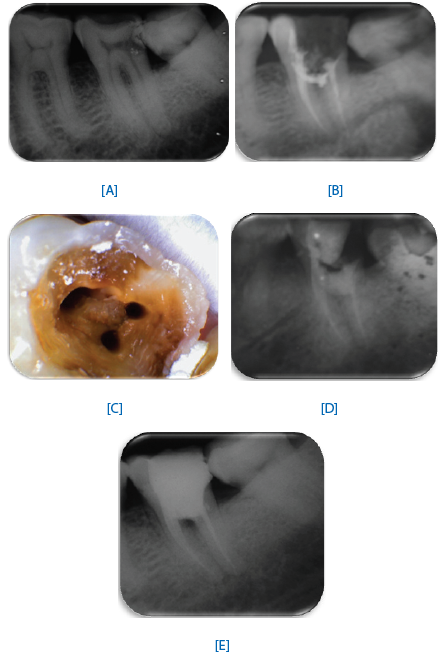
Case 1: A. Preoperative radiograph, B. Gutta percha removed, C. Working length radiograph, D. Master cone radiograph, E. Obturation Radiograph, F. One year recall radiograph
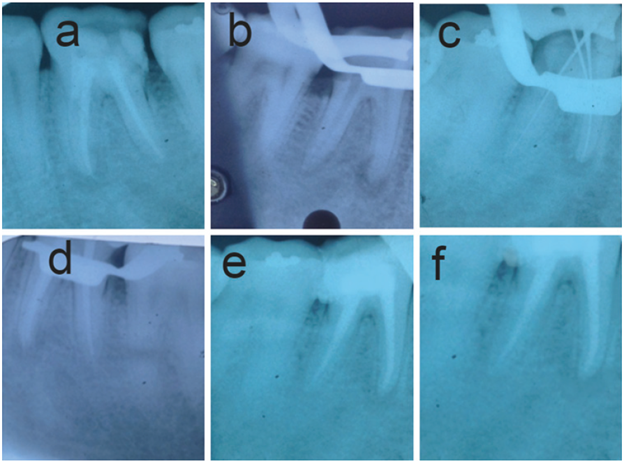
Case 2: A. Preoperative radiograph, B. Gutta percha removed, C. Working length radiograph, D. Master cone radiograph, E. Obturation Radiograph, F. One year recall radiograph
DISCUSSION
Non-surgical endodontic retreatment is an attempt to re-establish healthy periapical tissues after inefficient treatment or re-infection of an obturated root canal system because of coronal or apical leakage3.The success of retreatment depends on alterations in the natural course of the root canals caused by previous root canal treatment.The biomechanical preparation of the root canal is a complex procedure. In the present case reports Reciproc single File system was used both for the removal of gutta percha as well as the preparation of the canal. It removed the gutta percha efficiently and without taking much time. As it is a single file system, it decreased patient and operator fatigue.
The majority of canal anatomies can be prepared with this new technique using only one reciprocating file, with or without glide path or initial instrumentation. In reciprocation, the Reciproc file is initially driven in a cutting direction and then reverses to release the instrument. One rotation of 360° is completed in several reciprocating movements. Root-canal preparation without creating a glide path goes against the current teaching standard for rotary instrumentation, which requires an initial glide path in order to minimise the risk of fracture due to an instrument binding in the canal. However, in reciprocation, the angles of alternating right and left rotations are significantly lower than the angles at which a Reciproc instrument would fracture4. These angles are stored in the Reciproc endodontic motor, preventing the instrument from rotating past its specific angle of fracture. The centric ability of the reciprocation technique allows the instrument to follow the natural path of least resistance, which is the root canal5. Reciproc instruments have been specifically designed for use in reciprocation and are produced with M-wire NiTi in an innovative thermal-treatment process. This alloy has both increased resistance to cyclic fatigue and greater flexibility than common NiTi material. Another advantage of the specific design is an enormous capacity to remove debris from the canal due to the deep flutes of this system6. Additionally, the flexible S-shaped cross-section with two cutting edges provides high cutting ability at reduced friction. It was reported that the larger cross-sectional area would have a higher flexural and torsional stiffness, and thus the file design (cross sectional shape, diameters of core, etc) would have a significant influence on the torsional and bendingresistance7. Kim et al. assessed that Reciproc R25 exhibited significantly higher cyclic fatigue resistance than WaveOne, primarily because of their geometry8. Reciproc system is designed for convenience and safety. The instruments are specified for single use, making the work flow more efficient and reducing the risk of contamination9. One Reciproc instrument replaces several hand and rotary instruments. In Reciproc rotary file system, from three file sizes—R25, R40 or R50—the one matching the canal size best needs to be selected. The initial taper of each file is larger over the first 3mm from the tip, enabling a #30 irrigation syringe to be placed close to the apex10. The canal shape obtained with each of the three instruments is optimal for all modern obturation techniques.
CONCLUSION
In Conclusion, the reciproc rotary file may be a good alternative for retreatment of the root canal.
REFERENCES
- Hulsmann M, Bluhm V. Efficacy, cleaning ability and safety of different rotary NiTi instruments in root canal retreatment. Int Endod J 2004;37:468-476.
- Hulsmann M, Stotz S. Efficacy, cleaning ability and safety of different devices for gutta-percha removal in root canal retreatment. Int Endod J 1997;30:227-233.
- Fruchi LC, Ordinola-Zapata R, Cavenago BC et al. Efficacy of reciprocating instruments for removing filling material in curved canals obturated with a single-cone technique: a micro-computed tomographic analysis. J Endod 2013;40(9):986-991.
- Rios M, Villela AM, Cunha RS, Velasco RC, De Martin AS, Kato AS, Bueno CE. Efficacy of 2 reciprocating systems compared with a rotary retreatment system for gutta-percha removal. J Endod 2014;40(4):543-546.
- Saad AY, Al-Hadlaq SM, Nasser H, Al-Katheeri. Efficacy of two rotary NiTi instruments in the removal of gutta-percha during root canal retreatment. J Endod 2007;33:38-41.
- Burklein S, Hinschitza K, Dammaschke T, Schafer E. Shaping ability and cleaning effectiveness of two single-file systems in severely curved root canals of extracted teeth: Reciproc and WaveOne versus Mtwo and ProTaper. Int Endod J 2011;37:468-476.
- SaberM, NagyM, SchäferE.Comparative evaluation of the shaping ability of WaveOne, Reciproc and OneShape single-file systems in severely curved root canals of extracted teeth. Int Endod J 2014;20:227-214.
- Zuolo AS, Mello JE Jr, Cunha RS, Zuolo ML, Bueno CE. Efficacy of reciprocating and rotary techniques for removing filling material during root canal retreatment.IntEndod J 2013;46(10):947-953.
- Dagna A, Poggio C, Beltrami R, Chiesa M and Bianchi S.Cyclic fatigue resistance of three Niti single-file systems after immersion in EDTA. Dentistry 2013; 4:1.
- Rödig T, Reicherts P, Konietschke F, Dullin C, Hahn W, Hülsmann M. Efficacy of reciprocating and rotary NiTi instruments for retreatment of curved root canals assessed by micro-CT. Int Endod J 2014;47(9)40 992-997
Disclaimer from Guident
The views and opinions expressed in articles published in Guident are solely those of the authors and do not necessarily reflect the views of the editors, the editorial board or the publisher, Ivory India. Guident does not endorse any product, technique or treatment described. Clinical content is intended for qualified dental and medical professionals and is not a substitute for individual clinical judgement. Guident, its editors and the publisher accept no liability for any consequence arising from the use of information published in the journal.
How to cite this article
Dr. Ruchi Gupta, Dr. Anil Dhingra, Dr. Neha Aggarwal. Endodontic Retreatment Using Reciproc Single File System. Guident. 2014 Dec;8(1). Available from: https://guident.in/articles/endodontics/endodontic-retreatment-using-reciproc-single-file-system.html