Principles of Tooth Preparation: Part-2
MIK Dental, Mumbai, India
Fixed Prosthodontic treatment can offer exceptional satisfaction to both, the patient and the dentist alike. It can transform an unhealthy and/or unattractive dentition into a comfortable and healthy dentition; one which is capable of providing functional service, while also greatly enhancing the appearance of the patient.
However, the creation of a successful restoration requires the careful synthesis of functional, biological and overall aesthetic considerations. One of the most important elements of this process resides in the actual tooth preparation.
Tooth preparation is an art that requires a high level of clinical skill. Simultaneously, it also requires an understanding of what needs to be done and how to achieve the end goal. Tooth preparation is a common restorative procedure involving selective removal and shaping of the abutment tooth/ teeth, in order to accommodate a fixed prosthesis.
Preparing a tooth is synonymous with rope walking; in the sense that it requires the clinician to strike the perfect balance between enough tooth reduction to ensure strength plus aesthetics, while at the same time the clinician has to be vigilant enough to protect the remaining tooth structure from insult and injury.
Thus, tooth preparation needs to be planned in accordance to the individual case needs, as in each situation this balance would be different.
DESIRED AMOUNT OF TOOTH REDUCTION ON THE BASIS OF PROSTHETIC MATERIAL USED
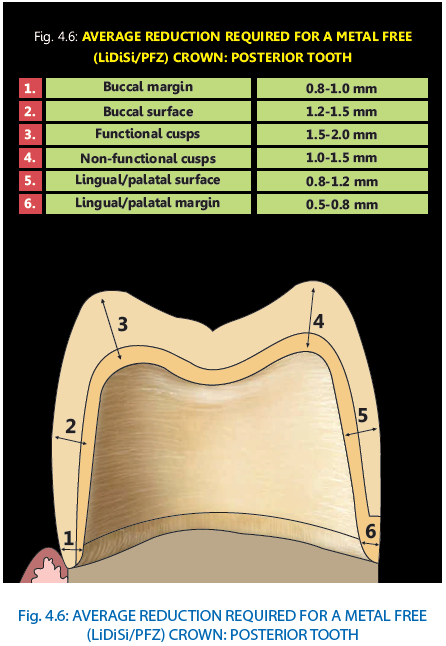
Depicted next (Fig. 4.1-4.7) is the desired amount of tooth reduction (in mm), required in accordance to the prosthetic material used for fabrication and the position of the tooth in the oral cavity. It is important to understand, that the values mentioned here are averages and that subjective changes need to be accounted for (and the preparation guidelines modified) during final tooth preparation.



FINISH LINE ARCHITECTURE
Finish line marks the transition between the prosthesis and the prepared tooth. This is a critical junction and needs to be planned for on the basis of the prosthetic material chosen to restore the tooth.
All fixed prostheses today can be successfully fabricated using one of the following two types of finish margins
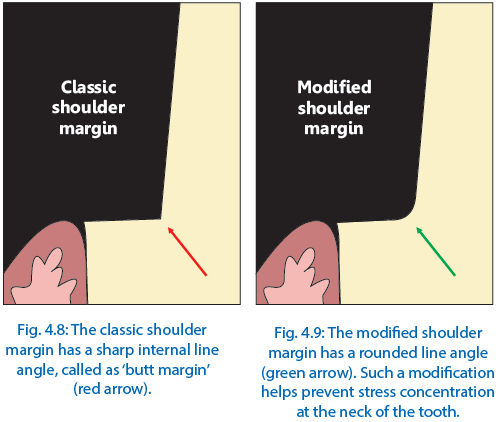
1.MODIFIED SHOULDER MARGIN
INDICATION
For PFM prostheses, selectively at those margins that are planned to receive porcelain (usually the buccal and both proximal margins).
ADVANTAGE
- By ensuring an adequate bulk of material at the margin, they provide good resistance to occlusal forces and thereby minimize the stresses that might lead to proclain Fracture.
- They are less likely to distort during porcelain firing, thereby exhibit less marginal opening.
DRAWBACK
t Such a margin requires considerable tooth reduction and thus, is not a conservative design.
INDICATIONS
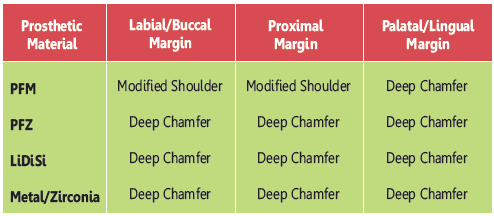
- All preparation margins (360°) for monolithic restorations.
- All preparation margins (360° ) for PFZ restorations.
- All preparation margins (360°) for glass ceramic restorations.
- Lingual/palatal margin for PFM (when planned with a metal collar).
ADVANTAGES
- It provides sufficient thickness and strength when used correctly.
- Its rounded concavity ensures lower stress concentrations within the cement layer.
DRAWBACK
Such a margin can create a lip of tooth structure, if the deep chamfer bur is used more than half its width. Such a lip is unsupported and can easily break away on the die (causing problems with crown seating) or can break away from the tooth (resulting in an open margin).
Table 4.1: The desired margin architecture for different prosthetic materials.
SUPRA-GINGIVAL MARGIN
A supra-gingival preparation margin is most desirable owing to various advantages such a design offers to both, the clinician and the patient alike.
ADVANTAGES
- It is the easiest margin to prepare and finish.
- There is no trauma to the marginal gingiva.
- The preparation margin usually lies on sound enamel.
- It is the easiest margin to make an impression, as tissue retraction is not needed.
- It is the easiest margin to identify on the cast (by the technician).
- It is easy to evaluate the fit and finish of the restoration (both, on the die and intra-orally).
- It is the easiest margin to remove excess cement from (post luting).
- It is possible to verify the margin at recall appointments.
CONTRAINDICATION
< /p>
It cannot be used within the aesthetic window, especially in patients with a high lip line and underlying tooth discoloration.
INDICATIONS
- Should be used wherever possible (within aesthetic limits).
- The lingual/palatal margin of all preparations should be kept supragingival (in an attempt to conserve tooth structure near the neck).
- On the buccal aspect of mandibular posterior teeth, especially were the width of attached gingiva is compromised.
EQUI-GINGIVAL MARGIN
This arguably is the most routinely used position for preparation margins.
Advantages
- It offers good aesthetics. This is because, it allows the underlying tooth to be masked completely from view (especially important for discolored teeth within the aesthetic window).
- Such a margin is accessible to regular oral hygiene measures and is thus, well tolerated by the gingival tissues
Drawbacks
- Any gingival recession leaves the margin exposed.
- Gingival discoloration is common when used with PFM prosthesis, especially in patients with thin gingival bio-type. This aspect is explained in Chapter No 16 on The Restorative Interface.
SUB-GINGIVAL MARGIN
This is the least preferred position, owing to the unpredictable clinical manifestations Observed with such a margin.
Indications
- In aesthetic cases where margins need to be hidden, especially for teeth with deep discolorations.
- In cases where additional retention/resistance is needed, like short clinical crowns (SCC).
- In cases with broad proximal contacts that extend up to the gingival crest, e.g. bruxers, tobacco chewers, etc.
- In cases where existing caries or cervical erosions extend subgingivally.
Drawbacks
- Sub-gingival margins demonstrate an increase in plaque index, gingival index, pocket depth, recession, etc.
- It carries the risk of biologic width violation, with associated chronic inflammation or gingival recession. This aspect is explained in detail in Chapter No. 16 on ‘The Restorative Periodontal Interface’
A combination approach can be used in teeth that have adequate clinical crown height remaining following completion of the occlusal preparation (molars >4 mm; premolars and anteriors >3 mm).
In this approach, the buccal and proximal margins are prepared equi- gingival, while the lingual/palatal margin is kept supra-gingival. This allows for conservation of tooth structure at the most vulnerable area of the tooth. As This area has minimalaesthetic concern, Such a Combination Approach should be used to advantage an a regular basis.
BURS TO BE USED FOR TOOTH PREPARATION
The finish margin is an exact replica of the bur head used to prepare it. There are various burs that can be used for tooth preparation and often operators have their own preferences. The Crown, Bridge, Veneer preparation kit by MIK Dental has been used to describe all tooth preparations in this book.
Note: This article is a direct extract from the book “Clinical Fixed Prosthodontics” by Dr. Moez I. Khakiani. With over 1700 colored illustrations, clustered into 23 chapters that span over 400 pages, this book is the ideal atlas for every clinicians who wishes to improve on their clinical skills and serve their patients with the highest level or oral care. To purchase the same call on +919111212912.
Disclaimer from Guident
The views and opinions expressed in articles published in Guident are solely those of the authors and do not necessarily reflect the views of the editors, the editorial board or the publisher, Ivory India. Guident does not endorse any product, technique or treatment described. Clinical content is intended for qualified dental and medical professionals and is not a substitute for individual clinical judgement. Guident, its editors and the publisher accept no liability for any consequence arising from the use of information published in the journal.
How to cite this article
Dr. Moez I. Khakiani. Principles of Tooth Preparation: Part-2. Guident. 2019 Jan;12(2). Available from: https://guident.in/articles/prosthodontics/principles-of-tooth-preparation-part-2.html